Tibet, China, and America: Towards The Light?

ECONOMIST– On the topic of Tibet, Xi Jinping, the man widely expected to be the next leader of the Chinese Communist Party, sounds much like his predecessors. Speaking on July 19th in the capital, Lhasa, in front of the Potala Palace, former residence of the Dalai Lamas, Tibet’s spiritual leaders, he celebrated the way Chinese rule had led Tibet “from the dark toward the light”. 

In material terms, he has an obvious point. Tibet is far better-off than in 1951, when a young Dalai Lama reached a “17-point agreement” ceding Chinese sovereignty over the territory. He also has a point that, before 1951, Tibet was not some idyllic Shangri-La of tinkling temple bells, lowing conch shells and smiling people, but a highly stratified society relying on mass monasticism and serfdom.

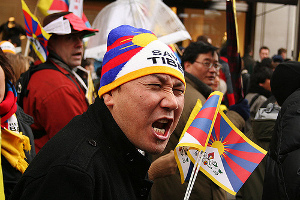
The difficulty Mr Xi and his predecessors face, however, is that large numbers of Tibetans resent Chinese rule. Many are still loyal to the Dalai Lama, who fled into exile with some 80,000 of his followers after the crushing of an anti-Chinese uprising in 1959. Since then the region has been scarred by periodic riots, including a bloody outburst of anti-Chinese violence in Lhasa in 2008.

This year has seen a confrontation at the Kirti monastery in a part of historic Tibet now incorporated in the Chinese province of Sichuan, after a young monk burnt himself to death in March. Hundreds of monks have been taken off for “patriotic education”. This year has also seen a heavy security crackdown to prevent any unrest to mark the 60th anniversary of the 17-point agreement, or the Party’s 90th birthday on July 1st.

China, in public at least, blames the Dalai Lama for the continued Tibetan disaffection. So its spokesmen fume when he is received by foreign leaders, especially America’s. On July 16th Barack Obama met the Dalai Lama in the White House. After the meeting, the White House emphasised that, besides underlining America’s support for Tibetans’ cultural identity and human rights, Mr Obama also repeated America’s acceptance of Chinese sovereignty over Tibet. 

Nevertheless, the People’s Daily called the meeting “an unscrupulous trick of pragmatism” that undermined the United States’ position as a great world power. Mr Obama has partly himself to blame for the accusation of pragmatism. In 2009 he postponed a meeting with the Dalai Lama in order not to sour the atmosphere for his trip to China a few months later—in effect conceding that such meetings are not matters of pure principle.

Read more about Tibet, China, and America: Towards The Light?

© 2011 The Economist

Photo by Flickr user Tanya Nagar

Philippines Extrajudicial Killings Continue

BBC– Human Rights Watch says activists in the Philippines are still being killed with impunity, despite the president’s campaign pledge to end such violence.

In a new report, the campaign group says it has evidence that the military was involved in seven killings and three enforced disappearances.

Each of these occurred since President Benigno Aquino took office last year, the group says.

When President Aquino came to power, he promised a change from the old regime.

The administration of his predecessor, President Gloria Macapagal-Arroyo, had been accused of turning a blind eye to the deaths and disappearances of hundreds of people.

But according to Human Rights Watch, these abuses are still continuing.

Most of the victims – now as before – are left-wing activists and outspoken journalists.

Their families often blame the military or police of involvement.

The security forces deny the claims or say those who died were communist rebels.

Read more about Philippines Extrajudicial Killings Continue

© 2011 BBC

Photo by Flickr user The Philippine Online Chronicles

Thousands Join Hong Kong Protest

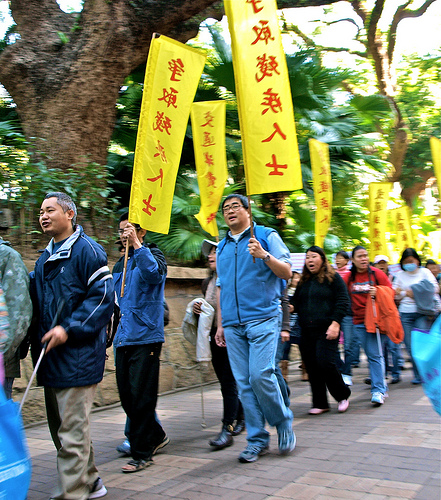
IRISH INDEPENDENT NEWS– Tens of thousands of people have voiced anger over Hong Kong’s skyrocketing property prices and government policies at an annual march marking the former British colony’s return to Chinese rule.

People blew whistles, beat drums and banged metal cups, and many waved flags calling for improved voting rights while others chanted “down, down with property tycoons” and called for chief executive Donald Tsang to step down.

Since the territory was handed back to China on July 1, 1997, Hong Kong has largely retained its Western-style civil liberties, including press freedom and the right to hold public protests.

But its people still cannot directly elect the city’s chief executive or all legislative members.

One of the big themes of the march marking the 14th anniversary is the growing rich-poor divide in Hong Kong, where soaring property prices have left many homes unaffordable and forced out small shopkeepers.

Some protesters carried large signs depicting Mr Tsang and billionaire Li Ka-shing, Hong Kong’s richest man whose business empire includes a major property developer, with devil horns and vampire fangs. They chanted slogans accusing the government and developers of colluding to establish a monopoly.

Citizens are also upset over a recent government proposal to scrap by-elections and instead fill vacant legislative seats based on previous results.

“The proposal to get rid of by-elections to fill vacancies in the Legislative Council is a crazy idea and insulting to the intelligence of the people of Hong Kong,” said veteran democracy activist Martin Lee.

Hong Kong is the only place in China that enjoys a degree of Western-style adversarial parliamentary politics.

Read more about Thousands Join Hong Kong Protest.

© 2011 Irish Independent News

Photo by Flickr user yip667

Meltdown Feared at Two More Reactors

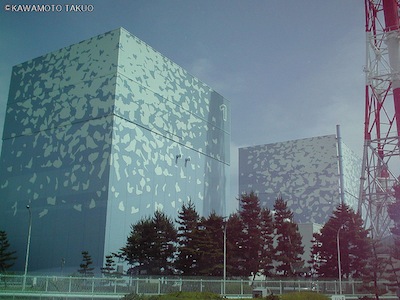
TELEGRAPH– The fuel in reactors No 2 and 3 is suspected to have melted amid reports that the operators Tokyo Electric Power Company (TEPCO) failed to cool the plant in the aftermath of the March 11 earthquake and tsunami.

The news came only days after it was confirmed for the first time that a meltdown had taken place in the No 1 reactor only 16 hours after the earthquake and tsunami hit the plant.

“The findings at the No. 1 reactor indicate the likelihood that the water level readings in the other reactors aren’t accurate,” said Junichi Matsumoto, a general manager at Tepco. “It could be that a meltdown similar to that in the No 1 reactor has occurred.”

Tepco has faced wide criticism for its apparent failure to fully comprehend or reveal the extent of the damage inflicted in the plant after crucial cooling systems were knocked out by the March 11 disaster.

Read more about Meltdown Feared at Two More Reactors.

© 2011 Telegraph

Photo by Flickr user mypoorbrain

Posted in Uncategorized | 1 Reply

Japan Consumers May Bail Out Nuke Plant Owner

MSNBC – Japanese consumers would be on the hook for nuclear damage payments and earthquake reconstruction costs under two tax plans the government is considering, officials said Tuesday.

The Kyodo News agency said one plan would raise electricity customers’ charges to help cover claims against Tokyo Electric Power Co. from people who suffer losses from the crisis at the Fukushima Dai-ichi nuclear power plant. The increase would come in the form of a higher electricity source-development tax, which is collected from customers as part of their electricity bills.

TEPCO must pay people forced to evacuate from the region surrounding the nuclear plant, but officials said the power company may not be able to pay all the claims.

“While TEPCO will be primarily responsible for damages payments, the government may have to support the firm,” Economy, Trade and Industry Minister Banri Kaieda told a press conference Tuesday. “We are considering taxation, the electricity charge and other measures to enable the government to shoulder some of the burden.”

A second plan would raise to 8 percent Japan’s current 5 percent consumption tax for about three years, Kyodo said. The extra $273 billion ($22.5 trillion yen) would pay for reconstruction of the country’s northeastern region, said senior lawmakers in the Democratic Pary of Japan.

The March 11 earthquake and ensuing tsunami caused about $300 billion in damage, experts have estimated.

Read full article on Japan Consumers May Bail Out Nuke Plant Owner

© 2011 MSNBC

Photo by flickr user hige2