$360M Lost To Insurgents, Criminals In Afghanistan

MEDIA ROOTS- Since the federal government tends to refer to anyone in Afghanistan with a gun as member of the “Taliban”, it’s difficult to take stories from the corporate media about the Taliban at face value. However, the first official US military estimate of how much money the US has paid the Taliban through “reverse money laundering” since the invasion has been disclosed: $360 million.

Considering how any official Pentagon budget has always been the most conservative estimate when compared to independent analysis, it’s safe to say that this number is a gross underestimate of the true amount of funds the US government has paid to the “terrorists” we are supposedly fighting in the region. For more breaking down the logic of why the US funds the opposition to sustain the Afghan war check out MR Original – Afghanistan War: Resources for Endless Control.

Abby

***

ASSOCIATED PRESS– After examining hundreds of combat support and reconstruction contracts in Afghanistan, the U.S military estimates $360 million in U.S. tax dollars has ended up in the hands of people the American-led coalition has spent nearly a decade battling: the Taliban, criminals and power brokers with ties to both.

In a murky process known as “reverse money laundering,” payments from the U.S. pass through companies hired by the military for transportation, construction, power projects, fuel and other services to businesses and individuals with ties to the insurgency or criminal networks, according to interviews and task force documents obtained by the AP.

“Funds begin as clean monies,” according to one document, then “either through direct payments or through the flow of funds in the subcontractor network, the monies become tainted.”

More than half the losses flowed through a large transportation contract called Host Nation Trucking, the official said. Eight companies served as prime contractors and hired a web of nearly three dozen subcontractors for vehicles and convoy security to ship huge amounts of food, water, fuel and ammunition to American troops stationed at bases across Afghanistan.

The Defense Department announced Monday that it had selected 20 separate contractors for a new transportation contract potentially worth $983.5 million to replace Host Nation Trucking. Officials said the new arrangement will reduce the reliance on subcontractors and diminish the risk of money being lost. Under the new National Afghan Trucking Services contract, the military will be able to choose from a deeper pool of companies competing against one another to offer the best price to move supplies. The new arrangement also gives the U.S. more flexibility in determining whether security is needed for supply convoys and who should provide it, according to a description of the contract.

HEB International Logistics of Dubai, a Host Nation Trucking prime contractor, “made payments directly to malign actors,” one of the task force documents reads. In 2009 and 2010, an HEB subcontractor identified in the document only as “Rohullah” received $1.7 million in payments. A congressional report issued last year said Rohullah – whose name is spelled Ruhallah in that report – is a warlord who controlled the convoy security business along the highway between Kabul and Kandahar, the two largest cities in Afghanistan.

After examining hundreds of combat support and reconstruction contracts in Afghanistan, the U.S military estimates $360 million in U.S. tax dollars has ended up in the hands of people the American-led coalition has spent nearly a decade battling: the Taliban, criminals and power brokers with ties to both.
In a murky process known as “reverse money laundering,” payments from the U.S. pass through companies hired by the military for transportation, construction, power projects, fuel and other services to businesses and individuals with ties to the insurgency or criminal networks, according to interviews and task force documents obtained by the AP.
“Funds begin as clean monies,” according to one document, then “either through direct payments or through the flow of funds in the subcontractor network, the monies become tainted.”
More than half the losses flowed through a large transportation contract called Host Nation Trucking, the official said. Eight companies served as prime contractors and hired a web of nearly three dozen subcontractors for vehicles and convoy security to ship huge amounts of food, water, fuel and ammunition to American troops stationed at bases across Afghanistan.
The Defense Department announced Monday that it had selected 20 separate contractors for a new transportation contract potentially worth $983.5 million to replace Host Nation Trucking. Officials said the new arrangement will reduce the reliance on subcontractors and diminish the risk of money being lost. Under the new National Afghan Trucking Services contract, the military will be able to choose from a deeper pool of companies competing against one another to offer the best price to move supplies. The new arrangement also gives the U.S. more flexibility in determining whether security is needed for supply convoys and who should provide it, according to a description of the contract.
HEB International Logistics of Dubai, a Host Nation Trucking prime contractor, “made payments directly to malign actors,” one of the task force documents reads. In 2009 and 2010, an HEB subcontractor identified in the document only as “Rohullah” received $1.7 million in payments. A congressional report issued last year said Rohullah – whose name is spelled Ruhallah in that report – is a warlord who controlled the convoy security business along the highway between Kabul and Kandahar, the two largest cities in Afghanistan.

Read more about $360M Lost To Insurgents, Criminals In Afghanistan

© 2011 The Associated Press

Photo by Flickr user azalea
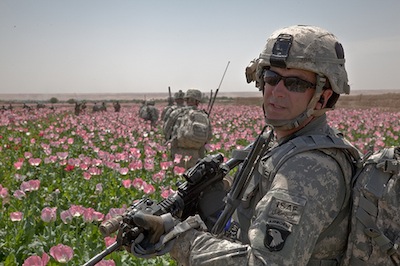
MR Original – Afghanistan: Endless War for Resources

MEDIA ROOTS- This year marked the tenth anniversary of America’s invasion of Afghanistan, officially making it the longest war in US history. Now that Osama Bin Laden is finally confirmed dead, the federal government’s logic of continuing the occupation remains unclear.

Initially, the Bush administration irrationally insisted that any sovereign nation harboring terrorists was itself complicit in “terror” and therefore open for pre-emptive US military action. This rationale is absurd– just because one criminal might be living inside of a particular country doesn’t make that entire country guilty of the criminal’s crimes.

In 2002, Secretary of Defense Donald Rumsfeld was quick to tell CNN that US forces had successfully pushed the Taliban and Al Qaeda out of the region, and reports reveal that Osama Bin Laden hadn’t even been in Afghanistan since 2001. Additionally, a White House spokesperson recently admitted that there hasn’t been a terrorist threat in the country for the last eight years.

So what has the US been doing in Afghanistan for the last decade?

War has always been about two things: resources and control. Alongside the supposed surprise discovery of Afghanistan’s $1 trillion wealth of untapped minerals, it’s more than coincidental that before the US invasion, the Taliban along with the UN had successfully eradicated the opium crop in the Golden Crescent. Now 90% of the world’s heroin comes from Afghanistan.

As reported by Global Research:

Heroin is a multibillion dollar business supported by powerful interests, which requires a steady and secure commodity flow. One of the “hidden” objectives of the war was precisely to restore the CIA sponsored drug trade to its historical levels and exert direct control over the drug routes.

Immediately following the October 2001 invasion, opium markets were restored. Opium prices spiraled. By early 2002, the opium price (in dollars/kg) was almost 10 times higher than in 2000.

In 2001, under the Taliban opiate production stood at 185 tons, increasing  to 3400 tons in 2002 under the US sponsored puppet regime of President Hamid Karzai.

While highlighting Karzai’s patriotic struggle against the Taliban, the media fails to mention that Karzai collaborated with the Taliban. He had also been on the payroll of a major US oil company, UNOCAL. In fact, since the mid-1990s, Hamid Karzai had acted as a consultant and lobbyist for UNOCAL in negotiations with the Taliban.

In today’s globalized world, one can’t discount the role that multinational corporations play in US foreign policy decisions. Not only have oil companies and private military contractors made a killing off the Afghanistan occupation: big pharmaceutical companies, who collectively lobby over $250 million to Congress annually, need opium latex to manufacture drugs for this pill happy nation.

Another fact worth mentioning is that Karzai, a notable player in Afghanistan’s opium trade, has been receiving regular payments from the CIA since the invasion. Even more infuriating, the US government has been paying Taliban insurgents to protect supply routes and to “switch sides” in a poor attempt to neutralize the insurgency and buy loyalty from the fighters. The fundamental logic of funding both sides of the war to “win” is possibly the most incomprehensible concept to grasp. Clearly, this war is meant to be sustainednot won.

Fast forward to ten years later, and the turmoil within the country still looms heavy. Last Thursday, the Taliban claimed responsibility for a deadly attack that killed 27 US soldiers and wounded dozens more. Earlier this month marked the deadliest day for US troops since the war started when a rocket propelled grenade shot down a helicopter and killed 30 US soldiers.

In June of this year, Obama delivered a speech about drawing down in Afghanistan, which corporate media outlets touted as a major step to ending the war (Media Roots cut through the speech rhetoric). Yet, a glaringly under reported factor of the praised “drawdown” is the fact that even if the reductions are carried out as planned, the US will still have far more troops in Afghanistan than at any point during Bush’s administration. Furthermore, the US and Afghanistan are about to sign a strategic pact that will allow thousands of special forces troops to remain in Afghanistan until 2024.

Considering how the US is spending at least $6.7 billion a month in Afghanistan and over 55% of Americans think that the US should immediately withdrawal, this issue should be a constant hot topic in the public dialogue– especially amidst the debate of economic sacrifice. Yet in 2010, the corporate news only allotted a measly 4% of its coverage to the war in Afghanistan.

The unsustainability of America’s endless wars and imperialistic foreign policy is the elephant in the room that not enough people in the public arena seem to want to discuss. Sadly, because Americans are conditioned to not bring up politics and religion with others, many are confined to their own rigid perspective fed by biased corporate media outlets. We must begin to challenge this societal dogma if we ever want to progress our society and evolve our collective human consciousness.

Written by Abby Martin

Photo by flickr user DVIDSHUB

US Buys Up All Satellite War Images

MEDIA ROOTS– In addition to throwing our country’s finances (and morals) away on the bombing of other countries, the Pentagon is also spending millions buying up all US satellite imagery in Afghanistan to make sure the stark reality of war is shielded from the western world. In America, the human cost of US bombing campaigns is never shown on corporate media outlets. When civilian casualties are reported on, they are relayed as cold statistics of the lowest estimates– no names, no faces, no stories of who these people were.

America’s wars are fought from a distance with robots, and people have never been more disconnected with what their country is sponsoring abroad. If people saw the dead bodies littering the streets of Afghanistan, they might feel more empathy and connection to the individuals who are casualties of US occuptaions. Eradicating the “us” and “them” mentality would completely undermine the logic of these endless wars– the last thing the establisment wants.

Abby

***

The GUARDIAN reports from 2001:

The images, which are taken from Ikonos, an advanced civilian satellite launched in 1999, are better than the spy satellite pictures available to the military during most of the cold war.

The extraordinary detail of the images already taken by the satellite includes a line of terrorist trainees marching between training camps at Jalalabad. At the same resolution, it would be possible to see bodies lying on the ground after last week’s bombing attacks.

Under American law, the US defence department has legal power to exercise “shutter control” over civilian satellites launched from the US in order to prevent enemies using the images while America is at war. But no order for shutter control was given, even after the bombing raids began 10 days ago.

The decision to shut down access to satellite images was taken last Thursday, after reports of heavy civilian casualties from the overnight bombing of training camps near Darunta, north-west of Jalalabad. Instead of invoking its legal powers, the Pentagon bought exclusive rights to all Ikonos satellite pictures of Afghanistan off Space Imaging, the company which runs the satellite. The agreement was made retrospectively to the start of the bombing raids.

Continue reading more of US Buys Up All Satellite War Images.

Abby

Photo by flickr user Ms Blue Sky

Exclusive: Inside Darpa’s Secret Afghan Spy Machine

WIRED– The Pentagon’s top researchers have rushed a classified and controversial intelligence program into Afghanistan. Known as “Nexus 7,” and previously undisclosed as a war-zone surveillance effort, it ties together everything from spy radars to fruit prices in order to glean clues about Afghan instability.

The program has been pushed hard by the leadership of the Defense Advanced Research Projects Agency. They see Nexus 7 as both a breakthrough data-analysis tool and an opportunity to move beyond its traditional, long-range research role and into a more active wartime mission.

But those efforts are drawing fire from some frontline intel operators who see Nexus 7 as little more than a glorified grad-school project, wasting tens of millions on duplicative technology that has nothing to do with stopping the Taliban.

“There are no models and there are no algorithms,” says one person familiar with the program, echoing numerous others who spoke on condition of anonymity because they are not authorized to discuss the program publicly. Just “200 lines of buggy Python code to do what imagery analysts do every day.”

During a decade of war, American forces have gathered exabytes of information on its enemies in Afghanistan. Nexus 7 aims to tap that data to find out more about the U.S.’ alleged friends: the people of Afghanistan, and how they interact with their government and with one another.

Read more about Exclusive: Inside Darpa’s Secret Afghan Spy Machine

© 2011 Wired

Photo by Flickr user RayVanEng

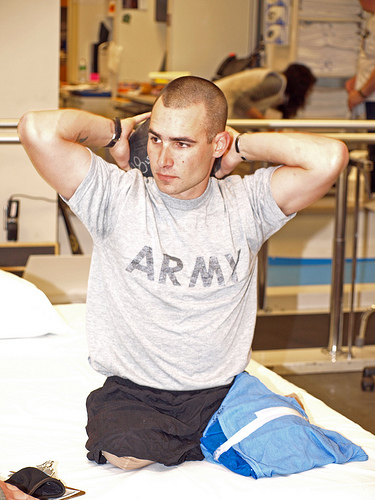
Breathing Problems Strike Soldiers Returning From Iraq

US NEWS– Some U.S. soldiers returning from Iraq and Afghanistan are suffering unexplained breathing problems that may be related to exposure to unknown toxins, a new study indicates.

“Respiratory disorders are emerging as a major consequence of service in southwest Asia,” said study author Dr. Matthew S. King, an assistant professor of pulmonary and critical care at Meharry Medical College in Nashville, Tenn.

“In addition to our study, there have been studies showing increases in asthma, obstructive lung disease, allergic rhinitis and a general increase in reports of respiratory symptoms,” he added.

The report was published in the July 21 issue of the New England Journal of Medicine.

For the study, King and colleagues had 80 soldiers with difficulty breathing from Fort Campbell, Ky., undergo physical exams that included tests to determine how well they were breathing and CT scans.

In addition, 49 soldiers had lung biopsies when the exam couldn’t find a reason for their breathing problems. Some of these soldiers had been exposed to a sulfur-mine fire in Iraq in 2003, the researchers noted.

All the biopsies were abnormal, and the researchers diagnosed 38 soldiers with constrictive bronchiolitis. Constrictive bronchiolitis is a rare non-reversible lung disease in which the small airways in the lungs are compressed and narrowed by scar tissue or inflammation.

“This a very rare condition in otherwise healthy individuals and is generally untreatable,” King said. “We believe that it is caused by an inhalational exposure with which they have contact while in southwest Asia.”

The other soldiers were diagnosed with other conditions that explained their breathing problems.

Read more about Breathing Problems Strike Soldiers Returning From Iraq

© 2011 US News

Photo by Flickr user Walter Reed Army Medical Center

Posted in Uncategorized | 1 Reply