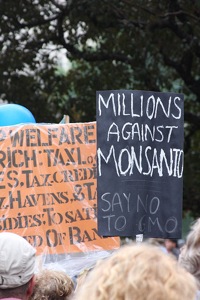
 THIRD WORLD NETWORK INFORMATION SERVICE ON BIOSAFETY– Below is a list of different initiatives in countries worldwide to
restrict or regulate the import, distribution, sale, utilization, field
trials, or commercial planting of genetically modified organisms (GMOs).
Information for this list was compiled from various sources. This list
is by no means exhaustive, as there are certainly other initiatives of
which we are not yet aware.
THIRD WORLD NETWORK INFORMATION SERVICE ON BIOSAFETY– Below is a list of different initiatives in countries worldwide to
restrict or regulate the import, distribution, sale, utilization, field
trials, or commercial planting of genetically modified organisms (GMOs).
Information for this list was compiled from various sources. This list
is by no means exhaustive, as there are certainly other initiatives of
which we are not yet aware.
Special note should be made of the bans implemented by Algeria, Sri
Lanka, Thailand, and China. Since December 2000, Algeria has banned the
import, distribution, commercialization and utilization of GE plant
material. Sri Lanka has banned the import of all GE foods from May 2001.
In April 2001, Thailand banned all GE crops trials, and continues to
ban all commercial planting of GE crops. Also in April, the Chinese
government banned the commercial planting of GE rice, wheat, corn and
soybean.
We hope this list provides a sense of the various actions being taken
by governments, local authorities, and communities worldwide to protect
their health and environment from the potential hazards of GMOs. Proper
restriction and regulation of GMOs, by keeping the country GE free or by
implementing and enforcing bans or moratoria on GMOs, is the only way a
country can effectively exercise the precautionary principle.
WORLDWIDE INTITIATIVES AGAINST GMOs
AFRICA
Algeria: Ban on the import, distribution, commercialization
and utilization
of GE plant material, except for research purposes.
Egypt: Declared not to import GE wheat.
The
draft Organization of African Unity (OAU) model biosafety law requires
that all GMOs, whether classified as food, crops, pharmaceuticals, or
commodities, and products thereof must be approved before import, transit,
contained use, release, and market release can take place. Any GMOs or
products thereof must be labeled as such and there is a strict liability
regime in place. This model law will serve as a model for national implementation
in African countries.
ASIA
Sri
Lanka: A ban on the import of all genetically modified foods, raw and
processed, went into effect on May 1, 2001. This includes GMOs and products
thereof.
Thailand:
Ban on field trials of GE crops, and the termination of ongoing field
trials of Monsanto’s GE cotton and corn. Ban on all commercial planting
of GE crops. Thailand will be drawing up legislation for labeling of GE
food by the end of 2001.
China:
Ban on commercial planting of GE rice, wheat, corn and soybean.
Japan:
Declared not to import GE wheat. Recent legislation has set zero tolerance
for imports containing unapproved GE products. Imports found to contain
unapproved GMOs will be destroyed or shipped back to origin. Violators
may incur penalties of up to one-year imprisonment and may be fined. The
legislation also seeks mandatory labeling for GMOs in food.
Philippines:
The community of Valencia called for a five-year moratorium on GE food
and GE crop trials and commercialization. The Philippine president recently
announced a moratorium on GE crop research.
EUROPE
The
European Union is expected to approve very strict legislation on labeling
and traceability; products thereof will have to be labeled even if traces
of GE material cannot be found in them.
Norway:
Ban on the import of six GE crops and products which contain antibiotic
resistance genes – two GE vaccines, GE maize, tobacco, chicory, and oil
swede rape. 31 GE applications have been rejected to date.
Austria:
Bans on three varieties of GE maize – Novartis, Monsanto and AgrEvo. The
Federal Institute for Less-favored and Mountainous Areas is pressing for
GE-free legislation and published a study on GE free zones, initiatives
in the States of Vorarlberg and Salzburg to ban GE trials.
Germany:
Ban of Novartis Bt maize. The initiative “No GE on communal land” of BUND
(Friends of the Earth Germany) launched activities in several German communities
to discuss and vote on the GE free resolutions. Applications have been
launched in: Bad Vilbel, Blauenstein, Lahr, konstanz, Hannover, Hamburg.
Applications have been accepted in: Mynchen, Reutlingen, Freidrichsdorf,
Blomberg, Selingenstadt, Niddatal, Maintal, Riedstadt, Adendorf, Schwebheim,
Pinneberg, Schwabach, Lan-genhagen, Wyhe, Burgdorf, Neetze, District Traunstein.
Several Protestant regional church organizations have banned GE crops
from their land: Hannover, Hessen und Nassau, Sachsen, Protestantic Church
of Westfalen, Protestantic Church in Berlin-Bradenburg, Church Province
of Sachsen.
United
Kingdom: The Church of England has refused permission for GE crop trials
on 60,000 hectares of its land, dozens of local authorities supply GE
free school lunches, while the House of Commons has banned GE food for
its catering. The Island of Jersey has banned GE crops.
Spain:
The Basque government has imposed a five-year blanket moratorium for GMOs.
The provinces of Castilla-La Mancha and Baleares have banned GE food,
while Andaluc’a declared a five-year moratorium on GE crops trials and
food.
Italy:
Bans on GE crops in four regions – Tuscany, Molise, Lazio and Marche –
and 25 provinces, cities and communes, including Rome, Milan, Turin, Brescia,
and Genoa.
Greece:
Ban on AgrEvo herbicide resistant rapeseed, moratorium on GE crop trials.
France:
Ban on PGS and AgrEvo herbicide resistant rapeseed.
Luxembourg:
Ban on Novartis Bt maize.
Portugal:
Ban on Novartis Bt maize.
LATIN AMERICA
Brazil:
Ban on the planting of GE seeds. The states of Rio Grande do Sul and Mato
Grasso do Sul have declared their intentions to remain GE-free. 18 states
have called upon the central government to block commercial GE crop planting.
Paraguay:
The Ministry of Agriculture plans to ban the commercial planting of GE
crops.
MIDDLE EAST
Saudi
Arabia: Ban on GE food and declared not to import GE wheat.
NORTH AMERICA
United
States of America: Maryland has banned GE fish. There are various bills
calling for moratoria on GE food (Vermont), and bans on GE wheat (North
Dakota and Montana) have been filed within the last year. Several municipalities
have declared moratoria on GE food (Burlington, Vermont), bans of GE crops
(City of Boulder, Colorado), or urged the federal government to ban GE
food (City and County of San Fransisco, California).
PACIFIC
14
South Pacific countries – American Samoa, Cook Islands, Fiji, Kiribati,
Federated States of Micronesia, Marshall Islands, Nauru, Niue, Papua New
Guinea, Samoa, Solomon Islands, Tonga, Tuvalu and Vanuatu – have recommended
a moratorium on the import of GMOs pending the implementation of appropriate
national risk assessment and risk management procedures.
Australia:
Ban GE rapeseed as weed in Tasmania, and a ban on commercial planting
of GE crops in Western Australia. Australian States have been given the
right to declare themselves GE free. Some communities (e.g. Bondi/Sydney,
West Wimmera Shire) have declared themselves GE free.
New
Zealand: Trials of GE salmon have been blocked by the government. Some
local bodies in Auckland and Wellington have declared themselves GE free.
© Third World Network, 2001
Photo by flickr users Tim & Selena Middleton



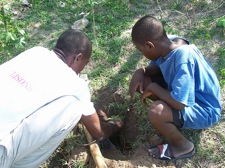 OTHER WORLDS– “A new earthquake” is what peasant farmer leader Chavannes
Jean-Baptiste of the Peasant Movement of Papay (MPP) called the news that
Monsanto will be donating 60,000 seed sacks (475 tons) of hybrid corn seeds and
vegetable seeds, some of them treated with highly toxic pesticides.
OTHER WORLDS– “A new earthquake” is what peasant farmer leader Chavannes
Jean-Baptiste of the Peasant Movement of Papay (MPP) called the news that
Monsanto will be donating 60,000 seed sacks (475 tons) of hybrid corn seeds and
vegetable seeds, some of them treated with highly toxic pesticides.  GUARDIAN
 THIRD WORLD NETWORK INFORMATION SERVICE ON BIOSAFETY
 ENVIRONMENT CALIFORNIA
 SAN DIEGO READER