U.S. Identifies Vast Riches of Minerals in Afghanistan

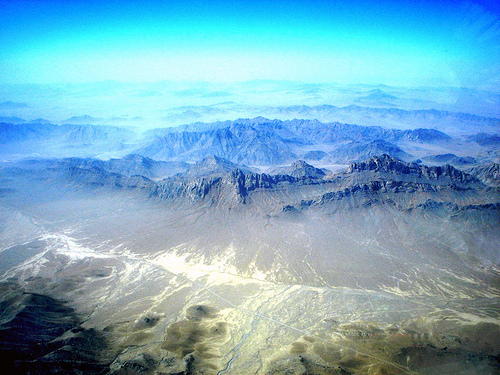
NY TIMES– The United States has discovered nearly $1 trillion in untapped mineral deposits in Afghanistan, far beyond any previously known reserves and enough to fundamentally alter the Afghan economy and perhaps the Afghan war itself, according to senior American government officials.

The previously unknown deposits — including huge veins of iron, copper, cobalt, gold and critical industrial metals like lithium — are so big and include so many minerals that are essential to modern industry that Afghanistan could eventually be transformed into one of the most important mining centers in the world, the United States officials believe.

An internal Pentagon memo, for example, states that Afghanistan could become the “Saudi Arabia of lithium,” a key raw material in the manufacture of batteries for laptops and BlackBerrys.

The vast scale of Afghanistan’s mineral wealth was discovered by a small team of Pentagon officials and American geologists. The Afghan government and President Hamid Karzai were recently briefed, American officials said.

While it could take many years to develop a mining industry, the potential is so great that officials and executives in the industry believe it could attract heavy investment even before mines are profitable, providing the possibility of jobs that could distract from generations of war.

“There is stunning potential here,” Gen. David H. Petraeus, commander of the United States Central Command, said in an interview on Saturday. “There are a lot of ifs, of course, but I think potentially it is hugely significant.”

The value of the newly discovered mineral deposits dwarfs the size of Afghanistan’s existing war-bedraggled economy, which is based largely on opium production and narcotics trafficking as well as aid from the United States and other industrialized countries. Afghanistan’s gross domestic product is only about $12 billion.

“This will become the backbone of the Afghan economy,” said Jalil Jumriany, an adviser to the Afghan minister of mines.

American and Afghan officials agreed to discuss the mineral discoveries at a difficult moment in the war in Afghanistan. The American-led offensive in Marja in southern Afghanistan has achieved only limited gains. Meanwhile, charges of corruption and favoritism continue to plague the Karzai government, and Mr. Karzai seems increasingly embittered toward the White House.

So the Obama administration is hungry for some positive news to come out of Afghanistan. Yet the American officials also recognize that the mineral discoveries will almost certainly have a double-edged impact.

Read full article about the Vast Wealth of Minerals Discovered in Afghanistan.

© COPYRIGHT NY TIMES, 2010

Photo by Flickr user Afghanistan Matters

Posted in Uncategorized | 1 Reply

Gaza Blockade Isn’t About Security

MCCLATCHY– As Israel ordered a slight easing of its blockade of the Gaza Strip Wednesday, McClatchy obtained an Israeli government document that describes the blockade not as a security measure but as “economic warfare” against the Islamist group Hamas, which rules the Palestinian territory.

Israel imposed severe restrictions on Gaza in June 2007, after Hamas won elections and took control of the coastal enclave after winning elections there the previous year, and the government has long said that the aim of the blockade is to stem the flow of weapons to militants in Gaza.

Last week, after Israeli commandos killed nine volunteers on a Turkish-organized Gaza aid flotilla, Israel again said its aim was to stop the flow of terrorist arms into Gaza.

However, in response to a lawsuit by Gisha, an Israeli human rights group, the Israeli government explained the blockade as an exercise of the right of economic warfare.

“A country has the right to decide that it chooses not to engage in economic relations or to give economic assistance to the other party to the conflict, or that it wishes to operate using ‘economic warfare,'” the government said.

McClatchy obtained the government’s written statement from Gisha, the Legal Center for Freedom of Movement, which sued the government for information about the blockade. The Israeli high court upheld the suit, and the government delivered its statement earlier this year.

Sari Bashi, the director of Gisha, said the documents prove that Israel isn’t imposing its blockade for its stated reasons, but rather as collective punishment for the Palestinian population of Gaza. Gisha focuses on Palestinian rights.

(A State Department spokesman, who wasn’t authorized to speak for the record, said he hadn’t seen the documents in question.)

The Israeli government took an additional step Wednesday and said the economic warfare is intended to achieve a political goal. A government spokesman, who couldn’t be named as a matter of policy, told McClatchy that authorities will continue to ease the blockade but “could not lift the embargo altogether as long as Hamas remains in control” of Gaza.

Read full article on the Gaza Blockade Not Being About Security.

Frenkel, a McClatchy special correspondent, reported from Jerusalem. Warren P. Strobel and Steven Thomma contributed to this article from Washington.

© COPYRIGHT MCCLATCHY, 2010

Latin America’s Path to Independence

GUARDIAN– Latin America took another historic step forward this week with the creation of a new regional organisation of 32 Latin American and Caribbean countries. The United States and Canada were excluded.

The increasing independence of Latin America has been one of the most important geopolitical changes over the last decade, affecting not only the region but the rest of the world as well. For example, Brazil has publicly supported Iran’s right to enrich uranium and opposed further sanctions against the country. Latin America, once under the control of the United States, is increasingly emerging as a power bloc with its own interests and agenda.

The Obama administration‘s continuation of former President Bush’s policies in the region undoubtedly helped spur the creation of this new organisation, provisionally named the Community of Latin American and Caribbean States. Most importantly, the Obama team’s ambivalence toward the military coup that overthrew the democratic government of President Mel Zelaya in Honduras last summer provoked deep resentment and distrust throughout the region.

Although the Obama administration was officially against the coup, numerous actions from day one – including the first White House statement that failed to condemn the coup when it happened – made it clear in the diplomatic world that its real position was something different. The last straw came in November 2009 when the Obama administration brokered a deal for the return of Zelaya, and then joined the dictatorship in reneging on it. Washington then stood against the vast majority of the region in supporting the November elections for a new president under the dictatorship, which had systematically repressed the basic rights and civil liberties necessary to an electoral campaign.

Arturo Valenzuela, the US state department’s top official for Latin America, said that the new organisation “should not be an effort that would replace the OAS [Organisation of American States]”.

The differences underlying the need for a new organisation were clear in the statements and declarations that took place in the Unity Summit, held in Cancun from 22-23 February. The summit issued a strong statement backing Argentina in its dispute with the UK over the Malvinas (as they are called in Argentina) or Falklands Islands. The dispute, which dates back to the 19th century and led to a war in 1982, has become more prominent lately as the UK has unilaterally decided to explore for oil offshore the islands. President Lula da Silva of Brazil called for the United Nations to take a more active role in resolving the dispute. And the summit condemned the US embargo against Cuba.

These and other measures would be difficult or impossible to pass in the OAS. Furthermore, the OAS has long been manipulated by the United States, as from 2000 when it was used to help build support for the coup that overthrew Haiti’s elected president. And most recently, the US and Canada blocked the OAS from taking stronger measures against the Honduran dictatorship last year.

Meanwhile, in Washington foreign policy circles, it is getting increasingly more difficult to maintain the worn-out fiction that the US’s differences with the region are a legacy of President Bush’s “lack of involvement,” or to blame a few leftist trouble-makers like Bolivia, Nicaragua, and of course the dreaded Venezuela. It seems to have gone unnoticed that Brazil has taken the same positions as Venezuela and Bolivia on Iran and other foreign policy issues, and has strongly supported Chávez. Perhaps the leadership of Mexico – a rightwing government that was one of the Bush administration’s few allies in the region – in establishing this new organisation will stimulate some rethinking.

There are structural reasons for this process of increasing independence to continue, even if – and this is not on the horizon – a new government in Washington were to someday move away from its cold war redux approach to the region. The US has become increasingly less important as a trading partner for the region, especially since the recent recession as our trade deficit has shrunk. The region also increasingly has other sources of investment capital. The collapse of the IMF’s creditors’ cartel in the region has also eliminated the most important avenue of Washington’s influence.

The new organisation is sorely needed. The Honduran coup was a threat to democracy in the entire region, as it encouraged other rightwing militaries and their allies to think that they might drag Latin America back to the days when the local elite, with Washington’s help, could overturn the will of the electorate. An organisation without the US and Canada will be more capable of defending democracy, as well as economic and social progress in the region when it is under attack. It will also have a positive influence in helping to create a more multipolar world internationally.

Mark Weisbrot is Co-Director of the Center for Economic and Policy Research (CEPR), in Washington, DC.

© Guardian News and Media Limited 2010

The Story of Stuff- Video

The Story of Stuff Project’s mission is to build a strong, diverse, decentralized, cross-sector movement to transform systems of production and consumption to serve ecological sustainability and social wellbeing. Our goals are to amplify public discourse on a diverse set of sustainability issues and to facilitate the growing Story of Stuff community’s involvement in strategic efforts to build a more sustainable and just world.

The Story of Stuff Project was founded in June 2008 by Annie Leonard to leverage the remarkable success of The Story of Stuff, a 20-minute web-film that explores the often hidden environmental and social consequences of America’s love affair with its stuff. Currently, the film has been viewed over 10 million times on-line and in thousands of schools, houses of worship, community centers and businesses around the world. Our Project’s focus is on systems of production and consumption—in particular the harmful environmental and social impacts of current modes of producing, consuming and disposing of material goods. Our Project is systems-focused, solutions-oriented and change-driven.

http://www.storyofstuff.com/

Giant Sinkhole Opens in Guatemala City

(Video Below)

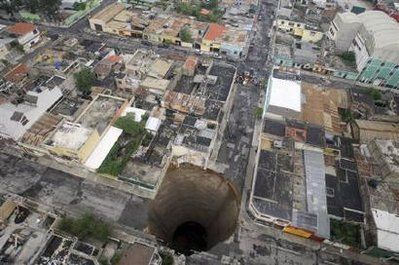
LONG ISLAND PRESS– A gigantic sinkhole, larger than a city intersection, has opened in the northern part of Guatemala City, Guatemala, after the region was battered by Tropical Storm Agatha. More than 100 people lost their lives in Guatemala, Honduras and El Salvador due to the intense weather.

A local newspaper reports that a security guard was killed when the giant sinkhole opened up, and local residents claim a three-story building and a house fell into the hole. Neither of these reports have been confirmed.

The sinkhole was blamed on poor sewage system, but was the least of Guatemala’s worries, as mudslides wracked the country, burying victims, closing roads and collapsing bridges, forcing more than 100,000 people to be evacuated from their homes.

Agatha decreased in strength from tropical storm status to a tropical depression Saturday, losing it’s depression ranking Sunday.


© COPYRIGHT LONG ISLAND PRESS, 2010

Page 55 of 62<<...5354555657...>>