Bay Area News: Biking to the City

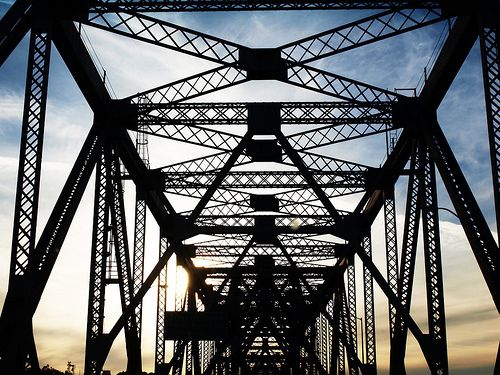
photo by KWDesigns/flickrEAST BAY EXPRESS– Fantasies of bicycling and walking between San Francisco and Oakland along the Bay Bridge are slowly inching their way toward reality. The Bay Bridge Bikeway Project, a joint venture between the Metropolitan Transportation Commission and Caltrans, hopes to allow bicyclists and pedestrians to travel between the two cities along the full span of the bridge. If approved, MTC officials said it would be the largest engineering feat of its kind in history.

The forthcoming completion of the eastern span already includes a fifteen-and-a-half-foot-wide elevated pathway on the south side to allow bicyclists and pedestrians to ride and walk to Yerba Buena Island. The pathway won’t extend to the western span, which would allow folks to make it to San Francisco. But that may change, as the MTC is currently working on a project study report for release early next year that officials hope will jump-start planning for a western pathway and put the project on the radar for funding.

The MTC study revisits and builds upon data gathered for a 2001 Caltrans study, which examined the feasibility of adding cantilevers on both sides of the western span’s upper deck to accommodate bike and pedestrian traffic. However, a decade’s worth of development changes on the San Francisco touchdown side of the bridge’s potential bikeway have caused the MTC to rethink the designs for the approach into the city as well as the cantilevers themselves, according to MTC Project Manager Peter Lee, who’s in charge of the study.

According to Lee, the 2001 study had the bikeway’s San Francisco touchdown in the Rincon Hill area, but the area has changed so dramatically over the last decade that the designers and engineers are now looking into a single pathway along one side of the bridge’s upper deck instead of the proposed two — an alternative that may prove to be cheaper as well. Lee says the initial feasibility study also didn’t include enough analytical work on the approaches and touchdowns, which prompted the current project study report.

The western suspension bridge is lifted 220 feet above the water, which makes the touchdowns even more challenging in San Francisco, said East Bay Bicycle Coalition Project Manager Dave Campbell. “How do you get people down from that height and get them down safely?” he asked.

The biggest structural challenge of the $1.2 million MTC study, Lee said, is figuring out how to add a structure alongside the bridge between San Francisco and Yerba Buena Island. He pondered how to manage staging equipment for the construction as well as how to handle traffic delays. “No one’s ever done this before,” he said. “Typically, people just build a new bridge.”

However, Lee said, building an unattached bikeway alongside the existing 2,310-foot western span is not an option, mostly because it would distort the bridge’s image. In 2001, preliminary funding priced the bikeway project on the western span at between $160 and $390 million for two alternatives that varied only slightly in design. The cheaper of the two involved adding two pathways on both sides of the span while using suspender cables to lift them. The more expensive alternative suggested adding two pathways but replacing the lower concrete deck with lightweight steel to minimize refraction. Today, Lee estimates that the project will cost half a billion to a billion dollars. “Half a billion dollars — that’s a whole bridge somewhere else,” Lee said.

But funding is truly the biggest obstacle. While there is currently no source of funding for the western bike pathway, the MTC and Caltrans are eyeing increased bridge toll revenue as one way to help fund the project, says MTC spokesman John Goodwin. “There’s no cheap way in finding funding to shoehorn something into a 75-year-old structure,” he said, adding that it’s very rare to receive one pot of funding for a project of this caliber.

Continue reading about Biking to the City.

Article by Nick Sucharski for the East Bay Express

Photograph by KWDesigns

© COPYRIGHT EAST BAY EXPRESS, 2010

Posted in Uncategorized | 1 Reply

Giant Coral Die-Off Found – Gulf Spill “Smoking Gun?”

animation by Fuseman/flickrNATIONAL GEOGRAPHICA massive deep say coral die-off was discovered this week about 7 miles (11 kilometeres) southwest of the source of the Gulf of Mexico oil spill, scientists announced Thursday.

Large communities of several types of bottom-dwelling coral were found covered with a dark substance at depths of about 4,600 feet (1,400 meters) near the damaged Deepwater Horizon wellhead, according to a scientific team on the National Oceanic and Atmospheric Administration (NOAA) ship Ronald H. Brown.

“The coral were either dead or dying, and in some cases they were simply exposed skeletons,” said team member Timothy Shank of Woods Hole Oceanographic Institution.

“I’ve never seen that before. And when we tried to take samples of the coral, this black—I don’t know how to describe it—black, fluffylike substance fell off of them.” 

“Smoking Cannon” Evidence for Gulf Oil Spill

About 90 percent of 40 large groups of severely damaged soft coral were discolored and either dead or dying, the researchers say. A colony of hard coral at another site about 1,300 feet (400 meters) away was also partially covered with a similar dark substance that’s likely oil from the BP spill.

(See pictures of ten animals at risk from the Gulf oil spill.)

“Corals do die, but you don’t see them die all at once,” said cruise lead scientist Charles Fisher of Penn State University. “This … indicates a recent catastrophic event,” he told National Geographic News.

The circumstantial evidence is strong enough to be considered a “smoking gun” that the BP spill could have played a role in the coral deaths, Fisher said in a statement.

For one thing, the dead coral was found at 4,600 feet (1,400 meters), about the same depth as the now sealed wellhead, and currents at the time of the April 20 blowout would have carried the oil southwesterly, scientists say.

“The proximity of the site to the disaster, the depth of the site, the clear evidence of recent impact, and the uniqueness of the observations all suggest that the impact we have found is linked to the exposure of this community to either oil, dispersant, extremely depleted oxygen, or some combination of these or other water-borne effects resulting from the spill,” Fisher said in a statement.

Scientists have predicted for months that the oil is not degrading and that the toxic ingredients may be having dire and unseen effects on the Gulf’s marine life.

In August, for example, University of Florida (USF) oceanographer David Hollander discovered that deep-sea creatures showed a “strong toxic response” to Gulf water containing hydrocarbons, an ingredient of oil.

Hollander’s USF colleague John Paul told National Geographic News Friday that the newly discovered coral die-off is more of a “smoking cannon.”

“It doesn’t surprise me,” he said. “It could be the tip of the iceberg of all kinds of weird things we’re going to see in the Gulf of Mexico in the next three to five years” due to the Gulf spill, Paul said.

Even so, both Fisher and Paul strongly caution that sediment and coral samples need to be tested in the lab to confirm a Gulf-spill origin.

Read the full article on the Giant Coral Die-Off.

Written and researched by, Kathleen Jones aboard the Ronald H. Brown for National Geographic News

Animation by Fuseman/flickr

© COPYRIGHT NATIONAL GEOGRAPHIC, 2010

World’s Forests Can Adapt to Climate Change

GUARDIAN– It is generally acknowledged that a warming world will harm the world’s forests. Higher temperatures mean water becomes more scarce, spelling death for plants – or perhaps not always.

According to a study of ancient rainforests, trees may be hardier than previously thought. Carlos Jaramillo, a scientist at the Smithsonian Tropical Research Institute (STRI), examined pollen from ancient plants trapped in rocks in Colombia and Venezuela. “There are many climactic models today suggesting that … if the temperature increases in the tropics by a couple of degrees, most of the forest is going to be extinct,” he said. “What we found was the opposite to what we were expecting: we didn’t find any extinction event [in plants] associated with the increase in temperature, we didn’t find that the precipitation decreased.”

In a study published todayin Science, Jaramillo and his team studied pollen grains and other biological indicators of plant life embedded in rocks formed around 56m years ago, during an abrupt period of warming called the Paleocene-Eocene Thermal Maximum. CO2 levels had doubled in 10,000 years and the world was warmer by 3C-5C for 200,000 years.

Contrary to expectations, he found that forests bloomed with diversity. New species of plants, including those from the passionflower and chocolate families, evolved quicker as others became extinct. The study also shows moisture levels did not decrease significantly during the warm period. “It was totally unexpected,” Jaramillo said of the findings.

Read full article HERE.

Photo by McD22

© COPYRIGHT THE GUARDIAN, 2010

Ciudad Juarez’s Grim Milestone: 6,000 dead

REUTERS– The daily killings have become so normal they have almost ceased to shock.  Unless Mexico’s Ciudad Juarez, across from El Paso, Texas, bucks all previous indicators and undergoes a dramatic security turnaround, the death toll from the drug war raging in the city since January 2008 will reach 6,000 people this month.

That is more than all the dead serving in the U.S.military in Iraq and Afghanistan combined. It is also a tragic milestone reached with the killings of mostly teenage hitmen, police, drug addicts, dealers and people who failed to cough up extortion money and kidnap ransoms.

The grim tally underlines a harsh decline for Ciudad Juarez, which was hailed in the 1990s as the poster child for free trade, the city that through the North American Free Trade Agreement was meant to bring prosperity and stability via its border factories exporting dishwashers and televisions to the United States. The Ciudad Juarez-El Paso region did handle $50 billion in trade in 2008, but little of that wealth stayed in Ciudad Juarez.

Federal police told Reuters last month that drug killings had fallen since they took over security in the city in April. But nothing seems to be further from the truth. According to tallies at the respected Ciudad Juarez daily El Diario, June was the bloodiest month yet with 306 deaths and July could surpass that total, with more than 130 deaths over the past 13 days.

Read full article HERE.

© COPYRIGHT REUTERS, 2010

Janitors With Ph.D.s: Spending Too Much on Higher Education

ALTERNET– For politicians, boosting college graduation rates has always been a fairly uncontroversial goal to support. The Obama administration is doing so, rather relentlessly, through a number of initiatives designed to better prepare students for college and support them once they get there.

The assumptions are 1) that students who graduate from college have increased potential for economic mobility, and 2) the more students who earn college degrees, the more our economy will grow. But are either of those assumptions still true, in light of our new economic reality? Or are we wasting money investing in a sector that’s producing thousands of janitors with Ph.D.s?

One thing’s for sure: our higher education system has produced thousands of janitors with Ph.D.s or other professional degrees — about 5,057 of them, in fact, plus more than 8,000 waiters and waitresses. When you look at all college degrees, there are more than 317,000 over-educated Americans serving us our meals, more than 80,000 shaking our martinis and some 62,000 mowing our lawns.

In all, about 17 million people in this country have completed college only to end up working jobs that require a skill level below that of a bachelors degree, according to the Bureau of Labor Statistics  

http://chronicle.com/blogs/innovations/files/2010/10/underemployment-chart.jpg

You can be sure that many college-educated McDonald’s workers have career goals that they’ve been unable to achieve because of the nation’s crippling 22.5% underemployment rate; some of them will, theoretically (and hopefully), move into their intended career one day. But what of the millions of people who don’t switch over to careers that require a degree, either by choice or because of circumstance?

Read full article HERE.

Photo by Kidsire

© COPYRIGHT ALTERNET, 2010

Page 46 of 62<<...4445464748...>>