
“Lock & Load” Rhetoric of US Politics Isn’t Just a Metaphor

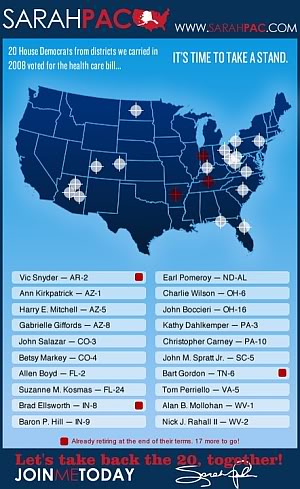
HUFFINGTON POST – I’m not saying that putting a bullseye on Arizona Democrat Rep. Gabrielle Giffords’ congressional race – as Sarah Palin did – was an explicit or intentional invitation to violence. Nor am I saying that the “Get on Target for Victory” events held by the guy Giffords beat – “Help remove Gabrielle Giffords from office Shoot a fully automatic M16 with Jesse Kelly” – was the reason her assassin went after her. This tragedy is still unfolding, and the questions of motive and incitement will be argued about for a long time to come.

But I am saying that the “lock and load”/”take up your arms” rhetoric of American politics isn’t just an overheated metaphor. For years, the language of sports has dominated political journalism, and discourse about hardball and the horserace and the rest of the macho athletic lexicon has been a factor in the trivialization of our public sphere. This has helped dumb down democracy, making a serious national discussion about anything important too wonky for words.

The “second amendment solution,” though, does something worse than make politics a branch of entertainment. It makes it a blood sport. I know politics ain’t beanbag. But words have consequences, rhetoric shapes reality, and much as we like to believe that we are creatures of reason, there is something about our species’ limbic system and lizard brainstems that makes us susceptible to irrational fantasies.

If you’re worried that violent video games may make kids prone to bad behavior; if you think that mysogenic and homophobic rap lyrics are dangerous to society; if you believe that a nipple in a Superbowl halftime show is a threat to our moral fabric – then surely you should also fear that the way public and media figures have framed political participation as a shooting gallery imagery is just as potentially lethal.

Article by Marty Kaplan, Director of the Norman Lear Center and Professor at the USC Annenberg School

© 2011 Huffington Post
 

Posted in Uncategorized | 1 Reply

Haiti’s Election Tally Shows Massive Irregularities

CENTER FOR ECONOMIC AND POLICY RESEARCH – An independent recount and review of 11,171 tally sheets from Haiti’s November 28 election shows that the outcome of the election is indeterminate. The review, conducted by the Center for Economic and Policy Research (CEPR), found massive irregularities and errors in the tally. A report detailing the recount’s findings, and methodology, will be made available next week.
“With so many irregularities, errors, and fraudulent vote totals, it is impossible to say what the results of this election really are,” said Mark Weisbrot, economist and CEPR Co-Director.

“If the Organization of American States certifies this election, this would be a political decision, having nothing to do with election monitoring,” said Weisbrot. “They would lose all credibility as a neutral election-monitoring organization.”

Among the preliminary findings:

While OAS Assistant Secretary General Albert Ramdin was quoted by the Associated Press as saying that “Nearly 4 percent of polling place tally sheets used to calculate the results were thrown out for alleged fraud at the tabulation center,” the actual number is closer to 12 percent. CEPR found that 11.9 percent (1,324) of the tally sheets were either never received by the CEP (Haiti’s Provisional Electoral Council) or were quarantined by the CEP due to irregularities.  These tally sheets added up to more than 15 percent of the total votes counted.

In addition to the 11.9 percent of tally sheets not counted by the CEP, CEPR found that 6.4 percent of the tally sheets were irregular. These tally sheets contained vote counts that were so far outside the distribution of votes that they would not be considered valid. If we add these to the tally sheets not counted by the CEP, there are more than 18 percent of tally sheets – representing more than 22 percent of votes counted — that are invalid.

In addition, there were widespread clerical errors – mis-recorded numbers – on the tally sheets: 5.4 percent of tally sheets had numbers that were obvious clerical errors. Although these errors did not necessarily affect the distribution of votes among the candidates, they add another element of uncertainty to the vote count. It is clear that with so many mistakes in recorded totals in the tally sheets, there would have to be errors in the candidate vote counts in addition to those that CEPR detected.

Turnout was extremely low: an estimated 22.3 percent of the electorate participated, as compared with 59.3 percent in the last (2006) presidential election. This was partly due to the fact that more than 12 political parties were arbitrarily excluded from participating in the election, including the country’s most popular political party.

Internally displaced people (IDP’s), who have been made homeless by the earthquake, were especially disenfranchised. In the cities of Port-au-Prince, Carrefour, Delmas and Petionville – which contain 20 percent of Haiti’s registered voters – the average participation rate was just 12.4 percent (11.25 percent if we remove additional irregular tally sheets).

“This election was of questionable legitimacy to begin with because the electoral authorities banned over a dozen political parties, including the country’s most popular political party,” said Weisbrot. “But with this massive level of irregularity, fraud, and disenfranchisement, it can hardly be considered a legitimate election.”


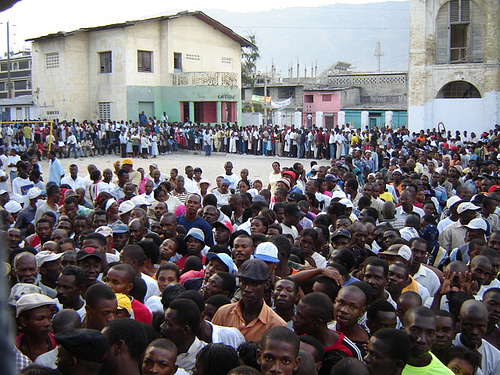
Photograph of Haiti’s 2006 election by Flickr user Robert Miller


IDF May Be Using Most Dangerous Type of Tear Gas

HAARETZ (ISRAEL) – Questions are surfacing about Israel’s use of tear-gas grenades, as security officials investigate the recent death of a protester at the weekly demonstration near the separation fence at the West Bank village of Bil’in. A 36-year-old woman, Jawaher Abu Rahmah, died on Saturday morning.

The medical report filed in the Ramallah hospital where Abu Rahmah was taken shows that her death was caused by respiratory failure resulting from the inhalation of tear gas.

Haaretz obtained the medical report on Sunday from Jawaher’s brother, Ahmed Abu Rahmah.

Jawaher Abu Rahmah was the sister of Bassem Abu Rahmah, who was killed in April 2009 when Israeli soldiers fired a tear-gas grenade at his chest at a demonstration at the fence in Bil’in. Ahmed Abu Rahmah has three surviving brothers; their father died five years ago.

“My entire family is ruined,” he said on Sunday. “The whole house feels a sense of catastrophe.” He said he bears no hatred toward Israelis. “They are people just like myself. We don’t seek vengeance against Israel. We want the return of our lands, and the struggle won’t end until our property is restored.”

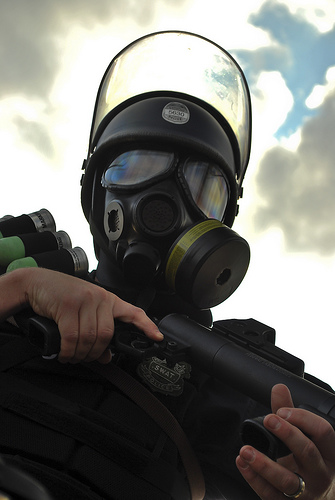
The Israel Defense Forces uses crowd-dispersal tear gas known as CS, which was developed half a century ago in Britain and the United States. It is used by armies and police forces around the world. In recent years, a number of studies have cast doubts about this type of gas; there have been reports of several deaths caused by the inhalation CS tear gas.

Click to read full article on IDF use of dangerous tear gas.

© Copyright 2011 Haaretz  

Article written by Avi Issacharoff and Anshel Pfeffer

Photograph by flickr user Mark Z.

Posted in Uncategorized | 1 Reply

Thousands Flee Ivory Coast

DEMOCRACY NOW – A general strike has been called for in the Ivory Coast today to force incumbent president Laurent Gbagbo to cede power. Gbagbo has refused to step aside following the disputed presidential election last month. Opposition leader Alassane Ouattara has been widely recognized as the winner of the vote. Meanwhile, the president of ECOWAS threatened that the West African bloc may use force to remove Gbago from power. We speak with Syracuse University professor Horace Campbell.

For transcript, visit Democracy Now.


Click to read Reuters report about UN concern for Ivory Coast on the ‘brink of genocide’.


Posted in Uncategorized | 1 Reply

Another Astonishing Victory: No New Nukes

TRUTHOUT – The atomic energy industry has suffered another astonishing defeat. Thanks to its loss, 2010 again left the “nuclear renaissance” in the Dark Age that defines the technology.

But an Armageddon-style battle looms when Congress returns next year.

The push to build new nuclear plants depends now, as always, on federal subsidies. Fifty-three years after the first commercial reactor opened at Shippingport, Pennsylvania, no private funders will step forward to pay for a “new generation” of nukes.

So the industry remains mired in unsolved waste problems, disturbing vulnerability to terror and error, uninsured liability in case of a major catastrophe and unapproved new design proposals.

Two new reactor construction projects in Europe – one in Finland and the other at Flamanville, France – are sinking in gargantuan cost overruns and multi-year delays. To financiers and energy experts worldwide, it’s a clear indicator that the “rebirth” of this failed technology is a hopeless quagmire.

Meanwhile, the 104 reactors currently licensed in the US are leaking radiation and facing escalating grassroots attack. Vermont’s new governor, Peter Shumlin, is committed to shutting the Yankee plant there, and public demands to close plants, including New York’s Indian Point and New Jersey’s Oyster Creek, among others, have reached a fever pitch.

Most importantly, advances in green technologies are leaving atomic power in the dust. Numerous new studies now show it is significantly cheaper to build new generating capacity with photovoltaics, wind and other renewable solartopian sources than to go nuclear. That gap will only grow in the coming years.

But Barack Obama proposed some $36 billion in new nuke loan guarantees to add to the $18.5 billion set aside by the Bush Administration. Earlier this year, Obama handed $8.33 billion of that money to a Georgia utility that broke ground on two new nukes at the Vogtle site, where two old, trouble-plagued reactors still operate.

The nukes are being built in Georgia – along with two more in South Carolina – because those states’ ratepayers are being forced to foot the bill as construction proceeds. The companies’ returns are guaranteed even if the reactors never operate. Georgia has already suffered crippling rate hikes of $1 billion and more to pay for a construction project likely to wind up as little more than a moribund mausoleum.

Nonetheless, even amidst a major economic crisis, the White House and its pro-nuke allies have been pushing hard to fund still more of these radioactive boondoggles.

Click to continue reading about the fight against Congress’ push for new nukes.

© COPYRIGHT TRUTHOUT, 2010

Article by Harvey Wasserman for Truthout

Posted in Uncategorized | 1 Reply
Page 43 of 62<<...4142434445...>>
