Israel Eyes Huge East Jerusalem Settlement Project

JERUSALEM (AFP) – Israel is to approve 1,400 new settler homes in east Jerusalem, media and the local council said on Sunday, defying pressure to halt settlement building that has stalled peace talks with the Palestinians.

The massive construction project will add homes to the annexed east Jerusalem settlement neighbourhood of Gilo and is expected to receive final approval from the district planning commission within days.

The project is likely to spark condemnation from the international community, which has repeatedly called on Israel to avoid new building projects in mainly Arab east Jerusalem.

Jerusalem’s municipal council in a statement confirmed the project, but said it was part of a long-standing policy to expand housing availability for the city’s Jewish and Arab residents.

“There has been no change in the policy towards construction in Jerusalem for the last 40 years,” it said. “The Jerusalem municipality continues to promote both Jewish and Arab construction in the city.”

Click to continue reading about settlement project in East Jerusalem.

© COPYRIGHT AFP, 2011

Photograph by flickr user moty66ipernity

The Economics of Happiness

THE ECONOMICS OF HAPPINESS, THE MOVIE – Economic globalization has led to a massive expansion in the scale and power of big business and banking. It has also worsened nearly every problem we face: fundamentalism and ethnic conflict; climate chaos and species extinction; financial instability and unemployment. There are personal costs too. For the majority of people on the planet life is becoming increasingly stressful. We have less time for friends and family and we face mounting pressures at work.

The Economics of Happiness describes a world moving simultaneously in two opposing directions. On the one hand, government and big business continue to promote globalization and the consolidation of corporate power. At the same time, all around the world people are resisting those policies, demanding a re-regulation of trade and finance—and, far from the old institutions of power, they’re starting to forge a very different future. Communities are coming together to re-build more human scale, ecological economies based on a new paradigm — an economics of localization.

We hear from a chorus of voices from six continents including Vandana Shiva, Bill McKibben, David Korten, Michael Shuman, Juliet Schor, Zac Goldsmith and Samdhong Rinpoche – the Prime Minister of Tibet’s government in exile. They tell us that climate change and peak oil give us little choice: we need to localize, to bring the economy home. The good news is that as we move in this direction we will begin not only to heal the earth but also to restore our own sense of well-being. The Economics of Happiness restores our faith in humanity and challenges us to believe that it is possible to build a better world.


© 2011 The Economics of Happiness

Photograph by Xanetia

Lebanon in Limbo

THE INDEPENDENT/UK – Soldiers, soldiers everywhere. In the valleys, on the mountains, in the streets of Beirut. I have never seen so many soldiers. Are they going to “liberate” Jerusalem? Or are they going to destroy all the Arab dictatorships?

They are supposed to stop the country of Lebanon from sliding into a civil war, I suppose. Hezbollah, we are told, has destroyed the government – which is true up to a point. For on Monday, so we are told, the Hague tribunal of the United Nations will tell us that members of Hezbollah killed the former prime minister, Rafiq Hariri.

America demands that the tribunal name the guilty men. So does France. And so, of course, does Britain. Which is strange, because in 2005, when Mr Hariri was killed 366 metres from me on the Beirut Corniche, we all believed that the Syrians had killed him. Not the President, mind you. Not Bashar Assad, but the security services of the Syrian Baath party. That’s what I believed then. That’s what I still believe. But we are told now that it will be Hezbollah, Syria’s friend and Iran’s militia (albeit Lebanese) in Lebanon. And now America and Britain are beating the drum of litigation.

Hezbollah must be blamed and of course, the Prime Minister – or, to be correct, the former prime minister of Lebanon Saad Hariri, son of Rafiq – has just lost his job.

There are many who believe that Lebanon will now descend into a civil war, similar to the fratricidal conflict which it endured from 1976 to 1980. I doubt it. A new generation of Lebanese, educated abroad – in Paris, in London, in America – have returned to their country and, I suspect, will not tolerate the bloodshed of their fathers and grandfathers.

In theory, Lebanon no longer has a government, and the elections which were fairly held and which gave Saad Hariri his cabinet are no more. President Michel Suleiman will begin formal talks on Monday to try to create a new government.

But what does Hezbollah want? Is it so fearful of the Hague tribunal that it needs to destroy this country? The problem with Lebanon is perfectly simple, even if the Western powers prefer to ignore it. It is a confessional state. It was created by the French, the French mandate after the First World War. The problem is that to become a modern state it must de-confessionalise. But Lebanon cannot do so. Its identity is sectarianism and that is its tragedy. And it has, President Sarkozy please note, a French beginning point.

The Shias of Lebanon, of which Hezbollah is the leading party, are perhaps 40 per cent of the population. The Christians are a minority. If Lebanon has a future, it will be in due course be a Shia Muslim country. We may not like this; the West may not like this. But that is the truth. Yet Hezbollah does not want to run Lebanon. Over and over again, it has said it does not want an Islamic republic. And most Lebanese accept this.

But Hezbollah has made many mistakes. Its leader, Hassan Nasrallah, talks on television as if he is the President. He would like another war with Israel, ending in the “divine victory” which he claims his last war, in 2006, ended in. I fear the Israelis would like another war too. The Lebanese would prefer not to have one. But they are being pushed further and further into another war which Lebanon’s supposed Western friends seem to want. The Americans and the British would like to hurt Iran. And that is why they would like Hezbollah to be blamed for Mr Hariri’s murder – and for the downfall of the Lebanese government.

And it is perfectly true that Hezbollah does want this government to fall. By getting rid of this government, getting rid of this cabinet, it has broken the rules of the Doha agreement, which stated that the government and security services of Lebanon should not be harmed.

It is effectively wiping out the Arab “solution” to the Lebanese sectarian conundrum, and what – with the help of its Christian allies – is turning Lebanon into a frightened state. No wonder there were no drivers on the roads yesterday. No wonder the Lebanese were so frightened to go out and enjoy the Mediterranean sun. We are all frightened.

But I think the Lebanese state has grown up. I noticed, yesterday, that the Christian leader of the Lebanese Forces, one of the Christian militias, Samir Geagea, had a new photograph on the front of his party offices in a mountain town. But he was wearing civilian clothes. He was wearing a suit and tie. Not the militia costume he use to wear. That was a good sign.

No civil war in Lebanon.

Click to read the full article, Lebanon in Limbo: A Nation Haunted by the Murder of Rafiq Hariri.

© 2011 The Independent

Robert Fisk is Middle East correspondent for The Independent newspaper.  He is the author of many books on the region, including The Great War for Civilisation: The Conquest of the Middle East.

Photograph by Flickr user conjure1

The Future of Food Riots

COMMONDREAMS – If all the food in the world were shared out evenly, there would be enough to go around. That has been true for centuries now: if food was scarce, the problem was that it wasn’t in the right place, but there was no global shortage. However, that will not be true much longer.

The food riots began in Algeria more than a week ago, and they are going to spread. During the last global food shortage, in 2008, there was serious rioting in Mexico, Indonesia, and Egypt. We may expect to see that again this time, only bigger and more widespread.

Most people in these countries live in a cash economy, and a large proportion live in cities. They buy their food, they don’t grow it. That makes them very vulnerable, because they have to eat almost as much as people in rich countries do, but their incomes are much lower.

The poor, urban multitudes in these countries (including China and India) spend up to half of their entire income on food, compared to only about ten percent in the rich countries. When food prices soar, these people quickly find that they simply lack the money to go on feeding themselves and their children properly – and food prices now are at an all-time high.

“We are entering a danger territory,” said Abdolreza Abbassian, chief economist at the Food and Agriculture Organisation, on 5 January. The price of a basket of cereals, oils, dairy, meat and sugar that reflects global consumption patterns has risen steadily for six months, and has just broken through the previous record, set during the last food panic in June, 2008.

“There is still room for prices to go up much higher,” Abbassian added, “if for example the dry conditions in Argentina become a drought, and if we start having problems with winter kill in the northern hemisphere for the wheat crops.” After the loss of at least a third of the Russian and Ukrainina grain crop in last summer’s heat wave and the devastating floods in Australia and Pakistan, there’s no margin for error left .

It was Russia and India banning grain exports in order to keep domestic prices down that set the food prices on the international market soaring. Most countries cannot insulate themselves from this global price rise, because they depend on imports for a lot of domestic consumption. But that means that a lot of their population cannot buy enough food for their families, so they go hungry. Then they get angry, and the riots start.

Is this food emergency a result of global warming? Maybe, but all these droughts, heat waves and floods could also just be a run of really bad luck. What is nearly certain is that the warming will continue, and that in the future there will be many more weather disasters due to climate change. Food production is going to take a big hit.

Global food prices are already spiking whenever there are a few local crop failures, because the supply barely meets demand even now. As the big emerging economies grow, Chinese and Indian and Indonesian citizens eat more meat, which places a great strain on grain supplies. Moreover, world population is now passing through seven billion, on its way to nine billion by 2050. We will need a lot more food than we used to.

Some short-term fixes are possible. If the US government ended the subsidies for growing maize (corn) for “bio-fuels”, it would return about a quarter of US crop land to food production. If people ate a little less meat, if more African land was brought into production, if more food was eaten and less was thrown away, then maybe we could buy ourselves another fifteen or twenty years before demand really outstripped supply.

On the other hand, about a third of all the irrigated land in the world depends on pumping groundwater up from aquifers that are rapidly depleting. When the flow of irrigation water stops, the yield of that highly productive land will drop hugely. Desertification is spreading in many regions, and a large amount of good agricultural land is simply being paved over each year. We have a serious problem here.

Climate change is going to make the situation immeasurably worse. The modest warming that we have experience so far may not be the main cause of the floods, droughts and violent storms that have hurt this year’s crops, but the rise in temperature will continue because we cannot find the political will to stop the greenhouse-gas emissions.

The rule of thumb is that we lose about 10 percent of world food production for every rise of one degree C in average global temperature. So the shortages will grow and the price of food will rise inexorably over the years. The riots will return again and again.

In some places the rioting will turn into revolution. In others, the rioters will become refugees and push up against the borders of countries that don’t want to let them in. Or maybe we can get the warming under control before it does too much damage. Hold your breath, squeeze your eyes tight shut, and wish for a miracle.

Gwynne Dyer’s latest book, “Climate Wars: The Fight for Survival as the World Overheats“, was published recently in the United States by Oneworld.

© COPYRIGHT COMMONDREAMS, 2011

Photograph by Markusram

A Year After the Earthquake, Haiti Still Needs Help

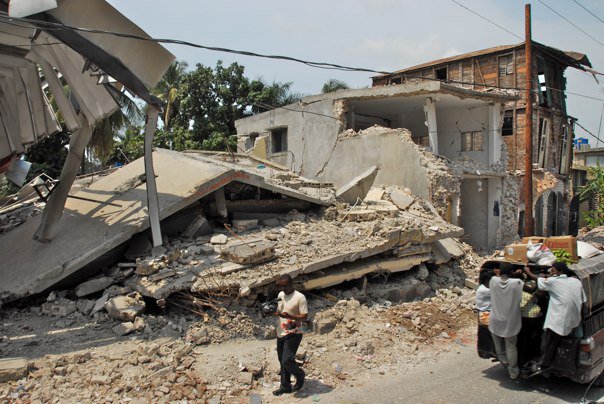
COMMONDREAMS – When the Enriquillo fault line shifted at 4:53 p.m. last Jan. 12, our bed was sent across the hotel room, the other side of the building collapsed and, as we would soon find out, Haiti was devastated.

My 1-year-old son and I had accompanied my wife, an HIV educator for health-care workers, to Haiti only two days before the earthquake. In the immediate aftermath, the emergency medical technician who was a guest at our hotel formed a makeshift clinic in the circular driveway to attend to hundreds of badly injured Haitians.

My wife and I were quickly deputized as orderlies in his driveway emergency room, and without any prior medical training, we assisted in whatever way we could – stripping the sheets off hotel beds to apply as bandages, breaking chairs to use the wood for splints, and transforming the poolside deck chairs into hospital beds.

However, tens of thousands of Haitians didn’t receive even this basic first-aid, resulting in a much higher mortality rate. The catastrophe can only begin to be grasped through comparisons; with some 300,000 people dead and another 300,000 injured, the total number of casualties roughly equals the entire population of Seattle. More than the entire population of King County – more than 2 million people – were rendered homeless. Some 1.5 million still live in tent encampments today.

Upon returning home, we learned that half of all American households had given a charitable donation to help the people of Haiti and were overjoyed that Haiti’s plight had not been overlooked.

However, the overwhelming majority of the money pledged to Haiti has yet to reach the Haitian people. Only $6 million of the $52 million Clinton-Bush Haiti Fund had been spent by November, The Washington Post reported. The U.S. government’s pledge of more than $1 billion dollars was completely unfulfilled until November, when it finally released $120 million.

Worse, the U.S. is pursuing a development strategy calling for garment factories (read: sweatshops) and tourism instead of the sustainable agriculture programs proposed by Haitian civil-society organizations that would create jobs, produce food for countless Haitians, and allow Haiti to address the environmental degradation that has crippled its economy for generations.

According to an extensive Institute for Justice and Democracy in Haiti study, “We Have Been Forgotten,” 75 percent of families living in the tent camps had someone go an entire day without eating, 44 percent drink untreated water, and 27 percent had no access to sanitation.

The terrible conditions of the tent camps have contributed to the rapid spread of cholera in Haiti, believed to have been introduced by United Nations occupying troops from Nepal. Already some 2,600 Haitians have died from the disease with The New York Times predicting, “cholera may become a way of life that could afflict as many as 270,000 people over the next several years.”

To tackle a problem of this proportion, Haiti will need an effective government that understands the needs of its people and can coordinate a rebuilding project on the scale required. Yet Haiti’s most popular political party, Lavalas, has been banned from participation in the most recent election – with U.S. and U.N. support – preventing any new government from truly representing the will of the people.

If any people can overcome these challenges, it is the Haitians, who gained their independence through the only successful slave revolt in history and who have as recently as the mid-1980s deposed a brutal dictatorship through popular uprising.

As the people of Haiti struggle for a better future, we here would do well to remember the Haitian proverb, Men anpil chay pa lou: “Many hands make the load lighter.”

Jesse Hagopian is a teacher in Seattle and serves on the board of Maha-Lilo (Many Hands, Light Load), a Haiti solidarity organization that is currently working to bring water filters to tent camps in Cap Haitien. He can be reached at [email protected]

Maha-Lilo is holding a dinner benefit to mark the anniversary of the earthquake Sunday in Seattle. The event will begin at 4 p.m. at Waid’s Haitian Cuisine, 1212 E Jefferson St., Seattle. For more information, call 734-218-6622 or go to: www.mahalilo.org

© COPYRIGHT COMMONDREAMS, 2011

Photograph by Rick Pickett III

Page 42 of 62<<...4041424344...>>