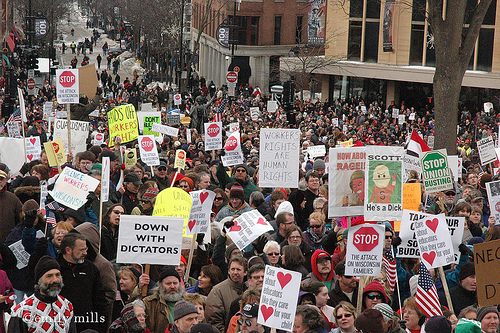
 COMMONDREAMS – When we study Marx in my graduate social theory course, it never fails
that at least one student will say (approximately), “Class struggle
didn’t escalate in the way Marx expected. In modern capitalist
societies class struggle has disappeared. So isn’t it clear that Marx
was wrong and his ideas are of little value today?”
COMMONDREAMS – When we study Marx in my graduate social theory course, it never fails
that at least one student will say (approximately), “Class struggle
didn’t escalate in the way Marx expected. In modern capitalist
societies class struggle has disappeared. So isn’t it clear that Marx
was wrong and his ideas are of little value today?”
I respond by challenging the premise that class struggle has
disappeared. On the contrary, I say that class struggle is going on all
the time in every major institution of society. One just has to learn
how to recognize it.
One needn’t embrace the labor theory of value to understand that
employers try to increase profits by keeping wages down and getting as
much work as possible out of their employees. As the saying goes, every
successful capitalist knows what a Marxist knows; they just apply the
knowledge differently.
Workers’ desire for better pay and benefits, safe working
conditions, and control over their own time puts them at odds with
employers. Class struggle in this sense hasn’t gone away. In fact, it’s
inherent in the relationship between capitalist employer and employee.
What varies is how aggressively and overtly each side fights for its
interests.
Where else does class struggle occur? We can find class struggle
wherever three things are at stake: the balance of power between
capitalists and workers, the legitimacy of capitalism, and profits.
The most important arena outside the workplace is government,
because it’s here that the rules of the game are made, interpreted, and
enforced. When we look at how capitalists try to use government to
protect and advance their interests — and at how other groups resist
— we are looking at class struggle.
Capitalists want laws that weaken and cheapen labor. This means laws
that make it harder for workers to organize unions; laws that make it
easier to export production to other countries; laws that make it
easier to import workers from other countries; laws and fiscal policies
that keep unemployment high, so that workers will feel lucky just to
have jobs, even with low pay and poor benefits.
Capitalists want tax codes that allow them to pay as little tax as
possible; laws that allow them to externalize the costs of production
(e.g., the health damage caused by pollution); laws that allow them to
swallow competitors and grow huge and more powerful; and laws that
allow them to use their wealth to dominate the political process.
Workers, when guided by their economic interests, generally want the
opposite.
I should note that by “workers,” I mean everyone who earns a wage or
a salary and does not derive wealth from controlling the labor of
others. By this definition, most of us are workers, though some are
more privileged than others. This definition also implies that whenever
we resist the creation and enforcement of laws that give capitalists
more power to exploit people and the environment, we are engaged in
class struggle, whether we call it that or not.
There are many other things capitalists want from government. They
want public subsidy of the infrastructure on which profitability
depends; they want wealth transferred to them via military spending;
they want militarily-enforced access to foreign markets, raw materials,
and labor; and they want suppression of dissent when it becomes
economically disruptive. So we can include popular resistance to
corporate welfare, military spending, imperialist wars, and government
authoritarianism as further instances of class struggle.
Class struggle goes on in other realms. In goes on in K-12
education, for example, when business tries to influence what students
are taught about everything from nutrition to the virtues of free
enterprise; when U.S. labor history is excluded from the required
curriculum; and when teachers’ unions are blamed for problems of
student achievement that are in fact consequences of the
maldistribution of income and wealth in U.S. society.
It goes on in higher education when corporations lavish funds on
commercially viable research; when capitalist-backed pundits attack
professors for teaching students to think critically about capitalism;
and when they give money in exchange for putting their names on
buildings and schools. Class struggle also goes on in higher education
when pro-capitalist business schools are exempted from criticism for
being ideological and free-market economists are lauded as objective
scientists.
In media discourse, class struggle goes on when we’re told that the
criminal behavior of capitalist firms is a bad-apple problem rather
than a rotten-barrel problem. It goes on when we’re told that the
economy is improving when wages are stagnant, unemployment is high, and
jobs continue to be moved overseas. It goes on when we’re told that
U.S. wars and occupations are motivated by humanitarian rather than
economic and geopolitical concerns.
Class struggle goes on in the cultural realm when books, films, and
songs vaunt the myth that economic inequality is a result of natural
differences in talent and motivation. It goes on when books, films, and
songs celebrate militarism and violence. It also goes on when writers,
filmmakers, songwriters, and other artists challenge these myths and
celebrations.
It goes on, too, in the realm of religion. When economic
exploitation is justified as divinely ordained, when the oppressed are
appeased by promises of justice in an afterlife, and when human
capacities for rational thought are stunted by superstition, capitalism
is reinforced. Class struggle is also evident when religious teachings
are used, antithetically to capitalism, to affirm values of equality,
compassion, and cooperation.
I began with the claim that Marx’s contemporary relevance becomes
clear once one learns to see the pervasiveness of class struggle. But
apart from courses in social theory, reading Marx is optional. In the
real world, the important thing is learning to see the myriad ways that
capitalists try to advance their interests at the expense of everyone
else. This doesn’t mean that everything in social life can be reduced
to class struggle, but that everything in social life should be
examined to see if and how it involves a playing-out of class interests.
Click to continue reading on class struggle.
Article by Michael Schwalbe, a professor of sociology at North Carolina State University. He is the author of: Rigging the Game: How Inequality Is Reproduced in Everyday Life (Oxford, 2008). He can be reached at [email protected].
© Copyright Common Dreams, 2011
Photograph by Flickr user: Lost Albatross



 WALL STREET JOURNAL– For the second time, Icelanders voted down a deal to repay Britain and
the Netherlands billions of euros lost in the island nation’s 2008
financial collapse—at once a bold popular rejection of the notion that
taxpayers must bear the burden for bankers’ woes and a risky outcome
that will complicate Iceland’s efforts to rejoin global markets.
WALL STREET JOURNAL– For the second time, Icelanders voted down a deal to repay Britain and
the Netherlands billions of euros lost in the island nation’s 2008
financial collapse—at once a bold popular rejection of the notion that
taxpayers must bear the burden for bankers’ woes and a risky outcome
that will complicate Iceland’s efforts to rejoin global markets. RAW STORY
 GUARDIAN
 COMMONDREAMS