Thousands of CA Inmates on Hunger Strike

COLOR LINES– What began as a hunger strike among inmates of the isolation wing of California’s Pelican Bay prison has turned into a statewide display of solidarity. A number of prisoners in Pelican Bay’s Security Housing Unit, California’s highest-security complex, refused their state-provided morning meal on Friday to protest the inhumane conditions of their confinement. Inmates in the Security Housing Unit spend 23 hours per day in soundproofed, windowless cells. Their daily hour of exercise is walking around a small, walled space. The intent is to keep prison-gang members and those considered dangerous to others separated from fellow inmates.

Despite original claims by the California Department of Corrections and Rehabilitation that the hunger strike was limited to fewer than two dozen Pelican Bay inmates, spokesperson Terry Thornton said yesterday that the weekend had seen a peak of 6,600 protesters. According to Thornton, there are currently around 2,100 prisoners declining meals. Thirteen of California’s 33 penal facilities have counted protesters among their inmate populations and it appears that the sentiment of solidarity is spreading beyond state borders. On Friday, a number of those incarcerated at Ohio State Penitentiary refused their food trays for a full 24 hours.

Molly Porzig, spokesperson for Critical Resistance, an organization dedicated to developing alternatives to incarceration, highlighted the significance of the strike’s timing. “California has been ordered by the Supreme Court to release prisoners due to the neglect and overcrowding in the state’s prisons. They recognize that the conditions of California’s prisons are absolutely atrocious.” Additionally, Porzig pointed to the state’s recent budget, which includes $140 million in overtime for guards, especially those in SHUs. “California is demonstrating that it prioritizes prisons over education, parks, health care, keeping our libraries’ doors open and other things that our communities need.”

The strikers’ demands include better food, warmer clothing and a phone call each month. They also hope to end the unit’s debriefing policy, which allows inmates to leave the unit in exchange for information about the actions of other gang members and prisoners. “Its an incredibly dangerous system for prisoners and their families because of retaliation,” said Porzig. “On the other end, all someone needs to do is point a finger at you and you’re in SHU indefinitely.”

Read more about Thousands of CA Inmates on Hunger Strike.

This video explains what the Pelican Bay Hunger Strike is all about, with former prisoners detailing why prisoners are protesting, how this action relates to a history of prisoner-led resistance, and what people outside prison can do to support the hunger strike.

This video was made by a coalition called Prisoner Hunger Strike Solidarity. For updates on the hunger strike, check out: prisonerhungerstrikesolidarity.wordpress.com

© 2011 Color Lines

Photo by Flickr User Ben Kraus

Child Poverty in US Nears 25%

CBS– Unemployment improved a bit last month but it is still nearly nine percent and the trouble is job creation is so slow, it will be years before we get back the seven and a half million jobs lost in the Great Recession. American families have been falling out of the middle class in record numbers. The combination of lost jobs and millions of foreclosures means a lot of folks are homeless and hungry for the first time in their lives.

One of the consequences of the recession that you don’t hear a lot about is the record number of children descending into poverty.

The government considers a family of four to be impoverished if they take in less than $22,000 a year. Based on that standard, and government projections of unemployment, it is estimated the poverty rate for kids in this country will soon hit 25 percent. Those children would be the largest American generation to be raised in hard times since the Great Depression.

Read full article about Child Poverty in US Nears 25%

© 2011 CBS

Photo by Flickr user Boasorte Careca

Unemployment improved a bit last month but it is still nearly nine percent and the trouble is job creation is so slow, it will be years before we get back the seven and a half million jobs lost in the Great Recession. American families have been falling out of the middle class in record numbers. The combination of lost jobs and millions of foreclosures means a lot of folks are homeless and hungry for the first time in their lives.
One of the consequences of the recession that you don’t hear a lot about is the record number of children descending into poverty.
The government considers a family of four to be impoverished if they take in less than $22,000 a year. Based on that standard, and government projections of unemployment, it is estimated the poverty rate for kids in this country will soon hit 25 percent. Those children would be the largest American generation to be raised in hard times since the Great Depression.

Israel to Shut Down Gaza Aid Flotilla

THE NATION– Amid the economic and social upheaval of Greece’s beleaguered capital city, where demonstrators have been protesting government-imposed austerity measures, forty activists from across the United States began training this week to nonviolently confront the Israeli military blockade of Gaza. The Americans are part of a flotilla of ten ships—from France, Ireland, Canada, Norway, Greece, Sweden and other countries—planning to set out for Gaza’s main seaport in the next week to relieve the siege.

With an age gap of sixty years between the youngest and oldest passenger, the diverse group of Americans have taken over a hotel in a trendy Athens neighborhood for days of nonviolence training and preparation.

Israel has stated that it will enforce its naval blockade by any political, military and economic measures at its disposal. This week it submitted an urgent request to UN Secretary General Ban Ki-moon asking for international cooperation in stopping the flotilla. Ban embraced the Israeli government’s position, arguing in a public statement that aid should be delivered to Gaza only through “legitimate crossings and established channels,” all of which are controlled by Israel. Ban added that the flotilla is not helpful in assisting the economy of Gaza and encouraged organizers to cancel their voyage.

Read the full article about Israel Attempts To Shut Down Humanitarian Gaza Aid.

© 2011 The Nation

Photo by Flickr user Zingaro

Alice Walker on the Struggle for Justice

ELECTRONIC INTIFADA– Celebrated American author and poet Alice Walker will later this month be among 38 people aboard the Audacity of Hope, the ship sponsored by US Boat to Gaza as part of an international effort to break Israel’s maritime siege of Gaza.

In a conversation with Ali Abunimah, Walker speaks about her thoughts on the eve of the trip and the parallels between the Gaza Freedom Flotilla and the Freedom Rides during the US Civil Rights movement when black and white Americans boarded interstate buses together to break the laws requiring racial segregation. The Freedom Riders were met with extreme violence — including bus burnings, attempted lynchings, jail and torture.

Walker — who has authored more than thirty books, the best known of which is the Pulitzer Prize winning novel The Color Purple — also reflects on her recent visit to the occupied West Bank, the role of dancing and joy in the struggle for freedom and the situation in the United States. Her latest book, a memoir, is titled The Chicken Chronicles.

Ali Abunimah: How do you feel about going on the US Boat to Gaza? Are you excited, fearful? What are your thoughts at this time?

Alice Walker: I’m thoughtful. Because we’re told it could be a quite dangerous journey. And so I am steeping myself in the wisdom and the images and words of people who in my culture have sustained us through dangerous journeys. Langston Hughes, Malcolm X, Martin Luther King and Ella Baker, Fanny Lou Hamer, Black Elk, Geronimo, Crazy Horse, Ida B. Wells, Sojourner Truth, Bob Marley. It’s good for me to feel that I am surrounded at all times by the presence of all these people who have understood American empire and who have stood against it.

AA: You’ve made the connection with the Freedom Rides that happened fifty years ago, in 1961. Can you talk about that?

AW: Yes, it means that the baton is being passed on to us of journeying to places in the world where people need us and where our governments are not helpful and in fact are destructive.

Just before my first year of college, the Freedom Riders came down to the South; I was living in Georgia under intense segregation that white supremacists and many black people assumed would last forever. They had become extremely complacent after a hundred years of brutality and subjugation of black people; and so when the Freedom Riders came down we didn’t expect them to survive.

Just as we didn’t expect Martin Luther King Jr. to live as long as he did. But we were very grateful because at least it assured us that someone outside of our own community objected to the repression that we endured every day and it meant a lot to us. It lifted our spirits, it gave us courage, it gave us hope.

AA: I was reading about the Freedom Riders recently and I was surprised by how little coverage the anniversary got in some of our mainstream media. Maybe I shouldn’t have been so surprised. But one of the things that struck me that I learned was that the Kennedy administration at the time did not look favorably on the Freedom Riders and said that they were being provocative and that they should refrain from what they were doing. And that just struck me as almost a parallel with what’s happening now.

AW: And I think that has been our experience. The government has never said “Oh yes, go out and protest.” It has never said that. It has always said, “we will not support you and you shouldn’t do it and it’s wrong and it’s bad and it’s not good for you.” But really that’s why you protest. You decide that you know what you think is good for you and you go ahead and you do it.

AA: Some of the — let’s call them “Gaza freedom riders” — have been writing or planning to write to their members of Congress or to the State Department to inform them that they are planning to take this trip. Are you planning to do that or have you done that?

AW: I have written a letter to Senator Barbara Boxer [(D-CA)] and Senator Diane Feinstein [(D-CA)] and Representative Barbara Lee who are my representatives to let them know what’s going on and to ask their support and what protection they can offer.

But I did that because I was asked to do it and it seems like a good idea. But I can’t say that I feel that they will be all that effective. I would like them to be but I think that at some point in all of these ventures one realizes that you’re on your own and that this is something that you feel you have to do because it’s a necessary work of the world and it’s a way that our children can stop being tormented and deformed by the brutality they see visited upon children just like themselves all over the world.

Read full interview about Alice Walker on the Struggle for Justice.

© 2011 Electronic Antifada

Photo by Lazar Simoneov via TED

Iraq: Thousands Rally Against U.S. Troops

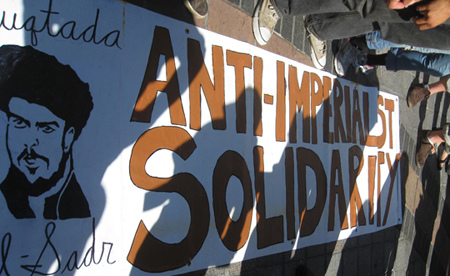
TIME– Iraqi Shi’ite militia fighters led a massive rally of followers of a hard-liner anti-American cleric on Thursday, marching in Baghdad in a show of defiance as Iraqi leaders weigh whether to keep U.S. troops in the country beyond the end of the year.

An estimated 70,000 supporters of Muqtada al-Sadr waved Iraqi flags and shouted “No, no, America!” as the tight columns of the unarmed but ominous Mahdi Army marched though one of Baghdad’s poorest neighborhoods.

U.S., Israeli and British flags were painted on the pavement to be stomped on by the marching protesters, and Iraqi military helicopters buzzed overhead while soldiers stood guard to keep peace if needed.

The rally was a message to Prime Minister Nouri al-Maliki about the staunch opposition by Iraq’s most devout Shi’ites — and the ones who grudgingly helped him clinch a second term in office last year — to a continued U.S. military presence in 2012.

Read full article about Iraq: Thousands Rally Against US Troops.

© 2011 TIME

Photo by Flickr user Absentee Redstate