Crisis of Capitalism: Radical Politics in Age of Austerity

MEDIA ROOTS — Capitalism Is The Crisis: Radical Politics in the Age of Austerity is a film featuring a diverse array of thinkers offering common sense analysis of the trappings of modern life and critical perspectives on basic assumptions of capitalism and democracy.  The film presents original interviews, including Chris Hedges, David Graeber, Derrick Jensen, Michael Hardt, Leo Panitch, David McNally.

The movie is about waking up our neighbours to the glaring ills plaguing our society. It argues that capitalism is the crisis and dares us to imagine saner alternatives.

“The way to make money is to buy when blood is running in the streets.”  —John D. Rockefeller, American oil magnate, robber baron

“The engines of corporatists cannot be halted.  They are impervious to the will of those who they exploit, they are more powerful than the governments they control, and they have built within them an inevitable, kind of, mechanism for self-annihilation because corporations have this strange pathology where they turn everything into a commodity.  Human beings become commodities.  The natural world becomes a commodity.  And you exploit these commodities until exhaustion or collapse.  And that’s precisely what’s happening.” —Chris Hedges

Messina

***

Capitalism is the Crisis

***

CAPITALISM IS THE CRISIS — The 2008 “financial crisis” in the United States was a systemic fraud in which the wealthy finance capitalists stole trillions of public dollars. No one was jailed for this crime, the largest theft of public money in history.

Instead, the rich forced working people across the globe to pay for their “crisis” through punitive “austerity” programs that gutted public services and repealed workers’ rights.

Austerity was named “Word of the Year” for 2010.

This documentary explains the nature of capitalist crisis, visits the protests against austerity measures, and recommends revolutionary paths for the future.

Special attention is devoted to the crisis in Greece, the 2010 G20 Summit protest in Toronto, Canada, and the remarkable surge of solidarity in Madison, Wisconsin.

It may be their crisis, but it’s our problem.

***

Photo by flickr user JHS

Documentary: The Shock Doctrine

MEDIA ROOTS — Film director Michael Winterbottom has adapted best-selling author Naomi Klein’s book Shock Doctrine in an excellent feature documentary.  Winterbottom, who has directed such films as Welcome to Sarajevo, The Road to Guantanamo and Code 46, produces a compelling treatment of Klein’s book.

The shock doctrine thesis maintains elites have taken draconian shock therapy ‘treatments’ (inflicted upon individual psychiatric patients during the 20th century) and applied them economically, politically, and psychologically to nations where leaders have exploited crises in order to push through elite policies against the interests of the people.  

The film also takes a look at U.S. imperialism and its consequences for humanity.  If you haven’t heard of it, it’d be no surprise.  This is not the kind of film corporate America loves to promote.

Messina

***

The Shock Doctrine directed by Michael Winterbottom

“The thesis of the shock doctrine is that we’ve been sold a fairy tale about how these radical policies have swept the globe, that they haven’t swept the globe on the backs of freedom and democracy, that they have needed shock.  They have needed crises.  They have needed states of emergencies. 

“Milton Friedman understood the utility of crisis.  ‘Only a crisis, actual or perceived, produces real change.  When that crisis occurs, the actions that are taken depend on the ideas that are lying around.’Naomi Klein

***

Photo by Flickr user david_shankbone

Posted in Uncategorized | 1 Reply

Employers Less Likely to Interview Openly Gay Men

MEDIA ROOTS- Several research studies have studied job discrimination by sending out resumes with different identifying features and tracking the response rates. For instance, one study conducted by researchers at MIT and University of Chicago sent out thousands of resumes that were identical except for the name of the applicant: in one version, the applicants name was stereotypically “Black” (e.g., Rasheed, Aisha) and another version had stereotypically “White” names (e.g., Greg, Emily). Even though the resumes were identical in terms of qualifications, those researchers found that the “White” resumes had a 30 percent greater chance of getting responses than the “Black” resumes.

A new study published this week in the American Journal of Sociology has used this method to test whether gay men face similar job discrimination. Identical resumes were sent out, with a key difference being membership in a college club: either the applicant reported membership in an LGBT organization, or a socialist organization. The results were striking: “gay” resumes were significantly less likely to lead to interview requests than “socialist” resumes. The socialist group was used as the comparison to rule out the possibility that any discrimination was due to an “anti-liberal” bias, and this makes the results even more striking: being openly gay is more of a liability on the job market than being openly socialist.

Perhaps even more concerning is that a huge scientific literature now shows that these types of discrimination are not necessarily due to overt, conscious prejudice – these differences tend to emerge from subtle, unconscious preferences that guide our judgments and decision making even when we’re not aware of it.

Steven Frenda for MR

***

EUREKALERT– A new study suggests that openly gay men face substantial job discrimination in certain parts of the U.S. The study, which is the largest of its kind to look at job discrimination against gay men, found that employers in the South and Midwest were much less likely to offer an interview if an applicant’s resume indicates that he is openly gay. Overall, the study found that gay applicants were 40 percent less likely to be granted an interview than their heterosexual counterparts.

“The results indicate that gay men encounter significant barriers in the hiring process because, at the initial point of contact, employers more readily disqualify openly gay applicants than equally qualified heterosexual applicants,” writes the study’s author, András Tilcsik of Harvard University.

For the study, Tilcsik sent two fictitious but realistic resumes to more than 1,700 entry-level, white collar job openings — positions such as managers, business and financial analysts, sales representatives, customer service representatives, and administrative assistants. The two resumes were very similar in terms of the applicant’s qualifications, but one resume for each opening mentioned that the applicant had been part of a gay organization in college.

“I chose an experience in a gay community organization that could not be easily dismissed as irrelevant to a job application,” Tilcsik writes. “Thus, instead of being just a member of a gay or lesbian campus organization, the applicant served as the elected treasurer for several semesters, managing the organization’s financial operations.”

The second resume Tilcsik sent listed experience in the “Progressive and Socialist Alliance” in place of the gay organization. Since employers are likely to associate both groups with left-leaning political views, Tilcsik could separate any “gay penalty” from the effects of political discrimination.

The results showed that applicants without the gay signal had an 11.5 percent chance of being called for an interview. However, gay applicants had only a 7.2 percent chance. That difference amounts to a 40 percent higher chance of the heterosexual applicant getting a call.

The callback gap varied widely according to the location of the job, Tilcsik found. In fact, most of the overall gap detected in the study was driven by the Southern and Midwestern states in the sample — Texas, Florida, and Ohio. The Western and Northeastern states in the sample (California, Nevada, Pennsylvania, and New York) had only small and statistically insignificant callback gaps.

“This doesn’t necessarily mean that there is no discrimination in those states, just that the callback gaps were small in the case of the jobs to which I sent applications,” Tilcsik explained. “I think it’s very plausible that, even in those states, there might be a large callback gap in some other jobs, industries, or counties. What this does show is that discrimination in white-collar employment is substantially stronger for the Southern and Midwestern states in the sample.”

The research also found that employers seeking stereotypically heterosexual male traits were more likely to discriminate gay men. Gay applicants had lower callback rates when the employer described the ideal candidate for the job as “assertive,” “aggressive,” or “decisive.

“It seems, therefore, that the discrimination documented in this study is partly rooted in specific stereotypes and cannot be completely reduced to a general antipathy against gay employees,” Tilcsik writes.

The technique Tilcsik used, known as audit study, has been used in the past to expose hiring prejudice based on race and on sex. This is the first major audit study to test the receptiveness of employers to gay male job applicants.

Understanding the ways in which these biases might operate at the interview stage of the employment process, or how they might apply to lesbian job seekers in the U.S., requires additional research, Tilcsik says.

###

András Tilcsik, “Pride and Prejudice: Employment Discrimination against Openly Gay Men in the United States.” American Journal of Sociology 117:2 (September 2011).

Established in 1895 as the first U.S. scholarly journal in its field, the American Journal of Sociology remains a leading voice for analysis and research in the social sciences.

Photo by Flickr user bpsusf

US Day of Rage – Occupy Wall St. on Sept 17

MEDIA ROOTS- The First Amendment prohibits Congress from making any law “abridging the freedom of speech, or of the press; or the right of the people peaceably to assemble, and to petition the Government for a redress of grievances.” A redress is a means to set right, to remedy or rectify; or a satisfaction for wrong done.

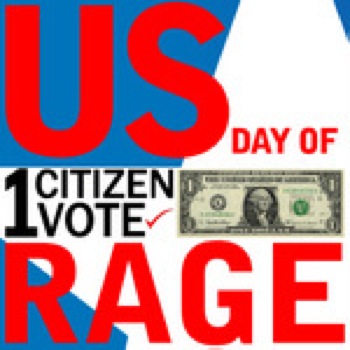
On Sept 17, the US Day of Rage has planned peaceable assemblies for people in New York, Los Angeles, San Francisco, and Seattle. We call on the rest of the nation to join us to Occupy Wall Street

Why?

Wall Street is a huge contributor to the political machine, which in turns enables the corporate plundering of our nation. Both the Democratic and Republican parties set the bankster agenda because of the MONEY they are given. When we at US Day of Rage speak of ‘taking the money out of politics’, we have no choice but to focus on the sources of where the money comes from. Because politicians are bought by bribes, greedy and wasteful interests have usurped our nation’s civil and military power which has spawned a host of threats to the liberty and national security of this country. We demand satisfaction for the wrongs done to our nation and its people.

The Plan

US Day of Rage has a plan that will overcome even the most totalitarian attempts to suppress the First Amendment. We are taking the high ground on the public sidewalks. Citizens have been prevented from exercising their right to peaceable assembly in New York City because the force established to ‘serve and protect’ civil society, the NYPD, has turned into a Counter-Intel paramilitary force.

CIA training has turned their operations into one of the “most aggressive domestic intelligence agencies”. Recently, the New York’s police commissioner confirmed that a CIA officer is even working out of police headquarters. We do not need the NYPD to protect us from the First Amendment. We need First Amendment protection from the NYPD.

The Tactics

1. Find space on a PUBLIC SIDEWALK in NYC on Wall Street (or in your respective city) or as close to Wall Street as possible. If the street is occupied or blocked, move to the next possible block. According to a 2000 federal court ruling, the use of “public sleeping as a means of symbolic expression” is allowed on public sidewalks in New York City as long as you do not block pedestrians. See METROPOLITAN COUNCIL, INC., Plaintiff, -against-HOWARD SAFIR, Commissioner of the New York City Police Department, et al., June 12, 2000 [99 F. Supp. 2d 438; 2000 U.S. Dist.]

2. Camping, however, is prohibited. DO NOT SET UP A TENT.

3. Keep in mind that permits are legally required for assemblies of more than 20 or more people within the confines of NYC public parks, which close at 10pm. YOU DO NOT NEED A PERMIT TO OCCUPY OR PEACEABLY ASSEMBLE ON PUBLIC SIDEWALKS.

4. Once you have found a available space on a public sidewalk, form or join a block assembly. An assembly is a group of two or more people on a public sidewalk in NYC.

5. Establish rules of order and rotating roles for each block’s assembly. Roles like facilitator, secretary, and time-keeper should rotate regularly. See suggested rules of order for assemblies.

6. First order of business, decide on a back up block location should the assembly be illegally disbanded by the NYPD police or other government agents.

7. Once assemblies are formed, we suggest that they establish specific demands for the block occupation by consensus, for instance: ‘One citizen. One dollar. One vote’.

8. Send the block location in the subject line of an email and your groups’ demands to [email protected], or post your location and demands on a block assembly’s twitter profile using twit longer with the hash-tag #usdor, a Facebook Page established for the assembly, or on meetup.com.

9. If your assembly is dispersed or disbanded, reform at the backup location or join another available one.

10. The assemblies are a way to empower ordinary citizens to have their voices heard. US Day of Rage will collate each assemblies’ demands and publish them on our web site to foster wider discussion across the nation.

This Land is OUR Land

New York City is the financial capital of the world. We consider the entire island of Manhattan and even the Citicorp building in Long Island City, Queens to be ‘Wall Street‘. The NYPD may kettle or blockade Wall Street, but they cannot kettle or blockade all of Manhattan.

If they shut us down, we will re-establish our assemblies at the nearest possible block up, down, east, or west. If the NYPD kettle or blockades every public street in Manhattan, Queens, Brooklyn, or the Bronx, they will only reveal what we at US Day of Rage already know: our government is corrupt, and its power is in the hands of treasonous and tyrannical forces. We the people, together, will prevail.

The American Revolution is alive and well: it’s a group of non-violent citizens who believe in the radical notion that Americans have a right to freedom of speech and the right to peaceable assembly, the right to engage in politics through free and fair elections unsullied by disloyal special interests that are destroying our democratic republic and preying upon the resources and spirits of its citizens.

Conclusions

Together we can build assemblies of people along every street of lower Manhattan from Wall Street to Washington Heights; and on every street in every town in every state. US Day of Rage is fighting a war for the soul of our nation and its people. Stand and be counted at 2:00 PM EST on any public sidewalk across America. Post your pictures on Twitter or YouTube with the hashtag #usdor or tag US Day of Rage on Facebook

In a democracy: progressives; unions; conservatives; tea party members; and unaffiliated Americans can govern and work things out with each other. In a kleptocracy, controlled by the banksters, we cannot. We must stop the bankers’ influence, motives, and their tricks from continuing to destroy our republic.

US Day of Rage demands that money be removed from the buying of politicians who feed the Wall Street beast. We demand that the resources of our nation no longer be used to benefit the interests of bankers and their minions. We demand that the US Government diligently reign in the parasitic destruction wreaked by the Wall Street. We demand that our nation no longer be held hostage to ‘too big to fail’ banks. We demand that solutions be found that stop the Federal Reserve from stealing our future.

More on local actions and the main event in NYC go to http://usdayofrage.org/

The above is a press release from US Day of Rage.

 

Posted in Uncategorized | 1 Reply

NYC West Side Curbs Drug Related Crime

MEDIA ROOTS- This is a perfect example of how a NYC community organized to tackle drug related crime by working on preventative methods instead of reactionary ones. The NYC West Side Crime Prevention Program just closed after 30 years of opertion, because members of the community began to take an active role in solving the region’s drug related crime epidemic.

Abby

***

WEST SIDE SPIRIT– It’s not every day that the end of a venerable and productive organization is cause for community celebration, but the closing of the West Side Crime Prevention Program last week, after 30 years in operation, marked a victory for the Upper West Side and its residents.

Formed in 1980 in response to the dangerous conditions on the streets, the program began working with local schools, businesses and NYPD precincts to combat the rampant street crime and drug use—crack cocaine was a major problem at the time—in the area.

“In 1980, the West Side was like a wild west show, and kids were constantly being mugged. It just was not a safe place,” said Mort Berkowitz, president of WSCPP. “A kid leaving school with a nice pair of sneakers, a new jacket, could be set upon.”

“It was truly a golden age of community organizing,” said long-time executive director Majorie Cohen. “It was necessary. Things were bad. The SRO across the street from where I was raising my kids [on West 92nd Street] had four drug-related homicides within six months.”

She and other community members began working with the District Attorney’s office, criminal justice agencies, community boards and the NYPD. They cleaned up a particularly bad block of 107th Street that was notorious for drug dealing by holding outdoor summer camps there with the police. Soon they realized that they could also work to prevent crime, not just clean up after it.

Read the full article about The End of Crime?

© 2011 West Side Spirit

Photo by Flickr user Garagendrachen