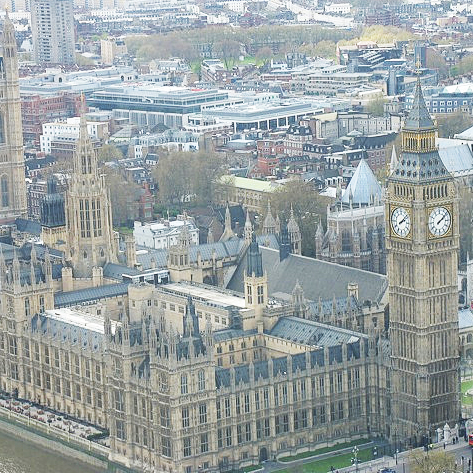
MEDIA ROOTS — A new law proposed in the UK could erode privacy to a level not yet seen in any western country (besides the United States). The law mimics the warrantless wiretapping and ‘sneak and peak’ provisions laid out in the now eleven-year old U.S.A. P.A.T.R.I.O.T. Act.
Robbie Martin of Media Roots
***
ZDNET — Controversial new British legislation could allow the UK’s electronics intelligence agency GCHQ access in real-time data of phone calls, emails, social networks, and Web traffic by all UK residents.
The UK is already the most surveilled country in the world, with number plate recognition systems, ISP deep-packet inspection, and a surveillance camera seemingly on every corner. These proposals would propel the UK into the lacking privacy realms of China, Burma, and Russia. But it already faces the possibility of stiff opposition at a European level unless safeguards are put into place that limits the scope of that monitoring. Though yet to be announced in the Queen’s speech, set for around May, which dictates the UK government’s legislative agenda for the year, it would allow the widespread monitoring of citizens’ activity — despite current UK laws making such actions only available by court-ordered search warrants.
Likened to the U.S.’ Patriot Act, it would grant the UK government access to personal data of ordinary citizens, despite the government’s defence that only certain people will be actively investigated. Data collected would include the time a call, email, or website was visited, the duration of which, and which websites or phone numbers were called. Details of the sender and recipient of emails, such as IP addresses, would also be collected. Everything scrap of data will be stored by ISPs, but not all of this data will be made available to GCHQ without a court order or Home Secretary-sanctioned authority.
MEDIA ROOTS — Abby and Robbie Martin grew up in Pleasanton, CA, a city located ten miles from the Lawrence Livermore National Laboratory (LLNL), a secret nuclear weapons production facility. They initially set out to explore the psychological impacts of taking nuclear testing into virtual space. But as their investigation unfolded, they found that the LLNL—in conjunction with Site 300—has built an impressive greenwashing PR campaign cloaking a sinister reality.
Despite a moratorium on nuclear testing, the nuclear arms race continues unabated at very high costs. In addition to the startling cases of LLNL’s mismanagement of dangerous materials and ‘accidental‘ releases, the facilities are still testing every radioactive component of a nuclear bomb in open air, according to sources.
Malignant melanoma (skin cancer) rates are six times higher among children born in Livermore; melanoma has been linked to radiation exposure. And the amount of radiation which has been expelled from the lab since its
inception is equivalent to that released from the bombing of Hiroshima.
Most disturbingly, the Livermore community is largely unaware of what the lab
is actually doing and what its potential impacts are on its health and the
environment.
Written by Abby Martin
***
The Continuing Nuclear Arms Race & The Lawrence Livermore National Lab:
Mismanagement, Dangers & Effects
Produced/Filmed/Directed/Edited by Abby & Robbie Martin
***
Abby Martin: “The United
States has the biggest weapons arsenal in the world and is the only country who
has ever used nuclear bombs during war.
All of the nuclear weapons stockpile management and nuclear weapon technology
come from two locations in the United States:
Los Alamos Laboratory in New Mexico, which is surrounded by a giant plot
of desert, and Lawrence Livermore Laboratory, a square-mile facility located
right next to a city of 90,000 people.
If a large-scale disaster or nuclear accident happened here, it would
affect the entire Bay Area—comprised of San Francisco/Oakland—with seven
million people living in it. This blue
well behind me is used to measure radioactive runoff from the Lawrence
Livermore Lab.”
Abby Martin Narration (c. 0:36): “The United
States used to blow up full-scale nuclear weapons in open air until the 1963 Limited Test Ban Treaty, which permitted the continuation
of nuclear testing underground. In 1992,
Congress passed the Nuclear Testing Moratorium Act, which banned all nuclear
testing. However, the treaty is not yet
ratified. And the U.S. still has over
5,000 nuclear weapons, 2,000 of which are on readiness alert at all times. To compensate for the loss of full-scale
underground nuclear testing, the Department of Energy created the Stockpile
Stewardship Program, which built new facilities that test different components
of a nuclear weapons explosion, using super computers to put them all together.
“Most of
the PR surrounding the Lawrence Livermore Lab gives the impression that it’s a
technology innovator, working to harvest
the energy of the sun to create clean
energy for the world. As it turns out, out
of the Lawrence Livermore Lab’s $1.5 billion dollar annual budget, less than 1%
is alternative energy; the rest is defence and nuclear weapons development.
“Another,
more elusive, site buried in the hills behind the Lawrence Livermore Lab is called
Site 300, a live-fire explosives test range where they blow up highly
radioactive compounds used to simulate many of the nuclear systems designed at
the lab. Site 300 is mountainous with
many watersheds and canyons making contamination easy to spread and clean-up
extremely difficult. At Site 300, we
found that they are testing depleted uranium and tritium, the radioactive
hydrogen in the hydrogen bomb, in open air tests. Site 300 happens to be located in a very
high-velocity wind area.
“We took a
closer look at Lawrence Livermore Lab and Site 300 and found out if the
Livermore community is aware of its impact on their health and the environment
and the potential danger it poses to the entire San Francisco Bay Area.”
Abby Martin (c. 2:25): “Do you know about the Lawrence Livermore
Lab?”
Livermore Man:
“Yes.”
Livermore Woman: “I mean it’s common knowledge to grow up in Livermore—”
Livermore Man B: “Oh, here we go.”
Abby Martin:
“What?”
Livermore Woman B: “I’m aware of it, yeah.”
Abby Martin:
“What is it
that you think they do there?”
Livermore Woman C: “At the Lab? Oh, it’s a
government [Shrugs], testing on all kinds
of different things?”
Livermore Man B: “I’m not really educated to what exactly, what they do. You gonna tell me?”
Livermore Woman C: “I know they do a lot of research and they have, like, the top
scientists from all over the world that work there.”
Livermore Woman B: “They used to do, like, nuclear devices.
But to my knowledge they don’t really do that anymore.”
Livermore Man C: “Well, what I think they do there is research and development.”
Abby Martin:
“What do you
think it is they do there?”
Livermore Man:
“I worked
there for nearly 30 years.”
Abby Martin:
“So, what
did you do there?
Livermore Woman B: “I don’t know. My dad works in a
machine shop there. [Laughs] I don’t know what he does, though. [Laughs]”
Marylia Kelley (Tri-Valley CAREs): “In many ways, Livermore is a community that’s in denial. It is also a community that I would call
disempowered because you have a super-secret nuclear weapons laboratory and a
community around it that’s supposed to not
ask questions.”
Abby Martin Narration (c. 3:39): “We went to the lab in Site 300 to try to
find out more.”
Site 300 Armed Military Gatekeeper: “Can you just turn that off please? [Leaving
Gate Booth]”
Abby Martin:
“Isn’t this publicly-funded
property?”
Site 300 Armed Military Gatekeeper: “The Federal, um, could you turn it off just to make? I gotta make, I gotta call my captain.”
Site 300 Armed Military Captain: “Um, could you go ahead and turn the camera off?” [Camera Cuts Out]”
Abby Martin:
“I don’t know;
I’ve read somewhere that they were testing depleted uranium. I was, like, that can’t be true. [Inside a Reception Area]”
Receptionist Woman: “No, nothing nuclear.”
Scott Yundt (Tri-Valley CAREs): “What we’ve been able to place together from FOIA requests and from public documents is that they’ve released over a million curies of radiation from the lab
since 1953 when they opened. That’s
about the same amount of radiation that was released in the bombing of Hiroshima.”
“The study
also found that, for one decade, there was a threefold increase in brain
cancer in Livermore children.”
Abby Martin (c. 4:47): “Do you think that there’s any sort of
impacts on the environment or to the health of the community with the testing
that they’re doing there? [Outside in
Downtown Livermore]”
Livermore Man:
“Probably
very little over what most all of us do everyday. [Shrugs]”
Livermore Woman B: “None that haven’t been around since I was a kid. [Shrugs] So, I don’t know. [Laughs]
I mean I survived. [Young Woman
Laughs and Shrugs]”
Livermore Woman C: “Yeah, ‘cos they’ve had some problems with the, you know, ground w-,
releases of some of the poisons and—”
Livermore Man D: “I know that there was plutonium
in a park near my house when I was growing up.”
Abby Martin Narration (c. 5:16): “During the ‘70s and ‘80s, the Lawrence
Livermore Lab was flushing radioactive materials, including plutonium down the
drain. And it was recycled by the City
of Livermore’s sanitation department as compost. The City then gave away the toxic compost as
landscaping.
“Local residents
around the lab have even coined a neighbourhood park, plutonium park, which is located adjacent to a school.
Marylia Kelley (Tri-Valley CAREs): “They kept a log book, you know, a guest register. So, people signed it, but one day the lab
showed up and took it with them. And it’s
never been seen again. So, there’s no
way to track who has this plutonium-contaminated sludge or if the particular bit of
sludge they took home has plutonium contamination in it or not.
“And, in
the midst of all this, Livermore Lab went and got some of this sludge because
they were interested in looking at the uptake of plants after a nuclear war.”
Livermore Man D: “Obviously, most cities don’t dump plutonium into their sewage treatment
plants. So, that’s a unique experience
to our area.”
Abby Martin Narration (c. 6:26): “One of the most impressive PR campaigns
coming from the lab is the National
Ignition Facility (or the NIF).”
Scott Yundt (Tri-Valley CAREs): “It’s a mega-laser that they love to talk about how it’s gonna save the
world through creating nuclear fusion energy.
Most of what the National Ignition Facility is for is ‘stockpile management.’ And it’s really a way for them to test
nuclear weapon components because it creates an environment—in that chamber—that is similar to the environment created by a nuclear weapons explosion.”
Abby Martin Narration (c. 7:01): “Just like many war technologies that the
U.S. government rebrands as peace through force, the ‘Stockpile Stewardship’ program is nothing more than a cloak on the
continued and unabated nuclear arms race.”
Scott Yundt (Tri-Valley CAREs): “We have a nuclear-weapons-complex that is still stuck in the Cold War era.”
Marylia Kelley (Tri-Valley CAREs): “80% of the American population tell pollsters that they would feel
safer if no county, including the United States, had nuclear weapons.”
Abby Martin Narration: “Despite the moratorium, we continue to find a way to test nuclear
weapons. But by testing each component
of a nuclear bomb separately with Site 300, the NIF, and super computers, they’re
able to pacify the public. However, in
the back of our minds, we all know that at any moment—by mistake, by
miscalculation, or by madness—life, as we know it, could end on this planet.
“How is the
looming threat of nuclear annihalation affecting our daily lives?”
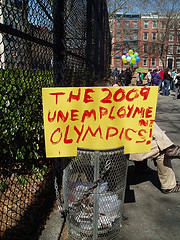
MEDIA ROOTS —Although the corporate media touts an improving economy, U.S. citizens continue to suffer cruel economic punishment and austerity. Millions of citizens still search for employment, and the typical income of a U.S. household is less now than it was in 1997. Why is the economy not improving? Wall Street makes an easy target for the ire of struggling workers, but is there a deeper, more complex reason why the economy creaks, tumbles and rolls like an outdated galleon laboring in rough seas?
Economist Joseph Stiglitz offers in-depth analysis of the weakening foundation of the U.S. economy. In the years leading up to 2008, U.S.A. lived in an easy-credit, fast-money mania, fueled by wildly inflated home values, corrupt appraisers, and financial gimmicks. However, the integrity of the economy was compromised even before the meltdown, explains Stiglitz. Our collective economic livelihood had been dealt a slow acting, poisonous blow long ago, as other observers such as Catherine Austin Fitts and Dr. Michael Hudson have described.
Stiglitz draws insight comparing today with the tumultuous Great Depression, which had been well underway for years before the banking sector crashed. What brought about the economic paralysis? The primary cause was a quiet, but massive, transition away from an agriculture-based economy. As food production modernized and became more efficient, less farmers were required to grow the food necessary to feed the U.S. Suddenly, a vast portion of the U.S. workforce became obsolete through automation.
Stiglitz argues broad changes must be made in tandem with large, concentrated investment. As once industrious manufacturing regions of U.S.A. wither and rust, elected officials neglect investment in education, research, and infrastructure, favoring austerity cuts. Yet, these three areas provide opportunities for healthy economic growth and future employment, as the nation struggles to adapt to the 21st century. Addressing these needs, perhaps, U.S.A. can fulfill its promise of greatness and prosperity.
MR
***
VANITY FAIR —Even when we fully repair the banking system, we’ll still be in deep
trouble—because we were already in deep trouble. That seeming golden age
of 2007 was far from a paradise. Yes, America had many things about
which it could be proud. Companies in the information-technology field
were at the leading edge of a revolution. But incomes for most working
Americans still hadn’t returned to their levels prior to the previous
recession. The American standard of living was sustained only by rising
debt—debt so large that the U.S. savings rate had dropped to near zero.
And “zero” doesn’t really tell the story. Because the rich have always
been able to save a significant percentage of their income, putting them
in the positive column, an average rate of close to zero means that
everyone else must be in negative numbers. (Here’s the reality: in the
years leading up to the recession, according to research done by my
Columbia University colleague Bruce Greenwald, the bottom 80 percent of
the American population had been spending around 110 percent of its
income.) What made this level of indebtedness possible was the housing
bubble, which Alan Greenspan and then Ben Bernanke, chairmen of the
Federal Reserve Board, helped to engineer through low interest rates and
nonregulation—not even using the regulatory tools they had. As we now
know, this enabled banks to lend and households to borrow on the basis
of assets whose value was determined in part by mass delusion.
The
fact is the economy in the years before the current crisis was
fundamentally weak, with the bubble, and the unsustainable consumption
to which it gave rise, acting as life support. Without these,
unemployment would have been high. It was absurd to think that fixing
the banking system could by itself restore the economy to health.
Bringing the economy back to “where it was” does nothing to address the
underlying problems.
The trauma we’re experiencing right now
resembles the trauma we experienced 80 years ago, during the Great
Depression, and it has been brought on by an analogous set of
circumstances. Then, as now, we faced a breakdown of the banking system.
But then, as now, the breakdown of the banking system was in part a
consequence of deeper problems. Even if we correctly respond to the
trauma—the failures of the financial sector—it will take a decade or
more to achieve full recovery. Under the best of conditions, we will
endure a Long Slump. If we respond incorrectly, as we have been, the
Long Slump will last even longer, and the parallel with the Depression
will take on a tragic new dimension.
Until now, the Depression
was the last time in American history that unemployment exceeded 8
percent four years after the onset of recession. And never in the last
60 years has economic output been barely greater, four years after a
recession, than it was before the recession started. The percentage of
the civilian population at work has fallen by twice as much as in any
post-World War II downturn. Not surprisingly, economists have begun to
reflect on the similarities and differences between our Long Slump and
the Great Depression. Extracting the right lessons is not easy.
MEDIA ROOTS — The
number of deeply impoverished Americans has exploded since Obama took office,
according to Panorama, BBC’s weekly
investigative news program. In fact, the U.S. is more unequal now than any other time since the
Great Depression. Three million are newly unemployed while one-fifth of the
wealth is earned by just one percent of the population. Additionally, nearly
50 million are now uninsured, up from 46 million in 2008.
BBC Host Hillary Anderson takes viewers inside the storm
drains of Las Vegas to meet some of the hundreds of formerly middle-class
Americans now living below one of the richest cities on Earth. She continues to interview a few of the 1.5 million homeless children in the U.S., where one child tragically explains
how her family once had to eat rats because no other food was available. Anderson also
stops by Tent City outside of Detroit to meet those who have been surviving
the harsh elements for over a year after losing their homes.
The once idealized American Dream is now an out of reach distant memory. Social mobility in the U.S. may be the lowest it’s ever been—half the poor, about five million families of four, now earn less than $11,000
a year. Yet, in one of the world’s richest lands it’s even more difficult for those that are impoverished to fully admit their situation.
MEDIA ROOTS — Residents
in the Carroll Boone Water District (CBWD) of Arkansas might soon have fluoride
removed from their water supply. According to Rene Fonseca, a licensed operator
with CBWD, the corrosive additive has been proven to leach lead from aging
distribution pipes which is likely causing increased lead contamination in the
region’s water supply.
Several other areas in the state of Arkansas have also
opposed adding fluoride to their water. Lobbyists from the fluoridation industry claim that CBWB taxpayers would not be strapped with
the $1.23 million cost to install fluoridation equipment. But the
Mockingbird Hill Water Association in Boone County unanimously opposed
adding fluoride to its water supply, stating that they don’t want to
take any chances amidst the current economic hardship.
Last year, in the Southern District Court of California, a
lawsuit was filed asserting the U.S. people have the right to neither ingest nor be exposed to a drug
that has never been tested or approved by the Food and Drug Administration. While the Surgeon General claims that the additive helps reduce
tooth decay, only the FDA is chartered by Congress
with the authority to approve claims of safety for products intended to treat
and prevent disease.
MR
***
Carroll County News — Eureka Springs has twice voted against fluoridation. Opponents of fluoridation
say many other cities across the country have stopped fluoridating waters after
studies have linked it to hypothyroidism, heart disease, learning problems in
children and possibly cancer.
There are also concerns the
fluoride products added to the water could be contaminated with toxic
chemicals. The CBWD, which serves a population of about 25,000, contacted 49
suppliers of fluoride asking for proper American National Standards Institute (ANSI)
and NFS60 certification that would list all contaminants by weight, and include
information about toxicological studies pertaining to those contaminants.
“These are extremely
dangerous substances,” Fonseca said. “The acute lethal toxicity of
sodium fluorosilicate for an adult man is 6.2 grams, which is about the weight
of an average driver’s license. At a water plant the size of CBWD, you would be
dumping 150 pounds a day into the water — enough oral doses to poison 9,600
men a day or 297,000 men a month. This is not pharmaceutical grade fluoride, as
you would receive in the dental office.



 MEDIA ROOTS — A new law proposed in the UK could erode privacy to a level not yet seen in any western country (besides the United States). The law mimics the warrantless wiretapping and ‘sneak and peak’ provisions laid out in the now eleven-year old U.S.A. P.A.T.R.I.O.T. Act.
  MEDIA ROOTS — Abby and Robbie Martin grew up in
  MEDIA ROOTS — Although the corporate media touts an improving economy, U.S. citizens continue to suffer cruel economic punishment and austerity. Millions of citizens still search for employment, and the typical income of a U.S. household is less now than it was in 1997. Why is the economy not improving? Wall Street makes an easy target for the ire of struggling workers, but is there a deeper, more complex reason why the economy creaks, tumbles and rolls like an outdated galleon laboring in rough seas?
.jpg) MEDIA ROOTS — The
number of deeply impoverished Americans has exploded since Obama took office,
according to Panorama, BBC’s weekly
investigative news program. In fact, the U.S. is
MEDIA ROOTS — The
number of deeply impoverished Americans has exploded since Obama took office,
according to Panorama, BBC’s weekly
investigative news program. In fact, the U.S. is  MEDIA ROOTS — Residents
in the Carroll Boone Water District (CBWD) of Arkansas might soon have fluoride
removed from their water supply. According to Rene Fonseca, a licensed operator
with CBWD, the corrosive additive has been proven to leach lead from aging
distribution pipes which is likely causing increased lead contamination in the
region’s water supply.
MEDIA ROOTS — Residents
in the Carroll Boone Water District (CBWD) of Arkansas might soon have fluoride
removed from their water supply. According to Rene Fonseca, a licensed operator
with CBWD, the corrosive additive has been proven to leach lead from aging
distribution pipes which is likely causing increased lead contamination in the
region’s water supply.