Khalid Sheikh Mohammed Waterboarded 183 times in One Month

TIMES ONLINE– CIA interrogators used the controverisal waterboarding technique 183 times on Khalid Sheikh Mohammed, the mastermind behind the September 11, 2001, attacks and 83 times on another al-Qaeda suspect, according to The New York Times.

A 2005 Justice Department memorandum revealed that the simulated drowning technique was used on Mohammed 183 times in March 2003.

Abu Zubaydah, the first prisoner questioned in the CIA’s overseas detention programme in August 2002, was waterboarded 83 times, although a former CIA officer had told news organisations that he had been subjected to only 35 seconds under water before agreeing to tell everything he knew.

President Barack Obama has banned the use of waterboarding, overturning a Bush Administration policy that it did not constitute torture.

The memo is one of four authorising “harsh interrogation” that were declassified by the Obama Administration last week. They show that the CIA based more than 3,000 intelligence reports on the questioning of “high-value” terror suspects from September 11, 2001, to April 2003.

According to The New York Times, some copies of the memo on Mohammed appeared to have the number of waterboardings used on him redacted while others did not.

A footnote to another 2005 Justice Department memo said that waterboarding was used both more frequently and with a greater volume of water than the CIA rules permitted, the newspaper claimed, while a separate footnote said that the use of the harshest techniques appeared to have been “unnecessary” in Abu Zubaydah’s case.

Read full article about Khalid Sheikh Mohammed Waterboarded 183 times in One Month.

© 2009 TIMES ONLINE

Posted in Uncategorized | 1 Reply

Senate Report Ties Rumsfeld to Abu Ghraib Torture

TRUTHOUT– Former Defense Secretary Donald Rumsfeld and other senior U.S. officials share much of the blame for detainee abuse at Abu Ghraib prison in Iraq, and Guantanamo Bay, Cuba, according to portions of a report released on Thursday by the Senate Armed Services Committee.

The report’s executive summary, made public by the committee’s Democratic chairman Sen. Carl Levin of Michigan and its top Republican Sen. John McCain of Arizona, said Rumsfeld contributed to the abuse by authorizing aggressive interrogation techniques at Guantanamo Bay on December 2, 2002.

He rescinded the authorization six weeks later. But the report said word of his approval continued to spread within U.S. military circles and encouraged the use of harsh techniques as far away as Iraq and Afghanistan.

The report concluded that Rumsfeld’s actions were “a direct cause of detainee abuse” at Guantanamo and “influenced and contributed to the use of abusive techniques … in Afghanistan and Iraq.”

“The abuse of detainees at Abu Ghraib in late 2003 was not simply the result of a few soldiers acting on their own,” the executive summary said.

“Interrogation techniques such as stripping detainees of their clothes, placing them in stress positions and using military working dogs to intimidate them appeared in Iraq only after they had been approved for use in Afghanistan and at (Guantanamo).”

The detainee scandal at Abu Ghraib and later revelations of aggressive U.S. interrogations such as “waterboarding” led to an international outcry and charges that the United States allowed prisoners to be tortured, a claim denied by the Bush administration.

The Bush administration has since recanted the policies under pressure from Congress, while President-elect Barack Obama has vowed to close the U.S. military prison at Guantanamo Bay.

The report found that the military derived the techniques from a Survival Evasion Resistance and Escape program, or SERE, which trains U.S. soldiers to resist enemy interrogation that does not conform to the Geneva Conventions or international law.

“These policies are wrong and must never be repeated,” McCain, who last month ended an unsuccessful bid for the White House, said in a statement released with the executive summary.

McCain said the report revealed an “inexcusable link between abusive interrogation techniques used by our enemies who ignored the Geneva Conventions and interrogation policy for detainees in U.S. custody.”

Written by David Morgan

Photo by flickr user Expert Infantry

© REUTERS, 2008

Top Bush Advisers Approved Enhanced Interrogation Techniques

ABC NEWS– In dozens of top-secret talks and meetings in the White House, the most senior Bush administration officials discussed and approved specific details of how high-value al Qaeda suspects would be interrogated by the Central Intelligence Agency, sources tell ABC News.

The so-called Principals who participated in the meetings also approved the use of “combined” interrogation techniques — using different techniques during interrogations, instead of using one method at a time — on terrorist suspects who proved difficult to break, sources said.

Highly placed sources said a handful of top advisers signed off on how the CIA would interrogate top al Qaeda suspects — whether they would be slapped, pushed, deprived of sleep or subjected to simulated drowning, called waterboarding.

The high-level discussions about these “enhanced interrogation techniques” were so detailed, these sources said, some of the interrogation sessions were almost choreographed — down to the number of times CIA agents could use a specific tactic.

The advisers were members of the National Security Council’s Principals Committee, a select group of senior officials who met frequently to advise President Bush on issues of national security policy.

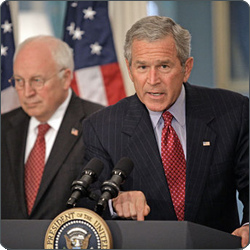
At the time, the Principals Committee included Vice President Cheney, former National Security Advisor Condoleezza Rice, Defense Secretary Donald Rumsfeld and Secretary of State Colin Powell, as well as CIA Director George Tenet and Attorney General John Ashcroft.

As the national security adviser, Rice chaired the meetings, which took place in the White House Situation Room and were typically attended by most of the principals or their deputies.

Contacted by ABC News today, spokesmen for Tenet, Rumsfeld and Powell declined to comment about the interrogation program or their private discussions in Principals Meetings. Powell said through an assistant there were “hundreds of [Principals] meetings” on a wide variety of topics and that he was “not at liberty to discuss private meetings.”

The White House also declined comment on behalf of Rice and Cheney. Ashcroft could not be reached for comment today. 

Critics at home and abroad have harshly criticized the interrogation program, which pushed the limits of international law and, they say, condoned torture. Bush and his top aides have consistently defended the program. They say it is legal and did not constitute torture.

Continue reading about Top Bush Advisors Approving Enhanced Interrogation Techniques.

Photo by flickr user Blatant News

© ABC, 2008

Bush-era Interrogations: From Waterboarding to Forced Nudity

MCCLATCHY– The long-awaited release Thursday of four Bush-era memos lays out in clinical detail many of the controversial interrogation methods secretly authorized by the Bush administration — from waterboarding to trapping prisoners in boxes with insects — while former President George W. Bush was publicly condemning the use of torture.

The memos were made public by the Justice Department with assurances from President Barack Obama that the intelligence officials who followed their guidance won’t be prosecuted. However, the president’s assurances don’t apply to the former administration officials who crafted the legal justification for the interrogation program.

The newly released memos offer the public the most unvarnished and explicit look yet at once-top secret efforts to psychologically break high-level terrorism suspects.

Despite the graphic description of the techniques, the memos at the time concluded that the tactics didn’t constitute “cruel, inhuman or degrading treatment,” even as Congress was moving to ban such treatment.

The memos reveal that by May 2005 various “enhanced” techniques were used on 28 detainees. Three high-level al Qaida operatives — Khalid Sheik Mohammed, Abu Zubaydah and Abd al Rahim al Nashiri — were subject to waterboarding, a procedure that simulates drowning and is widely regarded as torture. 

Obama said Thursday that the U.S. won’t prosecute CIA officials who used the techniques and ordered the memos rescinded. The CIA interrogators, some of whom were contractors, weren’t identified in the partially censored documents.

Continue reading about Bush Era Interrogations From Waterboarding to Forced Nudity.

© MCCLATCHY, 2009

Court Says US Asked Detainee to Drop Torture Claim

TRUTHOUT– US authorities asked a Guantanamo Bay detainee to drop allegations of torture and agree not to speak publicly about his ordeal in exchange for his freedom, according to British court documents.

A ruling by two British High Court judges, issued in October but released only on Monday, said the U.S. offered former detainee Binyam Mohamed a plea bargain last year – six years after he was first detained as an enemy combatant.

It was the first time details of the plea bargain offer were made public. The ruling said U.S. military prosecutors also asked that Mohamed plead guilty to two charges, accept a three-year sentence and agree to testify against other suspected terrorists.

Mohamed, an Ethiopian who moved to Britain as a teenager, was arrested in Pakistan in 2002. He claims he was tortured both there and in Morocco, before he was transferred to Guantanamo in 2004.

He was freed in February after months of negotiation between the U.S. and Britain. All charges against him were dropped last year. Mohamed refused to agree to any deal that prevented him from discussing his treatment, Lord Justice John Thomas and Mr. Justice David Lloyd Jones said in the ruling.

“He wanted it to be made clear to the world what had happened and how he has been treated by the United States government since April 2002,” Thomas said in the ruling.

The British judges had ordered that their written ruling be withheld from the public until after Mohamed was released. The judges considered the plea bargain issue during an appeal to the High Court by Mohamed’s lawyers demanding the British government release documents they claim would prove he was tortured.

Issuing a judgment on the case in February, Thomas said there was evidence to show Mohamed was tortured, but that the documents could not be made public because of the British government’s national security concerns.

He said Britain’s government had said releasing the documents could undermine intelligence-sharing with the United States. Mohamed claims British intelligence officers supplied questions to his interrogators and were complicit in his torture – a claim Prime Minister Gordon Brown has rejected.

In investigating Mohamed’s claims, the British court reviewed the draft plea bargain and correspondence between military prosecutors and Mohamed’s lawyers. The ruling quoted testimony from Mohamed’s lawyer about the offer.

“Mr. Mohamed must sign a statement saying he has not been tortured, which would be false. And he must agree not to make any public statement about what he has been through,” Clive Stafford Smith told the court in October, according to the ruling.

The ruling also quotes then-U.S. military prosecutor Lt. Col. Darrel Vandeveld as saying Mohamed would be given a date for his release if he agreed to the terms.

Vandeveld – who has since quit his post – had said Mohamed would need to plead guilty to two charges in exchange for a three-year sentence and to testify against other suspects, according to the court documents.

The ruling discloses that, had Mohamed agreed to the plea bargain, the British government told the U.S. it would not allow him to serve the three-year sentence in a UK jail.

Since February, Mohamed has given interviews to the BBC and a British newspaper.

Written by David Stringer / All republished content that appears on Truthout has been obtained by permission or license.

© AP, 2009