 COMMONDREAMS – In response to the mass protests of recent days, Egyptian President
Hosni Mubarak has appointed his first Vice President in his over 30
years rule, intelligence chief Omar Suleiman. When Suleiman was first
announced, Aljazeera commentators were describing him as a
“distinguished” and “respected ” man. It turns out, however, that he is
distinguished for, among other things, his central role in Egyptian
torture and in the US rendition to torture program. Further, he is
“respected” by US officials for his cooperation with their torture
plans, among other initiatives.
COMMONDREAMS – In response to the mass protests of recent days, Egyptian President
Hosni Mubarak has appointed his first Vice President in his over 30
years rule, intelligence chief Omar Suleiman. When Suleiman was first
announced, Aljazeera commentators were describing him as a
“distinguished” and “respected ” man. It turns out, however, that he is
distinguished for, among other things, his central role in Egyptian
torture and in the US rendition to torture program. Further, he is
“respected” by US officials for his cooperation with their torture
plans, among other initiatives.
Katherine Hawkins, an expert
on the US’s rendition to torture program, in an email, has sent some
critical texts where Suleiman pops up. Thus, Jane Mayer, in The Dark Side, pointed to Suleiman’s role in the rendition program:
Each
rendition was authorized at the very top levels of both
governments….The long-serving chief of the Egyptian central
intelligence agency, Omar Suleiman, negotiated directly with top
Agency officials. [Former U.S. Ambassador to Egypt] Walker described
the Egyptian counterpart, Suleiman, as “very bright, very realistic,”
adding that he was cognizant that there was a downside to “some of the
negative things that the Egyptians engaged in, of torture and so on. But
he was not squeamish, by the way” (pp. 113).
Stephen Grey, in Ghost Plane, his investigative work on the rendition program also points to Suleiman as central in the rendition program:
To
negotiate these assurances [that the Egyptians wouldn’t “torture” the
prisoner delivered for torture] the CIA dealt principally in Egypt
through Omar Suleiman, the chief of the Egyptian general intelligence
service (EGIS) since 1993. It was he who arranged the meetings with the
Egyptian interior ministry…. Suleiman, who understood English well,
was an urbane and sophisticated man. Others told me that for years
Suleiman was America’s chief interlocutor with the Egyptian regime —
the main channel to President Hosni Mubarak himself, even on matters far
removed from intelligence and security.
Suleiman’s role, was also highlighted in a Wikileaks cable:
In
the context of the close and sustained cooperation between the USG and
GOE on counterterrorism, Post believes that the written GOE assurances
regarding the return of three Egyptians detained at Guantanamo (reftel)
represent the firm commitment of the GOE to adhere to the requested
principles. These assurances were passed directly from Egyptian General
Intelligence Service (EGIS) Chief Soliman through liaison channels —
the most effective communication path on this issue. General Soliman’s
word is the GOE’s guarantee, and the GOE’s track record of cooperation
on CT issues lends further support to this assessment. End summary.
However,
Suleiman wasn’t just the go-to bureaucrat for when the Americans wanted
to arrange a little torture. This “urbane and sophisticated man”
apparently enjoyed a little rough stuff himself.
Shortly after
9/11, Australian citizen Mamdouh Habib was captured by Pakistani
security forces and, under US pressure, torture by Pakistanis. He was
then rendered (with an Australian diplomats watching) by CIA operatives
to Egypt, a not uncommon practice. In Egypt, Habib merited Suleiman’s
personal attention. As related by Richard Neville, based on Habib’s memoir:
Habib
was interrogated by the country’s Intelligence Director, General Omar
Suleiman…. Suleiman took a personal interest in anyone suspected of
links with Al Qaeda. As Habib had visited Afghanistan shortly before
9/11, he was under suspicion. Habib was repeatedly zapped with
high-voltage electricity, immersed in water up to his nostrils, beaten,
his fingers were broken and he was hung from metal hooks.
That treatment wasn’t enough for Suleiman, so:
To
loosen Habib’s tongue, Suleiman ordered a guard to murder a gruesomely
shackled Turkistan prisoner in front of Habib – and he did, with a
vicious karate kick.
After Suleiman’s men extracted Habib’s
confession, he was transferred back to US custody, where he eventually
was imprisoned at Guantanamo. His “confession” was then used as evidence
in his Guantanamo trial.
Click to continue reading the full article on Egypt’s new VP, Omar Suleiman.



 SALON.COM– Violence escalates in Libya. Unconfirmed reports say Gadhafi has fled as protesters march on compound.
 COMMONDREAMS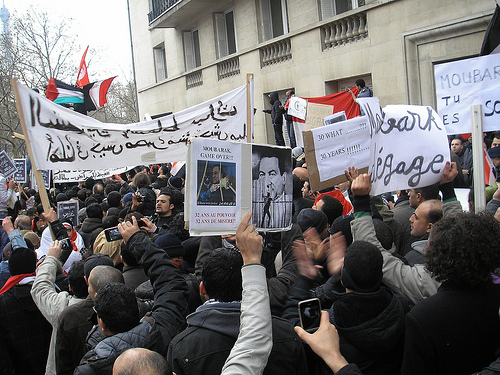
 BBC
BBC