
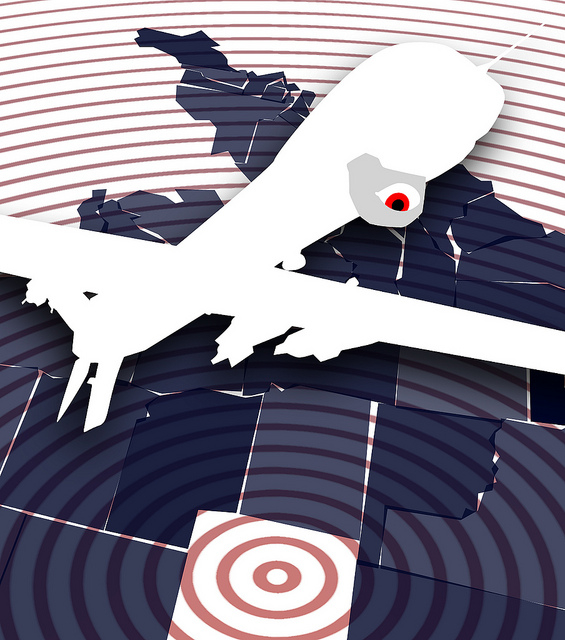
How Non-Violent Activists Can Land on the Drone King’s Kill List

obama droneSince 2008, the year of the worst financial crisis since the Great Depression of the 1930s, the U.S. Department of Defense has funded a multimillion dollar university research program to probe the complex dynamics of mass social and political movements, anticipate global trends, and ultimately augment the intelligence community’s preparations for civil unrest and insurgencies both abroad and at home.

Part of that has involved developing advanced new data mining and analysis tools for the U.S. military intelligence community to pinpoint imminent and potential threats from individuals and groups.

Among its many areas of focus are ongoing projects at Arizona State University (ASU) designed to enhance and automate the algorithms used by intelligence agencies like the NSA to analyze “open source” information from social media in order to track the potential threat-level to U.S. interests. Formal organizations and broad social networks as well as individuals could be identified and closely monitored with such tools to an unprecedented degree of precision.

Loosely defined concepts of political “radicalism,” violence and nonviolence, as well as questionable research methodologies, open the way for widespread suspicion of even peaceful activist groups and their members, and the equation of them with potential terrorists. Civil society organizations in the U.K., including both Muslim religious groups and non-religious anti-war networks, have been prioritized for study to test and improve the effectiveness of these data-mining tools.

Increasingly, though, the automation of threat-detection and terrorism-classification has been accompanied by the automation of killing, in the form of the generation of “kill lists” of terrorism suspects to be targeted via extrajudicial assassination by drone strikes. As President Obama, encouraged by powerful lobbies in the defense industries, has paved the way for the systematic integration of drones into domestic law-enforcement and homeland security operations, the prospect of extrajudicial assassinations occurring on U.S. soil are no longer merely hypothetical.

Now, new but little-known Pentagon directives authorize the use of armed drones against American citizens in the homeland in the context of domestic emergencies.

**

Flawed DoD Algorithms Determine Extrajudicial Assassinations

**

Algorithms of Death

“The algorithms being developed at ASU remind me of the algorithms used as the basis for signature strikes with drones,” said Thomas Drake, a former senior National Security Agency executive who leaked information about the NSA’s data-mining project Trailblazer to the press in 2006.

Drake agreed that the algorithms linked to “LookingGlass,” a new Pentagon-sponsored visual intelligence platform, could in fact be applied to fine-tuning the generation of the CIA’s notorious “kill lists.”

“Having the U.S. government and Department of Defense fund this kind of research at the university level will bias the results by default. This is a fall-out of big data research of this type, using algorithms to detect patterns when the patterns themselves are an effect – and mixing up correlation with causality. Under this flawed approach, many false positives are possible and these results can create an ends of profiling justifying the means of data-mining.”

It is now increasingly recognized that U.S. drone strikes against foreign terrorism targets have systematically killed large numbers of civilians, with a 2012 joint Stanford and New York University report suggesting that as few as 2% of casualties are “high-level” targets – an analysis cohering with counterinsurgency expert David Kilcullen’s 2009 estimate showing a “kill ratio” of 50 civilians to one militant, or, in other words, 98% civilian casualties.

“My colleagues in Special Forces tell me that the men on the front line are furious with the lack of accuracy and integrity at the national level, and no longer trust the targeting data,” said former veteran CIA case officer Robert Steele, who previously served as a Marine Corps infantry officer.

“They have seen for themselves how wrong the system is when they look their man in the eyes. Technical surveillance is the most expensive, least useful, and least accurate form of surveillance. Technology is not a substitute for thinking. We must become deeply and broadly expert at the human factor.”

Drones Come Home

U.S. administration officials including Obama himself have repeatedly refused to confirm whether the alleged legal power to conduct extrajudicial assassinations via drone strikes extends to the U.S. homeland. Last year, prior to becoming CIA director, John Brennan told the Senate Intelligence Committee: “…we do not view our authority to use military force against al-Qaeda and associated forces as being limited to ‘hot’ battlefields like Afghanistan.” He referred to Attorney General Eric Holder’s statement that “neither Congress nor our federal courts has limited the geographic scope of our ability to use force to the current conflict in Afghanistan.”

In February 2012, Obama signed in a law directing the Federal Aviation Administration (FAA) to throw American airspace wide open to drones by as early as September 2015. U.S. Customs and Border Protection (CBP) already deploys Predator drones to spot smugglers and illegal immigrants crossing into U.S. territory, and two dozen U.S. police departments have successfully applied for FAA permits for drones. As National Geographic observes, “all 18,000 law enforcement agencies in the U.S. are potential customers.” By 2020, it is estimated that some 30,000 drones would be active across the U.S. homeland.

Documents obtained under Freedom of Information by the Electronic Frontier Foundation (EFF) show that police plan to use drones essentially for surveillance. In Seattle and Miami, drones are already being used during criminal investigations and in “hot pursuit” of suspects, and could be used during natural disasters along with “specific situations with the direct authorization of the Assistant Chief of the Homeland Security Bureau.” Hundreds of “domestic drone missions” have been flown by CBP on behalf of other state and local agencies.

Last year, government documents revealed that Department of Homeland Security had customized its Predator B drones, built originally for foreign military operations, for domestic surveillance tasks and to “respond to emergency missions across the country,” including “identifying civilians carrying guns and tracking their cell phones.”

These drones are now being used on U.S. soil by the FBI, Secret Service, Texas Rangers and some local police forces. The DHS had also proposed to arm its domestic fleet of border patrol drones with “non-lethal weapons designed to immobilize TOIs [targets of interest]” – an option also being pursued by local police agencies that want to arm drones with rubber bullets, tear gas and other riot control weapons.

According to an unclassified U.S. Air Force document, the deployment of military drones in U.S. airspace will be controlled by the Pentagon and will be able to monitor unidentified groups, as well as “specifically identified” individuals with the Secretary of Defense’s approval. Military drones “are allowed to fly drones in public areas and record information on domestic situations,” noted Jennifer Lynch of the Electronic Frontier Foundation.

Executive Decisions

In February 2013, an extraordinary Pentagon directive authorized the deployment of U.S. military resources and personnel to respond to domestic emergencies, quell civil unrest and support civilian law enforcement in a domestic terrorism incident. The new directive builds on an earlier 2010/2012 DoD directive specifically authorizing the use of military surveillance drones on U.S. soil under Pentagon authority.

Although that directive prohibited the use of “armed” drones for “DSCA [Domestic Support to Civil Authorities] operations,” the new 2013 directive for Domestic Support to Civil Law-Enforcement Agencies goes further. It broadly asserts that “the Secretary of Defense may authorize the use of DoD personnel in support of civilian law enforcement officials during a domestic terrorism incident.”

Unlike the older directive, it stipulates that U.S. military commanders, including those at USNORTHCOM, USPACOM, and USSOCOM, would receive blanket authority over “operations, including the employment of armed Federal military forces at the scene of any domestic terrorist incident.” No limit is specified on what kind of “armed military forces” the Pentagon can conceivably deploy.

The “hypothetical” but nevertheless real extension of powers here was confirmed when Republican Senator Rand Paul asked Attorney General Holder to confirm the Obama administration’s position on conducting armed drone strikes on U.S. soil.

Holder wrote back that “the president could conceivably have no choice but to authorize the military to use such force if necessary to protect the homeland in the circumstances like a catastrophic attack.”

While denying any specific “intention” to do so, Holder conceded “it is possible, I suppose, to imagine an extraordinary circumstance, in which it would be necessary and appropriate under the constitution and applicable laws of the United States for the president to authorize the military to use lethal force within the territory of the United States.”

Although Holder’s comments were widely publicized last year, their pseudo-legal parallel in the form of the Pentagon’s 2013 directive was not. The latter demonstrates that Holder’s consideration of the U.S. military’s legal authority to execute drone strikes on U.S. soil is far from “hypothetical.” On the contrary, the U.S. military was determined to ensure that this extraordinary authority was formally adopted.

I asked the U.S. Department of Defense whether it could confirm that the Minerva-funded data-mining research would not be used to support the U.S. intelligence community’s analytical tools to identify terrorism suspects, in particular to identify targets for extrajudicial assassination. I did not receive a direct answer to this question.

“Research in these areas will improve strategic and operational responses to insurgencies,” said Dr. Erin Fizgerald, chief of the Minerva program. “Perhaps more importantly, these efforts will help analysts faced with a particular political environment that seems ripe for mass mobilization – or a particular movement that appears to be turning violent or destabilizing a government – know where to look to understand a particular movement and its implications for society.”

Global Instability

Prof. Mark Woodward, an anthropologist who leads the ASU projects funded by the DoD’s Minerva Research Initiative, is also affiliated to the CIA-funded Political Instability Task Force (PITF), originally formed in 1994 by appointment of the U.S. government. Although the PITF boasts of developing a predictive model with a “two-year lead time and over 80% accuracy” based purely on modelling “political institutions, and not economic conditions, demography, or geography,” in practice U.S. intelligence was unable to anticipate the unprecedented wave of instability that has swept across the Middle East and North Africa since 2011.

The Pentagon Minerva program addresses this gap in attempting to account for a complex range of interconnected factors beyond political institutions, including the impacts of environmental, energy and economic crises.

As I reported last year, the NSA’s surveillance programs are linked to extensive Pentagon planning for civil unrest in the context of escalating risks from climate, oil, food and economic shocks. Official documents over the last decade confirm that the intelligence community anticipates a heightened threat of instability, including “domestic insurgencies,” due to social and political collapse triggered by such shocks.

As episodes like the recent conflagration in Ferguson demonstrate, the Pentagon’s fears of a future of imminent domestic civil unrest are already being borne out.

Dr. Nafeez Ahmed is a bestselling author, international security scholar, investigative journalist and regular Guardian contributor on the geopolitics of interconnected environmental, energy and economic crises. This article was originally published on Occupy.com and is the fourth and last part of an investigation published. The first part can be read here, the second part here and the third part here.
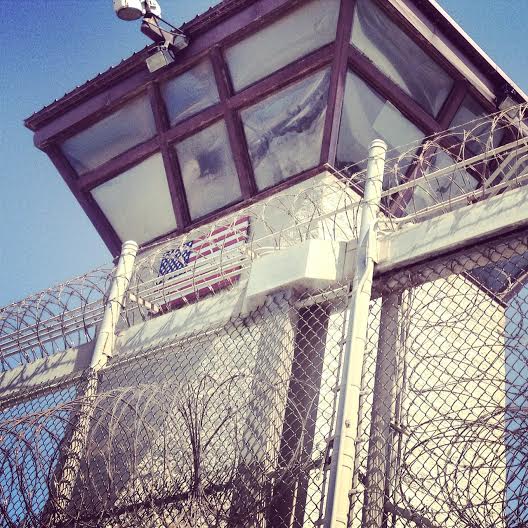
Photo by Truthout on flickr

Media Roots Radio – Abby Goes to Gitmo

Recently I traveled to one of the most nefarious prisons in the world: Guantanamo Bay, Cuba. Despite repeated government pledges to close the infamous detention facility down, 149 men remained indefinitely imprisoned there.

gitmoAccording to a top Bush administration official, the vast majority of prisoners are innocent, and were either swept up in a dragnet or handed over in exchange for US bounties.
It’s already hard enough traveling to Gitmo as a journalist, but upon arrival I realized the experience was going to be controlled 24/7 by military escorts preventing us from going anywhere near the detainees I had come to report on.

However, I was able to speak with several top brass defense attorneys for the military commissions, a corrupt system that grants alleged terrorists less rights than civilian courts. The fact that six men are facing formal charges at the prison in relation to 9/11 & the USS Cole bombing gives the world the false impression that even alleged terrorists get their day in court. In reality, the remaining 143 men never charged with a crime may never get that luxury.

Amazingly, according to their lawyers, the detainees watch RT and Breaking the Set regularly.

My brother Robbie interviewed me about my intense experience at Gitmo for Media Roots Radio, a much more personal account than presented on my show.

Watch my on-the-ground documentary special about Guantanamo Bay here.

Follow me @AbbyMartin, and my brother Robbie @fluorescentgrey

Celebrations of Imperialist War Abound

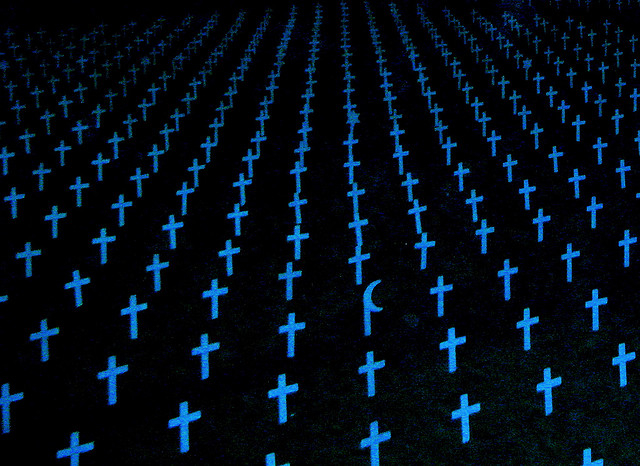
gravesPhotobyKevinDooleySummer is here and the stench of war is all around. Or, as Bob Marley put it, ‘everywhere is war’.
Start with the commemorations over a five-week span of Memorial Day, Flag Day and Independence Day, all presented varyingly as celebrations of our war dead, symbols of our greatness, the freedoms we love so dearly and seek to export to every corner of the world and, perhaps most important, the unquestioned rightness of our cause.

In reality, the celebrations are of imperialist war, with the talk about the hallowed dead just so much cover for the murderous nature of US foreign policy. Celebrating the dead – note that the dead celebrated are just the American dead, not any of the millions killed by US aggression or client states – is a no-lose proposition designed to render anyone who asks the wrong questions a traitor or a terrorist. The notion that the US regularly commits war crimes and that polished, well-educated men like Barack Obama are war criminals is unthinkable; war criminals look like Osama bin-Laden and Saddam Hussein and those other nasty people far away, over there.

It’s also the summer of the centennial of the start of what in its time was known as the Great War, the greatest blood-letting in history except for that of the Second Great War barely two decades later. One thing we can be sure is that the lessons drawn from mainstream discussions of World War I will be all the wrong ones. Worse, the spectacle of the intelligentsia waxing eloquent about the horrors of war while unflinchingly cheering on the warmakers in Washington will be accepted by one and all of their kind as perfectly reasonable – as beyond discussion, in fact.

In recent weeks, meanwhile, mainstream commentators have been shocked to discover that things in Iraq are not alright, in fact are worse than at any time since the second US blitzkrieg in 2003. Gee, who knew that an invasion predicated on a lie of weapons of mass destruction, designed to secure control of massive oil supplies, would go wrong? The political class and intelligentsia pretended they didn’t, but millions around the world who demonstrated against the invasion in the weeks before it was launched certainly did. And one of the points those demonstrators underscored was that a US invasion would fuel sectarian divisions and violence, precisely as has happened. Al-Qaeda, which did not exist in Iraq prior to the invasion, now flourishes while a new group, the Islamist State of Iraq and Syria (ISIS), rampages through the country.

The response of many elites in the US, naturally, is for more war. Calls from certain factions for a third US invasion are growing louder and Obama likely would have done so by now if not for grave ruling class concerns about how much more a war-weary populace can endure. Weary or not, people in the US came together in a remarkable groundswell of protest last summer that prevented Obama from attacking Syria. Given Obama’s penchant for resolving virtually any problem with violence, however, as in his determination to provoke war with Russia in Ukraine, his reluctance to invade Iraq may be temporary.

Also on the war front is the Veterans Affairs’ disgraceful neglect of ex-soldiers in need of medical care. For years, political elites have been slashing benefits for veterans while increasing spending on weapons and cutting taxes for the Super Rich. That the problem came to a head with a Democrat in the White House is simply an accident of timing, and it is especially outrageous that the most enthusiastic cheerleaders of the illegal Bush-Cheney invasions, as well as reductions to the VA’s budgets and the tax cuts for 1%, now pretend that they care about soldiers.

Equally farcical is the commencement of yet another round of hearings on the deaths of four Americans in Benghazi. Such hearings would certainly be valuable if everything related to US actions in Libya since the launch of the 2011 assault were up for review, but there is virtually no chance of that happening. The deaths of tens of thousands of Libyans in yet one more illegal military strike, as well as the resulting chaos and violence in that country, is of no concern to those who long for the good old days of Bush-Cheney interested only in scoring political points.

Last but not least is the saga of the much-vilified Bowe Bergdhal, a young man who came to see the criminal nature of the US invasion of Afghanistan. The refusal of working class youth to fight for Empire is the ruling class’s biggest nightmare and the attacks on Bergdahl, like the show trial that convicted Chelsea Manning, exemplify how far they will go to punish those in uniform who dare challenge their objectives. A hidden aspect of the movement that ended US carnage in Southeast Asia is that it was the widespread opposition of soldiers, both as embodied by organizations like Vietnam Veterans Against the War as well as active duty resisters, that decisively turned the tide.

This development was so alarming that two massive disinformation campaigns were immediately launched: the myth of the hostility of the anti-war movement for returning soldiers that sought to drive a wedge between active duty and homefront resistance (see Jerry Lembcke’s The Spitting Image: Myth, Memory and the Legacy of Vietnam); and the completely fraudulent MIA blitz (expertly exposed by Bruce Franklin in MIA, or Mythmaking in America) concocted by the Nixon Administration to shift attention away from the death and destruction wrought by the US to the plight of nonexistent prisoners of war.

Because preventing any similar resistance among soldiers is central to imperial objectives, discussion has largely avoided what Bergdahl actually said about his service in Afghanistan, including his telling declaration in a 2009 e-mail to his parents: “The future is too good to waste on lies and life is way too short to care for the damnation of others as well as to spend it helping fools with their ideas that are wrong. I’ve seen their ideas, I’m ashamed to even be American. The horror of the self righteous arrogance that they thrive in.” Rather than joining in the Bowe Bergdhal lynch mob, US soldiers everywhere, not to mention those with loved ones in the military, would do well to heed his words and experience.

Lastly, the same standard that applies to the war crimes of others applies to the US. As articulated by Robert H. Jackson, chief US prosecutor at Nuremberg, a war of aggression such as committed by the US against Afghanistan and Iraq “is not only an international crime; it is the supreme international crime, differing only from all other crimes in that it contains within itself the accumulated evil of the whole.” In such a circumstance, what Bergdahl did was proper and, it could be argued, obligatory for anyone party to war crimes.

So amidst the holiday flag waving and speeches that glorify imperialism, we should support prisoners of conscience like Chelsea Manning. We should demand that all services veterans require be provided, that US bases around the world be closed, that soldiers be returned home and that the US cease its campaign of endless aggression. And as enticing as the military may seem in such desperate economic times, we should counsel young people to stay away no matter how bleak the alternatives may be.

Written by Andy Piascik at [email protected]

Photo by flickr user Kevin Dooley

FBI Agent Who Executed Ibragim Todashev is a Corrupt Ex-Oakland Cop

Ibragim TodashevThe city of Boston was shaken last year when its marathon was tragically bombed, leaving three people dead and 264 others injured. The alleged mastermind behind the deadly attacks, Tamerlan Tsarnaev, was killed in a shootout with Boston police. His little brother and alleged co-perpetrator, Dzhohar, is now awaiting trial and will potentially face execution.
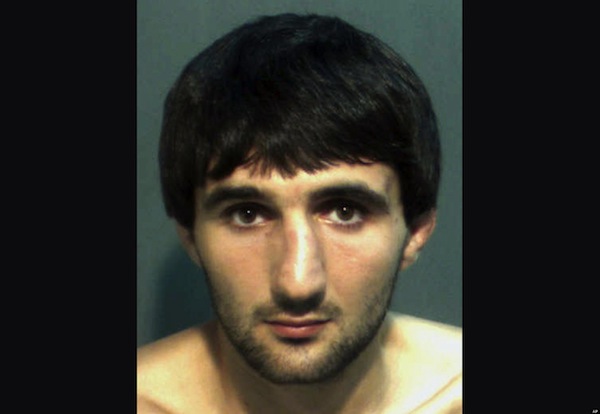
Amidst the insanity ensuing from last year’s horrors, one story was largely swept under the rug: the bizarre execution of 27 year old Chechan-American Ibragim Todashev. A month after the bombings, Todashev was interrogated by state and federal officials at his Orlando apartment about his alleged association with the Tsarneavs and his purported role in the Waltham triple murders of 2011.

According to official reports, Todashev was in the process of writing a confession to the Waltham homicides when for no apparent reason, he ‘flipped out’ and propelled a coffee table into the air, striking the agent on the back of his head. He then ran to the kitchen area of his apartment and armed himself with a red pole/broom handle. The unnamed FBI agent shot Todashev seven times, once in the head.

Earlier this year, an internal FBI investigation and Florida State Attorney cleared the FBI agent who fatally shot Ibragim Todashev of any wrong doing. Prosecutor Jeffrey L. Ashton ruled the shooting was reasonable in that: ‘the actions of the Special Agent of the FBI were justified in self-defense and in defense of another’.

Aaron McFarlane

Recent unredacted documents reveal the unnamed agent to be Special Agent Aaron McFarlane, an ex-Oakland police officer with quite a controversial record in his short stint on the force.

The ‘Riders’ case was the biggest police corruption scandal ever witnessed by Oakland Police Department. It cost the Department nearly $11 million to settle civil lawsuits by 119 people who claimed they were falsely arrested, beaten, and had evidence falsified against them. The plaintiffs also alleged that Oakland Police Department turned a blind eye to the police misconduct.

Officers Clarence Mabanag, Jude Siapno, and Matthew Hornung stood accused of 26 counts including kidnapping, assault, conspiracy, false arrests and lying in police reports. McFarlane testified in defense of Mabanag, stating that he had always taught him how to write accurate police reports. However, under cross-examination it was alleged that McFarlane had falsified his own reports at the request of the group’s leader. Once he was faced with evidence proving his guilt, McFarlane pled the fifth.

After five years and two mistrials, the charges were dismissed against the three officers. McFarlane was never charged in connection with falsifying police reports or potentially lying on the witness stand. Regardless, he ended up in legal trouble for committing the same types of actions as the riders.

Oakland PoliceIn November 2003, a man named Aaron Girard filed a civil suit against Aaron McFarlane and his Oakland PD colleague, Steven Nowak, for aggravated battery, false arrest, violation of his civil rights and emotional distress. Girard stated he had witnessed McFarlane and Nowak physically beating an individual who had already been subdued in front of a hospital. Girard took a photograph of the incident and when McFarlane and Nowak realized, they attacked him. The plaintiff alleged he was beaten, kicked and punched around the body, suffering injuries to his shoulder, arm, knee and neck. He claimed he was then falsely arrested by McFarlane and Nowak. Neither McFarlane nor Nowak ever faced charges over the incident.

Additionally, both officers were previously sued by a man named Michael Cole, who filed his complaint on March 26 of the same year (2003). The full details of the complaint are unavailable, although the pair were accused of beating the plaintiff with a ‘hand foot and billy club’ before falsely imprisoning him.

After serving only four years in the police force, Macfarlane retired on disability with a leg injury, collecting a pension of more than $52 thousand dollars annually for the rest of his life.

In his short time as an officer, McFarlane had been accused of falsifying police reports, lying under oath, aggravated battery, making false arrests, violating the rights of suspects, assault with a weapon and false imprisonment, yet was never convicted of any charges.

Other than the questionable circumstances surrounding the death of Ibragim Todashev, it is not known if Aaron McFarlane has ever been involved in any other incident after leaving the Oakland Police Department. And it’s not likely to be known, considering the agency’s secrecy surrounding the release of his identity.

According to Carol Rose, executive director of ACLU of  Massachusetts,

“We still don’t know what happened…nor why the explanations from those who were present at the shooting death have been inconsistent, suggesting at various times that Mr. Todashev allegedly threatened agents, including with a knife, a pipe, a stick or pole, an agent’s gun, the deceased’s martial arts training, or even a samurai sword.”

Unfortunately, the investigators on the case weren’t able to interview McFarlane himself about what happened, and had to rely only on prewritten statements.

This alone should prove the report is inconclusive, and prompt the investigation to re-open. However, a New York Times FOIA request reveals that between 1993 and 2011, FBI agents fatally shot about 70 subjects and wounded 80 others, and in every single case, the agent’s use of force was determined to be justified.

When a federal agency coordinates with so many forces to try to suppress the truth, there’s usually something to hide.

**

Watch Abby Martin break down Aaron McFarlane’s track record and the case of Ibragim Todashev starting at 14:45:

 Abby Martin Breaks the Set on Ibragim Todashev’s Ex Oakland Cop Killer

***

Written by Joanne Potter and Abby Martin

Posted in Uncategorized | 1 Reply

Media Roots Radio – Obama’s Weak NSA Retort & the Antidote to Defeatism

Robbie and Abby Martin discuss the unbelievable nature of the post 9/11 anthrax attacks. They also talk about Obama’s pathetic NSA retort revealing a chink in the establishment’s armor, inverted totalitarianism, Guantanamo Bay, and the antidote to defeatism

***

The above timeline is interactive. Scroll through it to find out more about the show’s music and to resources mentioned during the broadcast. If you would like to directly download the podcast click the down arrow icon on the right of the soundcloud display. To hide the comments to enable easier rewind and fast forward, click on the icon on the very bottom right.

This Media Roots podcast is the product of many long hours of hard work and love. If you want to encourage our voice, please consider supporting us as we continue to speak from outside party lines. Even the smallest donations are appreciated and help us with our operating costs.

Listen to all previous episodes of Media Roots Radio here.