
From Squawk Box to CSPAN – Cutting Through the Beltway Bubble & Democracy Gap

LadyLibertyByRobChandanaisFailed ideas, infighting, and glimmers of hope.

I found myself watching CNBC’s Squawk Box the other morning and an Ohio Republican named Ron Portman was on. He was being beamed in from the Russell Rotunda in Washington, with its columned grandeur and air of gravitas. What a lovely backdrop for the savaging of America. Portman is the Republican prototype. Innocent eyes. Puritan earnestness. Flour white face. Bland coat and tie. As part of that long-running hit, the GOP Weekly Address, Portman announced a seven-point plan to create American jobs. He said his program would spark an economic recovery, a whip that political hacks never tire of using to flog the presses. Here are his seven sterling steps to the next big boom:

1. Adopt “Common Sense” Healthcare Solutions

Portman didn’t go into much depth on this one, but a majority of Americans would agree. Although Portman and the people might fall into a bit of a quibble over what exactly “common sense” meant. For Portman and his colleagues, common sense healthcare means leaving it to the market, where the all-important profit margin invariably dictates stingy coverage and unaffordable premiums. For many Americans, health is a sacred human right that ought not to be subjected to human greed. But more to come on that front…

2. Power America’s Economy

Note the pun in this one? Clever. This is mostly about fracking, faster permitting, and exporting liquid natural gas (LNG). None of which are the slightest bit helpful from a climate change standpoint (See Gasland and this fast-track special for more on that). As the powers that become ever more enthralled by “energy independence” and the wondrous profits it promises our billion-dollar petro giants, the work of committed anti-frackers may be increasingly marginalized by the enormous financial incentives to fracture the bedrock of the earth, no matter how many poisoned aquifers result.

3. Begin Living Within Our Means

This is more fearmongering around the Koch brothers’ deficit reduction campaign, a bipartisan con if there ever was one. Without mentioning the elephants in the room—the military budget and the periodic trillion-dollar bailouts of corrupt mega-banks—Portman wants to slash the deficit in other ways. Gee, I wonder where those cuts will come from? Perhaps “reform to entitlement programs”? Republicans like nothing more than anything that will “encourage personal responsibility,” a perpetual refrain of Senatorial millionaires. Perhaps Goldman Sachs’ Jamie Dimon can be brought in to help make this case to Main Street.

4. Reform Tax Code to Spur Economic Growth

This is especially farcical coming right after the harangue about cutting debt. It must be acknowledged that cutting taxes cuts government revenue, which pays for programs that must otherwise be sustained with loans or—as the GOP prefers—not sustained at all, but rather demolished altogether. Yet “reform tax code” is itself code for lowering taxes on corporations and individuals, with particular callouts for cutting taxes on the rich. It’s not as though taxes are already pretty low by historical standards, and when you begin factoring in deductions, you soon arrive at globally competitive corporate rates, and occasionally discover that your multinational owes no tax at all. In any case, this concept is based on the fallacy of trickle down economics, that the more money you put into the pockets of rich people, the more they will spend creating jobs for poor people.

Perhaps Portman and his rabid neoclassical colleagues have been napping since 2008 and missed the mortgage meltdown, the too-big-to-fail bailouts, and the aftermath, when banks sat on more than a trillion dollars in government money since they had what is sometimes referred to as a “liquidity preference.” As political economist Alan Nasser has noted, nobody likes to invest in a crappy economy. Hence the need for Keynesian stimulus. But that would require government intervention, a terrifying scourge at which we’ll soon arrive. Even Obama seems to believe jobs can only come from the private sector, as he famously touted in 2009. But set reality aside, and let’s embrace failed economic theories in the hopes that uneducated workers will fall for the ruse of tax cuts one more time. Viva a falsidade!

5. Unburden the Economy from DC Regulations

This is perhaps the most comical point, especially when Portman tosses around terms like, “regulatory relief” as though American business is simply hamstrung by the myopic interference of our frothing socialist government. It’s not as though the lack of regulation, happy encouraged all through the Clinton years, led directly to the mortgage meltdown and the subsequent horror show, thanks to savings and investment bank mergers, lax lending standards, unregulated derivatives and commodities markets, and toothless criminal regulation of premeditated mortgage fraud, pension theft, and so on. And it’s not as though the history of British, American, and German, not to mention Korean, Japanese, and Chinese industrialization was dependent precisely on regulation in the form of protectionist measures such as import tariffs and currency and price controls.

6. Create Competitive Workforce

This is another laugher. As if Barack Obama isn’t already fast-tracking America labor toward Third World status. Have any Republicans been paying attention to the jobs being produced by the Obama-conomy? Part-time, low-wage, low-skill, high-turnover, nontradeable service positions. In other words, bartenders, wait staff, and bedpan emptiers. Or, to put it another way, we’re only creating jobs that can’t be exported. A Chinese laborer in Shanghai can’t bring a beer to your table in Des Moines, no matter how cheaply he can be had.

Of course, Portman’s bullet points on the workforce ignores the need to generate good jobs, and instead offers a fog of rhetoric about consolidating job training programs, consolidation being a synonym for cutting programs, as is the call to defer decisions on how to allocate training monies to states, where Republicans control the majority of legislatures. There is some logic to this: why train people for nonexistent jobs? Portman’s colleagues also smuggled education beneath the banner of a competitive workforce—another strange inclusion. Why waste money educating the population? But the purpose of mentioning education is, as always, the desire to enervate the Department of Education and empower the privatization of education, primarily by creating more charter schools.

7. Increase Exports to Create More American Jobs

Perhaps the only way to do this on a mass scale would be to drive wages down far enough for America to be competitive with Bangladesh and other nations were factories routinely collapse on top of their employees. Of course, ten buildings have collapsed in Harlem in just the last five years, so perhaps the analogy isn’t so apt. If this is indeed the goal—and the president does frequently harp on exports—this may be as much of an admission as point six that the bipartisan objective of our government is to pauperize America. Then feudal conditions can be implemented. Fiefdoms overseen by CEOs instead of Lords. We vassals can trade our labor for subsistence, never wondering where the surplus goes (who reads Marx anymore?). And perhaps then we will proudly become the world’s sweatshop, filling shipping containers with the plastics craved by Indian parvenus and Chinese arrivistes. It has been suggested that in a few years a Detroit autoworker will be competitive with his Chinese cohort. Should we rue the day, or accept our reduced privileges, even as our corporate moguls, untethered from their employees by labor arbitrage, soar above us in private sky fleets, while their state minions monitor our hoods from hovering drone helicopters, awaiting the advent of a tepid protest?

Hope Springs Infernal

But then you see Senator Dianne Feinstein making a speech before Congress that accuses the CIA of spying on the Senate. This is mighty surprising coming from one of Edward Snowden’s biggest haters on Capitol Hill. I suppose so long as the spying is done on low-wage, low-profile Americans, it’s fine. But once the surveillance community turns its wanton eye to Congress and its bevy of millionaire influence peddlers, the ethics take a sharp U-turn. Feinstein was plenty irate at the thought of Obama’s paramilitary “agency” impeding her committee’s investigation into its torture habits after 9/11. Anxious to further impair its public reputation, the CIA has accused the Senate of criminal activity and asked the DOJ to investigate. Nothing like getting out in front of a scandal, right?

But there’s always a harsh rebuke in store for a freethinker. This one comes in the form of CIA Director James Brennan, who openly scoffs at Feinstein’s accusations. A bemused Brennan claimed that illegal, clandestine activity is far below the ethical code of the CI—but wait, isn’t illegal, clandestine activity the heart of the CIA’s mission statement? You hear him tell a CSPAN staffer that Congress ought to be careful not to inflate its description of what the CIA has done. Yes, Mr. Brennan, because prudence has long been the byword of the Central Intelligence Agency. We all remember how careful it was in assessing the threat of Iraqi WMDs—it’s not as if it played fast and loose with the facts in the lead up to the Second Iraq Oil War.

What is occasionally mind-boggling is just how close these federal agencies actually come to seeing the truth—and even stating it. The Quadrennial Defense Review, or QDR, released last week, provided a summary of international threats. The authors were remarkably clear-eyed in noting that Al-Qaeda has vastly expanded its influence across the Middle East. Then, in a staggering admission, they conceded that destabilizing events in the region, such as wars in Syria and Iraq, were the leading causes of Al-Qaeda’s resurgence. It’s only the smallest of leaps from here to the question, “Why is the Middle East unstable?” Answering this question would lead our brave military leaders to the nearest mirror. But the leap is never made, the question left unasked, and the dark visage never glimpsed. This habitual lack of self-incrimination is increasingly a device employed by the White House.

Few presidents have spoken the truth with more regularity than Barack Obama. He has talked about the uninsured, income inequality, the trouble with surveillance, the need to reboot American manufacturing, and on and on. It’s clear, in some compartment of his brain, he knows what’s wrong with America, but is incapable of acting to fix it. It’s as though, in his incrementalist philosophy of political change, merely stating the truth is an innovation worthy of the name ‘progress.’ He might feel differently if his most secret conversations were being openly compiled by the dismissive Mr. Brennan.

The Subversive Breakout Session

Thankfully, there are pockets of sunlight, blades of brightness that slice through the dark cloud of ignorance that darkens the beltway day. A couple weeks ago, the irrepressible Senator Bernie Sanders hosted a hearing on healthcare, an event expressly designed to cast scorn on Obama’s Affordable Care Act (ACA). Sanders assembled a Benetton ad of healthcare experts from around the world—Taiwan, Canada, Denmark, Australia, and one dismayed and defensive defender of the ACA. This paladin of corporate interest increasingly retreated to some fortuitous study on infant mortality, only to see it quickly discredited by a bored academic seated along that dire row of socialists.

One after another, goaded by Sanders, the guests dispassionately extolled the virtues of free publicly funded healthcare—taking time, as one Canadian did, to disparage elements of their system (prescription drugs) foolishly left to the private sector. From lower costs to higher outcomes, the case was made. Eventually, the sole guest defender of the ACA and a couple of Republican Congressmen—condescendingly bemused by this minor specter of socialized medicine—argued that all of these Benetton nations were simply benefiting from America’s prodigious research budgets and thus able to offer free care. The implication being that only private industry was driving the medical innovation that saved lives. Nobody bothered to mention that vast funding for R&D comes from the government itself via taxpayer dollars. In any event, Sanders soon closed the proceedings and the foreign guests were sent packing, while the transcript of the festivities were hurled down Orwell’s memory hole. But trust me, this actually happened.

The Continental Divide

While there’s plenty of media coverage now—thanks to Occupy—about the gross inequalities of American incomes, very little coverage is given to another gap: the democracy gap. Or, to frame it otherwise, the gap between what Americans say they want and what American politicians give them. An abyss has opened between our desires and our policies. A majority want universal health care. We get the ACA. A majority want us out of other countries. We get clandestine coups. A majority want more spending on education. We get bigger Pentagon budgets. If polls like those of Pew or Gallup are to be believed, Americans generally don’t get what they want. Examining some of the debates underway in the beltway bubble is enough to illuminate you to this fact—you needn’t poll anyone. The story of our anti-democratic drift also occasionally surfaces, like a bubble from a gaseous swamp, amid the general miasma of mainstream media. The stray left-wing blogger. A labor union old-timer scribbling in a socialist rag. The curious senator with a bottomless ire for injustice. If only there were some force multiplier by which we could clone and amplify their voices. But then, something like that would have to be called democracy.

Jason Hirthler is a veteran of the communications industry. He lives and works in New York City and can be reached at [email protected].

Photo by Flickr User Rob Chandanais
Media Roots Radio – Obama’s Weak NSA Retort & the Antidote to Defeatism

Robbie and Abby Martin discuss the unbelievable nature of the post 9/11 anthrax attacks. They also talk about Obama’s pathetic NSA retort revealing a chink in the establishment’s armor, inverted totalitarianism, Guantanamo Bay, and the antidote to defeatism

***

The above timeline is interactive. Scroll through it to find out more about the show’s music and to resources mentioned during the broadcast. If you would like to directly download the podcast click the down arrow icon on the right of the soundcloud display. To hide the comments to enable easier rewind and fast forward, click on the icon on the very bottom right.

This Media Roots podcast is the product of many long hours of hard work and love. If you want to encourage our voice, please consider supporting us as we continue to speak from outside party lines. Even the smallest donations are appreciated and help us with our operating costs.

Listen to all previous episodes of Media Roots Radio here.

The Death of Irony: University of Penn’s Secret Meetings on Secret Surveillance Law

NSAbyEFFIt’s a crisp Saturday morning in late November, and the University of Pennsylvania’s campus is just barely stirring as I walk into the Silverman building and head towards Room 147, excited about the morning’s roundtable discussion: Spying and the Judiciary: FISA and Other Special Courts.

The event is one of seven moderated discussions at the Center for Ethics and the Rule of Law (CERL) Conference, On the Very Idea of Secret Laws: Transparency and Publicity in Deliberative Democracy.

I’m not the only geek fired-up either, a portly man in a suit walks up next to me as we briskly move towards the meeting room.

“We’re in for a treat this morning!” he says, his mouth cracked with a grin and his eyes alight. Only one of us would end up attending, however – and it had nothing to do with my lacking a tie.

After taking a seat (and catching out of the corner of my eye NSA’s deputy director John “Chris” Inglis drift into the room, among others), a wiry CERL staffer named Ilya Rudyak walks over and asks for my name. I introduce myself and offer my press badge.

“You’re going to have to leave,” he says with a nervous smile.

After escorting me out into the hallway, another CERL representative, Claire Finkelstein, says I can stop back in towards the end of the lunch break to ask her some questions.

In other words, this morning’s moderated discussion on secret courts, secret laws, and a rampaging surveillance apparatus is strangely, well, secret.

In fact, every event during this two day conference – with the exception of Chris Inglis’ keynote speech inside a packed auditorium the night before – is listed on the university’s law department website, yet completely shielded from press and public scrutiny. Furthermore, none of the event listings even have a full roster of attendees.

I find a 14-page list of participant bios outside of the room. The packet is chock full of representatives from the defense industry, intelligence community, academia, and think tanks such as the Cato Institute.

Courtesy for the Powerful, Not the Public

I return near the end of the attendees’ lunch break and quickly find CERL’s head staff member, Claire Finkelstein. She seems dismayed that I’m actually taking up her earlier invitation.

“Is there classified information being discussed here?” I ask Finkelstein.

“No, no classified information, but sensitive topics.”

“So if there’s no classified information being disclosed here, why is it closed to the public?”

“The main point of the discussions is for policy makers, academics, and others who are involved,” she begins, “to enter into dialogue with one another in a way that allows all of us to move up the learning curve, so that we become better-informed academics and policy makers become better-informed.”

She soon passes me off to another attendee: the ACLU’s Alex Abdo.

“There’s a non-attribution agreement that applies, a ‘Chatham House Rule’ that people here are talking about,” Alex Abdo tells me. Finally, we’re getting somewhere.

Abdo is an ACLU staff attorney and participant in that organization’s National Security Project. He arrived here this morning after doing battle with the National Security Agency in U.S. District Court in Lower Manhattan the day before. Abdo is also a conference participant. At moments during our conversation, he seems embarrassed when I press him on the absurdly-ironic secrecy cloaking a conference whose very theme ostensibly seeks to take a critical look at Intelligence Community obfuscation. Hell, even several participants (including Dr. Hans Blix) during a 2006 UK conference on freedom of information and the Iraq War scoffed at invoking the Chatham House rule.

“It’s a really fascinating discussion about how we should think about privacy in an era where so much private information can be collected so easily. That’s my understanding about what’s happened today so far.”

Thanks for the boilerplate, Mr. Abdo, but I’m still trying to wrap my head around why the public should be barred from participating in – or even observing – this “fascinating discussion” on how our “private information can be collected so easily.”

“I’ve been to a couple of these meetings before,” Abdo begins. “Usually, the thought is that if you get a bunch of people who are really thinking and working on these issues together in a room, and you promise not to use what they say against them later on, you’ll foster a thoughtful and uninhibited conversation.

He pauses, adding wryly:

If no one’s surveilling you, you can have an uninhibited conversation.

Julian Sanchez, a CATO Institute research fellow who attended the conference in its entirety, more-explicitly characterized this rule’s real purpose in a series of emails to me:

You’ve got a bunch of lawyers who used to work for the government, some who currently work for the government, and others who might very well hope to work for the government in the future, perhaps on these very issues” [such as Foreign Intelligence Surveillance Court opinions], he writes. I can promise you none of those people ever wants to be quoted in a newspaper making what comes off as a harsh personal criticism of a federal judge [who is assigned to the Foreign Intelligence Surveillance Court] — or even seeming like they partially agree with someone else’s criticism,” he continues.

“In certain circles, that’s at least going to be a huge PR headache, and very likely career kryptonite. Maybe I can just come right out and say ‘that opinion was a total disaster,’ but I’m never going to have to argue a case before that judge, or be applying for a job at DOJ, and I’m certainly not important enough to make headlines with an offhand remark. So the only way you really get a free-flowing, honest discussion is if everyone can just talk without thinking about whether they’re going to make a Huffington Post headline if they phrase something the wrong way.

Whether or not Sanchez was aware, there weren’t just “a bunch of [government] lawyers” in attendance, however. In addition to top-ranking officials within the Intelligence Community, individuals with long-standing corporate ties to the defense and intelligence industries participated too. To shed some light on a frustratingly non-transparent gathering, here’s a small sampling of attendees from the conference roster:

* John “Chris” Inglis, Deputy Director of the National Security Agency and the organization’s senior civilian leader, “responsible for guiding and directing strategies, operations, and policy.”

* Sean Kanuck, whose current position is National Intelligence Officer for Cyber Issues within the Office of the Director of National Intelligence. Kanuck came to this segment of the intelligence community after a decade-long position with the CIA’s Information Operations Center. Kanuck also has extensive experience in law focusing on corporate mergers and acquisitions;

* William R. Craven, the founder and CEO of Overwatch Systems, “a software company serving the Intelligence segment of the Defense industry.” Prior to forming Overwatch, Craven “had been the CEO of Paravant, a public company serving the defense community with rugged and high speed computing solutions for Battlefield and Intelligence applications;

* Lt. General Paul Menoher (Ret.), currently Director of Overwatch Systems LLC and an advising board member of Topia Ventures and Oberon Associates, Inc., and a consultant for ten other defense firms. Menoher also enjoyed a 35-year career in Army Intelligence;

* Amos Guiora, currently a Research Fellow at the International Institute on Counterterrorism in Israel, and Commander of the Israel Defense Force’s School of Military Law and a former legal advisor to Gaza Strip operations;

* George Casey, “head of Shearman and Sterling’s Global Mergers and Acquisitions Group”. Casey is an expert in U.S. domestic and cross-border mergers and acquisitions transactions, venture capital financing, and represents “many of the largest U.S. and non-U.S. corporate and investment banking clients.” Casey is also a current University of Pennsylvania School of Law lecturer.

* Harvey Rubin, M.D., Ph.D, Penn’s Institute for Strategic Threat Analyis and Response (ISTAR) director, and Associate Dean for Student Affairs in the School of Medicine.

So while influential members of government and private industry discuss issues (behind closed doors and shielded from any attribution to “career-damaging” statements) that clearly belong in the realm of public debate – and have been since the beginning of the Snowden-spurred surveillance scandal in April – you and I are shut out from these discussions because these officials are concerned that their statements might be recorded, publicized, and prove damaging to their reputations, careers, and profit margins.

And while this particular conference may not directly produce public policy, as Julian Sanchez also assured me, academic papers may be written about what was discussed. These papers may then become white papers that form the basis for later policy by unelected officials, and often outside the public eye.

Scrutinizing Penn’s Center for Ethics and the Rule of Law

What’s no secret, unlike the conversations throughout this two day CERL conference on surveillance and secret law, is how deeply entrenched this – and so many other non-state funded schools like Penn – are with the defense industry.

Including up to the third quarter of FY 2012 (the most recently available data), the University of Pennsylvania raked in over $17 million in government research work. FY 2011 saw a very lucrative $32 million in such contract work for Penn.

It’s worth taking a closer look at CERL too. Its advisory board contains not only law professors from a variety of universities, but defense contractors like William Craven, currently the CEO of Overwatch Systems and the former head of Paravant. Both companies have deep roots within the defense and intelligence communities. As stated earlier, Craven also participated in this Penn conference.

Ambassador Dell Dailey (Ret.) is another CERL board member whose consulting company “spans both Department of Defense and Department of State programs, numerous product focused companies, private equity, small arms company, think tank efforts and international operations.” Dailey also serves on the nonprofit Center for a New American Security’s Board of Advisors. CNAS boasts of developing “strong, pragmatic and principled national security and defense policies.”

CERL’s seeming affinity for defense industry players and its apparent sympathy for current national security policies doesn’t stop with its private contractor leadership, however.

In a Penn Law Journal article published this past summer titled The Perils of Push Button War, CERL’s head and perhaps its most publicly-visible member, Claire Finkelstein, is paraphrased regarding drone warfare:

Finkelstein points out, however, that as a weapons system, there’s a lot to like about drones. They are more precise than traditional aerial bombs, better able to pinpoint targets, and therefore have the potential to dramatically reduce civilian casualties.

Two law professors and current CERL board members, Jens Ohlin and Kevin Govern, are cited in the same article as supporting the targeted assassination of U.S. citizens abroad, as in the case of Anwar al-Awlaki:

Jens Ohlin, a law professor at Cornell, and a member of CERL’s advisory board, said that the presence of an al-Qaeda branch in Yemen with an avowed intent of engaging Americans more than justified the invocation of war powers there. He said it has never been the case that American citizens taking up arms against the U.S. get special treatment on the battlefield.

Another board member, Kevin Govern, law professor at Ave Maria Law School, and a former Army Judge Advocate, said that al-Awlaki might be compared to Nazi propaganda chief Joseph Goebbels.

What, then, do we make of Penn’s “secret” conference participants, their relationships to the U.S. defense and intelligence apparatuses, and the pervasive secrecy by which they are surrounded? Can we trust that whatever academic treatises, white papers, and possible policy decisions that may come from “On the Very Idea of Secret Laws” will represent not just the national security state’s perceived desires, but those of the public’s too?

Written by Dustin Slaughter. This article is cross-posted at Phawker.

Photo by EFF

Oliver Stone Uncensors American History

UntoldHistoryAmericans grow up learning history through the lens of a victorious US empire. This notion isn’t just bred through the educational system – every major institution in society maintains the same perspective in order to help unify the people under a national identity.

Although it benefits the whole if there is a sense of unity among the population, the false belief that an arbitrary national border makes one human better than the other is socially destructive. Not only is this isolated worldview of American exceptionalism insulting to non-Americans, it’s a propaganda tool used to manufacture consent for the US government’s disastrous and hypocritical policies.

Throughout the last half century, the United States has acted as military arbitrator of the world, policing other countries in the name of “freedom” while constantly waging war to undermine other nations’ democracies.

This classified history of America is deeply explored in a ten-part documentary Showtime series called The Untold History of the United States, a film adaptation of the joint book authored by Academy Award-winning director Oliver Stone and prolific historian Peter Kuznick.

The epic saga looks back with a critical eye at historical events that went under reported at the time, but ended up crucially shaped America over the 20th century. From the dropping of two atomic bombs over Japan to the Cold War and the fall of Communism, this in-depth, provocative documentary series challenges many Americans’ long held political paradigms.

Oliver Stone and historian Peter Kuznick have corrected American history on Breaking the Set before. Recently, they came on again to discuss the truth behind everything from JFK’s legacy to Obama’s expansion of the surveillance state.

Abby

***

Abby Martin Breaks the Set with Oliver Stone and Historian Peter Kuznick.

***

LIKE Breaking the Set @ http://fb.me/BreakingTheSet
FOLLOW Abby Martin @ http://twitter.com/AbbyMartin


Philly Fusion Center’s Reckless Disregard for Privacy Must Be Held to Account

The Declaration has uncovered troubling revelations regarding law enforcement operations at Philadelphia’s Delaware Valley Intelligence Center (DVIC), which include the fact that the DVIC, an “all crimes, all hazards” fusion center that assists law enforcement agencies in four states, appears to operate without any privacy policy in place, while its privacy officer position has been vacant since 2010.

In a related development, before the fusion center officially opened, the Philadelphia Police Department operated what one private contractor and a Senate subcommittee labeled a “DVIC Cell”. This unit’s existence indicates probable Constitutional violations dating as far back as 2009, as there doesn’t appear to be any indication of privacy or civil liberties protections attached to the “cell’s” operations.

If the Policy Exists, We Won’t Show it to You

Our research into the South Philly fusion center began in the summer of 2012. At that time the only readily discoverable item of any official nature was a brochure made by architect LR Kimball. Formal inquiries, which began in January of 2013, followed by multiple editorial admonitions published on our website and repeated communication with officials both on and off the record over a 10-month period, have not yielded any official policies. Local police officials have been unwilling – or unable – to produce any documents. They have on numerous occasions tried to assure us that a policy exists.

The Declaration also contacted the Department of Homeland Security’s Civil Liberties office, who upon first contact told the Declaration they would quickly locate the document. Our inquiry is now frozen after being passed to the Fusion Center Training Coordinator Ada Albright, whose final communication with us was a deferral to a telephone number which the Declaration has called countless times.

The officer or employee who answered the phone and confirmed that he was indeed at the DVIC told us that he knew Director Walt Smith already had our request, and that “he’d be best to deal with it.” The stonewall continues.

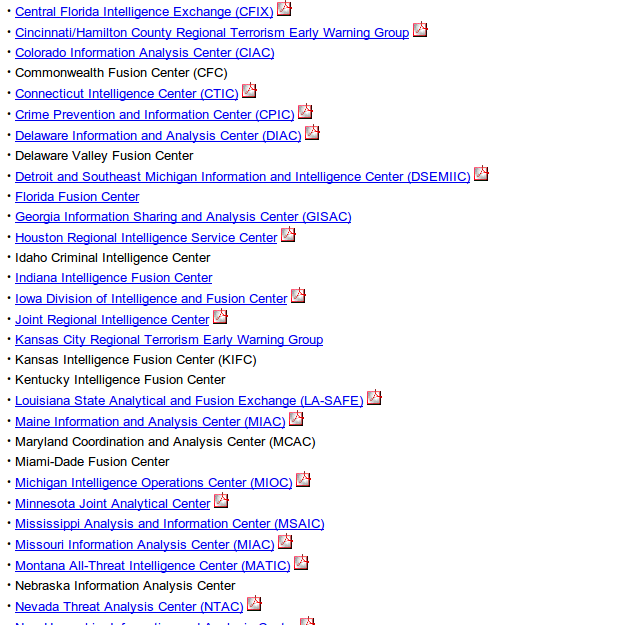
Additionally, a thorough online search for a DVIC policy will lead you to the National Fusion Center Association website and their list of member facility’s privacy policies. The “Delaware Valley Fusion Center” is on the page, with no link to a policy. A very important note sits at the bottom of that page:

FY 2010 DHS grant funds may not be used to support fusion center-related initiatives unless the fusion center is able to certify that privacy and civil rights/civil liberties (CR/CL) protections are in place that are determined to be at least as comprehensive as the ISE Privacy Guidelines by the ISE Privacy Guidelines Committee (PGC) within 6 months of the award date on this FY 2010 award. If these protections have not been submitted for review and on file with the ISE PGC, DHS grants funds may only be leveraged to support the development and/or completion of the fusion center’s privacy protections requirements.

A list of privacy policies on the NFCA website shows the DVIC among center missing a link to a document
A list of privacy policies on the NFCA website shows the DVIC, among a number of other fusion centers, missing a link to a document.

SEPTA police chief Thomas Nestel III, the DVIC’s privacy officer until July of 2010, told The Declaration that he resigned because he could not perform the on-site, full time duties he felt the position required. He believes he had “seen the final draft approved by the Department of Homeland Security.”

Furthermore, in an emailed statement given to us this morning, Nestel says that he “assisted in the creation of the privacy policy and it does exist. Since I no longer hold a position with the DVIC, I am reluctant to release the policy without [Philadelphia Police Inspector Walt Smith’s] permission.”*

Another law enforcement official, on condition of anonymity, also confirms that the DVIC has yet to hire a privacy officer, and describes the facility as not yet fully operational – despite a much-publicized opening on June 28th of this year – in part because the DVIC plans to hire “civilian intelligence analysts.”

These revelations cast strong doubt on the legality of the DVIC’s operations, as fusion centers across the country must adhere to basic standards – outlined in the Department of Homeland Security’s Fusion Center Guidelines as well as the agency’s Baseline Capabilities supplement – standards that include civil liberty and privacy protections. These standards must be implemented in order to receive federal funding.

Privacy guidelines, which the Department of Homeland Security provides a template for on its website and which other fusion centers across the country have in place, establish protocols for the types of intelligence DVIC analysts gather, as well as how that information can be used or disseminated to federal, state, and local law enforcement agencies throughout the four-state region.

Pre-Crime, Suspicious Activity Reporting, and No Privacy: A Troubling Mix

One facet of a fusion center’s day-to-day operations involves either civilian or privatized intelligence analysts examining “suspicious activity reports” filed by law enforcement. These analysts then create threat assessments based on these reports and will often upload them to a federal database, such as the FBI’s e-Guardian system. These assessments are accessible to other local, state, and federal agencies too, as part of a networked law enforcement ecosystem.

During last month’s International Association of Chiefs of Police conference in Philadelphia, The Declaration had the opportunity to attend a presentation on the controversial Nationwide Suspicious Activity Reporting Initiative, often known as “See Something, Say Something.”

David Sobzyk, the scheduled speaker, asserted almost immediately after beginning the presentation that the Nationwide SAR Initiative (NSI) contains built-in privacy and civil liberties protections, yet in the same breath notes that the NSI has 16 behaviors which authorities claim are “indicative of terrorist activity”. In other words, “pre-crime” behavior that could deem an individual or group of people eligible for increased scrutiny by authorities. Other revealing statistics cited by Sobzyk include the fact that 57% of fusion center directors have less than one year of experience; over 85,000 emergency personnel ranging from police officers to 9-1-1 operators and EMS workers have taken SAR training; and a standard SAR training for emergency personnel only consists of a one hour course.

It’s no surprise, then, that a recent ACLU document dump of a Los Angeles fusion center’s suspicious activity reporting made quite a stir among civil libertarians and the press – and this particular center has a published and publicly available privacy policy.

The Declaration submitted a Right-to-Know request in September with the police department for DVIC suspicious activity reporting, which was then rejected. We have since refiled, will appeal if denied again, and are prepared to litigate if necessary.

The potential for operational abuse at the DVIC, then, only increases the need for Constitutional protections that will only come with increased oversight by lawmakers and public scrutiny.

The DVIC’s Troubled Birth

As previously reported, the DVIC received intense criticism from a bi-partisan Senate subcommittee in October of 2012. Their findings indicated (Page 72) that federal grant money was likely being misappropriated by Southeastern Pennsylvania Regional Task Force (SEPA-RTF) officials. SEPA-RTF is multi-county task force that obtained grant funds for a regional intelligence center through the FEMA Homeland Security Grant Program in 2006, and with a consortium of private contractors named the System of Systems Security Consortium (SOSSEC, Inc), was tasked with developing and making the fusion center operational while adhering to federal grant regulations.

According to the subcommittee’s conclusions, the Pennsylvania Emergency Management Agency (PEMA) cut off federal grant money to SEPA-RTF and DVIC development in 2011, because PEMA became aware of plans to illegally use those funds for construction of a Philadelphia Police Department Real Time Crime center at the site of what would become the fusion center. The Senate subcommittee report notes that any planned use of Homeland Security grant money for building construction is prohibited by federal law.

Another curious thread contained in the Senate report, and one which may be another reason PEMA felt it necessary to pull funding in 2011: the existence of a fusion center, listed on the DHS website, that in reality “didn’t exist” according to FEMA testimony before the Senate subcommittee.

The contracting agent tasked with planning and developing the DVIC from 2009 until December of 2011, SOSSEC, Inc., also assisted in the creation of a “DVIC Cell”, a precursor to the current facility.

SOSSEC Vice President Eugene Del Coco, in a lengthy interview with The Declaration this week, revealed the existence of this offsite “microcosm” fusion center launched on July 15th, 2011. Because the DVIC project was experimental, in that it brought together resources and contacts from every jurisdictional tier within a large geographic area, Del Coco says DVIC planners thought it beneficial to establish a prototype operation where a minimal staff could familiarize themselves with the concept of an intelligence center, and gain practical experience and insight into technology and information sharing practices. This offsite center was relocated to the DVIC facility in December, according to a schedule we obtained, and is quite likely one of the mysterious “virtual fusion centers” referred to in testimony by DHS to the same Senate Subcommittee in response to questions about why the DHS listed centers on its site that it knew did not physically exist.

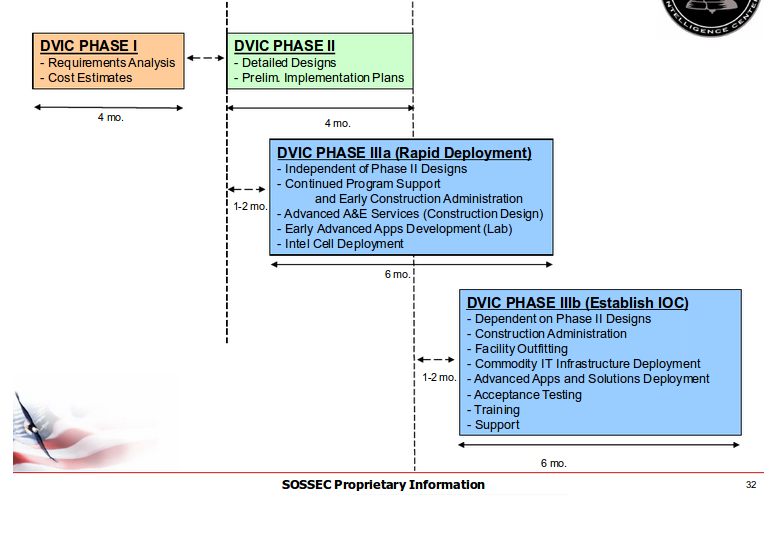
While the general notion of providing advance training to fusion center personnel is rational, given the sensitivity of the operation, the existence of the “Cell” is another example in a litany of cases where the fusion center has been conducting operations which pose serious dangers to Constitutional protections, without significant oversight, and with no record available to the public as to how authorities are ensuring those protections. Del Coco says SOSSEC was originally supposed to complete Phase III-b, “Implementation,” but in December 2011, at the request of the city and SEPA-RTF, relinquished all fusion center responsibilities.

SOSSEC's Del Coco said that the original three phase project was split by SEPA-RTF into two sub-phases for its third stage, for which the City of Philadelphia assumed control
SOSSEC’s Del Coco said that the original three phase project was split by SEPA-RTF into two sub-phases for its third stage, for which the city Philadelphia assumed control

It is Time for Answers

In October, the DVIC facility was host to a Mounted Unit ceremony, an Asian American Advisory Board meeting which apparently included a briefing on the police department’s intelligence gathering practices for members, and an untold number of formal and informal tours for out of town colleagues during the recent International Association of Chiefs of Police, including a former government intelligence officer who now works for IBM and who requested their name not be used for this article. It only seems fair, by matter not only of best transparency practices but simple intuition, that a privacy policy – the most conspicuous public offering regarding the facility – should indeed be available to the public.

Written by Dustin Slaughter and Kenneth Lipp, Image by Dustin Slaughter