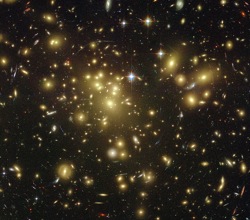
Dark Matter Experiment Disproves Earlier Findings

universePHYSORG– Early data from a Columbia-led dark matter experiment rule out recent hints by other scientists who say they have found the elusive particle that holds the universe together. The findings show that dark matter, which is believed to make up 83 percent of the matter in the universe, is more elusive than many had hoped.

continue to escape our instruments, yet we are getting much more clever in our search and feel confident that we will soon unveil them,” said Elena Aprile, spokesperson of the XENON100 experiment and a professor of physics at Columbia University.

Aprile and her collaborators, who number more than three dozen physicists at nine institutions around the world, presented their findings at a workshop on May 1 and have submitted a paper to the journal . The scientists, whose experiment is the most sensitive search for dark matter to date, plan to release a much larger set of data over this summer.

The group did not expect to find dark matter in this short run of data taken last fall. Instead, their results show that the detector is better than any other at screening out that can be mistaken for the elusive particles.

Continue reading about Dark Matter Experiment Disproves Earlier Findings.

© Columbia University, 2010

Photo by flickr user NASA Goddard Photo and Video
Time Travel? Maybe.

time travelLA TIMES– Imagine that you’re a science-fiction writer on a tight schedule. You’d like to play in the vast expanses of the universe, but you have too much scientific integrity to conjure up a warp drive or a DeLorean out of thin air.

You’re also concerned that your audience would get bored in the thousands of years that it would take for a spaceship to realistically travel the distances between stars. What you really need is a wormhole — a shortcut through time and space. Best of all, unlike most science-fiction tropes, wormholes might very well be real.

Seventy-five years ago today, Albert Einstein and his collaborator, Nathan Rosen, submitted a paper to the Physical Review with the goal of unifying gravity and electromagnetism. Although they failed to discover a theory of everything, they did something arguably more much important: By creating the first theoretical model of a wormhole, Einstein and Rosen allowed science-fiction writers — including Arthur C. Clarke, Madeleine L’Engle and the writers of “Babylon 5″ and “Doctor Who” — to explore vast stretches of space and time in the blink of an eye.

From the outside, an Einstein-Rosen bridge, as wormholes were originally known, looks a lot like its cousin, the black hole. And I risk having my official Physics Badge revoked if I don’t tell you, ideally in a spooky voice, that “nothing can escape from a black hole — not even light.”

Continue reading about Time Travel? Maybe.

© 2010, Los Angeles Times

Photo by flickr user Uberto

Dave Goldberg is the author, with Jeff Blomquist, of “A User’s Guide to the Universe: Surviving the Perils of Black Holes, Time Paradoxes, and Quantum Uncertainty.” He is an associate professor of Physics at Drexel University. His Web site is usersguidetotheuniverse.com.

Galaxy May Be Full of ‘Earths,’ Alien Life

galaxyCNN– As NASA prepares to hunt for Earth-like planets in our corner of the Milky Way galaxy, there’s new buzz that “Star Trek’s” vision of a universe full of life may not be that far-fetched.

Pointy-eared aliens traveling at light speed are staying firmly in science fiction, but scientists are offering fresh insights into the possible existence of inhabited worlds and intelligent civilizations in space.

There may be 100 billion Earth-like planets in the Milky Way, or one for every sun-type star in the galaxy, said Alan Boss, an astronomer with the Carnegie Institution and author of the new book “The Crowded Universe: The Search for Living Planets.”

He made the prediction based on the number of “super-Earths” — planets several times the mass of the Earth, but smaller than gas giants like Jupiter — discovered so far circling stars outside the solar system.

Boss said that if any of the billions of Earth-like worlds he believes exist in the Milky Way have liquid water, they are likely to be home to some type of life.

“Now that’s not saying that they’re all going to be crawling with intelligent human beings or even dinosaurs,” he said.

“But I would suspect that the great majority of them at least will have some sort of primitive life, like bacteria or some of the multicellular creatures that populated our Earth for the first 3 billion years of its existence.”

Continue reading about Galaxy May Be Full of ‘Earths,’ Alien Life

© Cable News Network, 2009

Photo by flickr user Patrick Hoesly

Alien Life? Astronomers Predict Contact by 2025

alienNATIONAL GEOGRAPHIC– Earthlings could make contact with extraterrestrial beings by the year 2025, two astronomers predict in a new book.

The authors say it’s unlikely space aliens look like Hollywood’s ET—little, green, and hairless—and that while aliens are highly unlikely to pay Earth a visit, they may be sending radio signals across space to let us know they exist.

The book, Cosmic Company, “is an explication of why we think they’re out there, how we’re looking for them, what they must be like, and a little bit of what it might mean” to find life on other planets, said co-author Seth Shostak, a senior astronomer at the Search for Extraterrestrial Intelligence Institute (SETI) in Mountain View, California.

The institute conducts research in astronomy, the planetary sciences, and evolution. Past research projects have been funded by NASA, the National Science Foundation, and numerous universities and foundations.

Beyond Our Galaxy

Shostak and co-author Alexandra Barnett, an astronomer and executive director of the Chabot Space and Science Center in Oakland, California, base their predictions on a number of factors.

They include the billions of years in which extraterrestrial life could have evolved and the abundance of planets and stars elsewhere in the universe that are likely to mimic environmental conditions found on Earth.

Continue reading about Alien Life? Astronomers Predict Contact by 2025.

© National Geographic, 2003

Photo by flickr user Jay Adan

Don’t Talk to Aliens, Warns Stephen Hawking

stephen hawkingTIMES ONLINE– The aliens are out there and Earth had better watch out, at least according to Stephen Hawking. He has suggested that extraterrestrials are almost certain to exist- but that instead of seeking them out, humanity should be doing all it that can to avoid any contact.

The suggestions come in a new documentary series in which Hawking, one of the world’s leading scientists, will set out his latest thinking on some of the universe’s greatest mysteries. Alien life, he will suggest, is almost certain to exist in many other parts of the universe: not just in planets, but perhaps in the centre of stars or even floating in interplanetary space.

Hawking’s logic on aliens is, for him, unusually simple. The universe, he points out, has 100 billion galaxies, each containing hundreds of millions of stars. In such a big place, Earth is unlikely to be the only planet where life has evolved.

“To my mathematical brain, the numbers alone make thinking about aliens perfectly rational,” he said. “The real challenge is to work out what aliens might actually be like.”

Continue reading about Don’t Talk to Aliens, Warns Stephen Hawking.

© Times Online, 2010

Photo by flickr user BlatantNews.com

Posted in Uncategorized | 1 Reply