Two Planets Found Sharing One Orbit

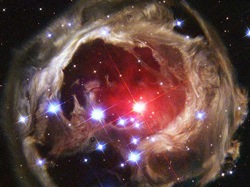
NEW SCIENTIST– Buried in the flood of data from the Kepler telescope is a planetary system unlike any seen before. Two of its apparent planets share the same orbit around their star. If the discovery is confirmed, it would bolster a theory that Earth once shared its orbit with a Mars-sized body that later crashed into it, resulting in the moon’s formation.

The two planets are part of a four-planet system dubbed KOI-730. They circle their sun-like parent star every 9.8 days at exactly the same orbital distance, one permanently about 60 degrees ahead of the other. In the night sky of one planet, the other world must appear as a constant, blazing light, never fading or brightening.

Read full article about Two Planets Found Sharing One Orbit.

Photo by NASA/Ames/JPL-Caltech

© Copyright Reed Business Information Ltd.
Rocky Exoplanet: An Earth-like World

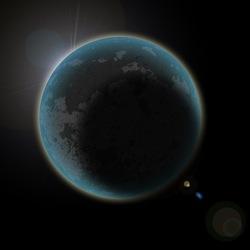
planetBBC NEWS – Astronomers have discovered the smallest planet outside our Solar System, and the first that is undoubtedly rocky like Earth.

Measurements of unprecedented precision have shown that the planet, Kepler 10b, has a diameter 1.4 times that of Earth, and a mass 4.6 times higher.

However, because it orbits its host star so closely, the planet could not harbour life.

The discovery has been hailed as “among the most profound in human history”.

The result was announced at the 217th annual meeting of the American Astronomical Society in Seattle, US, by Nasa’s Kepler team.

Continue reading about Rocky Exo-planet: An Earth-like World.

Article by Jason Palmer

© BBC, 2011

Photograph by flickr user sezzles

Probability of Finding Aliens Is Now Three Times Higher

universeGIZMODO– The total number of stars in the Universe “is likely three times bigger than realized.” Yale University astronomer Pieter van Dokkum says there are “possibly trillions of Earths orbiting these stars,” dramatically increasing the possibility of finding alien civilizations.

According to the new study just published in Nature, new observations on the red end of the optical spectrum at the W. M. Keck Observatory in Hawaii show an overwhelming population of red dwarfs in eight massive nearby elliptical galaxies. The team has discovered that these galaxies hold twenty times more red dwarfs than the Milky Way.

Van Dokkum says that “there are possibly trillions of Earths orbiting these stars” which are “typically more than 10 billion years old.” According to him, that’s long enough for complex life to evolve, which is “one reason why people are interested in this type of star.” In fact, astronomers discovered the first exoplanet similar to our own Earth—and therefore capable of harboring complex life—orbiting the Gliese 581 red dwarf star system, 20.3 light years from our home planet.

Carl Sagan explains why this discovery has a dramatic impact in our search for intelligent life in the Universe, using the Drake Equation:


Continue reading about Probability of Finding Aliens Is Now Three Times Higher.

© Gizmodo, 2010

Photo by flickr user Temari 09

Antimatter Atom Trapped For First Time, Say Scientists

BBC– Antimatter atoms have been trapped for the first time, scientists say. Researchers at Cern, home of the Large Hadron Collider, have held 38 antihydrogen atoms in place, each for a fraction of a second.

Antihydrogen has been produced before but it was instantly destroyed when it encountered normal matter. The team, reporting in Nature, says the ability to study such antimatter atoms will allow previously impossible tests of fundamental tenets of physics.

The current “standard model” of physics holds that each particle – protons, electrons, neutrons and a zoo of more exotic particles – has its mirror image antiparticle.

The antiparticle of the electron, for example, is the positron, and is used in an imaging technique of growing popularity known as positron emission tomography.

Continue reading about Antimatter Atom Trapped For First Time, Say Scientists.

© BBC, 2010

Photograph by flickr user Temari 09

Diamond Star Thrills Astronomers

diamond starBBC– Twinkling in the sky is a diamond star of 10 billion trillion trillion carats, astronomers have discovered. The cosmic diamond is a chunk of crystallised carbon, 4,000 km across, some 50 light-years from the Earth in the constellation Centaurus.

It’s the compressed heart of an old star that was once bright like our Sun but has since faded and shrunk. Astronomers have decided to call the star “Lucy” after the Beatles song, Lucy in the Sky with Diamonds.

“You would need a jeweller’s loupe the size of the Sun to grade this diamond,” says astronomer Travis Metcalfe, of the Harvard-Smithsonian Center for Astrophysics, who led the team of researchers that discovered it.

The diamond star completely outclasses the largest diamond on Earth, the 546-carat Golden Jubilee which was cut from a stone brought out of the Premier mine in South Africa. The huge cosmic diamond – technically known as BPM 37093 – is actually a crystallised white dwarf. A white dwarf is the hot core of a star, left over after the star uses up its nuclear fuel and dies. It is made mostly of carbon.

For more than four decades, astronomers have thought that the interiors of white dwarfs crystallised, but obtaining direct evidence became possible only recently. The white dwarf is not only radiant but also rings like a gigantic gong, undergoing constant pulsations.

Continue reading about Diamond Star Thrills Astronomers.

© BBC, 2004

Photo by flickr user stevendepolo