
Corporations Show Largest Profit in History Amidst Crisis

FIREDOGLAKE–  According to revised statistics, the US economy grew at a faster rate than first expected, up to 2.5%. Earlier growth in Q3 2010 was estimated at 2%. But the entire problem with looking at this topline number is reflected in these three paragraphs:
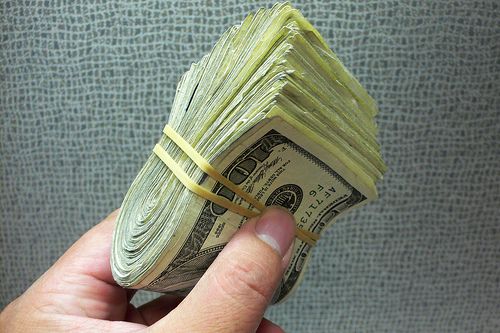
photo by refracted moments/flickrBut the most recent increase in GDP still isn’t strong enough to make a dent in the country’s high unemployment rate, stuck at 9.6% in recent months. Analysts say GDP growth of at least 3% is needed to bring down the jobless figure, but many don’t expect the economy to perform that well in the fourth quarter or early next year.

The Federal Reserve’s latest economic outlook, to be released later Tuesday, is likely to reflect concerns among policymakers that unemployment will remain very high in the U.S. for the foreseeable future.

American corporations, on the other hand, have rebounded robustly from the recession. Tuesday’s report showed corporate profits jumped 28% in the third quarter from a year earlier, to an annualized total of $1.66 trillion. That’s a record high and reflects deep cost-cutting in the past and increases in demand for goods and services.

That’s right. Despite record unemployment, and no hope for reductions cleaa rerly in sight, corporations have experienced all-time record profits, the highest since the Commerce Department started tracking the figure 60 years ago. They’ve learned to produce as many or more goods without workers.

This is something of a dream for corporate America – bigger profits without those meddling workers to pay. This is the seventh straight quarter of corporate profit growth, with none of those benefits being shared with the working class. “Uncertainty” is blamed for the lack of job growth, but corporations are sitting on giant mounds of cash while they bask in the glow of their strategy to increase their profit margins by cost-cutting.

The other part of this is that multinational corporations are reaping profits from increased consumer spending in China and India. Their markets there have expanded greatly in the past few years.

In the other side of the funhouse mirror, American workers continue to have little hope for returning to the job. They are anxious about their future prospects, and while they continue to spend on necessities, they have trouble with the more substantive payments. Foreclosures and defaults continue unabated, and home sales have dropped, which will probably lead to lower home prices.

But capitalism is working, and the great malefactors of wealth are happy. Happy Thanksgiving.

article by David Dayen of Firedoglake.com

photograph by Refracted Moments/flickr

© 2010 Firedoglake.com
 

Prison Economics Help Drive Arizona Immigration Law

NPR– For all the attention given to Arizona’s immigration law, one part of the story is not well-known. The state approved a law last April to answer concerns about illegal immigrants. The new law fueled a national debate, and this morning we’ll tell you who drafted that law.

Read full transcript HERE.

Photo by flickr user Casey Serin

© NPR, 2010

BP Enjoys Lobbying Strength as Investigation Looms

COMMON DREAMS– On Thursday, oil giant BP asked for U.S. government assistance in cleaning up massive amounts of crude oil ominously approaching the coast of Louisiana — the messy results of a recent oil rig explosion 40 miles off-shore.

In response, the Obama administration promised support in both clean up and containment of the environmental crisis. The president also sent clear signals indicating a potential federal investigation to determine cause and responsibility for the accident.

If BP faces heavy federal scrutiny, it’s well-positioned to fight back: The London-based company has consistently spent top dollar to influence legislative and regulatory activity in Washington, D.C., the Center for Responsive Politics finds.

During the 2008 election cycle, individuals and political action committees associated with BP — a Center for Responsive Politics’ “heavy hitter” — contributed half a million dollars to federal candidates. About 40 percent of these donations went to Democrats. The top recipient of BP-related donations during the 2008 cycle was President Barack Obama himself, who collected $71,000.

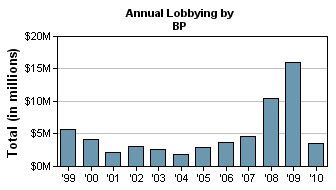
BP regularly lobbies on Capitol Hill, as well. In 2009, the company spent a massive $16 million to influence legislation. During the first quarter of 2010, it spent $3.53 million on federal lobbying efforts, ranking it second (behind ConocoPhillips) among all oil and gas industry interests.

Its registered lobbyists include a number of former federal government and high-ranking political campaign officials, including longtime political operative Tony Podesta, former congressional chief of staff Bob Brooks, former congressional legislative director David Pore and vice presidential aide Michael S. Berman, the Center’s research shows. 

The oil and gas industry, of which BP is a member, reported $169 million in 2009 lobbying expenditures.

Comparatively, the entire environmental industry spent $22 million on lobbying in 2009 — not much more than BP alone spent for the year. The most active member of the environmental industry, the Nature Conservancy, reported $2.2 million in 2009 expenditures. Last year, BP was active lobbying on the American Clean Energy Leadership Act of 2009, which allows increased oil and gas leasing in the Gulf of Mexico, in areas closer to shore than current law allows.

The bill also calls for additional research and inventory of oil and gas reserves in the U.S. Outer Continental Shelf. The bill is sponsored by Sen. Jeff Bingaman (D-N.M.), who has received $14,000 in campaign donations during the past two decades from those associated with BP, the Center finds.

In 2009, BP also lobbied on the Oil Spill Prevention Act of 2009 and the Clean Water Restoration Act.

The oil spill, which has yet to be remedied, was caused by an explosion on a BP-leased oil rig on April 20.

A state of emergency has since been enacted in Louisiana, and the White House has designated it an event of “national significance.” The oil well is reportedly leaking between 1,000 and 5,000 barrels a day, and rescue crews are trying to eliminate  the oil by setting it on fire, breaking it up with chemicals and skimming it off the surface of the ocean. Already, questions are being asked about cause and responsibility.

Upon hearing the cry for help in the Gulf of Mexico, Rep. Henry A. Waxman (D-Cal.), chairman of the House Energy and Commerce Committee, called for a “full blown investigation.”

In 2009, individuals and political action committees associated with BP donated $16,000 to members of the House Energy and Commerce Committee.

In addition, five of the all-time top 10 recipients of BP money in the House of Representatives sit on the House Energy Committee: John D. Dingell (D-Mich.) Joe Barton (R-Tex.), Ralph M. Hall (R-Tex.), Roy Blunt (R-Mo.) and Fred Upton, (R-Mich.).

All have received upward of $13,000 from BP-related individuals and political action committees during the past two decades. Dingell, the second most favored recipient of BP money in the House, has received $31,000.

Written by Cassandra LaRussa

© COPYRIGHT COMMON DREAMS, 2010
