MEDIA ROOTS- One domino falls while another globalist target awaits toppling. Before the fog of war in Libya begins to sift, the political and media establishment have already latched their tentacles onto another chess piece in the Middle East: Syria. Last week, the US slapped economic sanctions on Syria for President Bashar al-Assad’s human rights abuses, freezing assets and blocking US business in the region.
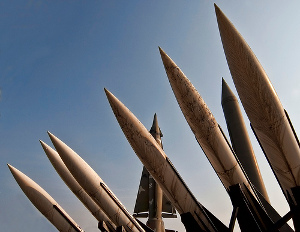
Besides the saber rattling coming from the US government and the EU, the corporate media has launched a fear mongering campaign about Syria’s stockpile of chemical weapons that is all too reminiscent of the WMD propaganda preceding the Iraqi invasion. The Washington Post released an article that is riddled with exaggerations and hyperbolic scenarios about Syria’s chemical arsenal, calling it the “largest in the world, consisting of tens of tons of highly lethal chemical agents.”
Even if the reports of Syria’s stockpile of weapons are true, it’s still completely illogical to engage militarily with a country simply for harboring chemical or nuclear weapons– especially since the US has the second largest stockpile of nuclear weapons in the entire world.
Abby
***
 WASHINGTON POST– In 2008, a secret State Department cable warned of a growing
chemical weapons threat from a Middle Eastern country whose autocratic
leader had a long history of stirring up trouble in the region. The
leader, noted for his “support for terrorist organizations,” was
attempting to buy technology from other countries to upgrade an already
fearsome stockpile of deadly poisons, the department warned.
WASHINGTON POST– In 2008, a secret State Department cable warned of a growing
chemical weapons threat from a Middle Eastern country whose autocratic
leader had a long history of stirring up trouble in the region. The
leader, noted for his “support for terrorist organizations,” was
attempting to buy technology from other countries to upgrade an already
fearsome stockpile of deadly poisons, the department warned.
The Middle Eastern state with the dangerous chemicals was not
Libya, whose modest stockpile was thrust into the spotlight last week
because of fighting there. It was Syria, another violence-torn Arab
state whose advanced weapons are drawing new concern as the country
drifts toward an uncertain future.
A sudden collapse of the government of Syrian President Bashar
al-Assad could mean a breakdown in controls over the country’s weapons,
U.S. officials and weapons experts said in interviews. But while Libya’s
chemical arsenal consists of unwieldy canisters filled mostly with
mustard gas, the World War I-era blistering agent, Syria possesses some
of the deadliest chemicals ever to be weaponized, dispersed in thousands
of artillery shells and warheads that are easy to transport.
Syria’s
preferred poison is not mustard gas but sarin, the nerve agent that
killed 13 people and sickened about 1,000 during a terrorist attack on
the Tokyo subway system in 1995. Sarin, which is lethal if inhaled even
in minute quantities, can also be used to contaminate water and food
supplies.
Read more about US Says Libyan Chemical, Nuclear Materials Secure.
© 2011 Yahoo News
Photo by Flickr user Dapper snapper




 RAW STORY