


MEDIA ROOTS- In an empirical study using complex systems analysis models, mathematical theorists in Zurich have revealed the architecture of transnational corporations’ (TNCs) interconnectedness. The report bolsters the charges made of late by the Occupy Wall Street Movement touting society’s obscene inequality—1% of the population owns almost half of all U.S. wealth. This study’s findings, an uncanny correlative of the individual TNC to the individual ruling-class elitist, reveal that less than 1% of all TNCs essentially control 40% of the global economy.
Messina
***
 NEW SCIENTIST— AS PROTESTS against financial power sweep the world this week, science may have confirmed the protesters’ worst fears. An analysis of the relationships between 43,000 transnational corporations has identified a relatively small group of companies, mainly banks, with disproportionate power over the global economy.
The study’s assumptions have attracted some criticism, but complex systems analysts contacted by New Scientist say it is a unique effort to untangle control in the global economy. Pushing the analysis further, they say, could help to identify ways of making global capitalism more stable.
The idea that a few bankers control a large chunk of the global economy might not seem like news to New York’s Occupy Wall Street movement and protesters elsewhere (see photo). But the study, by a trio of complex systems theorists at the Swiss Federal Institute of Technology in Zurich, is the first to go beyond ideology to empirically identify such a network of power. It combines the mathematics long used to model natural systems with comprehensive corporate data to map ownership among the world’s transnational corporations (TNCs).
“Reality is so complex, we must move away from dogma, whether it’s conspiracy theories or free-market,” says James Glattfelder. “Our analysis is reality-based.”
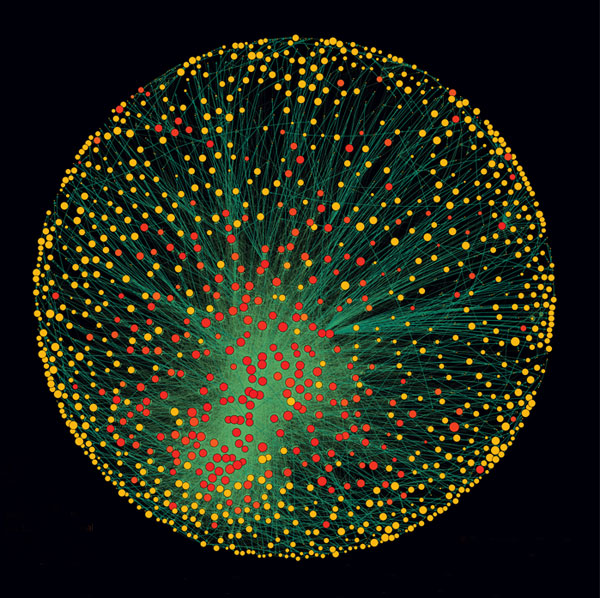
The work, to be published in PLoS One, revealed a core of 1318 companies with interlocking ownerships (see image). Each of the 1318 had ties to two or more other companies, and on average they were connected to 20. What’s more, although they represented 20 per cent of global operating revenues, the 1318 appeared to collectively own through their shares the majority of the world’s large blue chip and manufacturing firms – the “real” economy – representing a further 60 per cent of global revenues.
When the team further untangled the web of ownership, it found much of it tracked back to a “super-entity” of 147 even more tightly knit companies – all of their ownership was held by other members of the super-entity – that controlled 40 per cent of the total wealth in the network. “In effect, less than 1 per cent of the companies were able to control 40 per cent of the entire network,” says Glattfelder. Most were financial institutions. The top 20 included Barclays Bank, JPMorgan Chase & Co, and The Goldman Sachs Group.
Read more about the capitalist network that runs the world.
© 2011 Reed Business Information Ltd.
Image by PLoS One
 MEDIA ROOTS- In an ideal world, your partner would not judge you based on
the way your last relationship ended. Unfortunately, as a recent study in the
scientific journal
MEDIA ROOTS- In an ideal world, your partner would not judge you based on
the way your last relationship ended. Unfortunately, as a recent study in the
scientific journal 