
Operation Northwoods Proposed False Flag Attack to Gain Support for Cuban War

ABC NEWS– In the early 1960s, America’s top military leaders reportedly drafted plans to kill innocent people and commit acts of terrorism in U.S. cities to create public support for a war against Cuba.

Code named Operation Northwoods, the plans reportedly included the possible assassination of Cuban émigrés, sinking boats of Cuban refugees on the high seas, hijacking planes, blowing up a U.S. ship, and even orchestrating violent terrorism in U.S. cities.

The plans were developed as ways to trick the American public and the international community into supporting a war to oust Cuba’s then new leader, communist Fidel Castro.

America’s top military brass even contemplated causing U.S. military casualties, writing: “We could blow up a U.S. ship in Guantanamo Bay and blame Cuba,” and, “casualty lists in U.S. newspapers would cause a helpful wave of national indignation.”

Details of the plans are described in Body of Secrets (Doubleday), a new book by investigative reporter James Bamford about the history of America’s largest spy agency, the National Security Agency. However, the plans were not connected to the agency, he notes.

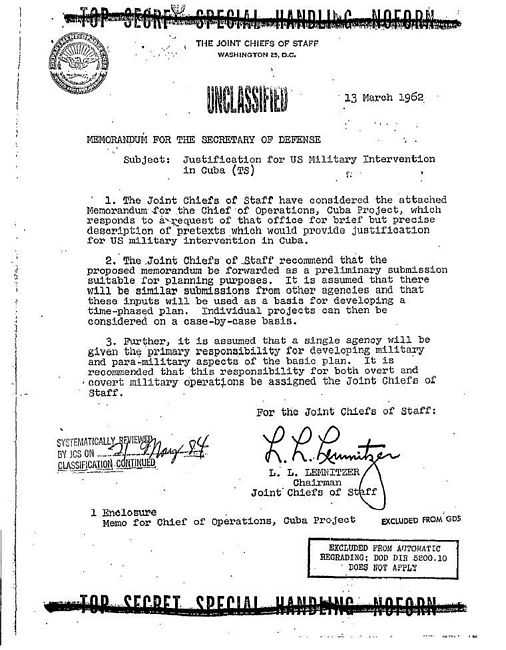
The plans had the written approval of all of the Joint Chiefs of Staff and were presented to President Kennedy’s defense secretary, Robert McNamara, in March 1962. But they apparently were rejected by the civilian leadership and have gone undisclosed for nearly 40 years.

“These were Joint Chiefs of Staff documents. The reason these were held secret for so long is the Joint Chiefs never wanted to give these up because they were so embarrassing,” Bamford told ABCNEWS.com.

“The whole point of a democracy is to have leaders responding to the public will, and here this is the complete reverse, the military trying to trick the American people into a war that they want but that nobody else wants.”

Gunning for War

The documents show “the Joint Chiefs of Staff drew up and approved plans for what may be the most corrupt plan ever created by the U.S. government,” writes Bamford.

The Joint Chiefs even proposed using the potential death of astronaut John Glenn during the first attempt to put an American into orbit as a false pretext for war with Cuba, the documents show.

Should the rocket explode and kill Glenn, they wrote, “the objective is to provide irrevocable proof … that the fault lies with the Communists et all Cuba [sic].”

The plans were motivated by an intense desire among senior military leaders to depose Castro, who seized power in 1959 to become the first communist leader in the Western Hemisphere — only 90 miles from U.S. shores.

The earlier CIA-backed Bay of Pigs invasion of Cuba by Cuban exiles had been a disastrous failure, in which the military was not allowed to provide firepower.The military leaders now wanted a shot at it.

“The whole thing was so bizarre,” says Bamford, noting public and international support would be needed for an invasion, but apparently neither the American public, nor the Cuban public, wanted to see U.S. troops deployed to drive out Castro.

Reflecting this, the U.S. plan called for establishing prolonged military — not democratic — control over the island nation after the invasion.

“That’s what we’re supposed to be freeing them from,” Bamford says. “The only way we would have succeeded is by doing exactly what the Russians were doing all over the world, by imposing a government by tyranny, basically what we were accusing Castro himself of doing.”

Over the Edge’

The Joint Chiefs at the time were headed by Eisenhower appointee Army Gen. Lyman L. Lemnitzer, who, with the signed plans in hand made a pitch to McNamara on March 13, 1962, recommending Operation Northwoods be run by the military.

Whether the Joint Chiefs’ plans were rejected by McNamara in the meeting is not clear. But three days later, President Kennedy told Lemnitzer directly there was virtually no possibility of ever using overt force to take Cuba, Bamford reports. Within months, Lemnitzer would be denied another term as chairman and transferred to another job.

The secret plans came at a time when there was distrust in the military leadership about their civilian leadership, with leaders in the Kennedy administration viewed as too liberal, insufficiently experienced and soft on communism. At the same time, however, there real were concerns in American society about their military overstepping its bounds.

There were reports U.S. military leaders had encouraged their subordinates to vote conservative during the election.

And at least two popular books were published focusing on a right-wing military leadership pushing the limits against government policy of the day.

The Senate Foreign Relations Committee published its own report on right-wing extremism in the military, warning a “considerable danger” in the “education and propaganda activities of military personnel” had been uncovered. The committee even called for an examination of any ties between Lemnitzer and right-wing groups. But Congress didn’t get wind of Northwoods, says Bamford.

“Although no one in Congress could have known at the time,” he writes, “Lemnitzer and the Joint Chiefs had quietly slipped over the edge.”

Even after Lemnitzer was gone, he writes, the Joint Chiefs continued to plan “pretext” operations at least through 1963.

One idea was to create a war between Cuba and another Latin American country so that the United States could intervene. Another was to pay someone in the Castro government to attack U.S. forces at the Guantanamo naval base — an act, which Bamford notes, would have amounted to treason. And another was to fly low level U-2 flights over Cuba, with the intention of having one shot down as a pretext for a war.

“There really was a worry at the time about the military going off crazy and they did, but they never succeeded, but it wasn’t for lack of trying,” he says.

After 40 Years

Ironically, the documents came to light, says Bamford, in part because of the 1992 Oliver Stone film JFK, which examined the possibility of a conspiracy behind the assassination of President Kennedy.

As public interest in the assassination swelled after JFK’s release, Congress passed a law designed to increase the public’s access to government records related to the assassination.

The author says a friend on the board tipped him off to the documents.

Afraid of a congressional investigation, Lemnitzer had ordered all Joint Chiefs documents related to the Bay of Pigs destroyed, says Bamford. But somehow, these remained.

“The scary thing is none of this stuff comes out until 40 years after,” says Bamford.
See Declassified Document HERE.

© ABC NEWS 2001

In the early 1960s, America’s top military leaders reportedly drafted plans to kill innocent people and commit acts of terrorism in U.S. cities to create public support for a war against Cuba.

Code named Operation Northwoods, the plans reportedly included the possible assassination of Cuban émigrés, sinking boats of Cuban refugees on the high seas, hijacking planes, blowing up a U.S. ship, and even orchestrating violent terrorism in U.S. cities.

The plans were developed as ways to trick the American public and the international community into supporting a war to oust Cuba’s then new leader, communist Fidel Castro.

America’s top military brass even contemplated causing U.S. military casualties, writing: “We could blow up a U.S. ship in Guantanamo Bay and blame Cuba,” and, “casualty lists in U.S. newspapers would cause a helpful wave of national indignation.”

Details of the plans are described in Body of Secrets (Doubleday), a new book by investigative reporter James Bamford about the history of America’s largest spy agency, the National Security Agency. However, the plans were not connected to the agency, he notes.

The plans had the written approval of all of the Joint Chiefs of Staff and were presented to President Kennedy’s defense secretary, Robert McNamara, in March 1962. But they apparently were rejected by the civilian leadership and have gone undisclosed for nearly 40 years.

“These were Joint Chiefs of Staff documents. The reason these were held secret for so long is the Joint Chiefs never wanted to give these up because they were so embarrassing,” Bamford told ABCNEWS.com.

“The whole point of a democracy is to have leaders responding to the public will, and here this is the complete reverse, the military trying to trick the American people into a war that they want but that nobody else wants.”

Gunning for War

The documents show “the Joint Chiefs of Staff drew up and approved plans for what may be the most corrupt plan ever created by the U.S. government,” writes Bamford.

The Joint Chiefs even proposed using the potential death of astronaut John Glenn during the first attempt to put an American into orbit as a false pretext for war with Cuba, the documents show.

Should the rocket explode and kill Glenn, they wrote, “the objective is to provide irrevocable proof … that the fault lies with the Communists et all Cuba [sic].”

The plans were motivated by an intense desire among senior military leaders to depose Castro, who seized power in 1959 to become the first communist leader in the Western Hemisphere — only 90 miles from U.S. shores.

The earlier CIA-backed Bay of Pigs invasion of Cuba by Cuban exiles had been a disastrous failure, in which the military was not allowed to provide firepower.The military leaders now wanted a shot at it.

“The whole thing was so bizarre,” says Bamford, noting public and international support would be needed for an invasion, but apparently neither the American public, nor the Cuban public, wanted to see U.S. troops deployed to drive out Castro.

Reflecting this, the U.S. plan called for establishing prolonged military — not democratic — control over the island nation after the invasion.

“That’s what we’re supposed to be freeing them from,” Bamford says. “The only way we would have succeeded is by doing exactly what the Russians were doing all over the world, by imposing a government by tyranny, basically what we were accusing Castro himself of doing.”

‘Over the Edge’

The Joint Chiefs at the time were headed by Eisenhower appointee Army Gen. Lyman L. Lemnitzer, who, with the signed plans in hand made a pitch to McNamara on March 13, 1962, recommending Operation Northwoods be run by the military.

Whether the Joint Chiefs’ plans were rejected by McNamara in the meeting is not clear. But three days later, President Kennedy told Lemnitzer directly there was virtually no possibility of ever using overt force to take Cuba, Bamford reports. Within months, Lemnitzer would be denied another term as chairman and transferred to another job.

The secret plans came at a time when there was distrust in the military leadership about their civilian leadership, with leaders in the Kennedy administration viewed as too liberal, insufficiently experienced and soft on communism. At the same time, however, there real were concerns in American society about their military overstepping its bounds.

There were reports U.S. military leaders had encouraged their subordinates to vote conservative during the election.

And at least two popular books were published focusing on a right-wing military leadership pushing the limits against government policy of the day.

The Senate Foreign Relations Committee published its own report on right-wing extremism in the military, warning a “considerable danger” in the “education and propaganda activities of military personnel” had been uncovered. The committee even called for an examination of any ties between Lemnitzer and right-wing groups. But Congress didn’t get wind of Northwoods, says Bamford.

“Although no one in Congress could have known at the time,” he writes, “Lemnitzer and the Joint Chiefs had quietly slipped over the edge.”

Even after Lemnitzer was gone, he writes, the Joint Chiefs continued to plan “pretext” operations at least through 1963.

One idea was to create a war between Cuba and another Latin American country so that the United States could intervene. Another was to pay someone in the Castro government to attack U.S. forces at the Guantanamo naval base — an act, which Bamford notes, would have amounted to treason. And another was to fly low level U-2 flights over Cuba, with the intention of having one shot down as a pretext for a war.

“There really was a worry at the time about the military going off crazy and they did, but they never succeeded, but it wasn’t for lack of trying,” he says.

After 40 Years

Ironically, the documents came to light, says Bamford, in part because of the 1992 Oliver Stone film JFK, which examined the possibility of a conspiracy behind the assassination of President Kennedy.


As public interest in the assassination swelled after JFK’s release, Congress passed a law designed to increase the public’s access to government records related to the assassination.

The author says a friend on the board tipped him off to the documents.

Afraid of a congressional investigation, Lemnitzer had ordered all Joint Chiefs documents related to the Bay of Pigs destroyed, says Bamford. But somehow, these remained.

“The scary thing is none of this stuff comes out until 40 years after,” says Bamford.

The Rhetoric of 9/11: George W. Bush Speech on 9/20/01

PBS– Transcript:

Mr. Speaker, Mr. President Pro Tempore, members of Congress, and fellow Americans:

In the normal course of events, Presidents come to this chamber to report on the state of the Union. Tonight, no such report is needed. It has already been delivered by the American people.

We have seen it in the courage of passengers, who rushed terrorists to save others on the ground — passengers like an exceptional man named Todd Beamer. And would you please help me to welcome his wife, Lisa Beamer, here tonight. We have seen the state of our Union in the endurance of rescuers, working past exhaustion. We’ve seen the unfurling of flags, the lighting of candles, the giving of blood, the saying of prayers — in English, Hebrew, and Arabic. We have seen the decency of a loving and giving people who have made the grief of strangers their own. My fellow citizens, for the last nine days, the entire world has seen for itself the state of our Union — and it is strong.

Tonight we are a country awakened to danger and called to defend freedom. Our grief has turned to anger, and anger to resolution. Whether we bring our enemies to justice, or bring justice to our enemies, justice will be done. I thank the Congress for its leadership at such an important time. All of America was touched on the evening of the tragedy to see Republicans and Democrats joined together on the steps of this Capitol, singing “God Bless America.” And you did more than sing; you acted, by delivering 40 billion dollars to rebuild our communities and meet the needs of our military. Speaker Hastert, Minority Leader Gephardt, Majority Leader Daschle, and Senator Lott, I thank you for your friendship, for your leadership, and for your service to our country. And on behalf of the American people, I thank the world for its outpouring of support. America will never forget the sounds of our National Anthem playing at Buckingham Palace, on the streets of Paris, and at Berlin’s Brandenburg Gate.

We will not forget South Korean children gathering to pray outside our embassy in Seoul, or the prayers of sympathy offered at a mosque in Cairo. We will not forget moments of silence and days of mourning in Australia and Africa and Latin America. Nor will we forget the citizens of 80 other nations who died with our own: dozens of Pakistanis; more than 130 Israelis; more than 250 citizens of India; men and women from El Salvador, Iran, Mexico, and Japan; and hundreds of British citizens. America has no truer friend than Great Britain. Once again, we are joined together in a great cause — so honored the British Prime Minister has crossed an ocean to show his unity with America. Thank you for coming, friend.

On September the 11th, enemies of freedom committed an act of war against our country. Americans have known wars — but for the past 136 years, they have been wars on foreign soil, except for one Sunday in 1941. Americans have known the casualties of war — but not at the center of a great city on a peaceful morning.  Americans have known surprise attacks — but never before on thousands of civilians. All of this was brought upon us in a single day — and night fell on a different world, a world where freedom itself is under attack. Americans have many questions tonight. Americans are asking: Who attacked our country?The evidence we have gathered all points to a collection of loosely affiliated terrorist organizations known as al Qaeda. They are some of the murderers indicted for bombing American embassies in Tanzania and Kenya, and responsible for bombing the USS Cole. Al Qaeda is to terror what the mafia is to crime. But its goal is not making money; its goal is remaking the world — and imposing its radical beliefs on people everywhere.

The terrorists practice a fringe form of Islamic extremism that has been rejected by Muslim scholars and the vast majority of Muslim clerics, a fringe movement that perverts the peaceful teachings of Islam. The terrorists’ directive commands them to kill Christians and Jews, to kill all Americans, and make no distinctions among military and civilians, including women and children. This group and its leader — a person named Usama bin Laden — are linked to many other organizations in different countries, including the Egyptian Islamic Jihad and the Islamic Movement of Uzbekistan. There are thousands of these terrorists in more than 60 countries. They are recruited from their own nations and neighborhoods and brought to camps in places like Afghanistan, where they are trained in the tactics of terror. They are sent back to their homes or sent to hide in countries around the world to plot evil and destruction.

The leadership of al Qaeda has great influence in Afghanistan and supports the Taliban regime in controlling most of that country. In Afghanistan, we see al Qaeda’s vision for the world. Afghanistan’s people have been brutalized; many are starving and many have fled. Women are not allowed to attend school. You can be jailed for owning a television. Religion can be practiced only as their leaders dictate. A man can be jailed in Afghanistan if his beard is not long enough.

The United States respects the people of Afghanistan. After all, we are currently its largest source of humanitarian aid; but we condemn the Taliban regime. It is not only repressing its own people, it is threatening people everywhere by sponsoring and sheltering and supplying terrorists. By aiding and abetting murder, the Taliban regime is committing murder.

And tonight, the United States of America makes the following demands on the Taliban: Deliver to United States authorities all the leaders of al Qaeda who hide in your land. Release all foreign nationals, including American citizens, you have unjustly imprisoned. Protect foreign journalists, diplomats, and aid workers in your country. Close immediately and permanently every terrorist training camp in Afghanistan, and hand over every terrorist, and every person in their support structure, to appropriate authorities. Give the United States full access to terrorist training camps, so we can make sure they are no longer operating. These demands are not open to negotiation or discussion. The Taliban must act, and act immediately. They will hand over the terrorists, or they will share in their fate.

I also want to speak tonight directly to Muslims throughout the world. We respect your faith. It’s practiced freely by many millions of Americans, and by millions more in countries that America counts as friends. Its teachings are good and peaceful, and those who commit evil in the name of Allah blaspheme the name of Allah. The terrorists are traitors to their own faith, trying, in effect, to hijack Islam itself. The enemy of America is not our many Muslim friends; it is not our many Arab friends. Our enemy is a radical network of terrorists, and every government that supports them. Our war on terror begins with al Qaeda, but it does not end there. It will not end until every terrorist group of global reach has been found, stopped, and defeated.

Americans are asking, why do they hate us? They hate what they see right here in this chamber — a democratically elected government. Their leaders are self-appointed. They hate our freedoms — our freedom of religion, our freedom of speech, our freedom to vote and assemble and disagree with each other. They want to overthrow existing governments in many Muslim countries, such as Egypt, Saudi Arabia, and Jordan. They want to drive Israel out of the Middle East. They want to drive Christians and Jews out of vast regions of Asia and Africa. These terrorists kill not merely to end lives, but to disrupt and end a way of life. With every atrocity, they hope that America grows fearful, retreating from the world and forsaking our friends. They stand against us, because we stand in their way.

We are not deceived by their pretenses to piety. We have seen their kind before. They are the heirs of all the murderous ideologies of the 20th century. By sacrificing human life to serve their radical visions — by abandoning every value except the will to power — they follow in the path of fascism, Nazism, and totalitarianism. And they will follow that path all the way, to where it ends: in history’s unmarked grave of discarded lies. Americans are asking: How will we fight and win this war? We will direct every resource at our command — every means of diplomacy, every tool of intelligence, every instrument of law enforcement, every financial influence, and every necessary weapon of war — to the disruption and to the defeat of the global terror network.

Now this war will not be like the war against Iraq a decade ago, with a decisive liberation of territory and a swift conclusion. It will not look like the air war above Kosovo two years ago, where no ground troops were used and not a single American was lost in combat. Our response involves far more than instant retaliation and isolated strikes. Americans should not expect one battle, but a lengthy campaign, unlike any other we have ever seen. It may include dramatic strikes, visible on TV, and covert operations, secret even in success. We will starve terrorists of funding, turn them one against another, drive them from place to place, until there is no refuge or no rest. And we will pursue nations that provide aid or safe haven to terrorism. Every nation, in every region, now has a decision to make. Either you are with us, or you are with the terrorists. From this day forward, any nation that continues to harbor or support terrorism will be regarded by the United States as a hostile regime.

Our nation has been put on notice: We’re not immune from attack. We will take defensive measures against terrorism to protect Americans. Today, dozens of federal departments and agencies, as well as state and local governments, have responsibilities affecting homeland security. These efforts must be coordinated at the highest level. So tonight I announce the creation of a Cabinet-level position reporting directly to me — the Office of Homeland Security. And tonight I also announce a distinguished American to lead this effort, to strengthen American security: a military veteran, an effective governor, a true patriot, a trusted friend — Pennsylvania’s Tom Ridge. He will lead, oversee, and coordinate a comprehensive national strategy to safeguard our country against terrorism, and respond to any attacks that may come.

These measures are essential. But the only way to defeat terrorism as a threat to our way of life is to stop it, eliminate it, and destroy it where it grows. Many will be involved in this effort, from FBI agents to intelligence operatives to the reservists we have called to active duty. All deserve our thanks, and all have our prayers. And tonight, a few miles from the damaged Pentagon, I have a message for our military: Be ready. I’ve called the Armed Forces to alert, and there is a reason. The hour is coming when America will act, and you will make us proud. This is not, however, just America’s fight. And what is at stake is not just America’s freedom. This is the world’s fight. This is civilization’s fight. This is the fight of all who believe in progress and pluralism, tolerance and freedom.

We ask every nation to join us. We will ask, and we will need, the help of police forces, intelligence services, and banking systems around the world. The United States is grateful that many nations and many international organizations have already responded — with sympathy and with support. Nations from Latin America, to Asia, to Africa, to Europe, to the Islamic world. Perhaps the NATO Charter reflects best the attitude of the world: An attack on one is an attack on all. The civilized world is rallying to America’s side. They understand that if this terror goes unpunished, their own cities, their own citizens may be next. Terror, unanswered, can not only bring down buildings, it can threaten the stability of legitimate governments. And you know what? We’re not going to allow it.

Americans are asking: What is expected of us? I ask you to live your lives, and hug your children. I know many citizens have fears tonight, and I ask you to be calm and resolute, even in the face of a continuing threat. I ask you to uphold the values of America, and remember why so many have come here. We are in a fight for our principles, and our first responsibility is to live by them. No one should be singled out for unfair treatment or unkind words because of their ethnic background or religious faith. I ask you to continue to support the victims of this tragedy with your contributions. Those who want to give can go to a central source of information, libertyunites.org, to find the names of groups providing direct help in New York, Pennsylvania, and Virginia.

The thousands of FBI agents who are now at work in this investigation may need your cooperation, and I ask you to give it. I ask for your patience, with the delays and inconveniences that may accompany tighter security; and for your patience in what will be a long struggle. I ask your continued participation and confidence in the American economy. Terrorists attacked a symbol of American prosperity. They did not touch its source. America is successful because of the hard work, and creativity, and enterprise of our people. These were the true strengths of our economy before September 11th, and they are our strengths today. And, finally, please continue praying for the victims of terror and their families, for those in uniform, and for our great country. Prayer has comforted us in sorrow, and will help strengthen us for the journey ahead.

Tonight I thank my fellow Americans for what you have already done and for what you will do. And ladies and gentlemen of the Congress, I thank you, their representatives, for what you have already done and for what we will do together. Tonight, we face new and sudden national challenges. We will come together to improve air safety, to dramatically expand the number of air marshals on domestic flights, and take new measures to prevent hijacking. We will come together to promote stability and keep our airlines flying, with direct assistance during this emergency. We will come together to give law enforcement the additional tools it needs to track down terror here at home. We will come together to strengthen our intelligence capabilities to know the plans of terrorists before they act, and to find them before they strike.

We will come together to take active steps that strengthen America’s economy, and put our people back to work. Tonight we welcome two leaders who embody the extraordinary spirit of all New Yorkers: Governor George Pataki, and Mayor Rudolph Giuliani. As a symbol of America’s resolve, my administration will work with Congress, and these two leaders, to show the world that we will rebuild New York City.

After all that has just passed — all the lives taken, and all the possibilities and hopes that died with them — it is natural to wonder if America’s future is one of fear.  Some speak of an age of terror. I know there are struggles ahead, and dangers to face. But this country will define our times, not be defined by them. As long as the United States of America is determined and strong, this will not be an age of terror; this will be an age of liberty, here and across the world.

Great harm has been done to us. We have suffered great loss. And in our grief and anger we have found our mission and our moment. Freedom and fear are at war.  The advance of human freedom — the great achievement of our time, and the great hope of every time — now depends on us. Our nation, this generation will lift a dark threat of violence from our people and our future. We will rally the world to this cause by our efforts, by our courage. We will not tire, we will not falter, and we will not fail.

It is my hope that in the months and years ahead, life will return almost to normal.  We’ll go back to our lives and routines, and that is good.  Even grief recedes with time and grace. But our resolve must not pass. Each of us will remember what happened that day, and to whom it happened. We’ll remember the moment the news came — where we were and what we were doing. Some will remember an image of a fire, or a story of rescue. Some will carry memories of a face and a voice gone forever.

And I will carry this: It is the police shield of a man named George Howard, who died at the World Trade Center trying to save others. It was given to me by his mom, Arlene, as a proud memorial to her son. This is my reminder of lives that ended, and a task that does not end. I will not forget this wound to our country or those who inflicted it. I will not yield; I will not rest; I will not relent in waging this struggle for freedom and security for the American people. The course of this conflict is not known, yet its outcome is certain. Freedom and fear, justice and cruelty, have always been at war, and we know that God is not neutral between them.

Fellow citizens, we’ll meet violence with patient justice — assured of the rightness of our cause, and confident of the victories to come. In all that lies before us, may God grant us wisdom, and may He watch over the United States of America. Thank you.

Photo by flickr user Editor

Bush Spent Over $1.6 Billion on Advertising and PR Contracts

TRUTHOUT– Today Rep. Henry A. Waxman, Democratic Leader Nancy Pelosi, Rep. George Miller, Rep. Elijah E. Cummings, and other senior Democrats released a new Government Accountability Office report finding that the Bush Administration spent more than $1.6 billion in public relations and media contracts in a two and a half year span.

“The government is spending over a billion dollars per year on PR and advertising,” said Rep. Waxman. “Careful oversight of this spending is essential given the track record of the Bush Administration, which has used taxpayer dollars to fund covert propaganda within the United States.”

“No amount of money will successfully sell the Bush Administration’s failed policies, from the war in Iraq, to its disastrous energy policy, to its confusing Medicare prescription drug benefits,” said Democratic Leader Pelosi. “The American people know the Bush Administration is on the wrong track and the White House PR machine won’t change that fact.”

“The extent of the Bush Administration’s propaganda effort is unprecedented and disturbing,” said Rep. Miller. “The fact is that after all the spin, the American people are stuck with high prescription drug prices, high gas prices, and high college costs. This report raises serious questions about this Administration’s priorities for the country and I would hope that my colleagues on both sides of the aisle would agree that changes need to be made to reign in the President’s propaganda machine.”

“It is unbelievable that the Administration, on several occasions, has used limited taxpayer dollars to secretly promote initiatives such as No Child Left Behind, while underfunding money for our schools, books, technology, and after school programs,” said Rep. Elijah E. Cummings.

Democrats requested that GAO conduct the study after evidence emerged last year that the Bush Administration had commissioned “covert propaganda” from public relations firms. Several federal departments had hired firms to develop “video new releases” to promote department initiatives which appeared to television viewers to be independent newscasts. Other revelations that triggered the GAO report included the disclosure that the Department of Education paid conservative commentator Armstrong Williams to promote the No Child Left Behind Act on the radio and in his columns.

To conduct its study, GAO obtained information from seven federal departments on all public relations, advertising, and media contracts during 2003, 2004, and the first two quarters of 2005. GAO found that during that time:

-The Administration spent $1.6 billion on contracts with advertising agencies ($1.4 billion), public relations firms ($197 million), and media organizations and individual members of the media ($15 million).The Department of Defense spent the most on media contracts, with contracts worth $1.1 billion. The Department of Health and Human Services spent more than $300 million on these contracts, the Department of Treasury spent $152 million, and the Department of Homeland Security spent $24 million during this period.

-The Administration’s public relations and advertising contracts spanned a wide range of issues, including Administration priorities like “marriage-related research initiatives,” message development presenting “the Army’s strategic perspective in the Global War on Terrorism,” and an FDA contract to warn the public of the consequences and potential danger of importing prescription drugs from other nations.

The detailed list of contracts provided by the Air Force demonstrates the wide range of public relations and advertising contracting entered into by the federal government. This list included $179 million for a recruitment advertising campaign, more than $35,000 for promotional materials for a golf program, including “golf towel with embroidered design and golf tees with imprint,” and $10, 212 for “prize giveaways, such as cruises to Mediterranean and to Canada/New England.”

GAO’s accounting of the Bush Administration’s public relations and advertising contracts is limited. GAO surveyed only seven of the 15 cabinet-level departments, relied on self-reported information from the agencies, and did not include subcontracts, task orders on existing contracts, or public relations work done by government employees.

For a fact sheet on the GAO report and the report itself, visit www.democrats.reform.house.gov.

© TRUTHOUT 2006

Photo by flickr user purpleslog

Bush Lied About the War? Nope, No News There!

SALON– Halfway through Sunday’s “Meet the Press,” host Tim Russert, interviewing Republican National Committee chairman Ken Mehlman, asked about a secret, top-level British government memorandum. Consisting of minutes from a July 23, 2002, meeting attended by Prime Minister Tony Blair and his closest advisors, the memo revealed their impression that the Bush administration, eight months before the start of the Iraq war in 2003, had already decided to invade and that Washington seemed more concerned with justifying a war than preventing one.

The memo was leaked this year to the Times of London, which printed it on May 1. The story, coming on the eve of Blair’s reelection, generated extensive press coverage in Britain. In setting up his question to Mehlman on Sunday, Russert said, “Let me turn to the now famous Downing Street memo” (emphasis added).

Famous? It would be famous in America if the D.C. press corps functioned the way it’s supposed to. Russert’s June 5 reference, five weeks after the story broke, represented the first time NBC News had even mentioned the document or the controversy surrounding it. In fact, Russert’s query was the first time any of the network news divisions addressed the issue seriously. In an age of instant communications, the American mainstream media has taken an exceedingly long time — as if news of the memo had traveled by vessel across the Atlantic Ocean — to report on the leaked document. Nor has it considered its grave implications — namely, that President Bush lied to the American people and Congress during the run-up to the war with Iraq when he insisted over and over again that war was his administration’s last option.

And yet, as Russert’s weeks-late inquiry illustrates, the Downing Street memo story has also refused to simply fade away. Championed by progressive activists, media advocates, nearly 100 Democratic members of Congress, liberal radio hosts and bloggers, ombudsmen, a handful of columnists and an army of newspaper readers — who have flooded editors with letters demanding that the story be reported — the British memo continues to enjoy a peculiar afterlife. A small band of protesters, led by a retired Air Force lieutenant colonel, even held a sidewalk vigil outside a Tampa, Fla., television station over the weekend, demanding that it “Air the truth!” about the memo.

At Tuesday’s joint White House press briefing, Bush and Blair were finally asked about the memo in public, an event that the press dutifully chronicled. But the two leaders, not accepting follow-up questions, simply denied the accuracy of the memo’s contents, while circumventing the central question of why Blair’s most senior intelligence officer believed the White House had already decided on war in the summer of 2002. (Bush finished his response to the memo question with his well-worn catchphrase, “The world is better off without Saddam Hussein in power.”)

The fact that it took five weeks for more than a handful of Washington reporters to focus on the memo highlights a striking disconnect between some news consumers and mainstream news producers. The memo story epitomizes a mainstream press corps that is genuinely afraid to ask tough questions and write tough stories about the Bush administration. Worse, in the case of the Downing Street memo, it simply refuses to report on the existence of a plainly newsworthy document.

Continue reading on SALON.

Written by Eric Boehlert

© SALON 2005

Photo by flickr user Editor

Posted in Uncategorized | 1 Reply

The Secret Downing Street Memo

TIMES ONLINESECRET AND STRICTLY PERSONAL – UK EYES ONLY

DAVID MANNING
From: Matthew Rycroft
Date: 23 July 2002
S 195 02

cc: Defence Secretary, Foreign Secretary, Attorney-General, Sir Richard Wilson, John Scarlett, Francis Richards, CDS, C, Jonathan Powell, Sally Morgan, Alastair Campbell

IRAQ: PRIME MINISTER’S MEETING, 23 JULY

Copy addressees and you met the Prime Minister on 23 July to discuss Iraq.

This record is extremely sensitive. No further copies should be made. It should be shown only to those with a genuine need to know its contents.

John Scarlett summarised the intelligence and latest JIC assessment. Saddam’s regime was tough and based on extreme fear. The only way to overthrow it was likely to be by massive military action. Saddam was worried and expected an attack, probably by air and land, but he was not convinced that it would be immediate or overwhelming. His regime expected their neighbours to line up with the US. Saddam knew that regular army morale was poor. Real support for Saddam among the public was probably narrowly based.

C reported on his recent talks in Washington. There was a perceptible shift in attitude. Military action was now seen as inevitable. Bush wanted to remove Saddam, through military action, justified by the conjunction of terrorism and WMD. But the intelligence and facts were being fixed around the policy. The NSC had no patience with the UN route, and no enthusiasm for publishing material on the Iraqi regime’s record. There was little discussion in Washington of the aftermath after military action.

CDS said that military planners would brief CENTCOM on 1-2 August, Rumsfeld on 3 August and Bush on 4 August.

The two broad US options were:

(a) Generated Start. A slow build-up of 250,000 US troops, a short (72 hour) air campaign, then a move up to Baghdad from the south. Lead time of 90 days (30 days preparation plus 60 days deployment to Kuwait).

(b) Running Start. Use forces already in theatre (3 x 6,000), continuous air campaign, initiated by an Iraqi casus belli. Total lead time of 60 days with the air campaign beginning even earlier. A hazardous option.

The US saw the UK (and Kuwait) as essential, with basing in Diego Garcia and Cyprus critical for either option. Turkey and other Gulf states were also important, but less vital. The three main options for UK involvement were:

(i) Basing in Diego Garcia and Cyprus, plus three SF squadrons.

(ii) As above, with maritime and air assets in addition.

(iii) As above, plus a land contribution of up to 40,000, perhaps with a discrete role in Northern Iraq entering from Turkey, tying down two Iraqi divisions.

The Defence Secretary said that the US had already begun “spikes of activity” to put pressure on the regime. No decisions had been taken, but he thought the most likely timing in US minds for military action to begin was January, with the timeline beginning 30 days before the US Congressional elections.

The Foreign Secretary said he would discuss this with Colin Powell this week. It seemed clear that Bush had made up his mind to take military action, even if the timing was not yet decided. But the case was thin. Saddam was not threatening his neighbours, and his WMD capability was less than that of Libya, North Korea or Iran. We should work up a plan for an ultimatum to Saddam to allow back in the UN weapons inspectors. This would also help with the legal justification for the use of force.

The Attorney-General said that the desire for regime change was not a legal base for military action. There were three possible legal bases: self-defence, humanitarian intervention, or UNSC authorisation. The first and second could not be the base in this case. Relying on UNSCR 1205 of three years ago would be difficult. The situation might of course change.

The Prime Minister said that it would make a big difference politically and legally if Saddam refused to allow in the UN inspectors. Regime change and WMD were linked in the sense that it was the regime that was producing the WMD. There were different strategies for dealing with Libya and Iran. If the political context were right, people would support regime change. The two key issues were whether the military plan worked and whether we had the political strategy to give the military plan the space to work.

On the first, CDS said that we did not know yet if the US battleplan was workable. The military were continuing to ask lots of questions.

For instance, what were the consequences, if Saddam used WMD on day one, or if Baghdad did not collapse and urban warfighting began? You said that Saddam could also use his WMD on Kuwait. Or on Israel, added the Defence Secretary.

The Foreign Secretary thought the US would not go ahead with a military plan unless convinced that it was a winning strategy. On this, US and UK interests converged. But on the political strategy, there could be US/UK differences. Despite US resistance, we should explore discreetly the ultimatum. Saddam would continue to play hard-ball with the UN.

John Scarlett assessed that Saddam would allow the inspectors back in only when he thought the threat of military action was real.

The Defence Secretary said that if the Prime Minister wanted UK military involvement, he would need to decide this early. He cautioned that many in the US did not think it worth going down the ultimatum route. It would be important for the Prime Minister to set out the political context to Bush.

Conclusions:

(a) We should work on the assumption that the UK would take part in any military action. But we needed a fuller picture of US planning before we could take any firm decisions. CDS should tell the US military that we were considering a range of options.

(b) The Prime Minister would revert on the question of whether funds could be spent in preparation for this operation.

(c) CDS would send the Prime Minister full details of the proposed military campaign and possible UK contributions by the end of the week.

(d) The Foreign Secretary would send the Prime Minister the background on the UN inspectors, and discreetly work up the ultimatum to Saddam.

He would also send the Prime Minister advice on the positions of countries in the region especially Turkey, and of the key EU member states.

(e) John Scarlett would send the Prime Minister a full intelligence update.

(f) We must not ignore the legal issues: the Attorney-General would consider legal advice with FCO/MOD legal advisers.

(I have written separately to commission this follow-up work.)

MATTHEW RYCROFT

(Rycroft was a Downing Street foreign policy aide)
