 MEDIA ROOTS — The U.S.
Government’s raging paranoia regarding terrorism has now led to a high-octane
obsession with perpetual and complete surveillance of its citizens in every
manner conceivable.
MEDIA ROOTS — The U.S.
Government’s raging paranoia regarding terrorism has now led to a high-octane
obsession with perpetual and complete surveillance of its citizens in every
manner conceivable.
“The thought police would get him just the same. He had committed—would
have committed, even if he had never set pen to paper—the essential crime that
contained all others in itself. Thoughtcrime, they called it.
Thoughtcrime was not a thing that could be concealed forever. You might
dodge successfully for a while, even for years, but sooner or later they were
bound to get you.” —George Orwell, 1984 (Book 1, Chapter 1)
Each day, we move closer to Orwell’s dystopic vision. The latest
addition to U.S. domestic surveillance is the National Security Agency’s (NSA)
new data mining facility behemoth in San Antonio, Texas. More worrisome,
a Microsoft data centre is located just a few blocks away, so the NSA will be
able to tap into the massive stores of data without a warrant being necessary,
only a simple fibre optic cable.
The NSA’s hulking complex raises any number of serious questions, such as
the large numbers of people arbitrarily placed on watch lists. Does data mining even justify the ends? Catherine
Austin Fitts has long described
the Data Beast, data mining
apparatus, “the reality was you had Lockheed Martin and their subcontractors
owning and controlling the data and you couldn’t get it.”
“And if
you look at all the other databases that IBM and their subcontractors have
access to government-wide, the question is if you integrate those databases
what you’re talking about is a complete control system ‘cos you’ve got the mortgages, you’ve
got the IRS payments, on and on and on and on and on. So, if you watch
the movie ‘Enemy of the State’ or you watch the movie ‘Listening,’ you’re talking about an intelligence capacity that can
basically manage and manipulate the economy at a very detailed level, whether
it’s manipulation of the stock in the financial markets or manipulation of
households.”
With so many lumbering and uncoordinated security agencies engaged in
electronic surveillance, how can all this information be shared and
correlated? What risk does the U.S. run should it fall prey to a
tyrannical despot with a fully functioning and devastatingly intrusive
surveillance system already in place? These questions and more must give
U.S. citizens pause to reflect on the swiftness with which our privacy
evaporates before our eyes.
The concept of the CIA project Total Information Awareness has now migrated
over to the NSA, which is determined to turn that vision into reality.
The NSA wants to know every detail about our lives: what we eat, where we
travel, what books we read, what movies we watch, every iota of our
lives. But with very little progressive legislation emanating from the
regressive two-party system to harness this rapid data grab for electronic
omnipotence, is it too late for U.S. voters to pull their lives out from
underneath the microscope of the state?
MR
***
SAN ANTONIO CURRENT — “Eisenhower
warned of the military-industrial complex, but now it’s mostly the
security, industrial complex; it’s these people that build all the
hardware and software for Homeland Security and Intelligence and all
that,” says Bamford. “As far as I can see, nobody has a handle on how
many contractors are out there, what they’re doing, how much money’s
going to them, how much is useful, how much is wasted money.”
Cate
says the NRC committee is not necessarily opposed to data-mining in
principal, but is concerned about how it’s carried out. “The question is
can you do it and make it work so that you don’t intrude unnecessarily
into privacy and so that you reach reliable conclusions.”
Bamford writes in the Shadow Factory
of how the NSA’s Georgia listening post has eavesdropped on Americans
during the Iraq War, including journalists, without a warrant or any
indication of terrorism. He also reports on NSA eavesdropping on
undecided members of the United Nations Security Council in the run-up
to the vote on the Iraq War resolution, with the Bush regime seeking
information with which to twist the arms of voting countries. The spying
was only revealed due to British Parliament whistleblower Claire Short,
who admitted she’d read secret transcripts of UN Secretary-General Kofi
Annan’s confidential conversations.
“The UN people have been aware of [NSA eavesdropping] for a long time, but there’s not much they can do about it,” says Bamford.
A
common response to concerns about data surveillance is that those who
keep their noses clean have nothing to worry about. But the reach of the
NSA’s surveillance net combined with lack of oversight and the
political paranoia escalated by the 9/11 attacks means that almost
anyone could wind up on the terrorist watch list.
“The
principal end product of all that data and all that processing is a list
of names — the watch list — of people, both American and foreign,
thought to pose a danger to the country,” writes Bamford. “Once
containing just twenty names, today it is made up of an astonishing half
a million — and it grows rapidly every day. Most on the list are
neither terrorists nor a danger to the country, and many are there
simply by mistake.”
Read more about the NSA’s long arm of surveillance
© 2012 San Antonio Current
***
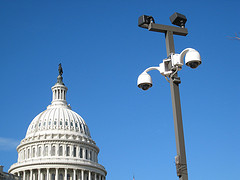
Photo by Flickr user satanoid



 MEDIA ROOTS — The U.S.
Government’s raging paranoia regarding terrorism has now led to a high-octane
obsession with perpetual and complete surveillance of its citizens in every
manner
MEDIA ROOTS — The U.S.
Government’s raging paranoia regarding terrorism has now led to a high-octane
obsession with perpetual and complete surveillance of its citizens in every
manner  MEDIA ROOTS —
  MEDIA ROOTS — The enduring U.S. quest for security, or
police state repression, truly knows no bounds.
If your community hasn’t been surveilled by Obama’s drones yet, it’ll be
MEDIA ROOTS — The enduring U.S. quest for security, or
police state repression, truly knows no bounds.
If your community hasn’t been surveilled by Obama’s drones yet, it’ll be 