Revolution: Egypt Protest Death Toll Passes 100

HARAKAH DAILY–  At least 100 Egyptian protesters have been killed during clashes with police as the explosion of anger at President Hosni Mubarak continues to rock the North African country.

Medical sources stated on Saturday that over 100 people, including 23 protesters in the port city of Alexandria have lost their lives in streets fighting with police forces across Egypt since the outbreak of anti-government protests, while 13 people were killed and 75 others injured in the flash point city of Suez, along the strategic Suez Canal.

According to medical sources, at least 1,030 protesters have been injured as mass protests remain unabated across the country for a fifth consecutive day.

The worst unrest in Egypt’s history appeared to be ceaseless and police have reportedly fired tear gas and rubber bullets at the protesters.

The fall-out comes after a curfew from 6 p.m. to 7 a.m. was imposed Friday in Cairo, Suez and Alexandria.

In another development, Mohamed El Baradei, one of Mubarak’s fiercest critics and a former head of the International Atomic Energy Agency, was detained by Egyptian police after appearing on the streets in the capital Cairo.

ElBaradei has promised that the street protests will continue with even more intensity until Mubarak resigns.

Continue reading about the Eqyptian Revolution.

Photo by flickr user Jacques Delarue

© COPYRIGHT HARAKAH DAILY, 2011

Wikileaks, Bradley Manning & False Memory Research

Media Roots Radio- Wikileaks, Bradley Manning, False Memories with Guest Researcher Steven Frenda by Media Roots

MEDIA ROOTS – In this episode of Media Roots Radio, Robbie and Abby Martin discuss Wikileaks, Bradley Manning and the inhumane conditions of his detention.

During the second half of the show, guest Steven Frenda talks about his studies and research in the field of human memory: manipulated and false memories, coerced confessions, and how they relate to the legal system.

The above timeline is interactive. Scroll through it to find out more about the show’s music and to resources mentioned during the broadcast. To see a larger version of the timeline with clickable resources go to the soundcloud link below the player. If you would like to directly download the podcast click the down arrow icon on the right of the soundcloud display.

This Media Roots podcast is the product of many long hours of hard work and love. If you want to encourage our voice, please consider supporting us as we continue to speak from outside party lines. If you donate, we want to thank you with your choice of art from AbbyMartin.org as well as music from RecordLabelRecords.org. Much of the music you hear on our podcasts comes from Robbie’s imprint Record Label Records, and Abby’s art reflects the passion and perspective that lead her to create Media Roots.

$40 donation: One 8×10 art print and one RLR release (You choose! Tell us in the Paypal notes.)

$80 donation: Two 8×10 art prints and two RLR releases (You choose!)

$150 donation: Four 8×10 art prints and four RLR releases (You choose!)

Even the smallest donations are appreciated and help us with our operating costs.

Thanks so much for your support!

Listen to all previous Media Roots Radio broadcasts here.

A Year After the Earthquake, Haiti Still Needs Help

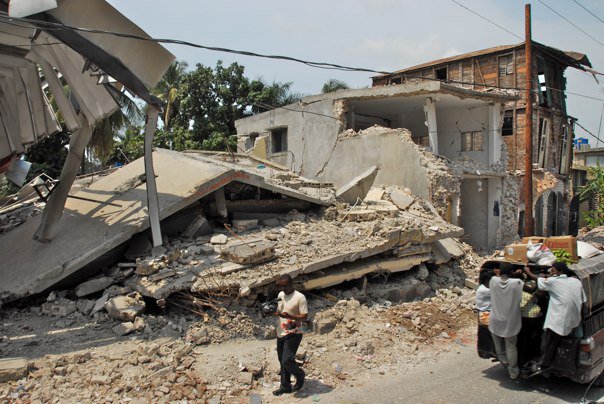
COMMONDREAMS – When the Enriquillo fault line shifted at 4:53 p.m. last Jan. 12, our bed was sent across the hotel room, the other side of the building collapsed and, as we would soon find out, Haiti was devastated.

My 1-year-old son and I had accompanied my wife, an HIV educator for health-care workers, to Haiti only two days before the earthquake. In the immediate aftermath, the emergency medical technician who was a guest at our hotel formed a makeshift clinic in the circular driveway to attend to hundreds of badly injured Haitians.


My wife and I were quickly deputized as orderlies in his driveway emergency room, and without any prior medical training, we assisted in whatever way we could – stripping the sheets off hotel beds to apply as bandages, breaking chairs to use the wood for splints, and transforming the poolside deck chairs into hospital beds.

However, tens of thousands of Haitians didn’t receive even this basic first-aid, resulting in a much higher mortality rate. The catastrophe can only begin to be grasped through comparisons; with some 300,000 people dead and another 300,000 injured, the total number of casualties roughly equals the entire population of Seattle. More than the entire population of King County – more than 2 million people – were rendered homeless. Some 1.5 million still live in tent encampments today.

Upon returning home, we learned that half of all American households had given a charitable donation to help the people of Haiti and were overjoyed that Haiti’s plight had not been overlooked.

However, the overwhelming majority of the money pledged to Haiti has yet to reach the Haitian people. Only $6 million of the $52 million Clinton-Bush Haiti Fund had been spent by November, The Washington Post reported. The U.S. government’s pledge of more than $1 billion dollars was completely unfulfilled until November, when it finally released $120 million.

Worse, the U.S. is pursuing a development strategy calling for garment factories (read: sweatshops) and tourism instead of the sustainable agriculture programs proposed by Haitian civil-society organizations that would create jobs, produce food for countless Haitians, and allow Haiti to address the environmental degradation that has crippled its economy for generations.

According to an extensive Institute for Justice and Democracy in Haiti study, “We Have Been Forgotten,” 75 percent of families living in the tent camps had someone go an entire day without eating, 44 percent drink untreated water, and 27 percent had no access to sanitation.

The terrible conditions of the tent camps have contributed to the rapid spread of cholera in Haiti, believed to have been introduced by United Nations occupying troops from Nepal. Already some 2,600 Haitians have died from the disease with The New York Times predicting, “cholera may become a way of life that could afflict as many as 270,000 people over the next several years.”

To tackle a problem of this proportion, Haiti will need an effective government that understands the needs of its people and can coordinate a rebuilding project on the scale required. Yet Haiti’s most popular political party, Lavalas, has been banned from participation in the most recent election – with U.S. and U.N. support – preventing any new government from truly representing the will of the people.

If any people can overcome these challenges, it is the Haitians, who gained their independence through the only successful slave revolt in history and who have as recently as the mid-1980s deposed a brutal dictatorship through popular uprising.

As the people of Haiti struggle for a better future, we here would do well to remember the Haitian proverb, Men anpil chay pa lou: “Many hands make the load lighter.”

Jesse Hagopian is a teacher in Seattle and serves on the board of Maha-Lilo (Many Hands, Light Load), a Haiti solidarity organization that is currently working to bring water filters to tent camps in Cap Haitien. He can be reached at [email protected]

Maha-Lilo is holding a dinner benefit to mark the anniversary of the earthquake Sunday in Seattle. The event will begin at 4 p.m. at Waid’s Haitian Cuisine, 1212 E Jefferson St., Seattle. For more information, call 734-218-6622 or go to: www.mahalilo.org

© COPYRIGHT COMMONDREAMS, 2011

Photograph by Rick Pickett III

Chris Hedges: US Empire Could Collapse at any Time

RAW STORY– America’s military and economic empire could collapse at any time, but predicting the precise day, week or month of its potential demise is unattainable, according to a former New York Times war correspondent who spoke with Raw Story.

“The when and how is very dangerous to predict because there’s always some factor that blindsides you that you didn’t expect,” Pulitzer-winning journalist Chris Hedges said in an exclusive interview. “It doesn’t look good. But exactly how it plays out and when it plays out, having covered disintegrating societies, it’s impossible to tell.”

He explained that he learned this lesson as events unfolded around him in the fall of 1989. Then, members of the opposition to the Soviet Empire told him that they predicted travel across the Berlin Wall separating East from West Germany would open within the year.

“Within a few hours, the wall didn’t exist,” he said.

Hedges was one of the 131 activists were arrested in an act of civil disobedience outside the White House yesterday, even as Obama was unveiling a new report citing progress in the Afghanistan war.

Speaking to Raw Story on Wednesday night, he said the signs of US collapse are plain to see and compared the country’s course through Afghanistan to Soviet Russia’s.

“We’re losing [the war in Afghanistan] in the same way the Red Army lost it,” he said. “It’s exactly the same configuration where we sort of control the urban centers where 20 percent of the population lives. The rest of the country where 80 percent of the Afghans live is either in the hands of the Taliban or disputed.”

Read more about how the US empire could collapse at any time here.

© COPYRIGHT RAW STORY, 2010

China Tries to Sterilize 10,000 Parents Over One Child Rule

TIMES ONLINE– Doctors in southern China are working around the clock to fulfil a government goal to sterilise — by force if necessary — almost 10,000 men and women who have violated birth control policies. Family planning authorities are so determined to stop couples from producing more children than the regulations allow that they are detaining the relatives of those who resist.

About 1,300 people are being held in cramped conditions in towns across Puning county, in Guangdong Province, as officials try to put pressure on couples who have illegal children to come forward for sterilisation. The 20-day campaign, which was launched on April 7, aims to complete 9,559 sterilisations in Puning, which, with a population of 2.24 million, is the most populous county in the province.

A doctor in Daba village said that his team was working flat out, beginning sterilisations every day at 8am and working straight through until 4am the following day. Zhang Lizhao, 38, the father of two sons, aged 6 and 4, said that he rushed home late last night from buying loquats for his wholesale fruit business to undergo sterilisation after his elder brother was detained. His wife had already returned so that the brother would be freed.

Mr Zhang said: “This morning my wife called me and said they were forcing her to be sterilised today. She pleaded with the clinic to wait because she has her period. But they would not wait a single day. I called and begged them but they said no. So I have rushed back. I am satisfied because I have two sons.”

Thousands of others have refused to submit and officials are continuing to detain relatives, including elderly parents, to force them to submit to surgery. Those in detention are required to listen to lectures on the rules limiting the size of families.

On April 10 The Southern Countryside Daily reported on about 100 people, mostly elderly, packed into a damp 200sq m (2,150sq ft) room at a township family planning centre. The newspaper said: “There were some mats on the floor but the room was too small for all people to lie down and sleep, so the young ones had to stand or squat. Owing to the lack of quilts, many cuddled up to fight the cold.”

Among those being held was the 68-year-old father of Huang Ruifeng, who has three daughters. Mr Huang said: “Several days ago a village official called me and asked me or my wife to return for the surgery. Otherwise they would take away my father.” He said that he was too busy to go and did not have confidence in village medical techniques. In any case, he wanted his wife to give birth to a son first.

An official at the Puning Population and Family Planning Bureau, who declined to be identified, told The Global Times: “It’s not uncommon for family planning authorities to adopt some tough tactics.”

In Puning county couples with illegal children and their relatives who apply for permits to build a house are rejected. Illegal children are refused residency registration, a penalty that denies them access to healthcare and education. Authorities have discovered, however, that those methods have less success than rounding up relatives. One official said that an investigation would be launched to establish whether authorities in Puning had exceeded their remit.

A state-level regulation stipulates that couples who violate the family planning policy must not be punished without proper authorisation and family members may not be penalised to put pressure on couples. In the years after China launched its strict “one couple, one child” family planning policy in the late 1970s abuses such as forced late-term abortions, sterilisations and even the killing of newborn babies were widely reported. Such practices have diminished in recent years, as the policy has become more widely accepted and exceptions have been introduced.

Officials in Puning are under particular pressure, however: they risk failing in their bid for promotion to a second-tier county if they cannot meet all quotas. That includes keeping the number of births within government limits. The county is under criticism from Guangdong authorities, who want to slow a population growth that is reflecting badly on the entire province. One reason for Puning’s large population is that families in the mainly rural region often have up to three or four children.

Many of those with extra children have left to find factory jobs along the more developed coast, taking advantage of being away from local government surveillance to give birth outside the quotas. Rules in Puning, as throughout rural China, allow farmers to have a second child if the first is a daughter. After that couples must stop. By the morning of April 12 Puning officials said that they had achieved, in a mere five days, about half of their sterilisation goal after their “education” persuaded people to comply.

Family planning

• China is the world’s most populous country with about 1.3 billion people. By 2025 the population is expected to exceed 1.4 billion

• The birthrate is low at 14 births per 1,000 people every year but the infant mortality rate is also low, at 20.25 deaths per 1,000 live births

• The single-child policy, referred to by the Chinese Government as the family planning policy, was introduced in 1978 to ensure that China could feed all of its people

• The policy stipulates that couples living in cities can have one child, unless one or both are from an ethnic minority or they are both only children. In most rural areas a couple may have a second child after a break of several years

• Despite the policy, it is common to find couples in the countryside, where 80 per cent of the population live, with a large number of children

• Many couples get round the law by sending pregnant women to stay with relatives, then claiming that the baby was adopted or belongs to a friend or relative

• Critics say that the policy has led to the killing of female infants because of the traditional preference for boys

Sources: BBC; CIA World Factbook

© COPYRIGHT TIMES ONLINE, 2010

Photo by Flickr user Benoitflorencon