In the US, Civil Disobedience is Strong and Growing

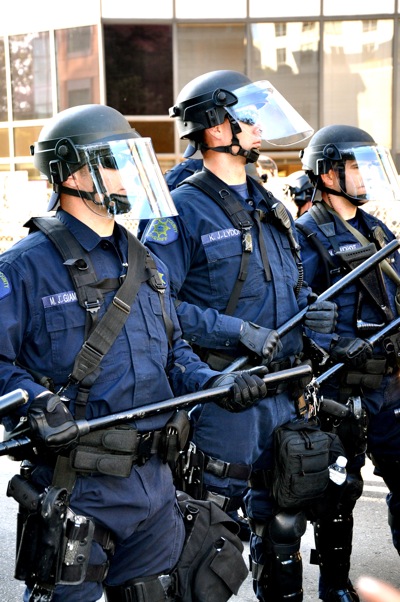
HUFFINGTON POST– Since President Obama was inaugurated, there have been over 2,600 arrests of activists protesting in the U.S.. Research shows over 670 people have been arrested in protests inside the U.S. already in 2011, over 1,290 were arrested in 2010, and 665 arrested in 2009. These figures certainly underestimate the number actually arrested, as arrests in U.S. protests are rarely covered by the mainstream media outlets which focus so intently on arrests of protestors in other countries.

Arrests at protest have been increasing each year since 2009. Those arrested include people protesting U.S. wars in Afghanistan and Iraq, Guantanamo, strip mining, home foreclosures, nuclear weapons, immigration policies, police brutality, mistreatment of hotel workers, budget cutbacks, Blackwater, the mistreatment of Bradley Manning, and right wing efforts to cut back collective bargaining.

These arrests illustrate that resistance to the injustices in and committed by the U.S. is alive and well. Certainly there could and should be more, but it is important to recognize that people are fighting back against injustice.

Information on these arrests has been taken primarily from the newsletter The Nuclear Resister, which has been publishing reports of anti-nuclear resistance arrests since 1980, and anti-war actions since 1990.

Jack Cohen-Joppa, who with his partner Felice, edits The Nuclear Resister, told me:

Over the last three decades, in the course of chronicling more than 100,000 arrests for nonviolent protest and resistance to nuclear power, nuclear weapons, torture, and war, we’ve noted a quadrennial decline as support for protest and resistance gets swallowed up by Presidential politicking. It has taken a couple of years, but the Hopeium addicts of 2008 are finally getting into recovery. We’re again reporting a steady if slow rise in the numbers willing to risk arrest and imprisonment for acts of civil resistance. Today, for instance, there are more Americans serving time in prison for nuclear weapons protest than at any time in more than a decade.

Read full article about Two Thousand Six Hundred Activists Arrested in U.S. Protests.

Article written by Bill Quigley

© 2011 Huffington Post

Photo by Flickr user hozinja

Backroom Deal Set To Extend Patriot Act

CARE2– With bi-partisan opposition to key provisions of the Patriot Act, you would think that now would be the time to move to take back American civil liberties once and for all.

You would be wrong.

With a week until the provisions expire, Sen. Harry Reid (D-NV) and Rep. John Boehner (R-OH) made a deal to reauthorize the Act for four more years.  Doing so avoids a messy and extended debate over the extension and a potentially humiliating defeat for both the White House and members of Congress who have continued to give the measure support through two administrations.

The move takes back a promise made by Sen. Reid for a full week of debate and consideration before an extension and, by its backroom nature, shows that even a transparent debate on the matter is no longer a possibility in Washington.

If the Tea Party Republicans are serious about shrinking the size of the federal government and really are libertarians then we should find out soon.  Since its enactment the Patriot Act has resulted in the widespread abuse of the use of National Security Letters by the FBI to secretly spy on innocent Americans and has produced no discernible national security benefit.

Read more about Backroom Deal Set To Extend Patriot Act

© 2011 Care2

Photo by Flickr user dad_and_clint

Supreme Court OKs Warrantless Searches

SEATTLE TIMES– The Supreme Court on Monday gave police more leeway to break into homes or apartments in search of illegal drugs when they suspect the evidence might be destroyed.

The justices said officers who smell marijuana and loudly knock on the door may break in if they hear sounds that suggest the residents are scurrying to hide the drugs.

Residents who “attempt to destroy evidence have only themselves to blame” when police burst in, Justice Samuel Alito said for an 8-1 majority.

In dissent, Justice Ruth Bader Ginsburg wrote that she feared the ruling in a Kentucky case had handed the police an important new tool.

“The court today arms the police with a way routinely to dishonor the Fourth Amendment’s warrant requirement in drug cases,” Ginsburg wrote. “In lieu of presenting their evidence to a neutral magistrate, police officers may now knock, listen, then break the door down, never mind that they had ample time to obtain a warrant.”

She said the Fourth Amendment’s “core requirement” is that officers have probable cause and a search warrant before they break into a house.

“How ‘secure’ do our homes remain if police, armed with no warrant, can pound on doors at will and … forcibly enter?” Ginsburg asked.

An expert on criminal searches agreed, saying the decision would encourage police to undertake “knock and talk” raids.

Read full article about Supreme Court OKs Warrantless Searches.

© 2011 Seattle Times

Photo by Abby Martin

Obama Wants to Censor ‘Unclassified’ Materials

RAW STORY– In the case of former National Security Agency (NSA) executive Thomas A. Drake — indicted last April and accused of funneling documents to an unnamed reporter at an unnamed newspaper, for stories that have not been identified — the president’s lawyers have made a unique and potentially unprecedented claim.

With less than a month before Drake’s trial begins, the Obama administration has filed a memo with the court claim the Classified Information Procedures Act (CIPA) gives courts the right to censor and withhold material that is “unclassified.”

“It is simply incorrect to argue that CIPA is a rigid set of procedures that precludes this Court from simultaneously considering the admissibility of classified information as well as other information, whether protected or unclassified,” they wrote (PDF).

The argument effectively hinges on earlier court cases which interpreted CIPA as less of a rulebook for judges and more of an advisory. The president’s lawyers took that a bit further, suggesting it actually just “provides the tools” needed for the judiciary to decide what information should be protected from the prying eyes of defense attorneys. They also claim the National Security Agency Act of 1959 (NSAA) allows courts to redact any and all information pertaining to the NSA’s activities.

Read more about Obama Admin. Claims Right to Censor ‘Unclassified’ Materials

© 2011 Raw Story

Photo by Flickr user meredithfarmer

FBI: If We Told You, You Might Sue

ACLU– Often when the government tries to suppress information about its surveillance programs, it cites national-security concerns. But not always.

In 2008, a few years after the Bush administration’s warrantless-wiretapping program was revealed for the first time by the New York Times, Congress passed the FISA Amendments Act. That act authorizes the government to engage in dragnet surveillance of Americans’ international communications without meaningful oversight. As we’ve explained before (including in our lawsuit challenging the statute), the FISA Amendments Act is unconstitutional.

In 2009, we also filed a Freedom of Information Act request to learn more about the government’s interpretation and implementation of the FISA Amendments Act. Last November, the government released a few hundred pages of heavily redacted documents. Though redacted, the documents confirmed that the government had interpreted the statute as broadly as we had feared and even that the government had repeatedly violated the few limitations that the statute actually imposed.

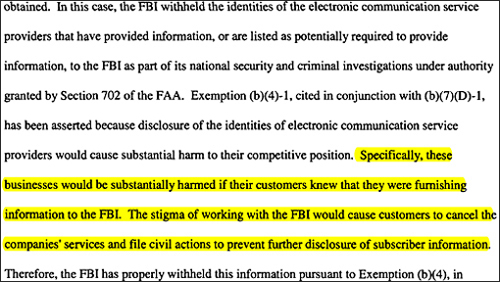
Two weeks ago, as part of our FOIA lawsuit over those documents, the government gave us several declarations attempting to justify the redaction of the documents. We’ve been combing through the documents and recently came across this unexpectedly honest explanation from the FBI of why the government doesn’t want us to know which “electronic communication service providers” participate in its dragnet surveillance program. On page 32:

There you have it. The government doesn’t want you to know whether your internet or phone company is cooperating with its dragnet surveillance program because you might get upset and file lawsuits asserting your constitutional rights. Would it be such a bad thing if a court were to consider the constitutionality of the most sweeping surveillance program ever enacted by Congress?

Read more about FBI: If We Told You, You Might Sue

© 2011 ACLU

Photo by Flickr user listentothemountains