MEDIA ROOTS – Abby Martin of Media Roots reports from the front lines of the brutal
police-state repression of the non-violent Occupy Oakland protesters, who were practicing their freedom to assemble on Tuesday, October 25, 2011 at 7:30pm. The footage captures an increasingly tense standoff between
the Oakland Police Department and the Occupy Wall Street protesters in the moments preceding the aggressive assault on the crowd.
Abby Martin reports from the front lines at Frank Ogawa Plaza in downtown Oakland.
Things came to a head around 7:45pm when the coordinated
17-agency police action, including Oakland PD, approved by Major Jean Quan, started throwing smoke bombs, firing tear gas projectile canisters and rubber bullets into the crowd, completely unprovoked.
Although it’s not evident in this footage, Iraq war veteran and Occupy Oakland-supporter Scott Olsen was shot in the head by a tear gas projectile at point blank range by one of the assaulting riot cops during this anti-democratic, unconstitutional drama of police terrorism. Olsen has been hospitalised and is reported to be in serious condition with a fractured skull at presstime.
Check
out exclusive Media Roots coverage from earlier that day when the Oakland PD, alongside many other police agencies, aggressively
raided the peaceful Occupy Oakland encampments and said they were just “following orders” to do so.
Contact Oakland Mayor Jean Quan, who conveniently left for Washington, D.C. during the ordeal, to voice your views on this brutal repression of Constitutionally-protected assembly.
MEDIA
ROOTS– Abby Martin of
Media Roots reports from the front lines of the immediate aftermath of the predawn Oakland police
raid against the peaceful
Occupy Oakland encampments on Tuesday, October 25, 2011. The raid was perpetrated under the ironic pretext of ‘sanitation and safety,’ even though the encampments were in accordance with safety standards.
Abby Martin questions the Oakland PD about the raid and seeks the elusive “press officer.”
During the brutal police raid of Occupy Oakland at 5:30 am, Tuesday morning, 500+
unprovoked Oakland and other agency police officers unlawfully used smoke bombs, tear gas, and rubber bullets on people, some with children and even as they lay sleeping, before completely destroying the two
encampments of peaceful protesters. 90+
protesters were then arrested at Snow Park and Frank Ogawa Plaza (which protesters have renamed Oscar Grant Plaza). Inexplicably, protesters continued to be arrested after park curfew was over.
Attorney and Occupy Oakland-supporter, Jesse Palmer, reported Wednesday on KPFA/Pacifica radio’s “Morning Mix” the various police agencies involved in the predawn raid:
“So,
the police came and cracked down and destroyed the encampment, as you know
yesterday. And they came with
overwhelming force. And as you said, you
know, we were on the streets, you know, early in the morning and people were
picking out all of the odd police forces, the Pleasanton police force and the
Union City police force. And I saw the
East Bay Regional Parks, um, police force there. And they came with overwhelming
force. And they, you know, there was,
um, there was no real, I mean, there was no way to resist that.”
Check out exclusive Media Roots TV coverage later that day of the intense showdown between Occupy Oakland and the Oakland PD (alongside 16 other police agencies) in the moments before and up to the first brutal attack on the crowd, which appeared to be a coordinated national security operation against popular dissent. The unprovoked Oakland police again launched smoke bombs, tear gas projectiles, and rubber bullets into
the group of unarmed, peaceful Occupy Oakland protesters. Similar raids and crackdowns occurred across the U.S.
Contact Oakland Mayor Jean Quan,
who conveniently left for Washington, D.C. throughout the ordeal, to
voice your views on this brutal repression of Constitutionally-protected
assembly.
MEDIA ROOTS-The short film I’m Not Moving is an excellent representation of the astounding hypocrisy of the US government’s support for the Arab Spring uprising in the Middle East as compared to the Occupy Wall Street movement happening in America.
MEDIA ROOTS – Ralph Nader answers questions from the
audience at Berkeley’s Hillside Club on Saturday, October 1, 2011 at the
First Annual Peter Miguel Camejo Commemorative Lecture. [Transcript Below]
Ralph Nader discusses Occupy Wall Street, Gandhi’s ‘Seven Deadly
Social Sins’, media reform, his presidential candidacy and what people
can do to fight back.
***
Ralph Nader:
“Gandhi’s ‘Seven Deadly Social Sins,’ you’ve probably heard them, that’s
his words, ‘Seven Deadly Social Sins.’
Everyone has three words. Gandhi
was really the sound-bite champion. He’d
have been great on TV.
“‘Politics
Without Principle. Wealth Without Work. Commerce Without Morality. Pleasure Without Conscience. Education Without Character. Science Without Humanity.’
“Science
is building drones. You heard about the
coming drone. You heard about the coming
drone? This is one that’s what’s called
Self-Automated. That is, a software will
select the suspects, locate the suspects, execute them. They don’t even need a button-pusher in
Nevada or Langley. The next drone is
gonna be a size of a hummingbird. With
nanotechnology, they’ll put the drone in your hair for surveillance. You’ll never know it. It’s a, it’s a coming, 1984 is a masterpiece of understatement.
“And
then, ‘Worship Without Sacrifice.’
“You
know, that’s like the so-called organised Christians who organise for war. You know, they organise for destroying the
rights of poor people. I wonder if Jesus
Christ would’ve condemned.
“I added
two more. You gotta bring it up to date.
“Belief
Without Thought.’ This is what Peter
[Camejo] was against. ‘Belief Without
Thought.’ And ‘Respect Without
Self-Respect.’ That’s the most important
one of all ‘cos if you respect yourself you don’t say, ‘I don’t have any
power. Why should I do anything? It doesn’t matter. It won’t change anything. It won’t have any effect ‘cos everyone else
is not gonna do what I’m doing.’
No. You do what you do. And you try to talk to others to convince
them. You never say, you don’t wanna go
out of your way to discomfort yourself because a million other people haven’t told
you, in one way or another, that they’re doing the same thing.
“So, the
key is how to get people who know what the prob-, there are very few people in
this country who are ignorant of the injustices. I mean they get it handed to ‘em every
day. Right? You have to, you have to have people who say
to themselves that if I know something I have a moral obligation to do
something about it, personally. I don’t care if ten million people don’t do
it. I can’t live with myself, unless I
do it. And once that spreads, you’ll get ten million people. So, that’s, that’s what we have to look ahead
for.”
Question: What do
you think about the Occupy Wall Street protests?
Ralph Nader: “Well, you
know, we don’t know what it is, but it’s refreshing whatever it is. It’s the young people, uh, probably without
jobs, a sense of theatre, uh, make sure there’s no leaders, no organisers, so
they’re, become [more] resistant to infiltration. And they’re modestly violating permits. Like, uh, the permit to march in the City of
New York and, therefore, they’re provoking the police to try to channel them
with these orange fences. And they’re
spreading to other areas. And that’s the
kind of spark that gets things underway.
“I wrote
a column years ago, months ago. I said,
‘How do we know when the spark comes? I
mean, the spark doesn’t usually come from [a] predictable source. It doesn’t come from the usual suspects, like
a bunch of oppressed people in some ghetto, in some city. It comes like the Tunisian spark, see? Who would have ever thought a fruit peddler,
slapped by a police woman who is rippin’ off his stall…? And look what happened. So, this may be a spark.
“What usually
launches things are totally unpredictable episodes that suddenly say to a lot
of people, ‘That’s it! We’ve had
enough!’ You know? So, we’ll see how it turns out. They’ve got a big band coming to get a bigger
crowd. I always worry about that, if
people come just for the music. Cornel West, Michael Moore, they’ve spoken to
‘em. Uh, the authorities are very
worried about this ‘cos they saw what happened in London. And they saw what happened in the Middle
East, the Arab Spring, and all. They’re
very worried about that. And so we’ll
see. I think we’re gonna have to wait [many]
days and see what goes on.”
Question: “A number
of people have asked, Mr. Nader, given the present crisis and this Presidential
year, will you make your announcement here for your candidacy for President of
the United States?” [audience chuckles]
Ralph Nader:
“No.
“I, [audience
laughs] I ran unofficially in the Green Party in 1996. I ran a none-of-the-above, really unofficial, Candidacy in New
Hampshire and Massachusetts in 1992, just none-of-the-above. I got almost as many votes as Jerry
Brown. And he was a rival in New Hampshire. Then
I ran officially in 2000 and 2004 and 2008.
[…]
“Four
out five people who declared to the pollsters they were gonna vote for us,
Nader-Camejo, Nader-Gonzalez, didn’t
when they got in the voting booth. They
chickened out and voted for the Democrats or the Republican, whatever. Mo-, people think all our votes would’ve gone
to the Democrats. No. The exit polls in 2000 by a Democratic
pollster have, uh, Nader-LaDuke, said that 25% of our votes would have voted
for Bush, 39% for Gore, and the rest would have stayed home.
“So, to
make a long answer short, it’s time for other people to do it, uh, because, uh,
I’m tired of pushing strings. I’m tired
of having a lot of people agree with our positions and they don’t put their
vote behind our positions. And, uh,
unless, that’s what I mean by ‘Respect Without Self-Respect.’ We are supported on many issues by a majority
of the American people. A majority of the
people wanted us on the Debates. These
are traditional poll, polling companies.
A majority of the people wanted us on the Presidential Debates. We didn’t get on. And a majority of the people, I mean, the
people, you meet all over the country, ‘I voted for you!’ And I look at ‘em and I say, ‘Uh, where did
you vote for me? Where? North Carolina?’ I’ll say, ‘I wasn’t on the ballot in North
Carolina.’ [audience chuckles] You know, I mean, people feel like, you know,
they wanted to, but.”
Question: “I
just, feeling, hearing all this, I’m just feeling so much that, you know, we
get the government we deserve. When
people voted for the lesser-of-two-evils instead of voting for their heart I
felt that we really get the government we deserve. That’s my statement. My question to you is: Is there any way that we can get the, uh, the
telecommunications and the communications and the airwaves and all that back to
the people. That was our public
domain. And I think if we control that
again, we would be able to control the length of the political season that goes
on, which is interminable, because the TV, uh, people wanna make profits and
they love to create fights that, that they’re not even, they don’t even care
who wins. They’re just making
money. And I think we can also get the
money out of, uh, politics. If we the
people own the airwaves, we give the Candidates the right to be on those
airwaves, an equal time kind of situation.
They don’t have to pay the TV, get ‘em, put ‘em on free.”
Ralph Nader:
“Yeah. Well, that was one of the
agendas we ran on. And probably helped
keep us off national TV.
“We own
the public airwaves. We’re the
landlords. The FCC is the real estate
agent. And the radio and TV stations,
the tenants. And they pay us no
rent. They haven’t paid us any rent for
this valuable property since 1934, the Communications Act of 1934. And they decide who says what and who doesn’t
say what on our property, namely the TV and radio, the public airwaves. So, you know?
That’s an easy one, right? I
mean, who’s gonna be against controlling what we own? Having our own audience, network, our own radio
and TV. It’s our property. We can say we want two hours a day,
here. We want three hours a day,
here. And then we’ll rent you the rest
of the time. You’ll have to pay rent. We’re gonna take the rent and put it into
studios and reporters and programmers and producers. And communicate with one another. And mobilise one another on anything we want,
from serious to humour. Boy, I mean, can
you imagine getting on national TV with that?
You see?
“So,
that was a larger part of the Commons.
We had a policy on the Commonwealth where we control what we own. We own a third of the, America, the public
lands and, you know, who controls it the timber, oil, gas, gold, whatever, the
companies. And we own trillions of
dollars of government taxpayer R & D.
Who do you think created the internet?
Who do you think built the biotech industry? Who do you think built the semiconductor
industry? Who do you think built the
aerospace? It was all government R &
D! You wouldn’t recognise it. I mean, it was all government R & D, out
of the Pentagon, NASA, National Institutes of Health. Half, three-quarters of the anti-cancer drugs
came from tax-payer-supported research from the National Cancer Institute with no
controls on the prices that the receiving drug companies could charge us. They were given all this free. So, you gotta dialogue like that. You know, you can’t do it with sound-bite.
“But
we’re shut out of our own property. That
should be the calling card. Let’s start
with our assets! Our assets are the
biggest wealth in America. $5 trillion
dollars of pension funds owned by workers.
That could control the New York Stock Exchange Members. That could control the companies in the New
York Stock Exchange. I mean, about a
third of all stock is held by worker pensions.
But, it’s not controlled by
worker pensions. It’s controlled by the banks and the insurance companies or
the intermediate.
“So, you
see, it’s not that hard once you get people, uh, just thinking a little bit,
getting excited. You gotta ask ‘em the
basic question, ‘Do you want power? Or
do you want to be powerless? You want
multiple choice tests? You want power or
do you want powerlessness? So, you need
thousands of people talking to millions of people. Just like the populist tradition. They call themselves lecturers. I’d have [texted this, no calling]. And they talk to people. So, if you have a thousand people who are
talking to a thousand people a week with these messages. They would talk to a million people face to
face in rooms like this. You have 10,000
people. They talk to a thousand people a
week in different venues. You have ten
million people. That’s the way we gotta
think. The hell with the media for the
meantime. One thing they can’t stop us
from doing is talking to one another.
And there are a lot of empty auditoriums and empty spaces around the
country that we could use to do that.
“That’s
why we need a few very rich people, like George Soros or Ted Turner or
whatever. You know, there’s always a few
tiny ones, a tiny percent. All you need,
a tiny percent to say, ‘Here’s a billion dollars. We want you to hire 20,000 organisers in the
country, all over the country.’ You will
see remarkable dramatic changes. There’s
no social movement in the country that was created without organising. And the lack of organisers delay the
maturation of these movements, women’s suffrage, abolition.
“But
remember, and there’s a fella yesterday, he came out, gawd, these guys are like
so predictable. This guy was real
hardcore, socialist, idealist. He said,
‘How dare you write a book called Only
the Super Rich Can Save Us. I said,
well, remember, it’s in quotes. It’s in fiction. He said, ‘I know! But I saw you on TV! You explained it. And you think that we have to rely on rich
people to mobilise the masses.’ So, I
said, ‘Well, how are you gonna hire the organisers?’ And he wouldn’t listen. So, I said, ‘Well, you ever heard of the Abolition
Movement? Slavery?’ He said, ‘Yeah.’ I said, ‘Don’t you know that a lot of proper
Bostonian rich people funded William Lloyd Garrison, Frederick Douglass, and
others? How about the Women’s Suffrage Movement? Some rich women funded those people. Women who were on the ramparts all over the
country. How about the early Civil Rights
Movement? Did you ever hear?’ He, he went away by then. [audience laughs] ‘How about the Stern Family? How about the Curry Family of the 1950s? Gave a big lot. Who’s gonna pay for those buses? Who’s gonna pay for the expenses, the
organisers? […]
“It’s
ridiculous. But, you know what? After he left, I said, I had the best
response to him. You always think after
it’s over. Here’s what I would’ve said
to him right after that: ‘Hey, you’re a socialist, right?’ He’d
have said, ‘Damn right! I’m proud of it!’ ‘All power to you. You gotta fight those corporate socialists.’ Okay. I’d
say ‘Hey, you ever hear of Karl Marx?’
He’d say, ‘What? Are you bein’
funny?’ I’d say, ‘Well, who do you think
funded year after year after year Karl Marx?
His name was Friedrich Engels.
And he got co-authorship of the Communist Manifesto.’ But he funded the living expenses of Karl
Marx. And a number of children. And he didn’t earn it writing Das Kapital.
“So, we
have to, people feel overwhelmed. They
feel depressed, discouraged. They can’t
do anything. The country’s gettin’
worse. The world’s goin’ to hell. [audience chuckles] Break it down and let’s each do our thing. And then build it. Someone strikes gold with a enlightened
billionaire whose in their 80s or 90s and has a sense of posterity and is quite
enlightened. As far as I’m concerned, if
you had two multi-billionaires givin’ us 15, 20 billion. And mind you, some of these people are worth
30, 40 billion. 15, 20 billion’s
nothing. You can turn the country
around. How do I know? I wrote 700 pages of this book only just to
prove it. Very, very detailed. Once the money, the resources, top-down,
bottom-up, movement.”
MR: Great, exactly what we need: “Israeli-style screenings” by the TSA.
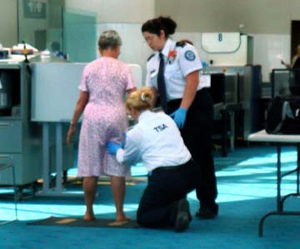
Despite the increased scrutiny against the TSA’s invasive security
procedures that involve groping children and humiliating the elderly, a
new element of interrogation is being added to the security program in Logan Airport.
BOSTON HERALD– Boston’s TSA screeners — part of a security force whose competency has come under fire nationwide — soon will be carrying out sophisticated behavioral inspections under a first-in-the-nation program that’s already raising concerns of racial profiling, harassment of innocent travelers and longer lines.
The training for the Israeli-style screening — a projected $1 billion national program dubbed Screening Passengers by Observation Techniques — kicks off today at Logan International Airport and will be put to use in Terminal A on Aug. 15. It requires screeners to make quick reads of whether passengers pose a danger or a terror threat based on their reactions to a set of routine questions.
But security experts wonder whether Transportation Safety Administration agents are up to the challenge after an embarrassing string of blunders — including patting down a 95-year-old grandmother in Florida and making her remove her adult diaper and frisking a 3-year-old girl who screamed “stop touching me” at a checkpoint in Tennessee.
Civil libertarians argue the screening is TSA showmanship — coming just weeks before the 10th anniversary of the Sept. 11, 2001, terrorist attacks — and could quickly devolve into profiling.



 The training for the Israeli-style screening — a projected $1 billion national program dubbed Screening Passengers by Observation Techniques — kicks off today at Logan International Airport and will be put to use in Terminal A on Aug. 15. It requires screeners to make quick reads of whether passengers pose a danger or a terror threat based on their reactions to a set of routine questions.