
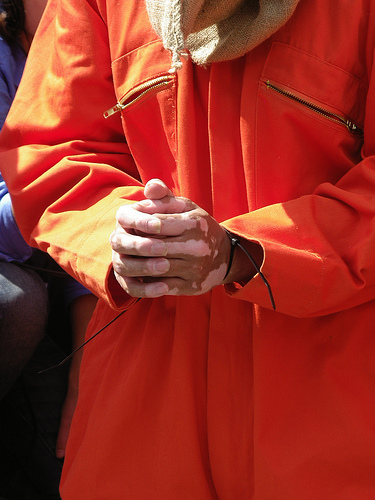
Guantánamospeak and the Manufacture of Consent

GitmoFlickrArtMakesMeSmileMEDIA ROOTS — On a recent KPFA radio broadcast, Project Censored discussed the ten-year mark of the U.S. Guantánamo Bay gulag and its implications for the Rule of Law.  One of Project Censored’s featured guests, Dr. Almerindo Ojeda, delivered an Occupy UC Davis – Dissent Lecture on December 1, 2011 at the University of California at Davis.  We present that address here, entitled Guantánamospeak and the Manufacture of Consent.  Dr. Ojeda is a professor of Linguistics and the Principal Investigator in the Guantánamo Testimonials Project of the Center for the Study of Human Rights in the Americas at UC Davis, for which Dr. Ojeda serves as Director.   

If prisoners at Guantánamo were the canaries-in-the-goldmine, then the U.S. people have not heeded the warning of the decade, a testament to the efficacy of U.S. state propaganda and social control.  The Bush era policies of imperialism and domestic repression have only escalated during the Obama Administration–with Obama’s recent signing of the NDAA (S.1867), any one of us may arbitrarily face the same fate as those languishing at Guantánamo.

MR

***

GUANTÁNAMOSPEAK AND THE MANUFACTURE OF CONSENT


For those who stubbornly seek freedom around the world, there can be no more urgent task than to come to understand the mechanisms and practices of indoctri­nation […] Propaganda is to democracy what vio­lence is to totalitarianism.

Noam Chomsky


Much has been made about prisoner abuse at Guantánamo.  And rightly so: Guantánamo is an ongoing crime against humanity.  If you don’t believe me, take a look at the Guantánamo Testimonials Project we have been carrying out at this campus.  But even though a lot has been said, there and elsewhere, about prisoner abuse at Guantánamo, relatively little has been said about language abuse at the Cuban airbase.  Yet, there has been a lot of it.  And we need to talk about it, if only because prisoner abuse is enabled by language abuse.

Abusing a human being is not easy to do; consenting to do it is not something that comes naturally.  As a matter of fact, the consent to abuse a fellow human being is something that needs to be manufactured.  It needs to be built.  Like a house.  Brick by brick and room by room.

How was this consent to abuse manufactured at Guantánamo?  First, you instill fear.  You say that Guantánamo holds vicious criminals that would not hesitate to chew on hydraulic tubes to bring an airplane down.  Then you cultivate hatred.  You say that each and every one of the individuals detained at the base was personally responsible for 9/11.  Then you abuse language; you engage in what Orwell would call Guantánamospeak.  It is this third step that I want to focus on today.

The abuse of language at Guantánamo began by coining the term war on terror.  A war is something that threatens the very survival of a nation.  Consequently, no citizen of that nation can be against it.  Except for the ‘traitors’ who seek the destruction of their own nation.  But is terrorism something that threatens the survival of our nation?  It can lead to massive loss of life (as 9/11 did).  And it can be a crime against humanity (as 9/11 was).  But threaten the survival of a nation?  Wars are events that have only two natural outcomes: victory or defeat.  Consequently, if you do not root for victory, you are rooting for defeat.  Only a traitor can root for defeat.

But casting our response to 9/11 in terms of a war creates a linguistic problem.  How would you call someone you capture in that war?  Prisoner of war?  This would be extremely problematic, as prisoners of war have rights under the Geneva Conventions, one of them being the right to be free from coercive interrogation.  But interrogate coercively is something our government very much wanted to do with these captives.  So we called them detainees instead of prisoners.  This has an added rhetorical advantage: it makes imprisonment at Guantánamo sound like a minor inconvenience (like being detained by traffic).  So we should consent to that.

By the way, the verb capture is already loaded. Being captured is what happens to fugitives, possibly of justice, and hence to criminals.  Never mind that some of the individuals held at Guantánamo were captured in their homes with their families.  Or fleeing carpet bombing.  Or coming out of a courthouse that had just cleared them from charges of terrorism.  Or were handed to us by local militias in exchange for bounties (a practice that might be called human trafficking in legal circles).

Alternatively, Guantánamo prisoners may be called enemy combatants.  This reinforces the context of war, and hence the survival of the nation.  But mention of war again brings about the term of prisoner of war.  So we should clarify the term enemy combatant and speak of unprivileged enemy combatants.  Adding the adjective unprivileged manages to turn the rights of the Geneva Conventions into privileges.  Privileges are things which are granted by the grace of a legitimate authority.  Rights are something you have regardless of the generosity of the powers that be.  Rights are something powers can no more grant than they can withhold.

And just for the record: Guantánamo prisoners have rights under the Geneva Conventions.  Everyone held in an armed conflict is protected by these conventions.  The fact that some captives did not wear uniforms only means that they do not have the rights Geneva grants to combatants.  They would still have the rights granted to civilians.  For civilians are protected by the Geneva Conven­tions as well as combatants.  I should add that thinking that the Guantá­namo prisoners are in fact protected by the Geneva Conventions is not my inter­preta­tion; it is the interpretation of the International Committee of the Red Cross, which is the accepted arbiter for the implementa­tion of the Geneva Conventions.  It is the organization the signatories of the Convention, the US included, have agreed to abide by.

But we digress. Let’s return to Guantánamospeak.

Guantánamo prisoners are being coercively interrogated.  This, of course, is not called this way. That may enable dissent.  In Guantánamo, when you are taken from your cell in order to be interrogated, you are said to be making good on a reservation.  Or to be going for an interview.  So, being interrogated is like going to a restaurant.  Or applying for a job.  Nothing to dissent about there.

Interestingly, language does not always take the abuse lying down; sometimes, it fights back.  Guantánamo personnel may say, for example, that so-and-so is going to reservation, a phrase which we would never use for making good on a reserva­tion made at a restaurant (and betrays the attempt to veil the reference to interro­gations, which are something one would ‘go to’).

As has been thoroughly reported, interrogations at Guantánamo can be brutal.  They may involve beatings, sleep deprivation, solitary confinement, exposure to temperature extremes, blaring noise, painful binding, and threats of death or harm to self or to others.  Such practices are what independent observers call torture.  But they cannot be called that in Guantánamo.  That would sow the seeds of dissent.  There, these practices are collectively referred to as procedures of enhanced interrogation instead.  Interrogation is acceptable in a criminal setting (given legal protections).  So, what is wrong with enhancing an acceptable procedure?  We should consent to it.

Each one of the aforementioned forms of torture has its own special entry in the dictionary of Guantánamospeak.  Food deprivation is called dietary manipulation—a lapse, perhaps, as manipulation often refers to less-than-legitimate doings (language fights back again).  Sleep deprivation is called sleep management (nothing wrong with managing sleep, is there?  After all, you do not want to be a slouch).  Under one of the modalities of sleep management, a prisoner can be moved, almost continuously from one cell to another for weeks.  This involves full bodily searches, gatherings of belongings, three-chain shackling, marching from one cell to another, and unshackling.  This is done around the clock for weeks, as a consequence of which the prisoner is unable to sleep for more than one hour at a time.  This form of sleep deprivation is referred to as the frequent flyer program (so the movement from cell to cell is to be thought of as the benefits program one gets from an airline by traveling a lot with it).  This is supposed to be funny.  The program is also called Operation Sandman, thus making a perverse reference to the nursery rhyme used to put children to sleep (and acknowledging, via sar­casm, the real purpose of the exercise).

The most common form of beating in Guantánamo comes in the context of forced cell removals.  Suppose a non-compliant prisoner refuses to go to interrogation (or to make good on a reservation he never made).  An Immediate Reaction Force is called in.  An Immediate Reaction Force is a team of six guards in full riot gear that march into a cell, pepper-spray the prisoner (some of you may know about this first-hand)…  In any event, they pepper-spray the prisoner, charge on him, slam him onto the ground, beat him up badly, hog-tie him, and take him wherever he needs to be—which, at that point, is usually the infirmary.  Interestingly, these events are called irfs (based on the acronym for Immediate Reaction Force), and the action itself is called an irfingIrf is a new word of American English.  But we didn’t need it.  We already had a term for that.  It would be aggravated battery.  But this term, of course, would sow dissent, and cannot be used.

Beyond aggravated battery, bearing three-chain shackling (on wrists, ankles, and waist) is referred to as wearing a three-piece suit (thus making light of excessive binding by reference to an elegant suit of clothes).  To soften up a hardened terrorist in reservation, the prisoner is made to squat on the floor about a metal eye-ring where he is painfully chained from his wrists and ankles.  This is called a stress position (stress being an unavoidable feature of modern life).  Independent observers might call that binding torture instead.  Then, if all else fails, a prisoner is threatened with being taken to a country where he can be physically abused (beaten, electroshocked, cut, suffocated, or burned).  A practice of torture by proxy from which we can remove ourselves linguistically by appealing to the aseptic term extraordinary rendition.  Language is used here to conceal reality rather than to reveal it.  But the most common form of torture associated with the war on terror is, by far, water­boarding.  Being a widespread form of torture, waterboarding goes under myriad names the world over.  It is not certain that waterboarding actually happened at Guantánamo.  But other forms of controlled suffocation (dryboarding) have been proposed as explanations for the first three deaths in custody at the base.  The one pertinent testimony we have about actual waterboarding has reached us anonymously, allegedly from a guard, who said the practice hap­pened all the time at Guantánamo, where it was not called waterboarding but drown-proofing.  As if prisoners were being protected from drowning—which I guess is true.  Except that it is us that are causing the drowning.  And the protection is only from the natural outcome of drowning (death).  And only to prolong the agony of the victim.

Incidentally, waterboarding is sometimes described as simulated drowning.  Or as a procedure that induces the misperception of drowning.  This is inaccurate and misleading.  It is inaccurate because waterboarding is not simulated drowning; it is actual drowning.  Only that it is controlled so as to prevent death and thus prolong the agony.  Controlled drowning would therefore be closer to the mark.  Describing waterboarding as simulated drowning is also misleading, as it suggests that the problem with waterboarding is deception—which would be no problem at all; deception is a perfectly legal interrogation tactic.

In 2004, the Supreme Court dealt the first of three blows to Guantánamo.  It ruled that prisoners had to be given a semblance of their day in court.  What they got was significantly less than a semblance.  They got a farce.  They were subjected to so-called Combatant Status Review Tribunals (CSRTs).  They were called tribunals in order to say that the ruling of the Supreme Court was followed.  But they were nothing like a real American tribunal.  First, the prisoners were not allowed a lawyer; only a personal representative.  And that representative was a member of the military.  Consequently, he had the same employer as the prosecution.  The tribunal took place before a panel of three judges.  They too were members of the military.  As was the “court of appeals” that could overturn the decisions of these tribunals.  As if this were not enough, the prisoner could be tried on secret evidence.  So, there was no way he could defend himself properly.  Hearsay was admitted into the record as well.  And the evidence brought about by the prosecution could not be questioned.  It had to be taken as fact.  This asymmetry between the claims of the prosecution and those of the defense can be traced linguistically in the transcripts of the CSRTs.  The allegations of the prisoner are described as such by appealing to verbs of saying (what are known in the trade as verba dicendi).  Verba dicendi are verbs like says, alleges, claims.  Crucially, however, the charges of the prosecution are mentioned straight up without such verbs.  The impression you therefore get is not one of a conflict between charges and refutations, but one of a clash between facts and counterclaims.  The former breeds dissent; the latter, consent.

The outcomes of the CSRTs were also interesting specimens of Guantánamospeak.  The verdicts of these tribunals were not, as one may expect, innocence or guilt.  No; they were still an enemy combatant or no longer an enemy combatant.  For, finding that a prisoner was not an enemy combatant would question the original evidence supporting his capture.  It would also raise the possibility that he was imprisoned without cause in the first place.  But that would detract from the consent being manufactured.

Amazingly, in remarkably few cases, and in spite of having the cards stacked squarely against him, a prisoner could be ruled to be no longer an enemy combatant.  At which point, the “court of appeals” which, as we said, was also employed by the military, convened a new tribunal to review the results.  Such revised tribunals invariably reversed the ruling of the first tribunals, and found the prisoners to be correctly designated as enemy combatants after all.  Interestingly, these new tribunals were called reconvened tribunals.  As if the original tribunal had just taken a break for lunch and “reconvened” afterwards.  Never mind that the new tribunal had an entirely different panel of judges, was allegedly handed new evidence, and reached the opposite verdict than the old one.

One of the constant fears in Guantánamo is that the prisoners would commit suicide (prison suicides reflect poorly on prisoner treatment).  So, suicides are linguistically impossible in Guantánamo.  According to the prison manuals that have been made public, what we have there can only be described as self-harm gestures—like slapping your forehead or biting your fingernails, I suppose.

Hunger strikes are linguistically impossible in Guantánamo as well.  Like prison suicides, prison hunger strikes are signs of poor conditions at the prison.  Thus, what the Guantánamo manuals prescribe is the use, not of hunger strikes, but only of total voluntary fasts.  This contorted Orwellian idiom removes hunger strikes from the realm of protest and transfers them into the realm of religious beliefs (the prisoners are religious fanatics anyway).  And into the realm of free, volun­tary activity, the existence of which would actually reflect well on the prison.

Incidentally, I mentioned that some Guantánamo manuals have been made public (thanks to the transparency organization WikiLeaks).  This is no small matter, given the amount of censorship that clouds the base.  Once again, censorship (which is unbecoming of a democracy) is called secrecy (an admissible practice in wartime).  It is also called redaction when it is applied to a document.  But to redact a document means to write it (or used to mean as much before the War on Terror).  By coopting the term redaction, censorship vanishes into the very creation of the document; it becomes inevitable (and hence acceptable).

More than 600 of the 779 individuals that have been imprisoned at Guantánamo at one time or another have been released.  A few of them went on to engage in hostilities against the United States or their interests (exactly how few is in dispute).  This has been described as recidivism.  Or as returning to the battlefield.  Even if their captors never claimed that the so-called battlefield returnees had ever been in a battlefield in the first place.  The possibility that these individuals were actually retaliating for the torture they endured at Guantánamo is seldom raised.  For that would suggest that some of the violence we endure is the result of the violence we inflict.  

Consenting to abuse a fellow human being is not something that happens naturally; it is something that needs to be manufactured.

Almerindo Ojeda, Principal Investigator

The Guantánamo Testimonials Project

Center for the Study of Human Rights in the Americas

University of California at Davis


Author’s Note:  The term manufacture of consent was coined in 1921 by Walter Lippman in his book Public Opinion (see Chapter XV).  According to Lippman, the manufacture of consent was a form of propaganda that the élite had to unleash on the unenlightened masses of a modern democracy.  The term was subsequently used by Chomsky and Herman in the title to a book they published in 1988.  In that book they revealed the way in which profit motive corrupts the mainstream media into manufacturing consent.  The term Guantánamospeak is based on the term Newspeak Orwell coined in his book 1984.  The epigraph to this paper was taken from “Propaganda, American style,” an article which is available online at zpub.com/un/chomsky.

***

Photo by flickr user Art Makes Me Smile
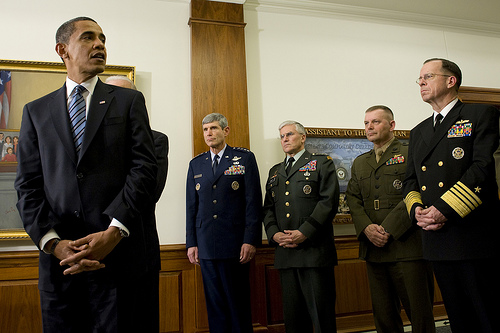
Hedges vs. Obama’s Indefinite Detention

ObamaPentagonFlickrUSArmyMEDIA ROOTS — Pulitzer Prize-winning journalist Chris Hedges has filed suit against Obama and Panetta to challenge the legality of the NDAA (S. 1867), which includes totalitarian provisions authorising the activation of U.S. Military within U.S. borders to imprison anyone within the U.S., or the world, without charge or trial.  Hedges, alongside his attorney, sharply articulates what’s wrong with the Levin/McCain provisions cynically inserted into this year’s NDAA.
MR

***

Chris Hedges on Democracy Now

DEMOCRACY NOW! — Pulitzer Prize-winning journalist Chris Hedges has filed suit against President Obama and Secretary of Defense Leon Panetta to challenge the legality of the National Defense Authorization Act, which includes controversial provisions authorizing the military to jail anyone it considers a terrorism suspect anywhere in the world, without charge or trial. Sections of the bill are written so broadly that critics say they could encompass journalists who report on terror-related issues, such as Hedges, for supporting enemy forces. “It is clearly unconstitutional,” Hedges says of the bill. “It is a huge and egregious assault against our democracy. It overturns over 200 years of law, which has kept the military out of domestic policing.” We speak with Hedges, now a senior fellow at the Nation Institute and former New York Times foreign correspondent who was part of a team of reporters that was awarded the Pulitzer Prize in 2002 for the paper’s coverage of global terrorism. We are also joined by Hedges’ attorney Carl Mayer, who filed the litigation on his behalf in the U.S. District Court for the Southern District of New York.

DN:  “During Monday night’s debate in South Carolina, Republican candidates sharply disagreed over a new policy to indefinitely detain American citizens. President Obama approved the measure as part of the National Defense Authorization Act, or NDAA, which includes controversial provisions authorizing the military to jail anyone it considers a terrorism suspect anywhere in the world without charge or trial. President Obama added a signing statement when he signed the NDAA, stating, quote, ‘I want to clarify that my administration will not authorize the indefinite military detention without trial of American citizens.'”

Well, last night, Republican front-runner Mitt Romney defended Obama’s approval of the bill, saying he would have done the same.

Audio of Kelly Evans:  “Governor Romney, as president, would you have signed the National Defense Act, as written?”

Audio of Mitt Romney:  “Yes, I would have. And I do believe that it’s appropriate to have in our nation the capacity to detain people who are threats to this country, who are members of al-Qaeda. Look, you have every right in this country to protest and to express your views on a wide range of issues, but you don’t have a right to join a group that has challenged America and has threatened killing Americans, has killed Americans and has declared war against America. That’s treason. And in this country, we have a right to take those people and put them in jail.”

DN:  “That was Republican presidential front-runner Romney, talking about the controversial indefinite detention provisions in the NDAA.

“Meanwhile, Rick Santorum said a U.S. citizen who’s detained as an enemy combatant should have the right to a lawyer and to appeal his case before a federal court. And Ron Paul said holding American citizens indefinitely is a breach of the U.S. judicial system.

“When President Barack Obama signed the NDAA, sections of the bill were opposed by key members of his administration, including Defense Secretary Leon Panetta, FBI Director Robert Mueller and Director of National Intelligence James Clapper. Many civil liberties activists believe the law is unconstitutional.

“Well, today, an announcement is being made in New York, filing a complaint in the Southern U.S. District Court against Barack Obama and Secretary of Defense Leon Panetta to challenge the legality of the NDAA. Their plaintiff is none other than veteran war correspondent and Pulitzer Prize winner Chris Hedges.

“For more, we’re joined by Chris Hedges himself, senior fellow at the Nation Institute, who recently wrote a piece for TruthDig called “Why I’m Suing Barack Obama.” Chris Hedges is a former foreign correspondent for the New York Times, was part of a team of reporters who won the Pulitzer Prize in 2002 for the paper’s coverage of global terror. He is author of a number of books, including Death of the Liberal Class and The World As It Is: Dispatches on the Myth of Human Progress.

“And we’re joined by Chris Hedges’ attorney Carl Mayer, who filed the litigation on his behalf.

“Chris Hedges and Carl Mayer, welcome to Democracy Now!”

Chris Hedges:  “Thank you.”

DN:  “Chris, why are you suing President Obama?”

Chris Hedges:  “Because it’s clearly unconstitutional, for starters. But secondly, it is a huge and egregious assault against our democracy. It overturns over 200 years of law, which has kept the military out of domestic policing. And even that passage that you read from the White House, I think, is deeply disingenuous, because Dianne Feinstein had a resolution by which, within that bill, Americans would be exempted from this, and the Democratic Party and Barack Obama rejected it. All of the debate with Carl Levin, who, with McCain, sponsored the bill, was a struggle between the White House so that they would assume—they would have the right to assume which Americans would be detained by the military without due process and held indefinitely until the end of hostilities, this kind of endless war on terror. It’s an extremely frightening step backwards for American democracy. And as someone who’s spent 20 years overseas and has lived in countries where the military has that kind of power, I have friends who have disappeared into these military gulags. We have unleashed something that I think is truly terrifying.

“And as discontent grows, of course, the criteria by which people can be investigated in this country are so amorphous, even bizarre—I mean, somebody who is missing fingers on a hand or somebody who has more than seven days’ worth of food. It’s a very seamless step to include in that list some of the obstructionist tactics of the Occupy movement. And I think that for those of us who care about civil liberties, the right of dissent and freedom, we have to stand up. And that’s why Carl and I have decided to do this.”

DN:  “Carl Mayer, how does this—how does this litigation work?”

Carl Mayer:  “Right, well—”

DN:
  “And why not a class action lawsuit, where many people file?”

Carl Mayer:  “Right. Well, the purpose of the litigation is to have a federal court declare this act unconstitutional. And that would apply to everyone.

“Chris is an important plaintiff in this, because—you just showed the clip from Mitt Romney. I’m not sure that Mitt Romney has read this bill. The act is so broad and vague that it covers, in its writing, any persons who give, quote, “substantial support to al-Qaeda, the Taliban, or,” quote, “associated forces,” which are incredibly broad, nebulous terms and could capture, within those—their terms, journalists like Chris Hedges, who courageously has gone around the world to interview members of opposition parties, to interview members of terrorist groups, to report the truth. And so, when Mitt Romney says these are people who are in terrorist organizations, that’s not how the bill is written. It’s written so broadly that it could encompass a journalist like Chris Hedges. It could encompass people who are engaged in free speech and in all sorts of activities that have nothing to do with what Mitt Romney, etc., are talking about.

“And so, we filed this action. I filed it in conjunction with my colleague Bruce Afran, who’s a professor of constitutional law at Rutgers Law School, another veteran public interest attorney. And what we’re asking the court to do is to declare that this law violates not only the First Amendment rights of citizens like Chris to report and to speak about these issues, but also the Fifth Amendment right to due process, because what this—what this bill does is it sends people to military tribunals, and it allows for the indefinite detention of these people. It even allows for the rendition of covered persons, which is not defined in the act, to render these people to foreign countries.

DN:  “And explain what you mean by that. This is extraordinary rendition.”

Carl Mayer:  “Right. And so, what the act permits is that if someone is deemed under the act to be giving, quote, “substantial support” to, quote, “associated forces” that are associated with terrorists, they could be sent overseas at the determination of the American military, or they could be held in a military prison here indefinitely, or they could be tried in a military court. And as Chris Hedges, who is courageously bringing this as a plaintiff, pointed out, there is a longstanding Supreme Court decision called ex parte Milligan, which dates to the Civil War period, in which several people were held by the military for plotting to overthrow, during the course of the Civil War, the governments of Indiana and Ohio. And they were sentenced to death. The Supreme Court ruled, after the Civil War, that as long as there are civilian courts operating, you cannot try these people in military courts, even people who are—whose avowed purpose was to overthrow the civilian governments of Ohio, Indiana, etc. So, it is that level of protection that is built into the Constitution. And that’s what our ancestors fought for, is to uphold the Bill of Rights, due process rights, right to a trial by jury. And all of this is being abrogated by this legislation.”

DN:  “I wanted to bring in what Rick Santorum said last night at the Republican debate in South Carolina about a U.S. citizen detained as an enemy combatant having the right to a lawyer to appeal their case before a federal court.”

Audio of Rick Santorum:  “First off, I would say this. What the law should be and what the law has been is that if you are a United States citizen and you are detained as an enemy combatant, then you have the right to go to federal court and file a habeas corpus petition and be provided a lawyer. That was the state of the law before the National Defense Authorization Act, and that should be the state of the law today. You should not have—you should not have—if you’re not an American citizen, that’s one thing. But if you are a citizen and you’re being held indefinitely, then you have a right to go to a federal court. And again, the law prior to the National Defense Authorization Act was that you had the right to go to a court and for that court to determine, by a preponderance of the evidence, whether you could continue to be held. That is a standard that should be maintained, and I would maintain that standard as president.”

DN:  “Chris Hedges, Rick Santorum versus President Obama?”

Chris Hedges:  “He’s not a politician I usually have much in common with, but this is right. I mean, this is about the egregious destruction of the rule of law. I mean, we have to remember that under the 2001 Authorization to Use Military Force Act, some of this was already happening. José Padilla, for instance, was picked up by military courts, held without trial, access to due process—again, a U.S. citizen—went to the Supreme Court, and by that time, they handed him over to civilian court to—and the Supreme Court never made a ruling on it. But I think that this essentially codifies this very extreme interpretation of this 2001 act into law.

“And more importantly, it expands the capacity by the state in terms of defining who is, quote/unquote, ‘not only a terrorist, but somebody who is,’ in their terms, ‘associated forces’ or substantially supports people defined as terrorists. And, of course, the reason for that is that many of these groups that are being attacked in Yemen and other places had nothing to do with 9/11—they didn’t even exist when 9/11 happened—and to expand this into the civilian population of the United States. And I think, Amy, one of the most sort of disturbing aspects of this is that the security establishment came out against it—the CIA, the FBI, the Attorney General, the Director of National Intelligence. None of them wanted it.

DN:
  “President Obama said he was going to veto it.”

Chris Hedges:  “President Obama said he was going to veto it, but we now know from leaks out of Levin’s office that that’s because the executive branch wanted to decide. They wanted the power to decide who would be tried, who would be granted exemptions. It wasn’t actually about the assault against due process.

And I think we have to ask, if the security establishment did not want this bill, and the FBI Director Mueller actually goes to Congress and says publicly they don’t want it, why did it pass? What pushed it through? And I think, without question, the corporate elites understand that things, certainly economically, are about to get much worse. I think they’re worried about the Occupy movement expanding. And I think that, in the end—and this is a supposition—they don’t trust the police to protect them, and they want to be able to call in the Army. And if this bill goes into law, and it’s slated to go into law in March, they will be able to do that.

DN:  “I wanted to ask you a quick question about a comment Texas Governor Rick Perry made last night, in a related, but not exactly the same thing as what you’re talking about. He said on Sunday the Obama administration has gone “over the top” in criticizing marines who were videotaped urinating on Afghan corpses.”

Audio of Gov. Rick Perry:  “What bothers me more than anything is this administration and this administration’s disdain all too often for our men and women in uniform, whether it is what they’ve said about the Marines—now, these young men made a mistake. They obviously made a mistake.

Audio of Bret Baier:  “You’re talking about urinating on the corpses?”

Audio of Gov. Rick Perry:
  “They made a mistake that the military needs deal with, and they need to be punished. But the fact of the matter—the fact of the matter is this. When the Secretary of Defense calls that a despicable act, when he calls that utterly despicable—let me tell you what’s utterly despicable: cutting Danny Pearl’s head off and showing the video of it, hanging our contractors from bridges. That’s utterly despicable.”

DN:  “That was Rick Perry, Texas governor. Chris Hedges, you were a longtime war correspondent.

Chris Hedges:  “Well, you know, when people are killed on a battlefield, and those who are deemed the enemy are, at best, treated like human refuse. But usually they’re treated like trophies. They’re often dismembered. I mean, one of the first things you do after you kill an enemy combatant is go through their pockets. And in war after war that I covered, the desecration and mutilation of corpses was extremely common. So, I think that what we saw was a window into the reality of war, one that has essentially been censored from public view.”

DN:  “I want to thank you both for being with us, Chris Hedges, Carl Mayer.”

The original content of this program is licensed under a Creative Commons Attribution-Noncommercial-No Derivative Works 3.0 United States License.

***

Photo (feature) by flickr user JBrazito

Posted in Uncategorized | 1 Reply

DHS Targets Dissent Through Social Media Spying


BusinessmanFlickrInternets_dairyMEDIA ROOTS — The Electronic Privacy Information Center has obtained documents through an FOIA request detailing how the Department of Homeland Security’s (DHS) domestic spying program focuses primarily on media reports that are “critical of the agency and the U.S. government more broadly.”
This may be an unsurprising revelation, but these documents further expose the increasingly oppressive nature of the state and DHS to stifle free speech and target dissent under the umbrella of “‘national security.”

MR

***

WASHINGTON POST
Civil liberties advocates are raising concerns that the Department of Homeland Security’s three-year-old practice of monitoring social media sites such as Facebook and Twitter could extend to tracking public reaction to news events and reports that “reflect adversely” on the U.S. government.

The activists, who obtained DHS documents through a Freedom of Information Act lawsuit, say one document in particular, a February 2010 analyst handbook, touts as a good example of “capturing public reaction” the monitoring of Facebook and other sites for public sentiment about the possible transfer of Guantanamo detainees to a Michigan prison.

With the explosion of digital media, DHS has joined other intelligence and law enforcement agencies in monitoring blogs and social media, which is seen as a valuable tool in anticipating trends and threats that affect homeland security, such as flu pandemics or a bomb plot.

But monitoring for “positive and negative reports” on U.S. agencies falls outside the department’s mission to “secure the nation,” said the Electronic Privacy Information Center, which obtained a copy of a contract and related material describing DHS’s social media monitoring through its FOIA suit.

Read more about DHS monitoring of social media concerns civil liberties advocates.

© 1996- The Washington Post

***

Photo by Flickr user Adam Selwood

Posted in Uncategorized | 1 Reply

Internet Censorship: SOPA, PIPA, & Big Brother


InternetUseflickrAdamSelwoodMEDIA ROOTS — A neutral Internet’s First Amendment rights to free speech, dissent, and political activity face serious challenges from Congress and the Obama Administration.  Currently, the House “Stop Online Piracy Act (SOPA) and its companion bill in the Senate, the Protect IP Act (PIPA)” are being debated in Congress. 

The Electronic Frontier Foundation has said the “major problem is that they are written to be overly broad and they are written to favour the rights-holders.  And, so, they allow a thing called a private right of action, which means that someone who believes that a [web]site is intended for, or allows, the distribution of their copyrighted material can go directly to that website’s ad networks or payment processors and have them cut off from those sources of revenue.” 

Clearly, SOPA and PIPA amount to a power grab by the legislation’s corporate supporters—Viacom, Netflix, U.S. Chamber of Commerce, Motion Picture Association of America, Recording Industry Association of America, and the AFL-CIO—to alter the structure of the internet in their pro-1% favour.  Today, Democracy Now! spoke with Corynne McSherry, who is the intellectual property director at the Electronic Frontier Foundation about the website strikes planned for tomorrow by Wikipedia and Reddit, protesting SOPA and PIPA, and Rebecca MacKinnon, author of Consent of the Networked: The Worldwide Struggle for Internet Freedom about online freedom and its role in cultivating a healthy democracy.

Media Roots is a prime example of the kind of website that could be targeted for aggregating material that may be deemed copyright  under the overarching SOPA and PIPA legislation.  Learn more about the bills and what you can do here.
 

MR

***
DEMOCRACY NOW! — Wikipedia, the online encyclopedia and sixth most visited site in the world, will join websites like the content aggregator Reddit to “go dark” on Wednesday [18 Jan 2012] in opposition to the Stop Online Piracy Act (SOPA) and its companion bill, the Protect IP Act (PIPA), which are currently being debated in Congress. “What these bills propose are new powers for the government and also for private actors to create, effectively, blacklists of sites that allegedly are engaging in some form of online infringement and then force service providers to block access to those sites,” says Corynne McSherry, intellectual property director at the Electronic Frontier Foundation. “What we would have is a situation where the government and private actors could censor the net.” Chief technology officials in the Obama administration have expressed concern about any “legislation that…undermines the dynamic, innovative global Internet.” But the bills’ main backers—Hollywood movie studios and music publishers—want to stop the theft of their creative content, and the bills have widespread bipartisan support. A vote on SOPA is on hold in the House now, as the Senate is still scheduled vote on PIPA next Tuesday [1/24/12]. [rush transcript included]


DN!:  “If you want to know more about two controversial internet anti-piracy bills moving through Congress, you won’t be able to consult Wikipedia on Wednesday. The online encyclopedia and sixth most visited site in the world will join websites like the content aggregator Reddit to ‘go dark’ for 12 to 24 hours in opposition to the Stop Online Piracy, or SOPA, Act and its companion bill, the Protect IP Act. Wikipedia co-founder Jimmy Wales announced the decision to bring down his website last night on Twitter, writing, quote, ‘Student warning! Do your homework early. Wikipedia protesting bad law on Wednesday!’

The White House responded over the weekend to two petitions opposing the bills. The administration’s chief technology officials wrote on White House blog Saturday, quote, ‘We will not support legislation that reduces freedom of expression, increases cybersecurity risk, or undermines the dynamic, innovative global Internet.’

While the White House did not take a definite position on SOPA and the Protect IP Act, it has called for legislation to combat online piracy that has hurt the legislation’s main backers: Hollywood movie studios and music publishers who want to stop the theft of their creative content. Now a vote on SOPA is on hold in the House. The Senate is still scheduled to vote on the piracy issue next Tuesday, a week from today.

Well, to talk more about the Stop Online Piracy Act, or SOPA, and the Protect IP Act, we go to San Francisco to talk Corynne McSherry, who is the intellectual property director at the Electronic Frontier Foundation.

We welcome you to Democracy Now! Please explain both of these bills. It’s very tough, I think, for most people to understand the technical aspects of this legislation.”

CORYNNE McSHERRY:  “Sure. In a nutshell, what these bills propose are new powers for the government and also for private actors to create, effectively, blacklists of sites that allegedly are engaging in some form of online infringement and then force service providers to block access to those sites. And that’s why we call these the censorship bills, because effectively what we would have is a situation where the government and private actors could censor the net. So, U.S. citizens would basically get a different version of the internet, different from what you might get in, say, Italy or even China.”

DN!:  “So, explain the difference between SOPA and the Protect IP Act.”

CORYNNE McSHERRY:  “Well, currently they’re quite—they’re quite similar. As drafted, SOPA was much broader than the Protect IP Act, and the folks behind the bill realized that maybe it was a little bit too broad, so they tailored it down. So now they’re quite similar. One of the differences is that SOPA is, finally, after a great deal of activism, more or less on hold for now. But Senator Reid is saying that he’s going to push forward the Protect IP Act, despite all of the opposition.”

DN!:  “And explain who is behind these two acts.”

CORYNNE McSHERRY:  “Well, that’s not a great mystery. Both of these acts are clearly being pushed hard by the big media industries, who seem to think that online piracy is why they’re having trouble, and actually, who insist that they’re having all kinds of trouble and they’re failing immediately if something doesn’t—if legislation isn’t passed immediately, they’re going to all go under, which is not true. In fact, the motion picture industry has been posting record profits for five years straight.”

DN!:  “In a December hearing of the House Judiciary Committee, Congress Member Jason Chaffetz, a Republican from Utah, talked about the lack of expert consultation in drafting SOPA.”

Rep. Jason Chaffetz:  “I was trying to think of a way to try to describe my concerns with this bill, but basically, we’re going to create—we’re going to do surgery on the internet, and we haven’t had a doctor in the room tell us how we’re going to change these organs. We’re basically going to reconfigure the internet and how it’s going to work, without bringing in the nerds, without bringing in the doctors. And again, I worry that we did not take the time to have a hearing to truly understand what it is we’re doing. And to my colleagues, I would say, if you don’t know what DNSSEC is, you don’t know what you’re doing. And so, my concern is that there is a problem, but this is not necessarily the right remedy.

DN!:  “That was Utah Congress Member Chaffetz. Corynne McSherry, your response?”

Corynne McSherry:  “I think he’s absolutely right. SOPA, in particular, was negotiated without any consultation with the technology sector. They were specifically excluded. And one of the things I think is really exciting, though, is that—you know, no one asked the internet—well, the internet is speaking now. And so, we’re seeing all kinds of opposition all over the web. And there’s going to be a day of action tomorrow. People are really rising up and saying, ‘Don’t interfere with basic internet infrastructure. We won’t stand for it.'”

DN!: What do you make of President Obama’s position on the bill, Corynne?

Corynne McSherry:  “Well, it was heartening to see the White House statement and see the White House sort of stand with the internet and stand with its own commitments against censorship and against online censorship, in particular. Up until recently, we have been very concerned that there seemed to be a contradiction. On the one hand, you had Hillary Clinton criticizing foreign governments for online censorship and for censoring web results and so on. But at the same time, you had these bills rocketing through Congress that would propose very similar things. So, it was good to see the White House stand against that and criticize these bills. On the other hand, I am concerned that the White House seems to think that some kind of legislation needs to be passed this year. And I actually don’t think the case has been made for that.”

DN!:  “Talk about the whole issue of the protection of artists, for example, the music industry and their concerns.”

Corynne McSherry:  “Well, look, there’s no question that there’s plenty of infringement online. That’s been true for a long time now. The question is how you’re going to answer it. And the best way to respond—it’s very clear at this point. The best way to respond to online infringement is to give people a better alternative. And when that happens, people go to that. So that’s the best way to do it. It’s not to pretend that the Pirate Bay doesn’t exist; it’s to give people an alternative to the Pirate Bay. And one of the things that we’ve seen is that, actually, independent artists are taking advantage of new technologies to reach the—reach new audiences. Music fans have more access to more music than they ever had before, and different kinds of music. And that’s what happens when you take advantage of new technologies, as opposed to running away from it.”

DN!:  “Let me read you a tweet that Murdoch sent out this weekend: ‘So Obama has thrown in his lot with Silicon Valley paymasters who threaten all software creators with piracy, plain thievery.'”


Corynne McSherry:  “Well, you know, I think it’s ironic to talk about paymasters, given the amount of money that Hollywood has been spending in Congress to try to ram these bills through. I think it is true that the Obama administration has somewhat stood with Silicon Valley here, but I think Silicon Valley knows how to protect itself against so-called software piracy better than Rupert Murdoch will.”

DN!:  “Finally, the votes, where they stand this week?”
 

Corynne McSherry:  “Well, what we’re seeing now is Harry Reid, Senator Reid, is insisting that he’s going to go forward with a vote next Tuesday on the Protect IP Act. We’ll see what happens over the course of the week. Things have changed a lot. And after the day of action tomorrow, a lot of us are hopeful that Senator Reid will think better of trying to push this bill through, given the level of opposition. It’s really just a bad idea, particularly when you think about what they’re doing here. This is basic internet infrastructure that they’re messing with. And I think that Representative Chaffetz had it exactly right. It’s foolish to go in and interfere with internet infrastructure when you don’t know what you’re doing.”

DN!:  “And overall, SOPA and PIPA, how they’ve been separated?”

Corynne McSherry:  “Well, SOPA seems to be on hold for now. If PIPA is rammed through, it may be that in the House of Representatives they will try to revive SOPA and sort of bring the two bills in line. I certainly hope not, because that would be very, very dangerous for human rights, for internet security, and send an extremely negative signal around the world that the United States government does in fact support censorship, as long as you say that you’re doing it in the name of intellectual property enforcement.”

DN!:  “Corynne McSherry, I want to thank you for being with us, intellectual property director at the Electronic Frontier Foundation. When we come back, we’ll be joined by author Rebecca MacKinnon. She has just written the book, Consent of the Networked: The Worldwide Struggle for Internet Freedom. This is Democracy Now! Back in a minute.”

The original content of this program is licensed under a Creative Commons Attribution-Noncommercial-No Derivative Works 3.0 United States License.

***

DEMOCRACY NOW! — As protests mount against two controversial internet anti-piracy bills moving through Congress, we speak with Rebecca MacKinnon, author of the forthcoming book, “Consent of the Networked: The Worldwide Struggle for Internet Freedom.” “If we want democracy to survive in the internet age, we really need to work to make sure that the internet evolves in a manner that is compatible with democracy,” MacKinnon says. “And that means exercising our power not only as consumers and internet users and investors, but also as voters, to make sure that our digital lives contain the same kind of protections of our rights that we expect in physical space.” She argues that for every empowering story of the internet’s role, there are many more about the quiet corrosion of civil liberties by companies and governments. [rush transcript included]

 DN! “We’re joined by Rebecca MacKinnon in Washington, D.C., author of Consent of the Networked: The Worldwide Struggle for Internet Freedom.

“We welcome you to Democracy Now! Rebecca, the internet has been touted as such a tremendous liberating force. When we look at the events of this past year, the uprisings throughout the Middle East, part of the discussion of how that moment came is because of the internet, because of social media. And yet you talk about, more often than not, the internet is being used to spy on, to crack down on—spy on people, crack down on civil liberties. Talk about what you have found and how this relates to the legislation that we’re seeing now being developed in Washington.”

Rebecca MacKinnon:  “Well, thanks very much, Amy, for having me on here today.

“And just to connect my book to the issues that you were just discussing in the previous segment about the Protect IP Act and the Stop Online Piracy Act, I think the reason why this—these issues are so important for ordinary Americans and really go beyond just sort of a nerdy, geeky technical issue is that in today’s society, we, as citizens, increasingly depend on internet services and platforms, mobile services and platforms, not only for our personal lives and our businesses and our jobs, but also for our political discourse and political activism, getting involved with politics. And so, it’s very important that people who are exercising power, whether they’re corporate or whether they’re government, that are exercising power over what we can see, over what we can access, over what we can publish and transmit through these digital spaces, need to be held accountable, and we need to make sure that power is not being abused in these digital spaces and platforms that we depend on. And so, that’s why this SOPA and PIPA legislation and the fight over it is so important, is who are you empowering to decide what people can and cannot see and do on the internet, and how do you make sure that that power is not going to be abused in ways that could have political consequences. And we’ve actually seen how existing copyright law has sometimes been abused by different actors who want to prevent critics from speaking out.

“But coming back to the Arab Spring, my book is not about whether the good guys or the bad guys are winning on the internet. The internet is empowering everybody. It’s empowering Democrats. It’s empowering dictators. It’s empowering criminals. It’s empowering people who are doing really wonderful and creative things. But the issue really is how do we ensure that the internet evolves in a manner that remains consistent with our democratic values and that continues to support people’s ability to use these technologies for dissent and political organizing. And while the internet was part of the story in the Arab Spring in terms of how people were able to organize, it’s not so clear to what extent it’s going to be part of the story in terms of building stable democracies in countries like Tunisia and Egypt, where the dictators did fall, let alone in a number of other countries.

“In Tunisia, for instance, there is a big argument going on, now that they’ve had their set of democratic elections to the Constitutional Assembly, and they’re trying to write their constitution and figure out how to set up a new democracy. And Tunisia, under Ben Ali, was actually one of the most sophisticated Arab countries when it came to censoring and surveillance on the internet. And quite a number of the people who have been democratically elected in Tunisia are calling for a resumption of censorship and surveillance for national security reasons, to maintain public morals and public order. And there’s a huge debate going on about what is the role of censorship and surveillance in a democracy, and how do you make sure that power is not abused.

“And they turn and look at the United States, they look at Europe, and censorship laws are proliferating around the democratic world. And there’s not sufficient discussion and consideration for how these laws are going to be abused. And we’ve seen, actually, in Europe, with a number of efforts to censor both copyright infringement as well as child pornography and so on, that a lot of this internet blocking that happens, even in democracies, oftentimes exercises mission creep, so things that weren’t originally intended to be blocked end up getting blocked when the systems are in place. It’s really difficult to make sure that the censorship does not spread beyond its original intent. It’s very hard to control. So, this is one of the issues.

“It’s not that the internet isn’t empowering. It’s not that the internet can’t help the good guys—it certainly does. But we’re at a critical point, I think, in history, where the internet is not some force of nature. How it evolves and how it can be used and who it empowers really depends on all of us taking responsibility for making sure it evolves in a direction that’s compatible with democracy, and that it doesn’t empower the most powerful incumbent governments or the most powerful corporations to decide what we can and cannot see and do with our technology.”

 DN! “Rebecca MacKinnon, talk about the phenomenon, Control 2.0.”

Rebecca MacKinnon:  “Right. So, Control 2.0 is what I refer to in terms of how authoritarian governments are evolving in the internet age. And so, one example I use is China. And China, in many ways, is exhibit A for how an authoritarian state survives the internet. And how do they do that? They have not cut off their population from the internet. In fact, the internet is expanding rapidly in China. They now have over 500 million internet users. And the Chinese government recognizes that being connected to the global internet is really important for its economy, for its education, for its culture, for innovation. Yet, at the same time, they have worked out a way to filter and censor the content overseas that they feel their citizens should not be accessing.

“And what’s even more insidious, actually, is the way in which the state uses the private sector to conduct most of its censorship and surveillance. So, actually, what we know as the Great Firewall of China that blocks Twitter and Facebook, that’s only one part of Chinese internet censorship. Actually, most Chinese internet users are using Chinese-language websites that are run by Chinese companies based in China, and those companies are all held responsible for everything their users are doing. And so, they have to hire entire departments of people to monitor their users at the police’s behest and also to not just block, but delete content that the Chinese government believes infringes Chinese law. And, of course, when—in a country where crime is defined very broadly to include political and religious dissent, that involves a great deal of censorship. And it’s being conducted, to a great degree, not by government agents, but by private corporations who are complying with these demands in order to make a profit in China.”

 DN! “Rebecca, talk about specifics, like Facebook, Facebook—changes in Facebook features and privacy settings, exposing identities of protesters to police in Egypt, in Iran. Talk about Google. Talk about Apple removing politically controversial apps.”

Rebecca MacKinnon:  “Right. So, for instance, with Facebook, Facebook has its own kind of type of governance, which is why I call private internet companies the “sovereigns of cyberspace.” And so, Facebook has a rule where it requires that its users need to use their real name, their real identity. And while some people violate that rule, that makes them vulnerable to having their account shut down if they are discovered. And so, the reason they do this is that they want people to be accountable for their speech and prevent bullying and so on. And that may make sense in the context of a Western democracy, assuming that you’re not vulnerable in your workplace or anything like that, which is even a question, but it means that you have to be—as an Egyptian activist or as an activist in Syria and so on, you’re more exposed, because you have to be on Facebook using your real name.

“And actually, a group of prominent activists in Egypt who were using Facebook to organize an anti-torture movement were doing so, before the regime fell, under fake names, and actually, at a critical point where they were trying to organize a major protest, their Facebook group went down, because they were in violation of the terms of service. And they actually had to find somebody in the U.S. to take over their Facebook page so that they could continue to operate.

“And you also have a lot of cases of people in Iran. There have been a number of reports of people being tortured for their Facebook passwords and so on. And the fact that Iranian users are, in most cases, using their real names makes them a great deal more vulnerable.

“And as you know, here in the United States, Facebook recently was subject to a fine and had to reach a settlement with the Federal Trade Commission because of the changes in its privacy settings that had been sudden at the end of 2009. People had made assumptions about whether their friends could be seen or not publicly. Suddenly those settings changed, and it exposed a lot of people in ways that, in some cases, were very dangerous.

“But also, let’s take some other companies and some of the issues that users face. Apple, in its App Store, it has different versions of its App Store in different parts of the world. And their Chinese App Store censors applications that the Chinese government believes to be controversial. So, for instance, the Dalai Lama app in the Apple Store is not available in China. But Apple employees are also making a lot of other judgments about what content is and isn’t appropriate, that goes according to standards that are much more narrow than our First Amendment rights. So, for instance, an American political cartoonist, Mark Fiore, had an app in which he was making fun of a range of politicians, including President Obama, and Apple App Store nannies decided to censor that app, because they considered it to be too controversial, even though that speech was clearly protected under the First Amendment. So you have companies making these judgments that go well beyond sort of our judicial and constitutional process.

“You also have Amazon, for instance, dropping WikiLeaks, even though it had not been accused, let alone, convicted, of any crime, simply because a number of American politicians objected to WikiLeaks. And so, there is this issue of: are companies, in the way in which they operate their services, considering the free expression rights and privacy rights of their users sufficiently to ensure that we’re able to have robust dissent, that people can speak truth to power in a manner that may be making current government officials very, very uncomfortable, but which is clearly protected both under our Constitution and the Universal Declaration of Human Rights?”

 DN! “Rebecca—”

Rebecca MacKinnon:  “Should we be expecting companies to push back a bit more?”

 DN! “I wanted to ask you about the newly released government documents that reveal the Department of Homeland Security hired the military contractor General Dynamics to monitor postings of U.S. citizens on dozens of websites. The sites monitored included Facebook and Twitter, as well as several news sites, including the New York Times, Wired, The Huffington Post. General Dynamics was asked to collect reports that dealt with government agencies, including CIA, FEMA, ICE. Your thoughts?”

Rebecca MacKinnon:  “Well, this is exactly the kind of issue that we need to deal with in a democracy. Now, if they have been hired to monitor postings that citizens are putting on a public website, I think that’s a reminder that our public information is public and that it’s being mined and watched by all kinds of people. But it’s also an example of why privacy settings are so important and why—why it’s important that people should be able to be anonymous if they want to be on the internet, if they fear consequences or if they fear misuse of the way in which they’re carrying out political discussions that could be used against them in different ways.

“And there’s also a real issue, I think, in the way in which our laws are evolving when it comes to government access to information stored on corporate servers, that is supposed to be private, that we are not intending to be seen in public, which is that, according to the PATRIOT Act and a range of other law that has been passed in recent years, it’s much easier for government agencies to access your email, to access information about your postings on Twitter, even if they’re anonymous, than it is for government agents to come into your home and search your personal effects. To do that, they need a warrant. There is very clear restriction on the government’s ability to read your mail. Yet, according to current law, if your email is older than 180 days old, the government can access your email, if it’s stored on Gmail or Yahoo! or Hotmail, without any kind of warrant or court order. So, there’s a real erosion of our Fourth Amendment rights, really, to protection from unreasonable search and seizure. And this is going on, I think, to a great degree without a lot people realizing the extent to which our privacy rights are being eroded.”

DN! “Rebecca, we have 30 seconds, but the significance of Wednesday, of tomorrow, of Wikipedia and many other websites going dark in protest of the legislation here in the United States? What do you think is the most important issue people should take away from what’s happening and also from your book, Consent of the Networked?”

Rebecca MacKinnon:  “Well, I think the action tomorrow really demonstrates that internet censorship affects everybody, it’s not just affecting people in China, that this is an issue that we all need to be concerned about, and it can happen in democracies as well as in dictatorships.”

And the core message of my book is that if we want democracy to survive in the internet age, we really need to work to make sure that the internet evolves in a manner that is compatible with democracy, and that means exercising our power not only as consumers and internet users and investors, but also as voters, to make sure that our digital lives contain the same kind of protections of our rights that we expect in physical space.”

DN! :  “Rebecca MacKinnon, I want to thank you very much for being with us, senior fellow at the New America Foundation, co-founder of Global Voices Online. Her new book is called Consent of the Networked: The Worldwide Struggle for Internet Freedom.”

The original content of this program is licensed under a Creative Commons Attribution-Noncommercial-No Derivative Works 3.0 United States License.

***

Photo (above) by Flickr user Adam Selwood

Photo (feature) by Flickr user Monkey Man Forever

Iowa Caucus, Ron Paul & GOP, Election Fraud, NDAA Update

Media Roots Radio – Iowa Caucus, Ron Paul & GOP, Election Fraud, NDAA Update by Media Roots

MEDIA ROOTS – Abby and Robbie Martin discuss the Iowa Caucus: the GOP candidates, the corporate media’s coverage of the events, cherrypicking racist attributes among the contenders, the phasing out of Ron Paul as a “front runner”; election fraud: the fact that there is voting software designed to flip the vote; NDAA: an update of how the legislation was passed and breakdown of what it actually means for citizens living in the US.

The above timeline is interactive. Scroll through it to find out more about the show’s music and to resources mentioned during the broadcast. To see a larger version of the timeline with clickable resources go to the soundcloud link below the player.

If you would like to directly download the podcast click the down arrow icon on the right of the soundcloud display. To hide the comments to enable easier rewind and fast forward, click on the icon on the very bottom right.

This Media Roots podcast is the product of many long hours of hard work and love. If you want to encourage our voice, please consider supporting us as we continue to speak from outside party lines. If you donate, we want to thank you with your choice of art from AbbyMartin.org as well as music from RecordLabelRecords.org. Much of the music you hear on our podcasts comes from Robbie’s imprint Record Label Records, and Abby’s art reflects the passion and perspective that lead her to create Media Roots.org.

$40 donation: One 8×10 art print and one RLR release (You choose! Tell us in the Paypal notes.)

$80 donation: Two 8×10 art prints and two RLR releases (You choose!)

$150 donation: Four 8×10 art prints and four RLR releases (You choose!)

Even the smallest donations are appreciated and help us with our operating costs.

Thanks so much for your support!

Listen to all previous episodes of Media Roots Radio here.