
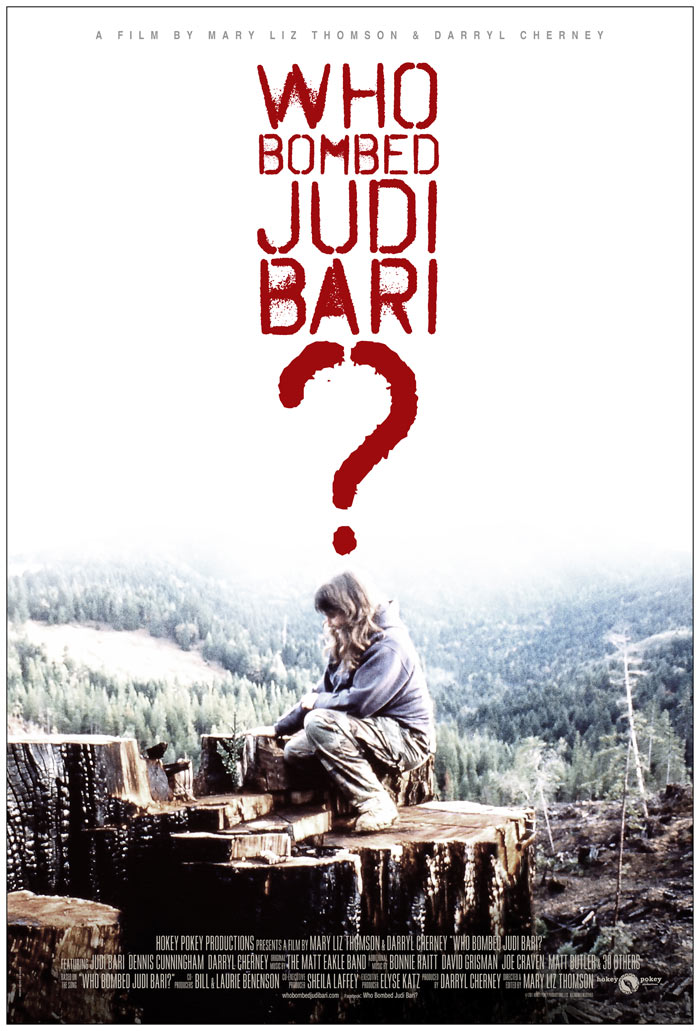
MR Transcript: Who Bombed Judi Bari? Interview


officialWBJB_White_02MEDIA ROOTS — Recently, Flashpoints interviewed the filmmakers of the new film, “Who Bombed Judi Bari?” which premiered at the SF Green Film Festival last Friday.  Mary Liz Thomson (Director) and Darryl Cherney (Producer) join Karen Pickett, a long-time friend of Judi Bari, to discuss with Flashpoints’ Dennis Bernstein, their shared experiences as friends and activists over the years of environmental organising and resistance to socioeconomic injustice and state repression through telling the story of their friend Judi Bari and the continued struggle for justice to find who bombed Judi Bari and Darryl Cherney.

Messina

***

FLASHPOINTS —  “Today, on Flashpoints, we’ll speak to Darryl Cherney and Mary Liz Thomson, the Producer and Director of the brand new film, “Who Bombed Judi Bari?” the film about the life and times of Judi Bari, who was car-bombed in Oakland in 1990.

“[Audio of Darryl Cherney] ‘I heard a crack and then my whole head started to ring like a sitar in my head.  And the car came to a screeching halt.  The first thought in my mind was, ‘Oh, no, not again.’  Because last August, we had been rear-ended by a log truck without ever seeing it coming and here we are again, me and Judi in a car.  And then I heard somebody scream out, ‘It’s a bomb! There was a bomb!’ And then it all made sense, that someone had tried to kill us.’”

“Darryl Cherney, you’ll hear more from him.  He’ll be joining us.  We’ll also be joined by Earth First! activist and long-time friend, Karen Pickett.  And we’ll explore the ongoing investigation, as Judi Bari’s bomber(s) still roam(s) freely.”

Dennis Bernstein (c. 1:56):  “You’re listening to Flashpoints on Pacifica Radio.  Legendary Earth First! organiser and car-bomb victim Judi Bari may have passed away in 1997.  But on the 15th anniversary of her death a 93-minute documentary, ‘Who Bombed Judi Bari?’ produced by her eco-cohort, Darryl Cherney will premiere at the SF Green Film Festival this Friday, March 2nd.  The film was directed by Mary Liz Thomson and it is based entirely on archival footage, including Judi Bari’s inspirational speeches, colourful and daring Redwood protests, etcetera.  ‘Who Bombed Judi Bari? is actually narrated by Judi Bari herself using footage taken at her deathbed testimony in her successful civil rights lawsuit against the FBI and the Oakland Police.  By the way, they blamed her and Darryl Cherney for bombing themselves. 

“We’re delighted to be joined now by Darryl Cherney and Mary Liz Thomson.  Darryl and Mary Liz, welcome to Flashpoints.  And we’re all celebrating the release of this film and the ongoing battle, shall we say, to track down and figure out who are the real murderers—and I say that word murderer because they gave her a slow motion death, of Judi Bari.  Darryl thanks for being with us.  Mary Liz thanks for being with us.”

Darryl Cherney (c. 3:27):  “Always a pleasure, Dennis.”

Mary Liz Thomson:  “Yeah.”

Dennis Bernstein:  “Alright.  Well, where to start?  Maybe we should start with a very, sort of, pragmatic, upfront, question.  Why do you think, Darryl, it’s important 22 years after the bombing of Judi Bari to tell the story?  Why does it remain relevant?”

Darryl Cherney (c. 3:53):  “Well, the movie has four essential purposes.

The first is to educate on tactics and strategy.  And we think nobody in the movement was superior in these arenas than Judi Bari, just a razor-sharp mind and wit.  And she could really come up with solutions quickly.  And this movie is filled with victories, major victories of saving forests, of taking on the FBI, of getting people to quit their jobs.  In other words, in a movement where, sometimes, defeat is the norm, I think it’s refreshing to have a movie that shows victory.  Judi was a radical.  I think she will appeal to young people as well as our elders.

“And the second purpose of our movie is to inspire action.  And Judi Bari’s speeches always inspired action and, to this extent, we are bringing her back to life.  Her speeches are as relevant today, and as inspirational today, as they always have been. 

The third reason for the movie is to educate people as to who the historical figure Judi Bari is.  And I don’t think it’s ever too late to learn about who are heroes can be, especially women heroes, who I prefer to call sheroes.  And Judi Bari needs to have her place in history.

And the fourth reason is that this case is an unsolved bombing case.  And we want to know who bombed Judi Bari.  And we think that this movie can help inspire a new generation to demand justice in this case.”

Dennis Bernstein (c. 5:26):  “What were the multiple struggles.  And I say multiple struggles in making this film?”

Darryl Cherney:  “Mary Liz, you wanna start with that?”

Mary Liz Thomson:  “Well, part of one of the struggles was that there was most of the footage, which we use is archival footage.  And it was spread out all over the place in the hands of a variety of videographers who had been following Darryl and Judi for years.  We had to find it and go around and collect it and make it into a digital format from all the old formats.

“I mean we knew where a lot of it was, but it was a great discovery process to find more.  There was just an amazing amount of footage to work with.  And, some of it’s mine and Ken Pearson as well, who shot at the time.  And it was pretty amazing.

“We also went to the Willits museum, where the bombed car is still there.  So, the research was pretty intense.

Darryl Cherney:  “And then, of course, the sound quality was a real bear to handle.  And it was actually Skywalker Sound, as in George Lucas’ ‘Star Wars’; it was Skywalker Sound who donated the studios to us to try to get some kind of equilibrium on the sound.  So, it was listenable.  And it was all listenable, but there was tape hiss.  There were mechanical noises.  So, these things were just some of the struggles.  There was over 250 contracts that we had to sign just to get musical releases and video releases.

“But, believe it or not, probably the least struggle we had was actually telling the story because, guess what, Judi Bari is a magnificent storyteller.  And, so, we simply allowed her to guide the movie along.”

Dennis Bernstein (c. 7:13):  “Well, Liz, first of all, just to get a little more from you, when you say archival footage, when we’re talking about archival footage, you mentioned that it was footage taken at the time.  You were there on the ground.  And the stuff you were filming had a lot to do with all the actions of Earth First! correct?”

Mary Liz Thomson:  “That’s correct, yes.  Myself and Ken Pearson were in San Francisco the day of the bombing.  And we took some Betacam cameras out and just started filming right then.  And we were able to interview Judi in the hospital later.  And we went up to Redwood Summer.  And we did a short [film] that was nationally broadcast on PBS at the time and used for Redwood Summer.

“So, a lot of the footage, when I say archival, we didn’t shoot a lot of new stuff of people talking about the past.  We take you there.  So, all of Darryl’s reasons are great, but it’s also just an amazing story.  And, so, you learn from it all these things, but it’s also the kind of story that you can get deep in, that you can really get to know a character who is an amazing person and who stands up for something.  You know, Judy and Darryl.”

Dennis Bernstein (c. 8:23):  “Alright, Darryl, let me ask you to talk a little bit about Judi Bari and let’s go back.  Because I’m sure that there are many people who don’t know much about this story and who maybe were born after the bombing. 

“How did you meet Judi Bari?  And tell us why you found this woman captivating and inspirational.”

Darryl Cherney:  “Well, I was running for Congress in the Democrat Primary in the 1st district, up in Mendocino/Humboldt Counties.  And in 1988, I was trying to design my brochure.  And I’m terrible with graphic design.  And Betty Ball, the founder of the Mendocino Environmental Center said, hey, I have a great graphic artist; her name is Judi Bari and, oh, here she comes now.  And in blew Judi like a gust of wind into the doors of the Mendocino Environmental Center.  And she immediately agreed to help me with my graphic design and, as she laid out my brochure for Congress perfectly, she was ridiculing my run for Congress, just ripping me to shreds, telling me I belonged in a tree, not on Capitol Hill, and that working for the system does absolutely no good.  And I just fell in love with her that minute.”

Dennis Bernstein (c. 9:41):  “And she, of course, was many things, including an organiser for the Wobblies.

Darryl Cherney:  “Yes, Judi Bari was a magnificent organiser.  She could bring thousands of people together.  She could raise a whole lot of money.  She could write and sing songs and play the fiddle.  She was a labour organiser who had led two strikes in the East Coast, at the bulk mail center at the United States Post Office in Washington, D.C. and the Retail Clerks Union in Maryland.”

Mary Liz Thomson (c. 10:10):  “[Those show up] in our movie, too.  So, you get a sense of where she came from and how that worked applying that in the redwoods.  She could talk to loggers like nobody else.  She was so good.”

Dennis Bernstein:  “And that, of course, was why she was so dangerous because she was so good.  And she could get down with loggers and get their attention.”

Mary Liz Thomson:  “That’s right.”

Darryl Cherney:  “She was a world-class bridge-builder.  And during the opening arguments of our eventual lawsuit with the FBI—and the cameras were not allowed in the courtroom—but one of the things Dennis Cunningham, the lead attorney said was, do not underestimate the significance and power of this woman inasmuch as it would warrant her being subject to an assassination attempt; don’t underestimate it.

“She was astoundingly powerful.  And that kind of a powerful person only comes along once in a blue moon.  And that’s why we made a movie about her.”

Dennis Bernstein (c. 11:06):  “Liz, how did you first hear about Judi Bari?  How did you first meet her?”

Mary Liz Thomson:  “I was doing a lot of video activism in the [S.F.] Bay Area and working with different groups, Rainforest Action, Network.  And someone else was involved with the Wobblies.  And they brought Darryl and Judi to a house I lived in, a big collective house in San Francisco.  And they did a performance and were down there letting people know what was happening with the redwoods.  So, I knew them before the bombing went off.  So, when it did happen, it was just chilling.  You know?  We just knew these people were taken down for speaking out.  And, I’ll never forget that day in San Francisco.”

Darryl Cherney:   “Which is, ironically or justifiably, where we’re premiering our movie on March 2nd at the San Francisco Green Film Festival.  So, it’s all coming back.”

Dennis Bernstein:  “That’s the voice of Darryl Cherney.  Also, on the line along with Darryl Cherney, is filmmaker Mary Liz Thomson together.  They have a brand new film out.  It’s going to be shown, premiered this Friday in San Francisco—‘Who Bombed Judi Bari?’—produced by Darryl and Liz, as I said.

“We’ve got a little bit of sound from the film.  So, let’s give a listen before we continue our discussion on this marvellous film.  I saw it in the works.  I was at many different, sort of, corners as the film moved along.  It was an honour to see it comin’ along.  And, boy, I am delighted to see that it is available now.  But let’s listen to some of the sound.”

Audio from “Who Bombed Judi Bari?” (c. 12:44):

News Anchor:  “The unofficial word is: the two environmentalists injured when a bomb went off in their car just before noon are suspects and not just victims.  The unconfirmed report said Judi Bari and Darryl Cherney will be charged with possession and transportation of explosives.”

Bullhorn Speaker:  “I think we need to save yield, so that our children can have wood to build out of; we’re not saying no loggin’!”

Interviewer:  “What is the basic event of which the case arose?

Judi Bari:  “I was bombed and nearly killed in a car bomb assassination attempt.  It was a very huge explosive and I felt it rip through me.”

News Anchor:  “Police say evidence is compelling.  But they would not say what it is.”

Judi Bari:  “Of course, the nails didn’t match either.  They went into my house and pulled nails out of the window trim.  This is not your normal investigation where they’re trying to find out who did something.  They were trying to frame me.

Male Commentator:  “Terrorists is all they are.  They go blowin’ up stuff.  And they caught ‘em down in Frisco with a bomb.”

Judi Bari:  “And our struggle to save these forests has been a trail of tears of broken treaties.  We’ve put, quote-unquote, the best forestry laws in the country on the books.  We’ve done everything we can to enforce them and they still take every tree in the forest!”

Interviewer:  “What was it you hoped to achieve by pursuing this lawsuit?”

Judi Bari:  “Justice.  Justice and vindication.”

News Anchor B:  “It was an emotional day in the courtroom today, in the case of Earth First! activists Judi Bari and Darryl Cherney versus the FBI and Oakland Police.”

Male Commentator B:  “People can see when activists are attacked for their activism by the government, by the police.”

Female Commentator:  “What the FBI has been doing, instead of fighting terrorism, is looking at activists and tampering with activists’ protected activities.  I mean that’s gotta stop.”

Darryl Cherney:  “The question, again, asked a lot is:  Do you think the FBI was involved in the bombing somehow?  And I would say they were involved in the bombing, right up to the present moment, by hiding the identity of the bomber.  They’re running cover for the bomber.  And they’re doing it right to this moment.”

Dennis Bernstein (c. 15:00):  “You’re listening to Flashpoints on Pacifica radio.  We’re speaking with Darryl Cherney and also the co-filmmaker, Director, Mary Liz Thomson.  Together, they have put together the film, ‘Who Bombed Judi Bari?’  It’s going to be showing Friday at the Green Film Festival in San Francisco.  And we’ll give you more about that and more in terms of finding out how to learn more about the film and participate in other showings and helping to get the word out. 

“On the line is Darryl Cherney.  I have to say, Darryl, I’m not usually tongue-tied.  But when I think about this—and I think about the whole curve of this story—I’m almost, she was mesmerising, what happened to her was extraordinary, most extraordinary was, as you say, the narration, essentially, the connecting tissue, really, was Judi Bari on her deathbed, refusing pain-killing medication in order to remain clear and give the deposition that led to the landmark case, in which the FBI and the Oakland Police Department were found liable for millions of dollars for, essentially, blaming the victim, blaming Darryl and Judy for bombing themselves.

“Let’s talk a little bit about that deposition and how that became the narration, if you will, or the connecting tissue.  Remind people what happened.”

Darryl Cherney (c. 16:53):  “Well, I’ve always been not a fan of narrators in documentaries.  And, in fact, not only is this film all archival, there is nobody in the present looking back on the past.  And I think that gives the film a sense of being in the now, being there on the scene.

“So, with Judi Bari’s deposition, there she is with 30 days left to live under questioning from Dennis Cunningham—Dennis Cunningham is the co-star of the movie, off-screen, but his voice was there asking the right questions—there’s Judi giving nothing less than a heroic performance under incredible stress.  And what’s particularly heroic about this is that she knows that she’s not gonna live to see the victory or the results of her labour.

“Now, somebody once said to me that if you’re really an activist in this world you know that whatever you’re working for, you’re not really gonna be able to live to see the results, ultimately, into the future.  And Judi epitomised that selflessness and that heroism.  And it is very clearly, you know, the power when she speaks, even when she cries.  She talks about her children and having their house searched a second time and the fear of being in prison while her children were growing up and not being able to watch them grow, bringing her to tears in the deposition, all just has this powerful thing.  She doesn’t know she’s gonna be in a movie.  This is just real, raw, Judi Bari, real, raw, activism at its core and at its finest.”

Dennis Bernstein (c. 18:34):  “Alright.  I wanna bring Karen Pickett into the discussion.  Karen Pickett was a long-time friend of Judi Bari, a member of Earth First! and was one of the first people after you and Judi were bombed, Darryl.  Karen was trying to figure out what the heck was going on.

“Karen, welcome to Flashpoints.  Welcome back.”

Karen Pickett:  “Thanks, Dennis.

Dennis Bernstein (c. 18:59):  “What I’d like you to do is maybe talk a little bit about Judi, how you met her, and what happened with you, and to you, after the bombing.”

Karen Pickett (c. 19:11):  “Well, I first met Judi in 1988 when she was first getting involved with Earth First!.  Actually, Darryl brought her as his date to my wedding, but that’s a whole other story.  But that’s when we met and we became fast friends.  We clearly had a lot to talk about even though she was up in Mendocino County and I was up in the Bay Area.  We were both working on the same issues.  And, particularly, as we were approaching the organising for Redwood Summer, we talked on the phone all the time.

“And I was at the Redwood Summer organising meeting the night before the bombing.  And I was also the first person at the hospital.  Somebody called my house.  Somebody called the Mendocino Environmental Center with the news of the bombing.  And that person called my house; and the person at my house called me at my work at the ecology centre.  And I just dashed out the door.

“So, when I got to the hospital, even though hundreds of people came very shortly, it was before the crowds were there and the FBI and the Oakland Police approached me, as I was trying to find out how badly Judi was hurt.  She was in emergency surgery.  And they took me downstairs for questioning.  And, initially, for a very short time I thought, well, okay, this is what authorities are supposed to do, right? When a bomb explodes they’re supposed to ask questions. They’re supposed to find out what happened.  But very quickly, after just a few minutes, I just had this terrible feeling that something was very wrong.  Something was very fishy in the way they were conducting themselves.  Something horrible had just happened, but there was something very wrong in the way that things were unfolding in the aftermath.

“And, so, I didn’t answer their questions.  And they took me down to the Oakland Police Station and detained me for several hours.  And a funny story in all that was that they made the mistake of locking me in a room at the Oakland Police Station that had a phone.  And even though we knew next to nothing, we knew that the police were not doing their job.  So, I picked up the phone and called KPFA News.  And they put me on live.  And I, kind of, told the world what had happened.  And that we needed to rally.  You know?  We needed to come together.  And people just converged.  Of course, this was before cell phones and Tweets and all of that kind of thing.

“So, to come around now and have this little piece of history be told the way that it’s told.  It’s, you know, this is a story that’s been told so many times.  We’ve had all these panels about COINTELPRO and we’ve talked about it a lot over the last 22 years.  But to bring it together graphically in this way, the way that the movie is presented, is beautiful because I think that one of the things that happen with time is that people look back and they think, oh, well, this must be hyperbole; it couldn’t have been that bad.  But when you hear Judi talking about waking up after extensive surgery, coming out of the anaesthesia, and seeing cops at the foot of her bed, and telling her that she is under arrest, and when you see Judi at the press conference with the police photos showing a hole in the floor under the driver’s seat and then you cut to the police reports—with the text highlighted that says they base the arrest warrant on the ‘fact’ that the bomb exploded in the back seat, they must have seen it, they must have known it was there, therefore, it was their bomb—then, clearly, it’s not hyperbole.

“And people need to know this story because it’s still going on today.”

Dennis Bernstein (c. 23:44):  “Alright.  Let me recap here.  That’s the voice of Karen Pickett, Earth Firster, and friend of the late Judi Bari.  A brand new film by Darryl Cherney and director, Mary Liz Thomson, is going to be premiering Friday in San Francisco at the Green Film Festival, for those of you in the [S.F.] Bay Area, that’s 1746 Post Street at 5 pm.  And we’re delighted to have Darryl, to have Liz on the line, and Karen in the studio.

“Darryl, let me take you back to that moment right after the bombing.  Talk a little bit about, I mean: you’re in the car; Judi was badly shaken, I guess, semi-conscious.  Talk a little bit about the explosion and what happened right after.”

Darryl Cherney (c. 24:44):  “I certainly will.  And I just wanna remind listeners that our website, WhoBombedJudiBari.com can give a lot of information…a great place to get our schedule and how to buy tickets.

“So, what happened right after, first of all, I didn’t even know it was a bomb because I had no frame of reference of knowing.  And the car came to skidding halt.  And two kids came out of Oakland High School; it was right at Park and MacArthur, right smack-dab in front of Oakland High School.  And they came screaming out:  It’s a bomb! It’s a bomb!  And that’s how I figured it out.

“But I was treated very rudely by the paramedics.  I told them to take Judi first.  And they told me to shut up.  And to just listen to what they said.  It was very rude, as if somebody had, ultimately, poisoned their ears and their mind with something about me.  I had no idea what was going on except that I was being treated very gruffly.  But before I was even pulled out of the car, I just turned to Judi—and this is depicted in the movie—‘cos she said, ‘Did Darryl say anything to you?’  And she says, ‘He told me that he loved me and he told me I was going to live.’  And I repeated that to her over and over again to keep her conscious and to do the only thing I could do in my power was to try to keep her spirit up and to keep her talking and alive.

“And, so, then they took us to the hospital, to the emergency room where they pulled glass out of my eye and stitched up a little bit of my upper eye.  And then they said the FBI came in and they said, what’s your name?  And for the millionth time I said, Darryl Cherney.  And I said, ‘who are you?‘And they didn’t tell me who they were.  They flipped down their little billfolds like they do on TV.  And I had a patch on this eye; the other eye was pretty closed.  And I knew that anybody who was stupid enough to show their badges to a blind man had to be the FBI.

“So, they said, who did this?  I gave them a laundry list of death threats we had received and they just waved their hands and said, look, we can tell that this is your bomb, so why don’t you just confess, get it over with, and make it easy on all of us?

“And then, of course, like Judi, I asked to see my lawyer.  And shortly after that I was taken out to the Oakland Police Station, we were coming out of a bombed car.  I was put in a cold room with linoleum floors and hard-backed chairs and left there for four hours or longer before anybody would come to talk to me.  I had to beg to go to the bathroom, beg, I was screamin’ my bloody butt off, man.  I was not, I was, get me the hell out of here; I needed to go see Judi is what I needed to see.

“And then they questioned me for four hours.  And a lot of people say, well, you shouldn’t talk to the cops.  And I agree.  But I am the exception, perhaps, that proves the rule because I’m pretty good with law, as we found out later.  And I talked to them for four hours, which, at the end of the day, was a good thing ‘cos the jury could see that we weren’t hiding anything.  We were willing to talk.  And there was one point—I believe it was Lieutenant Sims, scratched his head as he was talking to me—and he said, ‘gee, you sure don’t fit the profile of a bomber.’  Which I responded, ‘well, no—you know what—Sherlock.

“And that was kind of the opening hours.  And then in the morning after getting out of a holding cell, they put me into another holding cell.  And, like Karen Pickett, it had a telephone.  And I called KMUD radio, my own public radio station and I gave a talk to the people out there.  And KPFA was also very instrumental in this case.  And, in fact, KPFA has two different appearances in our movie, one by Mark Mericle and another more recently, by one of your reporters.  So, all the public radio stations were very helpful in getting the word out and letting us have a voice while we were being oppressed.” 

Dennis Bernstein (c. 28:37):  “Alright.  Well, here’s what we’re gonna do.  We’re gonna take just a little short break.  And we’re gonna listen to Darryl and Judi singing, Judi’s song, ‘The FBI Stole My Fiddle.’  They did take her instrument, right?  It was evidence.”

Darryl Cherney:  “Yes, they definitely took her instrument.”

Mary Liz Thomson:  “It was in the car, yeah.”

Darryl Cherney (c. 29:00):  “They took it.  They never gave it back.  And they said it was state evidence.  It was her childhood fiddle.  She never lived to see it again.”

Dennis Bernstein:  “Alright, well, let’s listen to you and Judi singing ‘The FBI Stole My Fiddle.’”

Audio of Judi singing “The FBI Stole My Fiddle” by Judi Bari and Darryl Cherney:

“(D) Well, I was drivin’ out of Oakland
On a tour for Redwood Summer
When a bomb went off inside my car
It was a major bummer (G) (F)
(D) They blamed me for the bomb (G) (F)
(D) That almost took my life (G) (F)
(D) But there’s one last thing that they did
One last twist of the knife

chorus:
The FBI (G) stole my fiddle
The FBI (D) stole my fiddle
The FBI (A) stole my fiddle (G)

The FBI stole my fiddle [1st chorus]

  (2nd chorus:  William Sessions stole my fiddle!)
  (3rd chorus:  J Edgar Hoover stole my fiddle!)
  (4th chorus: Richard Held stole my fiddle!)

And I want my fiddle (D) back! (G)(Gm)(D)(A)

The next day in the papers
Although it made no sense
Was a picture of my fiddle
And they called it evidence
They took away my Birkenstocks
They took away my car
But when they took my fiddle
Well, you know they went too far

(2nd chorus)

They said my strings was fuses
My bow it was the light
And down inside my fiddle hole
I stashed my dynamite
So when I stroke my fuse strings
With my fiddle bow
You’d better run for cover
‘Cos this fiddle might just blow!

(3rd chorus)

Well, Special Agent Richard Held
Is the man behind the show
He helped frame Leonard Peltier
And jailed Geronimo
He falsified the evidence
Life sentences, no bail
It’s time to get them free
Then let’s put Richard Held in jail!

(4th chorus)

Now, Louis Fries got my fiddle

And I want my fiddle back!

The FBI stole my fiddle

And I want my fiddle back!”

Dennis Bernstein (c. 31:58):  “Yeah, Judi Bari with Darryl Cherney, ‘The FBI Stole My Fiddle’—irrepressible. 

“The film ‘Who Bombed Judi Bari?’ is premiering.  And we’re delighted that after a long struggle to make it happen, it did, in fact, happen.  Darryl Cherney and his cohort, the co-filmmaker, Mary Liz Thomson put this together.  And I want to tell you, for people in the [S.F.] Bay Area, Friday [March 2nd], 5pm, in San Francisco, 1746 Post Street.  You can check it out.  And there is more information at the website WhoBombedJudiBari.com.  Is that correct?”

Darryl Cherney (c. 32:49):  “That’s correct.  And, by the way, that 1746 Post Street is the San Francisco Film Society.  They’re allowing the San Francisco Green Film Festival to have their event at their venue.”

Dennis Bernstein (c. 33:01):  “The FBI and the Oakland Police Department were clearly culpable.  A jury found them liable to the tune of $5 or $6 million bucks?”

Darryl Cherney:  “It was $4.4 [million].”

Dennis Bernstein:  “$4.4 [million].  Let me not exaggerate.  But when you’re suing the FBI and the Oakland Police Department you don’t usually win.  So, apparently, you had a great case and with Dennis Cunningham and others, such as Bill Simpich and the other lawyers.  You had a great team.  And, of course, as you say, you had Judi on your side.

“Darryl, this wasn’t the first attempt to kill Judi Bari was it?”

Darryl Cherney:  “No, eight months earlier Judi Bari and I were driving on Highway 128 toward the coast of Mendocino with Pam Davis from Santa Rosa Earth First! and four children.  I’d say very young children between the ages of three and eight.  And a log truck driver rear-ended us while we were on our way.  And we actually stopped for a soda, got back to the car, and we didn’t realise a log truck was behind us.  But then as we came into Philo, California, this truck rear-ended us, sent us flying into the air.  And we came down on a parked pickup truck, took out the porch and the deck of a café.  And when the truck driver came out he exclaimed twice—and I heard this with my own two ears—“I didn’t see the children! I didn’t see the children!,” meaning if he’d seen the children, he might not have tried to rear-end our [car].  But there was four children in the car, as well as three adults.”

Dennis Bernstein (c. 34:43):  “So, the truck driver was indicted?”

Darryl Cherney:  “No.  The CHP tried to blame Judi for getting rear-ended by telling her that her taillights were a little dim when, in fact, her taillights had been blown to smithereens by the logging truck.  And I actually looked at the police and said, ‘I was following Judy last night; her taillights worked fine.’  And they said, ‘Well, they were a little dim.’

“So, in other words, they tried to blame Judy for getting rear-ended by a logging truck.  No, no indictment occurred.”    

Dennis Bernstein (c. 35:13):  “And this wasn’t the only sign that people were unhappy with Judi Bari and what you were doing, all working on Earth First! because there were other little notes that would arrive, huh?”

Darryl Cherney:  “Many, many death threats occurred just before Redwood Summer, about a few dozen, three dozen, in a period of about a month and a half, just before Redwood Summer. 

There was also other violence being engaged upon Earth Firsters up north.  Greg King was punched out.  A grandmother named Mem Hill also had her nose broken by a logger.  The tension was—”

Mary Liz Thomson:  “There were all those fake press releases trying to stir up violence, saying that Earth First! was going to provoke violence.  So, some of those tactics, one thing that I think was so interesting is—just for Occupy today—all the climate change skeptics and all that onslaught of the fakeness, the attempt to be divisive and stir things up.  There’s just, kind of, a lot for people to learn that applies to today, too—same kind of tactics.”

Dennis Bernstein (c. 36:16):  “I guess I’m pointing that out—and it becomes very clear in the film—that there was every reason for the FBI and the Oakland Police Department to take this as an attempted homicide instead of arresting the bomb victims.  And I think that becomes clear in the film, yes?”

Mary Liz Thomson:  “Yeah.  Definitely, there were so many death threats in all these instances where clearly there were plenty of people who could have wanted to do this to bomb them.  And they never followed up on any of them—nothing.

Darryl Cherney:  “Well, one of the things that we had to prove in the trial, Dennis, was that the FBI lied and knew they were lying.  And, so, that’s very difficult to prove, to be able to get into somebody’s mind to show that they knew they were lying.  But the paper trail and even their own courtroom testimony made it so obvious that they knew they were lying that we won that lawsuit.  But the lying was just blatant.”

Dennis Bernstein (c. 37:23):  “Could you describe, Darryl, the impact Judi’s testimony, her posthumous deposition had on the jury.”

Darryl Cherney:  “Well, the jury was left in tears by Judi Bari’s deathbed deposition, her deathbed testimony.  But there was another component.  And it happened at the very beginning of the trial when the jury was selected.  And the jury, ultimately, wound up—it wound up being a jury of ten—and there was eight women and two men.  And I knew, as soon as I saw that they jury was 80% women.  I said I knew we were gonna win because Judi had a certain resonance with women.  She was a radical feminist, but she was a working-class mom.  She worked as a professional carpenter as well as a sign painter and graphic designer and other odd jobs.  She resonated with women; and it was metaphysical, just about, the way she could communicate with women.  And, so, when the jury was 80% women, I knew we were destined to win this case.”

Dennis Bernstein (c. 38:27):  “You’re listening to Flashpoints on Pacifica radio.  That is the voice of Darryl Cherney.  He’s joined by Mary Liz Thomson.  Together, they made the film ‘Who Bombed Judi Bari?’  And, again, it premieres in San Francisco [March 2nd] at 1746 Post Street at the San Francisco Film Society.

“And I have to say thank you, Darryl.  I’m really glad you made this film.  And I think Karen Pickett wants to jump in here.”

Karen Pickett (c. 39:06):  “Well, I’m so glad that this film was made, first of all, thank you Mary Liz and Darryl.  I know it’s been a tremendous amount of work on the part of a lot of people.  But the fact that it’s passing into the public realm now on a national basis, that’s significant in itself.  But the timing couldn’t be better because the Occupy Movement has me very excited these days.  And I think that there’s a lot of parallels that we can see. 

“You know, the cross-movement organising people are trying to do in the Occupy Movement that is really making it feel like something that hasn’t happened before.  That was the same kind of cross-movement organising that Judi was doing.  And I think that the organising that Judi did—and we all did—up to present has laid the foundation for a lot of the stuff that’s going on in the Occupy Movement and, also, the boldness, people just going out into the streets and then counting heads, instead of counting heads first and saying, do we have enough people to do this? Should we do this?  You just do it.  And that’s kind of what Redwood Summer was all about.  You know?  Let’s just put the call out

“And Redwood Summer was, essentially, Judi’s brainchild and we hadn’t done it before.  And it was a matter of looking at this crisis situation and saying, let’s just take this bold step. Let’s get as many people as we can and just do it.  And it made a difference.”

Dennis Bernstein (c. 40:58):  “Darryl, say a little bit more about Redwood Summer and the significance of this plan to bring large numbers of people in to stand with these extraordinary trees, these ancient survivors that meant so much to so many people and to the whole ecosystem up north.  I mean Judi—along with the rest of you—put this story on the map.  And before that nobody would really be thinking about trees.  Who could give a damn about cutting a few trees?  I mean this was a revolutionary movement.”

Darryl Cherney (c. 41:50):  “Yes.  And, before I totally dive into that, let me first say that Redwood Summer was based on Freedom Summer in Mississippi and the Deep South in the early 1960s, in which things were so bad for African-American people, even to get to the voting booth—especially to get to the voting booth—that they put a call out for northerners, particularly White northerners and college kids to come to the South and draw attention to what was going on down there because as long as it remained behind the curtain it could continue.  But as soon as you shone the light on it, of the public and the media, then change could happen. 

“And to that end we had a fundraiser in Los Angeles not too long ago, a few weeks ago.  And Tom Hayden, who co-hosted the event, brought with him a surprise guest, Charles McDew, that founded Freedom Summer in Mississippi.  And Charles McDew just gave this lavishly lauding speech of our movie, which we recorded on video and posted on our Facebook page, Who Bombed Judi Bari?.  So, if you want to see the connection between Freedom Summer in Mississippi and Redwood Summer and the call to bring people in, Charles McDew speaks about that on video.  And one of the things he said—”

Mary Liz Thomson (c. 43:12):  “I also [inaudible] too, which is great.  What he mentioned was how he could see how what they did was see that Redwood Summer followed up on [Freedom Summer], continuing into the future.”

Darryl Cherney:  “Yeah.  What he said, which is basically what Mary Liz said, but a little more in depth, is that they said, ‘if we all die two years from now and this movement is dead, at least we planted that seed and others will pick up on it.  And then he said, ‘you were the see that we planted.

“With Redwood Summer, Judi and I, without realising what Charles McDew had said back in Freedom Summer, we were saying the same thing.  In Judi’s speech, at the end of our movie, toward the end, she says, ‘You gotta take this message home. And work on whatever issue it is you work on because it’s all one issue.  The same issue that rewards Charles Hurwitz while it takes away welfare checks away from needy mothers.’

“And, so, the point is that Redwood Summer was just as much about educating and inspiring people, as much as it was about the redwoods.  And, of course, the redwoods were, and are still, very few and far between when it comes to the 2,000-year old majestic giants that Judi and I, Karen Pickett and Mary Liz and thousands of others felt so passionately about back then, as we do today.

“So, the idea was that just as racism exists, there’s also speciesism, that there is a discrimination against non-human life forms on this planet, which is a very strong Earth First! tenet, that we need to draw attention to the rights of all species as well as to the rights of human beings.”

Dennis Bernstein (c. 44:44):  “And one of the things true to Judi Bari was that she was a humanitarian, that she did not want to hurt any living being.  And she led the fight to come out against tree spiking.  You want to remind people what that is and what stand she took that didn’t win her the allegiance of all the environmentalists.” 

Mary Liz Thomson (c. 45:15):  “Well, it’s just interesting the Redwood Summer and that movement had to go through some issues that other movements go through, too.  And once it got to a bigger level Judy was a strong force in pushing for more of a mass, non-violent, movement.  You have to use civil disobedience in a non-violent way. 

“And people were so frustrated.  I mean they were taking redwoods out so fast.  It was an incredible time when you saw the surge in clearcutting and the huge rapid pace.  You know?  You can relate to, and understand, the frustration in people wanting to use monkey-wrenching, or sabotage, or whatever, just to put a stop to it.  And she saw that they had [end] the tactic because one logger was hurt—not by anything Earth First! did.  But it happened from a tree spike.  And that was something that she realised that it wasn’t worth the chance of anyone getting hurt.  It wasn’t gonna save enough trees.

“And maybe it did save some.  I mean there were areas where tree spiking was really widely applied all over and it probably did save some trees.  But she was a huge force in moving the movement towards renouncing it.”

Darryl Cherney (c. 46:27):  “Well, Judi said that you can’t have a movement that espouses sabotage and violence that also prints the names of its contacts in the back page of the newspaper.

“And just as I hear Occupy Oakland has issues with violence versus non-violence I say—by the way this is on my website, DarrylCherney.com, in Darryl’s 20 Rules of Activism, if I may make a plug—that violence is a dominant gene, that as soon as somebody brings violence into the movement, that it applies to everybody.  And that’s not fair to the people who are non-violent.

“And, so, Judi understood the need for a public movement to have a non-violent position.  And, also, the effectiveness of non-violence from Dr. King in the Civil Rights Movement to Gandhi and onward that non-violence has a proven track record of success.  And that’s what really counts.”

Dennis Bernstein (c. 47:15):  “You’re listening to Flashpoints on Pacifica Radio.  I don’t wanna belabour the point, but if you’re in the [S.F.] Bay Area.  You will want to be in San Francisco Friday [March 2nd] at 5pm on 1746 Post Street to see the [world] premiere of ‘Who Bombed Judi Bari?’  It is premiering in San Francisco and Washington on the 2nd and the 4th, but Friday—for all of you who know Judi Bari, who have heard about Judi Bari, and for all of you who never heard the name Judi Bari, even more so—you wanna go there.  If you want to meet, on the screen, a visionary, powerful woman who made a big difference in the lives of many people, many women, that would be Judi Bari.

“Now, Darryl, Judi never could participate during Redwood Summer, but it went ahead.”

Darryl Cherney (c. 48:16):  “She actually made it to one demonstration at the San Francisco Federal Building in front of the FBI offices.  It was an all women’s rally for Judi.  But, ultimately, you are correct the very grand pinnacle of all her organising at the time—Redwood Summer—she was not able to attend.  How sad is that?  But you are correct.  She, essentially, did not participate in Redwood Summer, unless you count the fact that her hospital room was in a sense its own organising office, just filled with people constantly.  The hospital threw their hands up in the air over the two-visitors-per-room position.  And it was just always a mob, not just of people in her room, but people sitting outside in the hallways waiting to get in.”

Dennis Bernstein (c. 49:04):  “Is there a song on the CD from that rally in front of the FBI?”

Darryl Cherney:  “Actually, ‘Who Bombed Judi Bari?’ was written for that rally.  And that is on the CD.”

Dennis Bernstein:  “Alright, let’s cue that up.  Let’s play a little bit of ‘Who Bombed Judi Bari?’ from that rally.”

Audio excerpt from the song “Who Bombed Judi Bari?” by Darryl Cherney (c. 49:27):

“Now, Judi Bari is a Wobbly organiser
A Mother Jones of the Georgia Pacific Mill
She fought for the sawmill workers
Hit by that PCB spill

G. Marshall Hahn’s calling GP’s shots from Atlanta
Don Nelson sold him the union long ago
Now, they weren’t gonna have no Wobblies
Running their logging show

So, they spewed out their hatred
And they laid out their scams
Jerry Philbrick called for violence
It was no secret what they planned

So, I ask you now, who bombed Judi Bari?
I know you’re out there still
Have you seen her broken body?
Or the spirit you can’t kill?”

Dennis Bernstein (c. 50:57):  “Darryl, we don’t know who bombed Judi Bari, do we, because the FBI arrested the bomb victims instead of going after the bomber?”

Darryl Cherney:  “Well, they never even conducted as much as a fingerprint comparison.  And there were fingerprints to compare.  They didn’t even compare our fingerprints.  There was no investigation of any kind whatsoever. 

“However, 22 years later we do have a motion in court that we are winning so far to get key evidence returned to us that has potential DNA and fingerprints on a partially exploded, essentially, an unexploded bomb that was made by the same bomber who bombed Judi Bari’s car.  Two weeks earlier a bomb had gone off at a sawmill in Cloverdale.  And then a letter writer came and took credit, not just for the bomb in Judi’s car, but for a bomb that was put at the Cloverdale mill and which he said he was trying to frame Judi Bari.

“The point is that bomb, very much intact, because it was a dud has never been tested for fingerprints or DNA.  The court ordered back in January of last year, of 2011, for the FBI to turn it over to an independent forensic laboratory, as directed by us, our side.  And the judge, it’s been appealed, the judge was listening to the appeal, has waited over a year, has said nothing.  And we are filing—here, Dennis, you’re getting the news story first—we are filing a motion tomorrow to wake this case back up and ask the judge to order this evidence turned over to an independent lab, so we can at least get a fingerprint and/or DNA identity of the person who bombed them.”

Dennis Bernstein (c. 52:46):  “And for some reason the FBI and the Feds wanted to get rid of all the evidence.”

Darryl Cherney:  “They want to incinerate it.  And, by the way, we do have DNA off of the letter that took credit, off of the postage stamp on the licked envelope.  And that DNA happens to be of an unidentified female, very interesting, makes you wonder if the bomber didn’t have a secretary. 

“So, if the DNA on the bomb turns out to be male, even if it’s an unknown male, then we have a conspiracy—a woman and a man involved in the bombing, not just one person.  But we don’t know yet.”

Karen Pickett (c. 53:20):  “And you also have to wonder why the FBI wants to get rid of the rest of the evidence, why they don’t want to turn it over.  Why do they care?  Why are they putting up a fight in this challenge? 

“And, you know, on the anniversaries of the bombings we go to the bombing site here in the [S.F.] Bay Area.  I do, and a handful of other people, every year to mark the moment.  And we take a banner that is a depiction of Judi with her fist raised in front of the FBI building and it says:  Don’t Ever Give Up.  And that’s part of the message here.  Don’t ever forget.  And don’t ever give up.  Because I think part of the function of this movie, of this film, is to be part of the investigation.  Because the more people are talking about it, this is how crimes are solved; this is how investigation is being done when it’s not being done by police agencies, but it’s being done by the people.

“And like we had back then, the Wobbly Bureau of Investigation, and I think that one lesson from the trial, from the last 22 years, from Judi’s strategy is that you can always stand up to that power no matter how powerful it seems.  And she said, in the movie, too, that it’s not enough to be right.  And it’s not enough to be innocent.  And that she had a fear of spending the rest of her life in jail, even though she was innocent, particularly, when it was revealed very early on that Richard Held from the FBI was heading up the investigation and behind all of this because he was the same COINTELPRO operative at the FBI that had waged campaigns against the American Indian Movement and the Black Panthers and the Puerto Rican Independistas.

“And, you know, it reminds me of the Homeland Security issuing orders to the Oakland Police Department about how to carry out their business.  It’s overwhelming, but we can always fight back.  We can always stand up to that power strategically.”

Dennis Bernstein (c. 55:43):  “Okay, we only have about two minutes left and I wanna [get] first, you, Mary Liz Thomson, and then you, Darryl—again, why this film was important for you to make.  Let me start with Mary Liz.”

Mary Liz Thomson:  “Well, I think a lot of people have a really vague idea that somehow the redwoods were saved.  And they don’t really have any sense of what that took and who did it.  And I think it’s an amazing American story, an amazing global story of these people who, like Karen said, stood up to power.  And I think it’s just a powerful thing to see that in action.  I think people will love seeing the story.”

Dennis Bernstein (c. 56:25):  “Darryl.”

Darryl Cherney:  “The original reason we started working on a film was actually to make a dramatic feature with a screenplay.  And when two screenplays later we hadn’t quite succeeded, we converted to making a documentary.  But Hollywood had been actually deluging us with offers to make this movie; and they all seemed kind of sleazy, if I may say so.

“So, part of making this movie was about making the movie ourselves.  And after we weren’t able to do it with a script, we moved to the documentary format.  But to repeat what Mary Liz essentially said, this is a movie about victory.  And I think we need more of that in this world.”

Dennis Bernstein (c. 57:00):  “Alright, well, Darryl, Mary Liz Thomson, and all the people who worked on this film, I congratulate you.  I urge people to check it out, if they want to be inspired again and meet somebody on the screen who can change your life.  She certainly changed mine.  I know I’m not alone.

“The film, again, is ‘Who Bombed Judi Bari?’  Friday—let me belabour the point—Friday [March 2nd], 5pm, in San Francisco, 1746 Post Street.  You want to check it out for the [world] premiere at the San Francisco Green [Film] Festival.

“Darryl, Mary Liz, Karen Pickett—”

Karen Pickett:  “And people should get advance tickets, too.”

Darryl Cherney:  “Yes.  On the SF Green, it’s SFGreenFilmFestival.org.  But go to San Francisco Green Film Festival.  Buy your tickets.  There’s only 143 seats in the auditorium.  It’s gonna sell out.”

Dennis Bernstein (c. 58:01):  “Alright.  Well, thank all of you—more to come.  I’m Dennis Bernstein for the Flashpoints team.  And we’re outta here.”

Karen Pickett:  “Thank you, Dennis.  Viva Judy.”

Darryl Cherney:  “Thank you.”

Mary Liz Thomson:  “Thank you.”

Transcript by Felipe Messina for Media Roots

***
Flashpoints – February 28, 2012 at 5:00pm

Click to listen (or download)


Enacting the NDAA: Limiting Protesters’ Rights

MEDIA ROOTS — The U.S. blindly took another giant step further into tyranny last week—no, really.
In most corporate and, even, many independent news outlets, the public was kept up-to-date with the deaths of singer Davy Jones and conservative blogger Andrew Breitbart.  However, relatively little attention was given to the annihilation of Constitutionally-protected civil liberties executed by the National Defense Authorization Act, which went into effect  Wednesday, March 1.  On the very same day two celebrities coincidentally died from unexpected heart-attacks in the U.S., a bipartisan Congress carefully dealt orchestrated attacks against the First Amendment.

Instead of the anti-democratic new law merely taking effect, the House resolved to further the scope of the NDAA by preventing assembly near public officials guarded by the Secret Service.  Not only is the U.S. tradition of protesting at the White House under siege—now those vying to replace the presidency are also exempt from the ‘nuisance’ of protesters.  499 Congressional Representatives voted in favor of HR 347—the Federal Restriction Buildings and Grounds Improvement Act—only three voted against: Paul Broun (R-GA), Justin Amash (R-MI), and Ron Paul (R-TX).

The President signed the NDAA into law on New Year’s Eve, but hardly did a media firestorm result from the fact that the military is now legally able to indefinitely detain U.S. citizens solely based on suspicion.  That’s right.  Despite Presidential Policy Directive 14, future protesters at the White House could be locked up indefinitely, without due process of the law.  Of course, Attorney General Eric Holder has begun engaging in Orwellian semantical double-speak regarding due process in cases of arbitrary targeted killings when he spoke before law school students today at Chicago’s Northwestern University:

“Due process and judicial process are not one and the same, particularly when it comes to national security.  The Constitution guarantees due process, not judicial process.”

It’s a terrible precedent Holder is working to set with regard to due process, which may easily spread to the First Amendment and other rights once the Fifth Amendment is undermined.  Although, no one may be “deprived of life” without due process of law under the Fifth Amendment, Holder claims that due process “doesn’t necessarily come from a court.”

Author Naomi Wolf reminded the world the day before NDAA Day 1 that U.S. citizens are “sleepwalking into becoming a police state.”  She explained further:

“Overstated?  Let’s be clear: the NDAA grants the president the power to kidnap any American anywhere in the United States and hold him or her in prison forever without trial.  The president’s own signing statement, incredibly, confirmed that he had that power.  As I have been warning since 2006: there is not a country on the planet that you can name that has ever set in place a system of torture, and of detention without trial, for an “other”, supposedly external threat that did not end up using it pretty quickly on its own citizens.”

The American Civil Liberties Union is now calling on all U.S. citizens to pressure the Senate to clean up the NDAA.  People must specifically demand that no president ever be given the power to use the military far from armed conflict to imprison civilians indefinitely, especially within U.S. borders.  Additionally, no President should be required to put civilians into military custody without charge.  Chris Anders from the ACLU explains:

“The United States itself should be off-limits for the military to impose indefinite detention without charge or trial.  It would be unconstitutional for the president to apply the NDAA provisions here at home, but the Senate rejected explicit protections to reinforce the Constitution’s and the Posse Comitatus Act’s protections.”

But without much leverage other than the power of the vote, which most voters perpetually award to the same politicians they protest, U.S. civilian demands are easily dismissed, as the Democrat and Republican parties know they have monopolized the political process.  Perhaps, it’s time to boycott both corporate political parties responsible for so much oppression.

Pulitzer Prize-winning journalist Chris Hedges is suing the President for signing the NDAA.  He, along with several other plaintiffs, such as Noam Chomsky and Daniel Ellsberg, blame both political parties for the passing of this totalitarian law.  They suspect that the corporate state ensured its passage because of potentially imminent uprisings in the United States.  In Hedges’ own words:

“This demented ‘war on terror’ is as undefined and vague as such a conflict is in any totalitarian state.  The NDAA expands our permanent war to every spot on the globe.  It erases fundamental constitutional liberties.  It means we can no longer use the word ‘democracy’ to describe our political system.”

Chris Hedges on Alex Jones’ Infowars discusses the lawsuit.

***

Oskar Mosquito is a regular contributor to Media Roots.

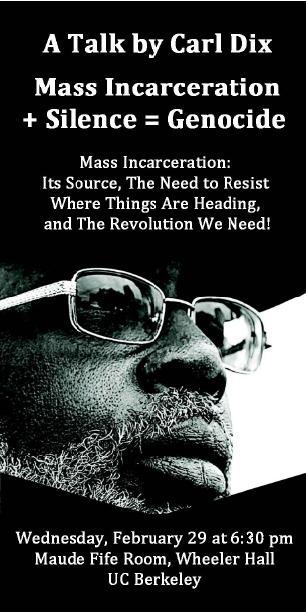
Photo provided by Flickr user DVIDSHUB.

***UPDATE

Obama recently came out to issue new guidelines for the NDAA provision, but the move is simply a PR stunt.  It does not strip his absolute power of indefinitely detaining U.S. citizens.

Abby

MR Transcript: Davey D, Carl Dix & Resistance

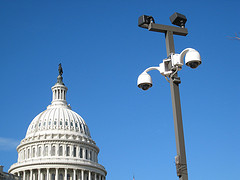
carl630is306wideMEDIA ROOTS  Carl Dix, Revolutionary Communist Party, is back in the S.F. Bay Area and will deliver an address to UC Berkeley this evening entitled “Mass Incarceration + Silence = Genocide.”  The last time Mr. Dix visited northern California, Media Roots featured his KPFA radio broadcast and UC Berkeley event with Dr. Cornel West.  Today, we present a new interview with Carl Dix.
Messina

***

THE MORNING MIX WITH DAVEY D  “Good morning, everybody.  Welcome to another edition of The Morning Mix.  It is at the top of the hour.  Davey D hangin’ out wit’ you and we’ve got a good, good, show for you.  We have a special guest in the building, Mr. Carl Dix of the Communist Party.  He is here to talk about mass incarceration, silence, and genocide, also about his big speech coming up tomorrow [29 Feb 2012] at UC Berkeley.  So, you don’t want to miss that, all that and more, coming up after the morning headlines.”

Carl Dix, Revolutionary Communist Party:

“Now, some people will say, well, look, I knew Obama wasn’t gon’ be able to do much anyway and maybe he didn’t even want to, but that’s not the point Brother Dix.  Think of the inspiration that Black youth will get from seeing a Black man in the White House, from seeing a Black First Family.  Think about what that will mean and how that will spur them to greater heights of achievement.

“So, let’s talk about that.  See?  And youth are getting charged up around it.  But what direction do they go when they get charged up?  I’ve had youth tell me, ‘I wouldn’t fight for George Bush. But, now, that Obama guy, he’s smart. If he says I gotta go fight, maybe I should do it.’  That’s where some of that inspiration has taken them. 

“But even as they take that inspiration out and try to achieve more in this society, and try to move on up and do better than they had done before, what will they run into?  They will run into the reality of the continuing White Supremacy that’s built into the very fabric of this country.  They will run into the male supremacy that’s out there.  They will run into capitalist, imperialist America

“So, what will happen to those dreams?  Will they be crushed to the Earth?  Will they dry up like a raisin in the sun?  Because I will tell you, sisters and brothers, the doors that are open for our youth are not the doors to higher education.  They’re not the doors to meaningful jobs, contributing to the development of society because it is still the case that the educational systems in the inner-city schools where most Black and Latino youth are are underfunded.  They are not geared toward success.  And most of the youth in there are being tracked towards failure by the time they reach the third and fourth grade. 

“It is still the case that jobs are being sucked out of ghettos and barrios.  And drugs have been poured in there.  That’s still what the youth are up against. 

“The doors that are being opened to our youth are the doors to the courthouse, where they get treated unequally by the criminal justice system in this country, and the doors to the jailhouse, where Black people are being warehoused at horrific numbers.  900,000 of the almost two and a half million people who are in prison are Black.  That’s a door that’s open for Black youth.

“And then there is the door to the recruiting station to join the military to go halfway around the world and kill people for this system, become a mindless killer for it.  Those are the doors that are being opened.  This is what’s being offered to our youth.” 

Davey D (c. 10:52):  “So, there you have it.  That’s our guest, Carl Dix.  He’s in the building with us, long-time revolutionary.  He is also one of the co-founders of the October 22 Coalition to Stop Police Brutality.  He is also a founding member of the Revolutionary Communist Party here in the U.S.  And, more recently, we know Carl for being an outspoken force against the New York City Police Department for their infamous Stop and Frisk situation.  In fact, him and Cornel West were up here at UC Berkeley not too long ago speaking truth to power around that situation.

“And, man, we could go down.  You have a long list of things.  You don’t shy away from any of the controversies, from Katrina on down to the police to definitely railing against the system, as you were doing there and the response to Barack Obama’s NAACP address where you very skilfully pointed out some of the challenges that we would still have no matter who’s in the White House.  You haven’t changed your mind on that, eh?”

Carl Dix (c. 12:02):  “No, I haven’t changed my mind.  See, the thing is, I’ve been at this for awhile because this system has been at what it does to people here in this country and around the world.  And, from one end, my grandmamma told me, you, stubborn, boy. But as long as you on the right thing, then you should be stubborn about it.  And then, from another end, I have not lost my hope in the possibility of bringing a totally different and far better world into being through revolution.”

Davey D (c. 12:34):  “Do you think that can happen?  In this lifetime?  Or is it something that you resigned yourself to seeing in a distant future somewhere when you might not be here, me and you.”

Carl Dix (c. 12:46):  “Okay.  Well, just on that thing of might not be here, you know, I could step out on the street and get hit by a bus, so I’m not going at it like I definitely have to be here for it.  But it is necessary, including in relation to the topic I’m gon’ be speakin’ at tomorrow in Berkeley, Mass Incarceration, to really end that and all of its consequences.  You gotta make a revolution and get this system off the face of the Earth.  And that’s what I’m working for; and the potential for that is there.  It’s real.  You can’t make revolution with people and conditions the way they are now, but conditions are changing.  And people can change, as they try to deal with those conditions.  And that’s something I’m working on, contributing to.  Can’t say exactly when that might happen, but I will not let somebody say it can’t happen because you could even see in just a few months of Occupy, people have begun to question things that had been accepted as, well, that’s just the way it is, capitalism is being talked about.

“Even revolution has come up, although people mean a lot of different things by revolution.  And that’s two discussions, capitalism and revolution, that I enjoy engaging in.

Davey D (c. 14:02):  “They’re not necessarily the same thing?”

Carl Dix:  “No, they’re not necessarily the same conversation, but I enjoy engaging in both.”

Davey D:  “You know I was very specific and deliberate by playing that speech that you gave; I think it was 2009, if I’m correct.”

Carl Dix:  “Yes.

Davey D:  “And I wanted to play it, and people might be, why did you play that one?  You know?  Since 2009, there’s been increased conversation in many circles around the incarceration rate of Black and Brown youth, in particular, as you pointed out, Black youth.  Michelle Alexander, of course with her groundbreaking book, talking about the new Jim Crow, another word for slavery; we’re now seeing that come up.  Dr. Joy DeGruy talks a lot about what is happening with this increased prison situation.  And on top of all that we know have lots of conversations of domestic spying, people being labelled ‘terrorists,’ all these types of things.  And for many of us, including myself, we didn’t think we would see that sort of direction take place under this President [Obama]. 

“First of all, are you surprised that we moved in this direction at the rate that we have?  Or is this something unique in the air that has made this accelerate or, at least, made the conversation be something that is more pointed now?”

Carl Dix (c. 15:29):  “Well, I think there are a few things.  One is that this has been a direction over four decades ‘cos, [if] you go back to the Attica Prison rebellion, there were less than 300,000 people in prison back in 1971.  Today, it’s more than 2.4 million, a more than eightfold increase, which is rooted in the very operation of this capitalist setup and conscious policies that the rulers adopted to deal with ‘how do we head off another 1960s-type situation?’  I mean, they consciously laid that out.  Richard Nixon is quoted, the President back then in the late ‘60s/early 70s, he’s quoted by members of his cabinet, as having said at a cabinet meeting, ‘The problem is the Blacks. And we have to devise a solution that does not acknowledge that’s what we’re dealing with.’ 

“And they came up with wars on drugs, wars on crime.”

Davey D (c. 16:30):  “Well, Nixon started off with a war on youth.”             

Carl Dix:  “Yeah.”

Davey D:  “If I remember correctly.”

Carl Dix:  “See, all of this was supposedly not about ‘race,’ but was carried out in oppressed communities, Black communities, then, increasingly, in Latino communities.  And this is what led us to the more than eightfold increase.  But part of what brought this together in this period, ironically, Obama’s election in the way that people got off into it, thinking they had fundamentally changed the direction of American society.  And I said, at the time, that hope that was being generated, there’s a real question of where will it go? Will it be crushed to the Earth? Will it dry up like a raisin in the sun?  Or will it explode?  And that I’m out here working, so that people will come to understand that their hopes in Obama were misplaced, but they don’t [have to] become demoralised or passive because of that. 

“And I’m not saying that it’s due to my work.  It’s just how things came together that as people became disappointed and let down in Obama, things have moved somewhere else.  And it’s not just Black people because I’ve had a lot of young White people tell me back in 2009, we made our revolution, we got our first Black president.  Now, they are seeing that the thrust has continued because we are dealing with a capitalist, imperialist, system.  And what it was doing was putting in place the person that it felt was best able to lead things, in relation to its interests, which are diametrically opposed to the interests of the overwhelming majority of people not only in this country, but also in the world. 

“And people are beginning to see that and taking stands around it.  That’s why we you’re seeing Occupy.  That’s why you’re seeing Michelle Alexander’s book and people taking it up and reading it, doing study groups around it.”

Davey D (c. 18:28):  “If you’re just tuning in, we have Mr. Carl Dix in the building with us.  He will be speaking tomorrow night at UC Berkeley.  I’m gonna get the exact address.  It’s gonna be at the Maude Fife room in Wheeler Hall and that will be starting tomorrow [29 Feb 2012] at 6:30pm.  And the topic:  Mass Incarceration: Its Source, the Need to Resist Where Things Are Headed, and the Revolution We Need.  

“Two questions:  You had mentioned a game plan initiated by President Nixon and carried on, as you said, for the past three or four decades to really oppress and repress numerous communities that are marginalized.  Was this because there was a fear in terms of the direction this country might go or did they discover early on that this is a money-making operation?  And if I’m looking at the prison-industrial-complex and, especially, I’m sure you know, when you go down south and people are literally paying for their incarceration.  There’s all these side-industries that start to make lots of money:  prison unions, private prisons, cheap labour, all these things.  Now, we have an economic incentive to fill these prisons up with bodies.  And why not go to communities that are voiceless in the mainstream sphere?  How are you seeing this?  Was it a political fear or was it a money-making venture?”

Carl Dix (c. 20:01):  “Okay, that’s a very good question.  And while the money-making part is a part of it and it’s become increasingly more of it, what it is has been at the start, and continues to be, a fear factor, as you were putting it and, frankly, a counterinsurgency, including a counterinsurgency before there was the insurgency has begun because they looked at the 1960s.  They remembered how their system was rocked back on its heels.  Henry Kissinger talks about how they felt under siege in the White House.  They also looked at how did that develop?  And the way that it developed was off of the inspiration of Black people standing up against what was being done to them in the South first and then throughout the country.  And that’s also where the revolutionary edge of it came from because you had groups like SNCC, the Student Nonviolent Coordinating Committee, the Black Panther Party, that began to question the system, not saying Black people need to get into the system, but begin to question the character and the nature of the system itself.  And that’s where the revolutionary thrust of that period came from.  And they are saying we’re not gonna let that go down again.  That’s what Nixon’s quote was all about:  We’re gonna go after this section of society and not give it a chance to play that role again

Davey D (c. 21:23):  “Oftentimes, when we look back at the ‘60s and that turbulent period, the focus does go to the Black freedom struggle, the Civil Rights era, but we would be wrong to dismiss the activities that were taking place in other communities, the Chicano Movement, American Indian Movement, Puerto Rican—”

Carl Dix:  “The Women’s Movement.”

Davey D:  “Women’s Movement.  There was a lot of questioning of the system.  Of course, White students with the Free Speech and Antiwar.  I bring this up to ask a couple of questions:  One, the concern of having these various groups now start to recognise that they have a common oppressor and that they start to act in coalition with one another, was that a main concern?  And I’m asking that now looking at the type of tactics that have been swift and very decisive around movements like the Occupy where you see this potential to all of a sudden get on the same page and start really going full force.  So, I guess what I’m asking is does this power structure fear us coming together across racial lines, ethnic lines, class lines, or is there something else at work?

Carl Dix (c. 22:48):  “No, if definitely does fear that and is moving to try to make sure that doesn’t happen.  But, again, we have to look to history and all of those movements did take off in this country.  There was also a worldwide thing going on.  You know, 1968 there were landscape things in France.  There was a war going on in Vietnam that was a liberation struggle on the part of the Vietnamese people.  There was a Great Proletarian Cultural Revolution in China, so it was a worldwide phenomenon and it was broadly taken up here. 

“But there is a way that the struggle of Black people was kind of on the cutting edge of that.  And a lot of the White youth who got involved in the Free Speech Movement, in the Antiwar Movement, and, increasingly, became more militant, radical, and, even, revolutionary.  A key thing for them was the relationship to the struggles of Black people.  So, that’s why I talked about the inspirational aspect of that, not that Black people were doing it by themselves.  But that it helped to spark off broader developments.  It helped to get a sharper edge to that.  And [the establishment] saw that and they don’t want to see it again.  So, they’re moving to cut that off and part of that is keeping people separate as well as crushing anything that comes up with the appearance of a threat to the [state] set-up.  And Occupy became that in the Fall [of 2011] when it spread like wildfire across the country, started posing big questions about the role of the banks, the big corporations, getting towards this question of capitalism.

“They held that coordinated phone conversation from the mayors of different cities across the country with the federal government.  And what came out of that were things like what you saw here in Oakland where they launched a military assault on Occupy, nearly killed a young man in that.”   

Davey D (c. 24:48):  “Right.  You mention about things going on around the world in 1968 and we see that happening in the form of the Arab Spring.  Just this morning we were hearing of unrest.  Well, we knew there was unrest in the Ivory Coast.  Now, we’re seeing a lot of questions come down in Senegal and other places.  Is this separate?  Or is this part of a larger reaction to the same forces?  If I’m framing the question well.”

Carl Dix (c. 25:18):  “I think you’re framing the question well.  And it is a reaction to a larger force, that force being capitalism and imperialism and the way that it is weighing down on people around the world.  Because when the young man in Tunisia killed himself that sparked things there and then Egypt came up in relation to that, in both cases you were talking about governments that were backed up by international imperialist forces.  And in Egypt you were talking about a government backed up and propped up by the U.S.  And then people there standing up began to spread, not only in the Muslim/Arab parts of the world, but people around the world, including right here were looking at that. And, so, that played a very important initiating role, to tie this back to my points around mass incarceration, which I’m gonna get into.  And the title of my talk is ‘Mass Incarceration plus Silence Equals Genocide.’

“You have a lot of people around the world who are seeing that this system is not offering them anything in terms of future.  And in some cases, it’s people who used to think they had a future and are beginning to see they don’t and in other cases it’s people who’ve never had a future or haven’t had one, or appeared to have one, in decades.  That’s the thing with Black people and Latinos and the way in which this system offers them nothing for the future like I was talking about in that speech that you played.  You know, jailhouse, courthouse, into the military to be killed or to kill someone else.  That’s what they offer large sections of our youth today.  And people don’t like that, in some cases, never liked it, but didn’t see an opening to do anything about it.  But things are coming together right now with the Arab Spring, with it being taken up in other parts of the world, that people are beginning to see an opening.”

Davey D (c. 27:23):  “Is that a few people or do you think the masses have become very comfortable?  I mean I know we may travel in circles where we’re gonna see people who are gonna constantly question, they may challenge, etcetera, etcetera.  But at the same time, you know, in the middle of the biggest demonstrations you still have people rushing home to watch Real Housewives of Atlanta and lose themselves into those things.  You have folks that won’t show up for an Oscar Grant or a Sean Bell rally, but will be up at four in the morning, literally, setting off a riot, to get the new, you know, Air Jordans that wasn’t even advertised. 

“And, so, we have a lot of these things going on and then you have people that will tell you, You know, Carl, I’m just tryin’ to put food on my table, feed my kids; I’m not trying to get involved with all this.

“So, the day to day life of just making sure that they can sustain themselves, even if it’s very marginal, is a front and centre thought and dictates action.  So, how detached from that routine and oftentimes a very limited type of space are we, versus moving in a direction where we can actually kick up dust?”

Carl Dix (c. 28:39):  “Okay.  Well, look, I’ve been in New York over the past period.  See, I’m not just talking with you about the people who come out to rallies and what they think.”

Davey D:  “Right.”

Carl Dix:  “We’ve been out in Harlem, talking about Stop and Frisk.  And before we did the first action what we would hear, often from the same person, is I hate Stop and Frisk. They did this to me. They did this to my son. They did this to—even sometimes—they did this to my sister, or my daughter.  You know, because they’re doing this to women as well.

“But then the next point is:  But you can’t do anything about it.  And that’s why we decided we have to do something about it.  And we launched this campaign to stop Stop and Frisk, which is a policy under which the police can just step to you, stop you, make you turn out your pockets, or search you themselves.  And then often bust you for nothing.”

Davey D (c. 29:00):  “Right.  I don’t think people really clearly understand here [in the S.F. Bay Area] ‘cos we don’t see it as much.  But in New York that is a huge problem that you could be walkin’ with a tuxedo on with your wife and kids and they pull you over and say, empty out your pockets, to make sure you don’t have a gun.”

Carl Dix (c. 29:46):  “Yeah.  And how big is it?  They stopped and frisked almost 700,00 people; it was 684-thousand-plus last year alone in New York City:  85% of them Black or Latino, more than 90% of them they let you go after they’ve harassed you and humiliated you, but then even some of that 10% that they don’t let go, some of them were doing nothing wrong because when we did the action in Queens, they held us overnight.  So, we were in there with a bunch of other people and people were telling us, Oh, they stopped me under Stop and Frisk. I didn’t have my driver’s licence. I didn’t have an ID, so they ran me in the prison.  So, it’s like, did I wake up in Johannesburg, South Africa, 30 years ago when there were past laws?  Because what’s the crime in not having an ID?

Davey D (c. 30:39):  “Right.  And that’s why I ask the question because it is so massive.  We just had, you know, we did a show about a brother who was killed over Stop and Frisk.  He had a little bit of weed.  The cops came by.  He decided to walk, you know, into his building—I’m sure you remember this.”

Carl Dix (c. 31:01):  “Yeah.  I’ve seen the video of it.”

Davey D:  “He just walked into his building—he wasn’t under arrest or anything—they ran up into his apartment, kicked down the door, and shot him in front of his grandma.  There was no gun, no nothing.  But there was a couple of joints that he was trying to get rid of, but this becomes the justification that is often used.  Well, they should’ve just listened to the authorities.  Or, they shouldn’t run.  Or, you shouldn’t, if you don’t have anything to hide, then there won’t be any problem.  But it’s those types of encounters that we see over and over again where people are like, the police are here, they’re gonna find something. I don’t want to deal with this.  And oftentimes it’s a fatal situation. 

“When you have these types of scenarios, Amadou Diallo, another victim of Stop and Frisk, all he had was a wallet, shot 41 times.  How did we go from the Panthers and Dr. King and Malcolm X to allowing ourselves—or did we allow ourselves?—to be in such a situation right now where it’s not even talked about in the mainstream, even amongst our pundits?  You know? 

“I mean, you do it.  Cornel does it.  But if I tune on and I see our own folks sitting up there, they’re not really making this a front and centre issue.  You know?  They’ll talk about LeBron James and what team he’s gonna choose before they’re talking about the absurdity of 700,000 people being stopped in one year.”

Carl Dix (c. 32:24):  “Okay, two things.  The first thing is we’re acting to change that.  And tomorrow night, when I talk, I’m gonna talk about a proposal for a national day of resistance to mass incarceration.  That’s the first thing, but to get back to your question:  How did we go from the days of the Panthers to this kind of situation? 

“And a couple things came together.  One is that they came at the Panthers with their fangs bared.  I mean they murdered Fred Hampton and Mark Clark, leaders of the Chicago Panthers, as they slept in their beds.  And they knew they were gonna be asleep because they had had—”

Davey D (c. 33:03):  “An informant.”

Carl Dix:  “—an informant drugged them, to make sure they’d be asleep.  And then they busted in and shot the place up, including consciously murdering these brothers.  They had a diagram of who would be sleeping where.  And they went straight to Fred Hampton’s bedroom and shot him, as he lay there asleep.  So, that happened.

“And the question of how to make a revolution and what kind of organisation and leadership you had for that, well, it was a gap there because the Panthers had been the leading force on that. 

“They came at the people, the communities that had been supportive of the Panthers with police acting like occupying armies in a conquered country, unleashed all kinds of—they even passed laws directed at trapping up our youth in prison, the 100-to-1 crack-to-powder cocaine disparity [policies], consciously aimed at Black and Latino communities.  They did all of that.

“And that’s what got us there.  And there wasn’t the leadership for what to do about it.  And then people got put in a situation where this just becomes the routine.  Right now, for large sections of Black and Latino youth in the inner-cities, going in and out of prison is a rite of passage.  It isn’t like for many youth, Am I gonna go that route or am I not gonna go that route?  It’s just; This is what happens to everybody in my neighbourhood.  You know?  And you see that in the cultures and the styles and all like that.

“But what needs to happen is we need to bring to people—and that’s something that we, in the Revolutionary Communist Party are working on—things don’t have to be this way.”

Davey D (c. 33:48):  “Right.”

Carl Dix:  “It’s this way because of this system and how it operates, what it operates based on.  But we can make revolution.  And then you get into a whole lot of questions about revolution because most people have heard, Well, that was tried and it failed.  And we say, Okay, revolution was tried and where, it succeeded, it accomplished many positive and powerful changes. 

Davey D (c. 35:03):  “Right.  I want you to hold that thought for a second.”

Carl Dix:  “Okay.”

Davey D:  “I want to take a break.  It’s 8:34 AM, if you’re just tuning in.  We have—I was gonna say doctor—Carl Dix.  Well, I’m ‘a call you doctor, anyway, ‘cos you have solutions.

“Carl Dix will be speaking at UC Berkeley tomorrow Wednesday [29 Feb 2012] at Maude Fife Room, Wheeler Hall.  And his topic is, [as] we were talking about, Mass Incarceration plus Silence Equals Genocide.

“I wanna take a break and come back.  And I wanna ask you to define revolution because many people have very different opinions as to what that means.  And then, I think, many people are asking, do we have to overhaul the system?  Because you’ve been like, get rid of the system.  But can it be reformed?  I mean if we get the right people in there and, you know, put all the right tools into place, can the system be reformed and saved and made to do what it’s supposed to ideally do? 

“So, let’s take those questions.  Maybe we’ll take a couple of phone calls.  If you wanna holler at Carl Dix, you can call us at 510.848-4425.  Once again, 510.848-4425.  And let’s check this out and we’ll be right back.”

[Musical intermission:  Curtis Mayfield and Carl Dix mashup]

Audio of Carl Dix speech (c. 36:21):  “See, and let’s get real particular about what happens to our youth.  Let’s talk about Sean Bell.  See?  And I want to tell you; and I’ll tell Obama, I know William Bell, Sean Bell’s father.  I know Valerie Bell.  These were not parents who were not involved in Sean’s life.  The problem wasn’t that they didn’t turn on the TV and make sure that he did his homework.  The problem wasn’t that Sean had his pants down too low, or that he was into gangs and drugs.  The problem was some trigger-happy cops happened on him the day of his wedding and blew him away in a hail of 50 bullets.  That’s what happened to that Black youth.

“This is what our youth are up against.  See?  And we gotta talk about the fact that it wasn’t just Sean Bell.  And I could give you all kinds of statistics, but I’m not gonna do that.  I’m just gonna remind you of something because we were out organising youth to protest when they let those cops go.  The slogan that the youth really got into and really took up was one that said, We Are All Sean Bell. The Whole Damn System Is Guilty

“Youth were wearing stickers.  Youth carried signs.  Youth made t-shirts that said that.  See, now, what’s the significance of that?  Why were the youth saying We Are All Sean Bell?  Because they all felt that, just like Sean, they could be blown away by trigger-happy cops, too.  And the cops could get away with it.  They knew in a certain intuitive sense that they were living their lives under a death sentence, a death sentence that may or may not be carried out, but was real just the same. 

“See, now, this should break your heart to hear about this and to know about that.  It should make you angry.  But then you’ve got to move from being angry.  You’ve got to go forward.  And going forward is a question, like I read in that quote, of sweeping this system off the face of the Earth because that, just that, would be enough to do it.  But that ain’t the only thing; there’s the wars for empire.  There’s the torture.  There’s the indefinite detention.  There is a way in which women are treated, as breeders of children, not as full human beings, subjected to rape and domestic violence.  There’s the way the environment is being spoiled.  You know, the very planet we are living on is being ripped apart in the chase after profit by this imperialist system.  There’s the disease and the starvation and the misery that this system inflicts on people.  There’s all kinds of reasons to want to get rid of this system.

“See, and in that context, it is especially criminal to get sucked back into this system because there’s a Black person presiding over the crimes that it’s carrying out.  ‘Cos look, here is the deal:  Obama’s problem is that this system is deep in trouble.  And his mission is to save that system.  Our problem is this system.  We don’t need to see it saved.  In fact, we need to see it ended through revolution.” 

Davey D (c. 39:52):  “So, I guess you might have answered my question.   And that is the voice of Carl Dix.  I’m playing a little excerpt of a speech he did a couple of years ago.  He’s in the building with us.  And we are talking to him about changing the system.  Or can it be reformed, Carl?  If I put you and people like you into office, this would be a better place, right?”

Carl Dix (c. 40:13):  “No.  Actually, it wouldn’t.  And, frankly, if you put me into office, there would probably be a contract put out on me by the real—”

Davey D:  “But I said, people like you.”

Carl Dix:  “—by the real gangsters—”

Davey D:  “Okay.”

Carl Dix:  “—in this world, the people that run this system.  Because you pose, like, can we get the right people in there?  Can we get some new mechanism, some new policies, so it would work like it’s supposed to? 

“Well, the question behind that is what is it supposed to do?  And from the very beginning—‘cos people talk about, well, we gotta get back to what the Founding Fathers were about.”

Davey D (c. 40:47):  “Right.”

Carl Dix:  “The Founding Fathers were about slavery. They were about stealing the land from the Native inhabitants.  And—”

Davey D:  “Right.  But they stole a lot of the ideals.  You know?  In terms of the separation of powers and this whole thing of democracy where one man, one vote was the ideal.  Now, they didn’t practice it, I would argue.  But can we get to that idea?”

Carl Dix (c. 41:12):  “Okay.  But see?  Look.  Again, people need to check out Thomas Jefferson.”

Davey D:  “Okay.”

Carl Dix:  “Because he was probably one of the foremost proponents of American Democracy.  And Thomas Jefferson talked about the common man; he meant the common White man, but we’ll leave that part of his limitations aside for the moment.  But, see, on top of saying, we gotta get the common man involved, he said the common man needs people like us to lead him.  And you saw that in practice when some farmers up in Massachusetts, all White, were being abused by this system, being ripped off, and rose up around that.  And the Founding Fathers, this was like a couple years after the founding of the American Republic, the founding fathers brutally crushed that rebellion.  You know?

“So, from the beginning, this set-up was about how to maintain and protect the interests of the handful of people who had wealth and power and monopolised that power.  And, at that point, they were split between developing capitalists and outright slave-owners.

“But the system has been geared from the beginning to protect those interests and to keep those interests in play.  And, frankly, the best way to do that is to give the majority of people the feeling that they have a stake in this.”

Davey D (c. 42:38):  “Okay.”

Carl Dix:  “You know?  And that’s what this thing has worked on.  And that’s why I say we need a revolution, because this stuff is built into the fabric of this system.  I mean, we talk about mass incarceration.  One side of it is the way this system has sucked the legitimate means of employment out of the inner-cities, takin’ it half-way around the world because they could make a lot more money by exploiting people.  They are paying them much less than they’d have to pay somebody here and working them in more dangerous conditions. 

“But, then, that leaves them with the people in the inner-city.  And then that’s where the criminalisation of our youth come from because those 2.4 million people are in jail because they have been criminalized.”

Davey D (c. 43:18):  “What do we replace the system with?

Carl Dix:  “We have to replace it.  And, let me bring in the point about what is revolution.”

Davey D:  “Okay.”

Carl Dix:  “Revolution comes down to—‘cos if you pose a challenge to this system, they’re gon’ try to violently suppress you; we’ve seen that, not only in the past, but I’m talkin’ about a few months ago with the Occupy, they even violently suppressed that.  So, you have to meet and defeat the attempts at violent suppression of this system.  And I mean actually defeat them and dismantle the repressive apparatus, dismantle the way in which the economy is dominated by a handful of capitalists, and replace it with different institutions that work on a different basis, that aren’t aimed at how do we keep these large corporations and the people who own them in effect ‘cos it will no longer be a thing of individuals owning factories, large farms, mines, all that, everything to create wealth.  We’re talking about a socialist system here.”

Davey D (c. 44:21):  “Right.”

Carl Dix:  “But a socialist system that is in transition to a point where exploitation and oppression is ended, once and for all.  And that’s what communism comes down to.”

Davey D:  “Right.  Now, let me ask you this—and we’re gonna take your calls in just a second; we have a number of people on hold at 510.848-4425.  Our guest:  Carl Dix.

“This sounds good.  You know?”

Carl Dix:  “M-hm.”

Davey D:  “I hear what you’re sayin’.  But my mindset is like, you know, I’m gonna be a predator no matter what you do. You can put me in the most serene, utopian-type place, but I’m still gonna be lookin’ like I want everything you have and then some. I’m addicted to power or trying to attain it.  How do we change the mindset of people that are like that?  That are just gonna act a fool, even in the best of scenarios, because we’ve been conditioned that way?”

Carl Dix (c. 45:13):  “Okay.  That’s what I meant by, you can’t make revolution with people and conditions as they are now.  But that can change because, look, let’s look back in the 1960s and what people did back then.  What did Black people do in the South?  They put their lives on the line.  They went to lunch counters and knew they were gonna get their behind kicked for doing it.” 

Davey D:  “Right.”

Carl Dix:  “For integration.  The Freedom Riders got on the bus, knowing that they—they made their wills out before they did it—so, they weren’t looking at it like, I’m doin’ this to get mine.

Davey D:  “Right.”

Carl Dix:  “They thought they were doing this to make revolution, to change society, to end injustice.  But it was through the process of looking at the problems, deciding what to do about it, doing some stuff.  That’s how their mindsets changed.”

Davey D (c. 46:03):  “Okay.”

Carl Dix:  “And, in the 1960s, I mean this whole thing of brother and sister.  You’re walking down the street, you see another Black person, that’s your brother or your sister.  That actually became the way people looked at each other to a large degree—”

Davey D:  “Well, it planted seeds of consciousness.”

Carl Dix:  “—because of the struggle, even if you weren’t right in the middle of that struggle, you were influenced by that.  See? 

“So, that’s what we’re looking at.  It’s not human nature.  If you are in a predatory situation, you gon’ have to pick up predatory instincts and aspects in order to survive in it.

Davey D (c. 46:36):  “Right.”

Carl Dix:  “But we have to unleash a collective struggle to get rid of that.  And, through the course of that collective struggle, people are going to change their mindsets, change their instincts, develop new aspects.  And that’s how we’re gonna deal with that.

“And, then, after we make revolution, because that’s what we’re aiming to do, get rid of this system through revolution, then we have to have a set-up where—‘cos people will have been born and grown up in the old society, so we’re gonna have to deal with that.  And, see, we’ve learned a lot from how they dealt with it in China and the revolution there.  Bob Avakian has led in looking at that, both, its strengths, but also its shortcomings.

“And one thing is they unleashed people.  You know?  They’d have a situation where a man felt like his wife was his property; he beat her up, he’d do this, he’d do that.  They’d have a delegation of his neighbours, especially, women neighbours.  But also men neighbours will sit the brother down and say, we got to talk about this because it was like that in the old society, but this is a new society. We can’t have this.  And then, if the brother persisted, they would come back and with a heavier form of communication, including sometimes they would whip the brother down and say, okay, now, we did that to you because you refuse to stop doing that to your wife, who is actually your partner, not your property.

Davey D:  “So, in other words, bad habits are gonna have to be broken.”

Carl Dix (c. 47:55):  “Yes.  Bad habits have to be broken, mainly through persuasion.  But, you know, like sometimes—what do the Jamaicans say? I’ve got to bring heavier manners to it.”

Davey D (c. 48:04):  “Okay.  Let’s take some calls.  We have, it looks like we have, Mary out of Sacramento.  I hope you’re still there.  Thanks for holding.”

Mary in Sacramento:  “Yeah.  Hi.”

Davey D:  “How you doing?

Mary in Sacramento:  “Yes, hello.  And thank you for taking my call.  My name is Mary Trudel.  I’m an author of A Voice of Reason and also a founder of a non-profit called A Voice of Reason.  And the reason I’m calling, first of all, is my, I’m from Elmira, New York, which is in the Iroquois Nation and, actually, it’s, Elmira is one of the oldest prisons in America. 

“Where I grew up there’s two major maximum-facility prisons and five ghettos.  And I grew up watching this socially-engineered economic restraint where I noticed that all the people of colour in my city were basically the target of these prison systems.  Namely, the prisons would allow these kingpins to come out and the D.A. would give drugs to the kingpin who would set him up in, say, a corner apartment.  And then the next thing you know everybody’s over there.  And he’s gettin’ everybody in the neighbourhood hooked.  Then next thing you know there’s these sting ops and then—boom!—the whole netful of people gone to prison. 

“And, since the 1850s, the Irish have been, kind of, captains of industry as far as authority over there and have been mainly the police.  I’m not saying it’s that way today.  It’s a little bit better. 

“But I really believe this is a socially-economic setting—”

Davey D (c. 49:33):  “Okay.”

Mary in Sacramento:  “—to, basically, keep coloured people down.  And I witnessed it all my life.”

Davey D:  “Well, we appreciate that, Mary.  And I think a lot of people would agree with you.  I’m gonna hold your comment for a second [Carl].  I want to get another call ‘cos we have a lot of people on.  Let’s go to, I believe it is Barbara from Berkeley.  Barbara what’s happening?”

Barbara in Berkeley (c. 49:59):  “Hey, Davey D and brilliant guest.  I want to go back to the Occupy Oakland situation.  And, you know, Jean Quan has plausible deniability based on her being in the air going to Washington, D.C. to secure funds for Oakland, federal funds.  And, yet, two weeks prior to that those federal funds provided an Israeli commando force to come and train the Oakland police on so-called crowd control. 

“And this is what I’m trying to get at, they pick out, the police pick out, one person that they will kill or harm to the point that it brings such fear to other people that were considering coming out into the streets.  And it’s just really a terrible, terrible thing.  You know?

Oakland is living in a police state right now.

“And I don’t feel very good that the federal police are gonna come in and take over the police force in Oakland because it’s not gonna be the answer to this.  Ands, so, I just wanted to get my two cents in on the fact that we’re all being so controlled by fear that we can’t go out and peacefully demonstrate without loss of life.”

Davey D (c. 51:37):  “Okay.  Well, I appreciate that.  And I think there are a number of people that are concerned if it becomes a federal takeover, maybe federal tactics and rules may suddenly be used.

“Let’s go to Antonio out of Castro Valley, how you doing, Antonio?”

Antonio in Castro Valley (c. 51:53):  “Good morning.  Yes.  Mr. Dix, I’m a Marxist.  And you say you are a Communist, but what you preach here has nothing to do with Marxism.  We, the Marxists, are not for the minorities.  We are for the majority, the working-class.

“And what matters to us is class, not ‘race.  ‘Race’ doesn’t matter to us.  To us, what matters is class! 

“And about the working-class, Marx says that the working-class has to transition from being a class, in itself, to a class for itself, not for anybody else, for itself.  So, lumpen elements are not our allies!  Lumpen elements are the most threat to—”

Davey D:  “Okay.  Antonio, you have different points of view.  But this is not a shouting match and this is not something to just, you know, get off on, so thank you.

“I’m gonna give you a chance to respond to a few of the comments [Carl]—”

Carl Dix:  “Okay.

Davey D:  “—and we may have time for a couple other calls.”

Carl Dix (c. 52:54):  “Alright.  Let me start with the last one.  I’m not talkin’ about the lumpenWho are the people in the inner-cities who have had the jobs ripped from them?  Because people talk about, well, these kids are into drugs, they’re into this, they’re into that. 

“Well, I did some work in the projects in Watts after the 1992 L.A. Rebellion.  And one thing that I ran into—because I got to know a lot of people, including some of the people higher up in the drug thing—and somebody who was fairly high up complained to me one day that when they opened up a new supermarket, he lost all of his runners and distributors of his product because they all ran down there to try to get the few jobs that had opened up.”

These people are not something separate from the working-class.  They’re that section of the working-class that can’t find employment.”

Davey D (c. 53:49):  “Right.”

Carl Dix:  “That’s what they are.  And they still look at themselves that way.  And that is an indication of that, that if they get a regular job, they would drop all of this stuff.  You know?  So, that’s still where they’re coming from.  They’re just lower and deeper in the working-class, not by their choice, but by the workings of capitalism.

“So, you know, class does matter.  But it’s not that class matters and not race’ because race is also a reality.  And, see, that’s actually where Marx was coming from.  He was coming from reality.  So, you have to look at how reality is developed.  That’s on that.

“On the first two people—because, largely, I’m with them on that, you know?  They’re getting different parts of this.  Because if people think the federal government coming in and taking over is going to deal with the problems in the relations between the police in Oakland and the communities, they haven’t been paying close enough attention because that assault on the Occupy Movement was part of a coordinated national assault that the federal government pulled together and pulled off.  So, that’s what you’re talking about, if you say that.

“And the sister is right on this question of the prisons, the fact that this is an engineered thing, that jobs were taken out.  And drugs were pumped in.  Go back to the Oliver North/Contras in Nicaragua situation where they would run weapons down to the Contras and then load up with drugs and bring the drugs back to the United States.  And when you looked into the funding for that project, it was these two brothers that were heavy into the cocaine thing in Central America, that were funding the whole project, both, the weapons side and the drugs on the back end.

“That’s what was going on.  That’s what’s been happening.  And that’s what’s got our youth trapped up in the criminal justice system.  And, see, from the perspective of making revolution, you have to say that that’s a section of society that would most need revolution and, many of whom, would welcome it.  And that’s why they want to trap them up in the criminal justice system.”

Davey D (c. 54:24):  “Right.”

Carl Dix:  “And that’s why we should want to not see that happen and build resistance to that.”

Davey D (c. 56:08):  “Let me see if we could just get one more [caller] in here.  It looks like we have Philip from Oakland.”

Harry in Oakland:  “Hello.”

Davey D:  “You’ve got maybe thirty seconds.”

Harry in Oakland (c. 56:22):  “Yes, I’m Harry.  I would like to ask your guest, what does he actually mean about his comment about Jamaicans?  Does he mean violence or torture?  What exactly does he mean?  Can he spell it out please?”

Davey D:  “He’s talkin’ about when—”

Carl Dix:  “Okay.”

Davey D:  “—do the Jamaicans come with heavier force.”

Carl Dix (c. 56:40):  “I’m from New York.  And I go to some shows, including reggae and dancehall-type shows and what they always put on the flyer is expect heavy manners.  I have never seen exactly what that means because the shows have all been copasetic.  So, I get the sense that what they’re basically saying to you is—” 

Davey D (c. 57:05):  “Violence—”

Carl Dix:  “—don’t start none, won’t be none, is where it’s coming from.

Davey D:  “You know, we have run out of time.  And we have so many people that wanted to talk to you.  First, we’ll remind them that tomorrow night [29 Feb 2012] you’ll be at Wheeler Hall at the Maude Fife Room.  That will be Carl Dix speaking on mass incarceration, silence, and genocide.  They will be talking about its source, the need to resist where things are headed, and the revolution that we need.

“So, Carl, I appreciate that.  Is there a way that people can get a hold of you?”

Carl Dix (c. 57:42):  “You can hit me via email:  carldix@hotmail.  You could also go to the website for Revolution Newspaper, where a lot of my writings are, that’s www.revcom.us.

And [if] you want to talk to me, come on out tomorrow night.  You know?  ‘Cos we gon’ have an extended question and answer discussion period.  We gon’ mingle afterwards.  If you think I’m goin’ too far by calling it a genocide, come on out ‘cos I’m gonna break down why I call it a genocide and what that means.”

Davey D (c. 58:20):  “Carl Dix, thank you.  We’re gonna make way for Democracy Now!  We’re out, folks.”

Transcript by Felipe Messina for Media Roots

***


Video streaming by UstreamUpdated 3 Mar 2012: “Mass Incarceration + Silence = Genocide,” Carl Dix, UC Berkeley, 29 Feb 2012

***

Further Reflections on the Work of Carl Dix

Carl Dix is, perhaps, one of the more important thinkers of our time, speaking to the common sense nuts-and-bolts mechanics of the state repression grinding the lives of countless millions of working-class people in the U.S, shunning the false hopes of the Democrat Party.  One may be reminded of the oratorical courage of a Malcolm X or Martin Luther King.  Carl Dix is one of the few advocates who speaks out plainly about the viciousness of the state against the working-class and its attempts toward liberation and socioeconomic justice.  It seems we have arrived at a point in U.S. history where the obvious truths about our nation have become sacrilegious truths, truths we dare not speak, truths which may provoke the rabid state to brand us with any number of labels designed to dehumanise and derail people of conscience with watch lists and arbitrary and indefinite detention.  Activists and journalists must conform to the establishment or get canned.  The persistent ones, the independent ones, are being secretly surveilled, obstructed, detained, harrassed, and killed—anyone with the slightest shred of curiosity in anything other than banal entertainment and distraction becomes an enemy of the state.

Carl Dix speaks about the state’s counterinsurgency before there was even an insurgency.  This point cannot be understated.  Dix describes the state’s motivation to avoid a repeat of the 1960s liberation and countercultural movements.  He characterises elected officials, such as Nixon, bemoaning how the problem, from the view of the state, “is the Blacks.”  Indeed, if any group within the U.S. during the 20th century had the potential to galvanise the U.S. people against the succession of repressive governments they’ve endured in their lifetimes, it was Afroamericans, Blacks.  Indeed, self-educating oneself about Black nationalists, Pan-Africans, Civil Rights organisers, and so forth, gave this author an education as a youth on the very real brutality and savagery of the state, behind the Disney veneer.

The mighty U.S. ship of state, may not be a monolithic entity, but it is predicated upon certain basic institutions and assumptions.  Some of those key assumptions are elitism, class division, a two-tiered justice system, racism, male chauvinism, and electoral complacency.  One key assumption is that people will shed their concern for others and play ball, U.S. style, which is to say, ignore injustice and go for self-enrichment.  Another key assumption is that U.S. voters, stubbornly clinging to egalitarian tendencies, will continue to fall for the false left/right paradigm, that they will continue to place their blind trust in the Democrat Party for Congress and the Executive.  Perhaps, Obama’s continuation and worsening of Bush policies will disabuse many progressives of such a notion.  To this end, Carl Dix is one of the few people who will speak plainly and truthfully.

***

“So, there you have it, just a little bit of the sights and sounds that went down yesterday, Indigenous People’s Day at Oscar Grant Plaza on 14th & Broadway, Occupy Oakland.

“As I said, folks, and I think, one of the people there that we interview laid it out: 

Life as we know it here in the United States is done. It’s a wrap. You now have a situation where those who are in the 1% are gonna be trying to take everything and anything and go all out to try and oppress the rest of us. And now is the time that we better pick a side. And we better figure out how we’re going to struggle to overturn that situation. And, more importantly, what are we gonna do to make sure we recognise and uplift the humanity in each of us?

“So, that’s definitely something to think about.”   —Davey D, The Morning Mix with Davey D, 11 Oct 2011 

***

Indeed.  As many of our friends and neighbours are going to support or ignore Obama’s campaign for reelection, enabling the continuation of U.S. imperialism and domestic repression, some are working to put the brakes on this madness.  Our nation is being gutted and we seldom hear truly indignant voices of righteous rage.  But it seems the public no longer has the stomach for fiery or towering critique, or even question the monopolised two-party system, as may have been heard during 20th century struggles.  We seem to be coerced into having such polite manners these days.  The good news is it’s in our hands to choose.

***

The Morning Mix with Davey D – February 28, 2012 at 8:00am

Click to listen (or download)
Posted in Uncategorized | 1 Reply

The U.S. Government’s Panopticon State

allseeingeyeMEDIA ROOTS — The U.S. Government’s raging paranoia regarding terrorism has now led to a high-octane obsession with perpetual and complete surveillance of its citizens in every manner conceivable
“The thought police would get him just the same. He had committed—would have committed, even if he had never set pen to paper—the essential crime that contained all others in itself.  Thoughtcrime, they called it.  Thoughtcrime was not a thing that could be concealed forever.  You might dodge successfully for a while, even for years, but sooner or later they were bound to get you.”  —George Orwell, 1984 (Book 1, Chapter 1)

Each day, we move closer to Orwell’s dystopic vision.  The latest addition to U.S. domestic surveillance is the National Security Agency’s (NSA) new data mining facility behemoth in San Antonio, Texas.  More worrisome, a Microsoft data centre is located just a few blocks away, so the NSA will be able to tap into the massive stores of data without a warrant being necessary, only a simple fibre optic cable.

The NSA’s hulking complex raises any number of serious questions, such as the large numbers of people arbitrarily placed on watch lists.  Does data mining even justify the ends?  Catherine Austin Fitts has long described the Data Beast, data mining apparatus, “the reality was you had Lockheed Martin and their subcontractors owning and controlling the data and you couldn’t get it.”

“And if you look at all the other databases that IBM and their subcontractors have access to government-wide, the question is if you integrate those databases what you’re talking about is a complete control system ‘cos you’ve got the mortgages, you’ve got the IRS payments, on and on and on and on and on.  So, if you watch the movie ‘Enemy of the State’ or you watch the movie ‘Listening,’ you’re talking about an intelligence capacity that can basically manage and manipulate the economy at a very detailed level, whether it’s manipulation of the stock in the financial markets or manipulation of households.” 

With so many lumbering and uncoordinated security agencies engaged in electronic surveillance, how can all this information be shared and correlated?  What risk does the U.S. run should it fall prey to a tyrannical despot with a fully functioning and devastatingly intrusive surveillance system already in place?  These questions and more must give U.S. citizens pause to reflect on the swiftness with which our privacy evaporates before our eyes.

The concept of the CIA project Total Information Awareness has now migrated over to the NSA, which is determined to turn that vision into reality.  The NSA wants to know every detail about our lives:  what we eat, where we travel, what books we read, what movies we watch, every iota of our lives.  But with very little progressive legislation emanating from the regressive two-party system to harness this rapid data grab for electronic omnipotence, is it too late for U.S. voters to pull their lives out from underneath the microscope of the state?

MR

***

SAN ANTONIO CURRENT “Eisenhower warned of the military-industrial complex, but now it’s mostly the security, industrial complex; it’s these people that build all the hardware and software for Homeland Security and Intelligence and all that,” says Bamford. “As far as I can see, nobody has a handle on how many contractors are out there, what they’re doing, how much money’s going to them, how much is useful, how much is wasted money.”

Cate says the NRC committee is not necessarily opposed to data-mining in principal, but is concerned about how it’s carried out. “The question is can you do it and make it work so that you don’t intrude unnecessarily into privacy and so that you reach reliable conclusions.”

Bamford writes in the Shadow Factory of how the NSA’s Georgia listening post has eavesdropped on Americans during the Iraq War, including journalists, without a warrant or any indication of terrorism. He also reports on NSA eavesdropping on undecided members of the United Nations Security Council in the run-up to the vote on the Iraq War resolution, with the Bush regime seeking information with which to twist the arms of voting countries. The spying was only revealed due to British Parliament whistleblower Claire Short, who admitted she’d read secret transcripts of UN Secretary-General Kofi Annan’s confidential conversations.

“The UN people have been aware of [NSA eavesdropping] for a long time, but there’s not much they can do about it,” says Bamford.

A common response to concerns about data surveillance is that those who keep their noses clean have nothing to worry about. But the reach of the NSA’s surveillance net combined with lack of oversight and the political paranoia escalated by the 9/11 attacks means that almost anyone could wind up on the terrorist watch list.

“The principal end product of all that data and all that processing is a list of names — the watch list — of people, both American and foreign, thought to pose a danger to the country,” writes Bamford. “Once containing just twenty names, today it is made up of an astonishing half a million — and it grows rapidly every day. Most on the list are neither terrorists nor a danger to the country, and many are there simply by mistake.”

Read more about the NSA’s long arm of surveillance

© 2012 San Antonio Current

***

Photo by Flickr user satanoid

Bloomberg Defends Secret NYPD Muslim Spying Program

MEDIA ROOTS NYC Mayor Michael Bloomberg stood up for the police state in a recent radio interview, where he defended the NYPD’s targeted discriminatory surveillance of Muslim communities in New York and New Jersey. 

He cites rhetoric from the 9/11 Commission Report as justification to ignore constitutional protections of free speech as outlined in the Handschu agreement of 1985.  In the 1985 federal court decision, police were allowed to obtain a warrant to monitor political activity only if there was a previous suspicion of criminality.  However, in 2002, under Bloomberg and NYC Police Commissioner Raymond Kelly, the post-9/11 NYPD requested that this decision be suspended, claiming it hindered them from preventing future terrorist attacks.

“We’re not going to make the mistakes we made after the 1993 bombing,” Bloomberg preached yesterday. “We cannot let our guard down again. We cannot slack in our vigilance. The threat was real. The threat is real. The threat is not going away.’’

Newark Mayor Corey Booker adamantly rejected the practice, stating that he was unaware of the NYPD’s widespread spying operation.  “If anyone in my police department had known this was a blanket investigation of individuals based on nothing but their religion, that strikes at the core of our beliefs and my beliefs very personally, and it would have merited a far sterner response,” Booker exclaimed.

Police Director Samuel DeMaio underscored this sentiment. “We want to be clear: This type of activity is not what the Newark PD would ever do.”

Rutgers-Newark hosted a rally yesterday to address the increased Muslim surveillance in the community. “We’re here to put a human face on it,” explained Nadia Kahf, chairwoman of New Jersey’s Council on American-Islamic Relations. Muslim student associations, referred to as MSAs by the NYPD, are of particular suspicion by the agency whose secret surveillance was created with the help from the CIA.

The practice even goes beyond the scope of the FBI, according to special agent Bryan Travers, a public affairs officer of the Newark Division. “The FBI follows strict guidelines and cannot open any investigation based simply on First Amendment activity.”

The issue gained momentum last week after the Associated Press published an article on Monday exposing the extent of the NYPD’s secret Muslim surveillance. The AP also posted a copy of a leaked NYPD report.

***

Oskar Mosco is a writer for Media Roots and producer at truth-march.

Photo provided by Flickr user Boss Tweed.
