Space-Time Cloak Could Make Events Disappear?

NATIONAL GEOGRAPHIC– It’s no illusion: Science has found a way to make not just objects but entire events disappear, experts say.

According to new research by British physicists, it’s theoretically possible to create a material that can hide an entire bank heist from human eyes and surveillance cameras.

“The concepts are basically quite simple,” said Paul Kinsler, a physicist at Imperial College London, who created the idea with colleagues Martin McCall and Alberto Favaro.

Unlike invisibility cloaks—some of which have been made to work at very small scales—the event cloak would do more than bend light around an object.

Instead this cloak would use special materials filled with metallic arrays designed to adjust the speed of light passing through.

In theory, the cloak would slow down light coming into the robbery scene while the safecracker is at work. When the robbery is complete, the process would be reversed, with the slowed light now racing to catch back up.

If the “before” and “after” visions are seamlessly stitched together, there should be no visible trace that anything untoward has happened. One second there’s a closed safe, and the next second the safe has been emptied.

Read more about Space-Time Cloak Possible, Could Make Events Disappear?

© 2011 National Geographic

Photo by Flickr user hembergler
Scientists ‘Trap’ Anti-Matter for Record 16 Minutes

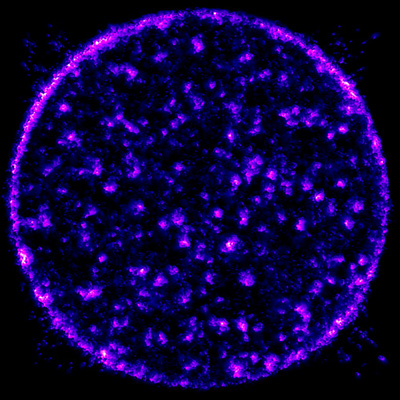
RAW STORY– Scientists said Sunday they had trapped and stored antihydrogen atoms for a record 16 minutes, a stunning technical feat that promises deeper insights into the mysteries of antimatter.

Particles and anti-particles annihilate each other in a small flash of energy when they collide.

At the moment of the big bang, nearly 14 billion years ago, matter and antimatter are thought to have existed in equal quantities. If that balance had persisted, the observable Universe we inhabit would never have come into being.

For unknown reasons — and fortunately for us — Nature seemed to have a slight preference for matter, and today antimatter is rare.

This asymmetry remains one of the greatest riddles in particle physics.

Ongoing low-energy experiments with hydrogen atoms could be a key step toward solving it.

“We can keep the antihydrogen atoms trapped for 1,000 seconds. This is long enough to begin to study them — even with the small number that we can catch so far,” said Jeffrey Hangst, spokesman for the ALPHA team conducting the tests at the European Organisation for Nuclear Research (CERN) in Geneva.

In the study, published in the journal Nature Physics, researchers report trapping some 300 antiatoms.

Scientists used CERN’s high-energy accelerator to create the antihydrogen atoms, and then chilled them to near-zero temperatures.

The aim is to use laser and microwave spectroscopy to compare the immobilised particles to their hydrogen counterparts.

The same team succeeded last fall in trapping dozens of antimatter atoms and holding them in place for a fraction of a second, a world first at the time.

But that was not long enough for the excitable particles to settle into the stable “ground” state needed for precise measurements.

The new benchmark extended this storage time 5,000 fold, making it possible to carry out crucial experiments.

Read the full story about Scientists ‘Trap’ Anti-Matter for Record 16 Minutes.

© 2011 RAW STORY

Photo by Flickr user Fire Brace

Is Quantum Mechanics Messing with Your Memory?

GUARDIAN– Imagine if a cold cup of coffee spontaneously heated up as you watched. Or a cracked pane of glass suddenly un-broke. According to physicist Lorenzo Maccone at the Massachusetts Institute of Technology, you see things like this all the time – you just don’t remember.

In a paper published last week in Physical Review Letters, he attempts to provide a solution to what has been called the mystery of “the arrow-of-time“.

Briefly, the problem is that while our laws of physics are all symmetrical or “time-reversal invariant” – they apply equally well if time runs forwards or backwards – most of the everyday phenomena we observe, like the cooling of hot coffee, are not. They never seem to happen in reverse.

We have a statistical law that describes these everyday phenomena called the Second Law of Thermodynamics. This law tells us that the “entropy” or degree of disorder of a closed system never decreases. Roughly speaking, a process in which entropy increases is one where the system becomes increasingly disordered. Windows break, thereby increasing disorder, but they will not spontaneously unbreak. Gases will disperse but not spontaneously compress.

However, entropy describes what happens with large numbers of particles. We presume that it must arise from what happens with individual particles, but all the laws that govern the behaviour of individual particles are time-reversal invariant. This means that any process they allow in one direction of time, they also allow in the other.

Read full article about Is Quantum Mechanics Messing with Your Memory?

© 2011 Guardian

Photo by Flickr user Nesster

Dark Matter Experiment Disproves Earlier Findings

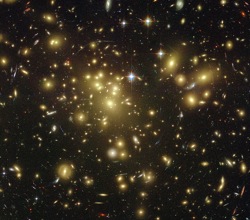
universePHYSORG– Early data from a Columbia-led dark matter experiment rule out recent hints by other scientists who say they have found the elusive particle that holds the universe together. The findings show that dark matter, which is believed to make up 83 percent of the matter in the universe, is more elusive than many had hoped.

continue to escape our instruments, yet we are getting much more clever in our search and feel confident that we will soon unveil them,” said Elena Aprile, spokesperson of the XENON100 experiment and a professor of physics at Columbia University.

Aprile and her collaborators, who number more than three dozen physicists at nine institutions around the world, presented their findings at a workshop on May 1 and have submitted a paper to the journal . The scientists, whose experiment is the most sensitive search for dark matter to date, plan to release a much larger set of data over this summer.

The group did not expect to find dark matter in this short run of data taken last fall. Instead, their results show that the detector is better than any other at screening out that can be mistaken for the elusive particles.

Continue reading about Dark Matter Experiment Disproves Earlier Findings.

© Columbia University, 2010

Photo by flickr user NASA Goddard Photo and Video

The Holographic Universe

HARPER COLLINS REVIEW– Today nearly everyone is familiar with holograms, three-dimensional images projected into space with the aid of a laser. Now, two of the world’s most eminent thinkers — University of London physicists David Bohm, a former protege of Einstein’s and one of the world’s most respected quantum physicists, and Stanford neurophysiologist Karl Pribram, one of the architects of our modern understanding of the brain — believe that the universe itself may be a giant hologram, quite literally a kind of image or construct created, at least in part, by the human mind. This remarkable new way of looking at the universe explains now only many of the unsolved puzzles of physics, but also such mysterious occurrences as telepathy, out-of-body and near death experiences, “lucid” dreams, and even religious and mystical experiences such as feelings of cosmic unity and miraculous healings.

Continue reading about The Holographic Universe.

Michael Talbot, author of the Holographic Universe, explains some important tenets to his theory and how it fits into human consciousness.