Nov. 7, 2017 marks the 100th anniversary of the seizure of power by workers and peasants in the Russian Revolution, regarded as the most world-altering event in the history of civilization.
To understand the context of this first socialist experiment, how it happened and what caused the many problems it faced, Abby Martin sits down withBrian Becker, long-time socialist organizer and co-author of the new book “Storming the Gates: How the Russian Revolution Changed the World.”
It’s been estimated that an average American living in cities sees up to 4,000 ads a day. This toxic culture of mindless consumption exploits our innermost insecurities and desire to meet impossible standards. The corporate PR machine is enormously successful due to model created by a man named Edward Bernays nearly a century ago.
The nephew of Sigmund Freud, Edward Bernays is considered the father of modern propaganda, or public relations. An Austrian aristocrat, Bernays first contribution to the United States was helping President Woodrow Wilson sell the idea of World War I as a noble mission to spread democracy in Europe. In order to create the engineering of consent, Bernays argued, you must appeal to the unconscious mind.
And on behalf of numerous corporate clients, Bernays helped perfect the tools of manipulation and conditioning that are used today. To understand more about the history of propaganda and the collusion between the U.S. Empire and the fourth estate, Abby Martin sits down with Professor of Media Studies at NY University, Mark Crispin Miller, who wrote the intro to the new edition of Bernays 1928 seminal book, Propaganda.
Propaganda and the Engineering of Consent for Empire with Mark Crispin Miller
In a country that declared the end of socialism, a major poll released in January 2016 revealed something unexpected. 43% of people under 30 in the US view socialism favorably compared to only 32% who view capitalism favorably. This shows that despite a concerted effort to smother the ideas of a man who died 133 years ago, the analysis put forward by Karl Marx remains extremely relevant today.
Marx is considered the most influential philosopher to ever live. With his co-thinker Friedrich Engels, he developed a way of understanding the world that has not only greatly contributed to the understanding of philosophy and economics but also history, anthropology, political science, biology and many other fields.
As a young man in the mid-19th century Marx embedded himself in the workers’ movement in his home country of Germany and in France from where he was exiled to London for his political activity. In addition to dedicating himself to the scientific study of capitalism and social change, Marx was also an organizer and he convened the very first international organization of socialists with the goal of overthrowing capitalism, known as the Communist League whose slogan was “Working men of all countries, unite.”
His work Capital is regarded as the premier dissection of the economic system we live under. His discovery of dialectical materialism redefined the world of philosophy and his rallying call the Communist Manifesto is considered the most influential political document in the world.
As the US Empire thrashes to survive the current global capitalist crisis, and with rejection of capitalism clearly growing among young people, I wanted to find out what it was about Marx’s work that has had such a profound impact, from peasants in Asia to miners in Africa, to workers in the US alike, so I talked to someone who has been teaching students and the public about Marxism for years, Dr. Richard Wolff, Professor of Economics Emeritus at the University of Massachusetts, Amherst.
Marxism 101: How Capitalism is Killing Itself
***
ABBY MARTIN: You’re a Marxist economist. Let’s start with the basics. What is Marxism? And what does it mean to have a Marxist lens with which to view the world?
RICHARD WOLFF: I think the best way to understand it is that the difference between Marxism and other things is that it wants to go to the root. It is radical in that sense. It wants to see these problems: homelessness, inequality, an economy that bounces around having a recession or depression every 3 to 7 years, a society that concentrates political power in the tiny number. These recurring problems of capitalism, Marxism says, are built into the system, and if you want to solve them you can’t do that within the framework of the system. You have to face the fact that this system itself is the problem, which is why Marxists tend to be people who abide by the idea that we can and we should do better than capitalism. We should reorganize society because that will be a better way to deal with all those problems than dealing with them individually as if you could solve homelessness or solve inequality by a quick fix, by a marginal adjustment. No, the problems are systemic, so you have to understand how capitalism as a system works in order to begin to work your way to a solution.
AM: Can you give a brief explanation of dialectical materialism?
RW: Marx was a philosopher, so being a rigorous and systematic thinker, he didn’t want to jump into economics, which is what he focused on, without grounding it in philosophy, so he begins as a student of Hagel, the great philosopher. When he begins his academic life—Marx began as a professor—he taught philosophy. His doctoral dissertation was on ancient Greek philosophy. He wasn’t an economist when he began. He ended up thinking he had to study economics because of how philosophy got him there. And to be quick in a way of an answer to your question, he comes out of a school of thought that believed that ideas were the supreme achievement of human beings. Ideas are what you get from the most refined reflection that the human brain can do. If you’re religiously oriented, ideas are what you get from God, from the spiritual realm, and so the world is really shaped by something prior to the world, namely ideas, so the notion is, sometimes called idealism, that the real world is the product of ideas, and if you want to really understand the real world, go to the ideas that make it what it is.
Religiously, in the beginning there was nothing. Then there was first God which is a non-material idea and that creates the world. In Genesis, in seven days God, a spirituality, creates the materiality of the world. Marx rejected that. For him the material is just as important as the ideal. If you want to see where the material comes from, it is shaped by ideas. But here comes his radicalism. It runs the other way too. The ideas don’t come from nowhere. They come out of the real world. The ideas we have as people have to do with the real material problems we have as human beings, and how we solve them. Where do we get our food? Where do we get our shelter? How do we get protection as little children from the elements from our parents? All of these real material matters of life and survival are shaping our ideas every bit as much as our ideas shape the reality. Dialectical materialism is the name for a point of view that says if you want to understand the world, you need to look at how ideas shape the material, but the other way too, and the two interact. That’s the way to see the world, and for that reason when it came to explaining the problems of capitalism, he never could and never did suggest it’s all because of the ideas of people about capitalism. It’s the real way human beings make their food, solve their clothing problems, their relationship problems, that shape their ideas as much, and he was going to analyze capitalism through that lens of the interaction of ideas and concrete material reality back and forth.
AM: Marxists take a particular view of history called historical materialism. How does the current era of capitalism fit into the long history? I think you’ve mentioned this before—how this is just the latest chapter in a long history of economic development.
RW: The basic idea is that every economic system has in it conflicting forces. The language in Marxism is internal contradictions. The system has in it problems it is constantly struggling with because they are built into the system, and for long periods of time it finds solutions, but in the end, historical materialism says, the internal contradictions become unmanageable, and then there’s a kind of explosion. The system dies, and a new one is born, so we had slavery, for example, in various parts of the world. It was born. It evolved. It had its contradictions. For example, there was the contradiction that the only way a slave system can continue is if you replace the slaves that reach old age and die. That became a big problem for many slaves societies, so eventually slavery couldn’t solve its problems and it died, replaced by feudalism in Europe which went through a parallel process, and then it blew up because it couldn’t solve its problems. So historical materialism begins to look at capitalism through the same lens. What are the internal contradictions? How do they bedevil the system? What solutions, for a while, had they found? When and where might we get to a level of internal contradiction that makes the system tremble, makes it vulnerable? And at that point, if revolutionaries can see and understand what’s going on, they can intervene to move to the next system, to get beyond this. Just like rebels overthrew slavery, rebels overthrew feudalism. The expectation of Marx was that capitalism would generate the contradictions, then the tensions, then the failed solutions that would then bring into being the rebels with the ideas of criticism, Marx himself being one of those, who would eventually move to the next system.
To illustrate it as concretely as I can, let me give you an example of the kind of contradiction Marx found in capitalism that has been crucial for everybody else. And I pick it because it’s so relevant right now in the United States and around the world. Every capitalist… I think most of the folks watching know this, just from their personal life… every capitalist is always trying to either make more money or survive competitively by saving on his labor costs. One capitalist does it by substituting machines for working people, automating, getting a computer to do what he used to have fifty people do etcetera. Another capitalist does it by trying to get cheaper workers in place of more expensive ones, hiring women, if they are less expensive, to do the job that they used to pay men more for, hiring immigrants rather than native folks, moving to another part of the world where wages are much lower. We all know that. So capitalists are always trying to save on labor costs because they can make a better profit if they do that, but here comes the contradiction. If all capitalists are reducing the number of workers they pay, or reducing the pay they give to their workers, what will result is that the working people have less and less money, and if they have less and less money they can’t buy what the capitalists are producing to sell. The capitalists therefore are destroying themselves, but they have no choice. They have to save on the labor outlay, and then that comes back and bites them in the rear end because there’s no demand. You’ve been so successful becoming rich as a capitalist, but you’ve killed yourself.
These kinds of contradictions for Marx are the beginning of the end of a system. It papers it over. For example, when people couldn’t buy in the 1970s, the capitalist system kept going anyway. How did it do that? How did it keep going when the people didn’t have enough money from their wages to buy? The solution was credit. We loaded the world up with house credit: your mortgage, car payment credit (nobody buys a car except by paying on credit), credit cards, which didn’t exist before the 1970s for anything but traveling businessmen, and a small number of them, and then when that was not enough, we loaded up for the first time in American history, an entire generation of students who can’t get a degree without loading up with tens of thousands of dollars of debt. We kept this system going. People could buy stuff even though their wages didn’t pay for it by borrowing, and in 2008 the predictable happened. It turned out your fix only lasts for a while. You really have to ask this, in a way that many of us as Marxists haven’t done for most of our lives: the problems of capitalism now are so severe, so systemic, so global, that we’re beginning to wonder whether this system is going to find a way out. The Marxists are not the only ones wondering whether this system is coming to an end. The people on the other side of the political fence are very worried too.
AM: You have billionaires writing op-eds: “The pitchforks are coming for the plutocrats!” because they know what’s coming. Let’s talk about the bubbles. You talk about the housing bubble, and I think this is a really interesting indication. The housing crisis, the crisis of overproduction, the fact that we have more [empty] houses than we do homeless people, but because you have this crisis of overproduction, too much of something was produced and people couldn’t utilize it. Talk about that concept and why this is an inescapable phenomenon under capitalism.
RW: Starting in the 1970s, American businesses began to have what I like to call a eureka moment. They realized that in the West, North America, Western Europe and Japan, a hundred, two hundred years of capitalism had built up impressive factories, offices and stores, but they were built up in the places where capitalism was born, Western Europe, North America and Japan. That’s where they had concentrated everything and that’s where they had drawn workers in off the countryside to become urban, industrialized working classes, and along the way the workers, noticing how productive capitalism was since they did the work, demanded for themselves a rising standard of living. So roughly from 1820 to 1970, particularly in the United States, but elsewhere, wages rose. That’s why over that time capitalists were doing so well that they could raise the wages of their workers and still make out like bandits, so it was a system in which people began to get the idea capitalism works. It delivers the goods because it raises wages. You have to not look at what was happening where most people in the world lived—Asia, Africa, Latin America—because for them the situation was horrible, but if you concentrated on where capitalism was born, you could fool yourself into thinking, “Wow, this is a system that works.” And capitalists, of course, and the people who like it, celebrated all of that.
Then in the 1970s capitalists had this eureka moment. They said to themselves, “Wait a minute. We are in North America, Western Europe and Japan where the wages are now very high. Workers are now very happy, but why are we here?” In the rest of the world which has been savaged by the growth of capitalism in those privileged areas, wages are very low. So in this eureka moment capitalists said, “What are we doing here in Western Europe, North America and Japan? It’s much more profitable if we produce in China, India and Brazil.” And there begins what we’re still in the middle of: the exodus, the abandonment of the places of origin of capitalism by the capitalists, so there’s a massive move to China, India, Brazil and all those places, producing what? Well, what every capitalist wants, which is to make a bundle, so they build big factories imagining that they can sell all of this stuff like they used to, but they forgot something. If you go from high wages in the United States to low wages in China, the bottom line is that the people earning wages are earning a lot less than they used to. It’s not just that they’re not Americans; they’re Chinese, but they can’t buy back what you’re building. They can’t manage to consume what you have the capacity to produce. Right now China is slowing down. It’s scaring the whole world, but it’s not China that’s slowing down. It’s the inability of China to sell to the world because the wages of the world’s workers have been depressed now for years as we move out of Western Europe, North America and Japan into these lower… and the system totters as it encounters a very old contradiction in its current form for which they have no solution. And right now when it’s happening on a global scale… Europe is having it. North America is having it… Japan. These are the centers of capitalism. They’re in the most trouble right now and they don’t see a way out, and I don’t either, which makes it possible for the first time in my life to begin to see a capitalism that is in fundamental, shaking difficulty, and if I were to explain to someone why you get bizarre politics unlike what we’ve had for a century, I’d say it’s because of this.
And here in the United States you see the kind of theatrical buffoonery, but there’s more to it. Why is Trump such a character in the Republican Party? Why is that party literally tearing itself apart? Because it can’t cope. And even the Democratic Party [can’t cope], suddenly confronted with a socialist who isn’t marginalized simply because he gives himself the name “socialist.” In fact, it makes him attractive. What Bernie Sanders is proving is that the interest in socialism has captured millions of Americans.
AM: So I think a lot of people are aware of socialism, now especially since you have a self-proclaimed democratic socialist running for president, but they don’t actually understand what it means. I think they’re taking little bits and pieces—free health care, free education… Talk about the means of production and how a socialist economy would actually be structured.
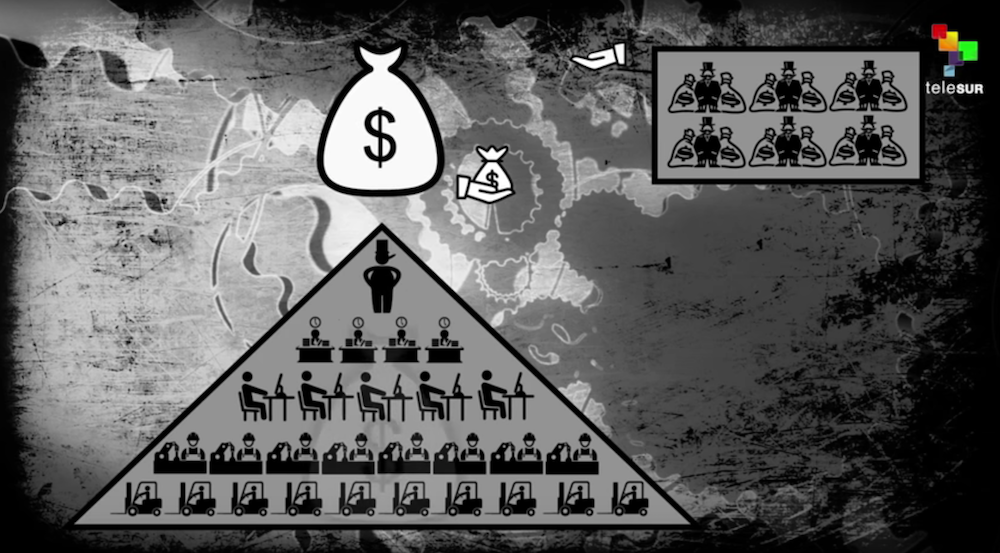
RW: They came up with the following idea: that the problem of capitalism is two fundamental things. One, that private individuals own the means of production. They own the land. They own the factories. They own the stores, the machinery, and the people, the owners, are really a very small part of the population, 1%, 2%, 5%, maybe even 10%, although rarely did it get that high. But that means the vast majority of people are never part of the owners, and the basic socialist idea was if you allow a small number of people to control the means of producing all the goods and services we all need to survive, they’re going to use that control to make the system work for them, and they’re not going to worry about the rest of us. In other words, it’s a recipe for a society that produces wealth for the top 5 to 10%, but not for everybody else. It gives power, political and other power, to those at the top, and not to everybody else, so the socialist idea was this is fundamentally unjust, fundamentally undemocratic. This is what’s wrong with capitalism, and how do you solve it? You make collective ownership, not private. The society as a whole should own the means of production—the factories, the offices, the stores, so that they are good for everybody, so that what they produce is distributed roughly equally, so that the influence on the decisions are made social. It’s why it’s called socialism. It’s the society that should own. It focuses on the workplace. Its idea is that the way you make sure that the government never again becomes an institution over the people, but rather simply an instrument of the people, is by making sure that at the base of society, where people live and work, the wealth, the productive capability, is in their hands.
If you want the slogan of 21st century socialism, it’s this: democratize the enterprise. End this process where there is a handful of people who make the decisions. In most American corporations… and corporations do the bulk of the business in modern capitalism… a tiny group of what are called major shareholders, the people who have big blocks of shares, select the board of directors. 1% of Americans own 3/4 of the shares. It’s highly concentrated. A tiny number of people, the 1%, own the bulk of the shares. How do you run a corporation? At the top is something called a board of directors, usually 15 to 20 people. How do you get on the board of directors? There’s an election every year to get on that board, and the way the election works is if you own a share of stock in the company, you get one vote. If you have 10 shares, you get 10 votes. If you own a million shares, you get a million votes. If you have no shares, that’s how many votes you get. There is no pretense of democracy, so if a handful of people own the bulk of the shares, they control everything. They select the 15 or 20 people on the board of directors. The board of directors decides what the company produces, how the company does it, where the company is located, and what’s done with the profits. Everybody helps produce the profits. The employees have to live with the decision, but have no influence on it. It is the opposite of democracy, and if you don’t have democracy at the workplace, you can’t ever have it real in politics, either, because those at the top will buy the political system, something which we see in the United States so starkly every day that everyone knows.
If workers took over a factory that had a workers’ co-op instead of a top-down [management], and the workers together decided what to do with the profits, do you think they would give a few executives $25 million so they would have more money than they would know what to do with while everybody else has to borrow money to send their kids to college? It’ll never happen. Do you think a collection of workers, say 400 in a factory, considering that you could make more money if you moved production to China… Are they going to vote to get rid of their own jobs? They’re not going to destroy their community by having an empty factory. They’re not going to deprive their local government of the tax revenues to run the schools and the hospitals and they’re not going to deprive themselves of jobs. So what we’ve had in the last 40 years—all those jobs leaving—they would never have left if it had been the collective decision of the workers where this production is going to take place.
AM: And I wanted you to also just counter another argument that I hear constantly: “I earned it! We earned this money!”
RW: The best way to describe this is to go back to Karl Marx and his analysis of capitalism so that we all understand what earning is about. Let’s imagine you are a person looking for a job, and I’m the employer that you’re looking to get hired by, so you come in and you sit down. You fill out your application form and I look at you, and I describe to you the kind of work we’d like to have you do. You come, you do your 9 to 5, Monday to Friday, and you’ll sit over there and you’ll do this kind of work. And we get through all that. You’re OK with that, and then we get to that big question: how much are you going to get paid? And let’s say we go back and forth and we agree on $20 an hour, so I’m going to pay you $20 an hour, and at this point Marx enters with a smile on his face and says, “I’m now going to show you, the reader, that when that deal is done, something is going on that you actually know, but you don’t want to face, but I’m going to show it to you. When I hire you for 20 bucks an hour, I know that for every hour that you give me your work, your brains, your muscles, I’m going to have more stuff to sell at the end of the day because you were added to my work force. You’re going to help me produce more goods or more services, or better quality goods and services than I would have if I didn’t employ you, so I’m going to say to myself, “It costs me to get Abby $20 an hour. What do I get out of it?” I’m going to have the output that Abby adds by her labor. That has got to be more than 20 bucks, so the only way I’m going to hire you for $20 an hour is if you produce more in the hour than I give you. So when you feel in a vague way at the end of the day as you walk home that you’re being ripped off, you’re absolutely right. Or in Marx’s language you’re exploited, so what does the capitalists say? “I earned it.” No you didn’t. You just ripped people off.
The way most corporations work is 4 times a year they take the profits they’ve made in the preceding 3 months and they distribute a portion of them to their shareholders. These distributions are called dividends, so if you own a lot of shares because, say, you inherited them from your grandma, or you stole money and bought them on the stock market. There are lots of ways of getting them, but if you have them, 4 times a year you go to your mailbox in the morning and you get an envelope and you tear it open and inside is a check for your share of the profits that have been distributed to shareholders. For rich people this is millions of dollars. They have all that money. What did they do exactly to earn that money? Nothing. Those people are going to tell me they earned? Do they ever set foot in the factory? No. Do they have any idea what this company does? No. They don’t care! They are simply sitting there collecting. Well let’s now do a little logic. If there are people like shareholders who get a lot of goods and services they didn’t help produce, then there must be elsewhere in that system people who produce what they do not get, so that means if we allow that, we are saying to some people your job is to produce a lot more than you get so that these people can get a lot more than they produce. Marx stands up and says, “I rest my case. This system sucks.”
AM: Famous socialist Rosa Luxemburg once said that it’s either socialism or barbarism. Here we are 100 years later. In what ways have you seen that play out today?
RW: One: the 62 richest people in the world, most of whom are Americans… not all of them are, but most of whom are US citizens… the 62 richest people together have more wealth than the bottom half of the population of this planet—roughly 3.5 billion people. That’s beyond obscene. I don’t have an adjective that captures this, but I can describe what it means. If you look at all the statistics of the World Health Organization, the bottom half of our population are people who die way earlier than they need to. Why? Because their diets are no good, or they don’t have enough food in the first place. Or they can’t get to a clinic. They have little problems that are easily solved by modern medical methods. It’s unspeakable what happens to the lower half. If we took half the wealth of the richest, they would still be the richest, and if we made it available to the bottom half, it would transform their lives, literally. Now there is no moral or ethical justification for this situation.
Number 2: it is well known all over the world, despite a few deniers that are still around, that the way capitalism has evolved has compromised the ecology and environment of this planet, literally threatening us with 27 diseases and 57 losses of fundamental resources. This is crazy to permit this to go on. This is another way capitalism confronts us with barbarism.
And the third one is—and here the United States plays a particular role—is this notion that the Western world, the world that has the wealth and the military might, is in a war, an endless war against something as vague as terrorism, whatever exactly that is. And this is used to justify an endless use of resources not available for people’s needs but to combat one enemy, real or imagined, after another, so we literally confront an endless military warfare state, a cataclysmic destruction of our natural environment, and a level of inequality that has no justification.
Our entire economic situation would have been completely different the last 30 years if we had had a movement, if we had had organizations to make these demands because I haven’t the slightest doubt that the majority of Americans will support all of them.
It used to be at this point in an interview I would have to look at a skeptical interviewer saying, “Ah, Americans support this kind of socialistic stuff?” I don’t have that problem anymore because Mr. Bernie Sanders has done me a favor. By throwing his hat in the ring in the democratic primary and running around the country, as he’s been doing as a socialist, he has proven for all Americans to see that the support for something other than capitalism has now captured millions of Americans, and we don’t know how many millions because that still has to be shown. And the argument that was heard when Occupy Wall Street emerged in 2011: this is a tiny group of people who don’t represent anything—all that’s gone because Mr. Sanders has said, “Well, let’s see.” Let’s see how many people are critical of the 1% vs 99. How many people will support a candidate who says that every day and even accepts the label “socialist”? And the answer is millions.
World renowned linguist and philosopher, Noam Chomsky, joins Abby Martin to discuss the so-called War on Terror, the warped political spectrum in the United States, and how power functions in the Empire.
Chomsky argues that both the Democratic and Republican party have shifted to the right, with Republicans going “off the spectrum”, dedicating themselves to the interests of the extremely wealthy and powerful, and today’s Democrats becoming what used to be called moderate Republicans.
Delving into libertarianism and the role of predatory capitalism, Chomsky discusses the institution of neoliberal policies, which have pushed for things like major financial institution bailouts, and government subsidies to energy corporations. The contention that markets provide choices is farcical, argues Chomsky, as the market focuses you on individual consumption of consumer goods. “New libertarians”, according to Chomsky, are deeply confused as to the meaning and history behind classical libertarianism, and what they propose would lead to society collapsing,
Describing the Iraq war as of one of the last century’s greatest atrocities, Chomsky asks what right the United States has in bombing or invading a country, for whatever reason. While there is a lot of criticism in regards to the US killing civilians inside Kunduz hospital, “what about killing [Taliban members]”, asks Chomsky. “What right do we have to kill somebody in some other country?”
Abby Martin once again takes up beyond the headlines and brings us to the very heart of the issues in this episode of The Empire Files.
Noam Chomsky & Abby Martin: The Empire’s Election Extravaganza
One human family living on one organism. Yet man is embroiled in a war against himself.
Unfortunately this blatant truth hasn’t yet been realized by the vast majority of humans living on earth.
The wars against ISIS, Russia, and now laughably Venezuela are dominating headlines in the latest front of the information war, but a far more deadly battle is being carried out against the organism we all share.
We face the most severe environmental crises in history with deforestation at a rate of 36 football fields per minute, floating trash islands the size of Texas in the Pacific, and half the world’s species being wiped out in the last 40 years as a result of habitat loss and pollution. In just the last 30 years, climate change has already caused a tripling of natural disasters, with scientists predicting an irreparable tipping point around year 2020, the same year Obama pledged to cut US carbon emissions by 17%.
But how can climate change solutions be taken seriously without a massive overhaul of the agricultural industry and complete termination of the military industrial complex? The Pentagon is the largest polluting institution in the world and is exempt from all international climate treaties.
The climate change disinformation campaign has gotten to the point of such absurdity, that Florida’s State Environmental Protection Department has banned the use of the terms climate change and sustainability in all emails and reports. It’s an issue that should supersede politics. But a corporate controlled press run by oil and gas won’t dare undermine its sponsors.
Of course the establishment showcases an alternate reality. Media hysteria abounds about missing planes and Iran’s non existent nukes, yet there’s an eerie calm about the issues that most impact us, and what we can do to fix them. The population remains dumbed down, complacent and willfully blind.
Maybe the CEOs, lobbyists and politicians are shortsighted because they’re building their own elysium and don’t give a fuck if we all die, but the majority of them are inevitably just changing deck chairs on the Titanic – and they know it.
Deep down everyone knows the truth. Every last vestige of this precious planet is being pillaged without consequence. Endless consumption and unfettered capitalism cannot and will not last. And every empire falls. That’s just a matter of time.
The system blatantly protects the bottom line and resists all substantial change with military force and police aggression to keep the old guard. The elites at the helm will never capitulate their security for the good of humanity.
Once a system doesn’t work for 99.9% of the people, it might be time for a new one.
Abby Martin at Zeitgeist Day 2015 in Berlin
I’m more than happy to be a part of an annual event that showcases a different future than the dark path humanity is bulldozing down. So thank fuck for Peter Joseph’s not only incredible three part Zeitgeist documentary series, but also for his follow up work with Culture in Decline – all of which dismantle the toxic conventional wisdom that strangles our mental development.
Seeing the power of video to shatter religious, political and economic dogma inspired the hell out of me. But I was also moved by the trajectory of the series, which first deconstructed systems of control and then presented an entirely new realm of possibilities.
I used to be an anti-war organizer. But once I saw the media selling the Iraq war I realized something was very systemically wrong, and it crossed all party lines. Media became my number one battle, because if you don’t have a platform to tell your story then no one will hear it.
I started Media Roots as a hub for censored information and it grew into a multimedia citizen journalism project, which eventually brought me to RT and Breaking the Set. It was a dream job to attack power on an international platform, but I decided I want to be meeting the people behind the stories and telling them independent from any state or corporate entity.
I don’t just want to react to the mainstream media’s circle jerk of fuckery.
Bush lackey Karl Rove once brazenly told New York Times reporter Ron Suskind in 2004 “We’re an empire now, and when we act, we create our own reality. And while you’re studying that reality… judiciously as you will… we’ll act again, creating other new realities, which you can study too, and that’s how things will sort out. We’re history’s actors… and you – all of you – will be left to just study what we do.”
Unfortunately, Rove’s right. Reality is dictated by an out-of-touch war mongering elite that doesn’t apply to the reality we live every day. But it’s only able to sustain on fear and war. And there’s nothing that terrifies the establishment more than a populace not living in fear.
People are rightly disillusioned after being called crazy for wanting more than two parties or questioning ludicrous paradoxical foreign policy. They also want sustainable energy.
Clearly I don’t have all the answers, and I don’t think anyone here claims to. But a resource based economy is one of the most thought provoking and groundbreaking solutions I’ve seen to the crisis of civilization we face.
We don’t have to wait for anyone but ourselves to start implementing the ideals either, because we are all agents of change and vessels of truth that can push our communities towards seismic sustainable shifts in the way we live right now.
Other countries already have a different approach. I recently had the chance to visit Cuba, and not only does the country have an organics renaissance, but there aren’t commercials telling you what a worthless piece of shit you are, or corporate chains eviscerating local culture.
But most spectacularly is Cuba’s medical internationalism. Cuba sent the world’s largest contingent of medical professionals to Liberia, Sierra Leone, and Guinea to fight the ebola epidemic, and has healthcare workers operating in 66 countries. The country also has a medical school that trains international students to become doctors for free.
Of course, this wasn’t out of pure altruism, the long imposed embargo on Cuba forced it to become self sufficient and fiercely community oriented. The country is far from perfect, but the obvious takeaway remains the tremendous amount of good that can be done with such little resources. If that’s what an economically crippled nation can achieve, what can the richest one in the world do?
If people came first.
Every government that has tried to incorporate different economic models gets systematically undermined with regime change attempts. USAID is still spending $20 million dollars a year in Cuba to undermine the government despite the normalization process. 56 years after the Cold War, and the US government still can’t let a small socialist nation live in peace.
In socialist Venezuela, Obama just announced the country poses and quote “extraordinary threat” to national security and that he has quote “deep concerns” about its human rights abuses. Meanwhile America’s biggest ally Saudi Arabia summarily carries out beheadings and public floggings to bloggers who criticize the king.
Clearly these issues are deep rooted and deeply interconnected. This is about hegemony, and the clutches of capitalism won’t give up easily. The system can’t afford alternatives, and we’ve seen how far it will go, with no remorse. It’s a machine that runs on death and destruction, having institutionalized structural violence that kills millions of our brothers and sisters every day.
No one has to go without water in the streets of Detroit, or freeze to death in bombed out Gaza, because we have the resources to provide everyone. Would you let your mother or brother starve on the streets? No, because we belong to the commons and the commons belongs to us.
The revolution of values is the extension of empathy, understanding, compassion and humility – globally. Which means shattering the illusion of me as separate from you or us as separate from the dirt underneath our concrete jungle. It comes with expanding consciousness and media literacy. And most importantly, it’s about building alternatives ourselves. That’s why I believe that this movement is unstoppable and the ideas it’s spawned will create our reality of a sustainable future.
Because if we don’t, we’ll just become casualties in the war being waged against us and every living thing on this planet.
On this pale blue dot.
As Carl Sagan said, “In our obscurity, in all this vastness, there is no hint that help will come from elsewhere to save us from ourselves.”



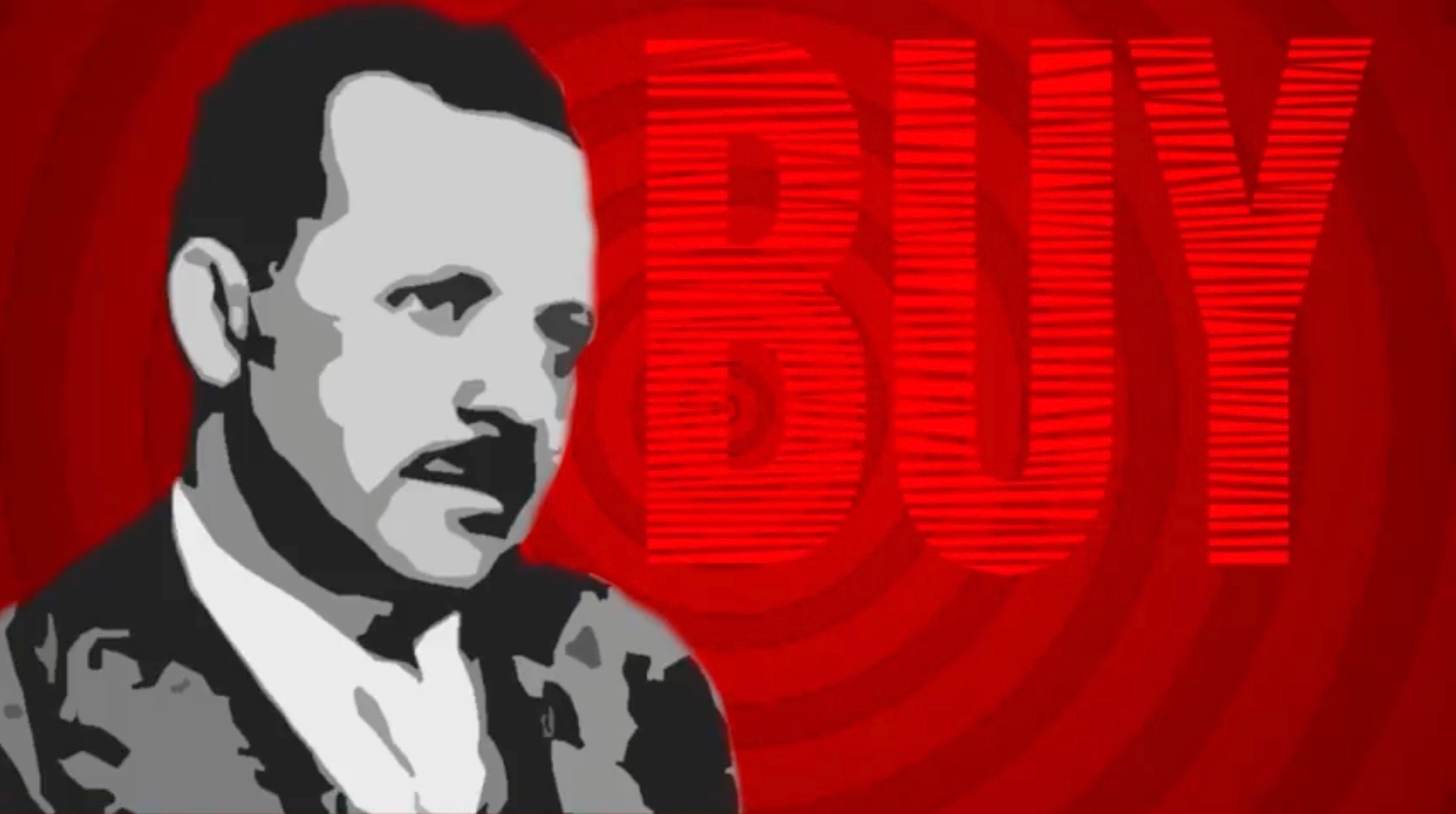 It’s been estimated that an average American living in cities sees up to 4,000 ads a day. This toxic culture of mindless consumption exploits our innermost insecurities and desire to meet impossible standards.
  In a country that declared the end of socialism, a major poll released in January 2016 revealed something unexpected. 43% of people under 30 in the US view socialism favorably compared to only 32% who view capitalism favorably. This shows that despite a concerted effort to smother the ideas of a man who died 133 years ago, the analysis put forward by Karl Marx remains extremely relevant today.
 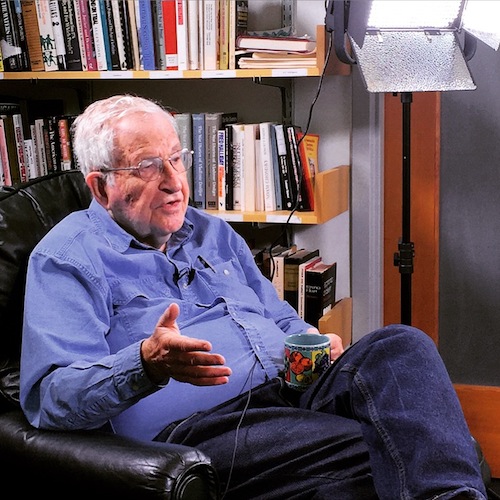 World renowned linguist and philosopher, Noam Chomsky, joins Abby Martin to discuss the so-called War on Terror, the warped political spectrum in the United States, and how power functions in the Empire.
 One human family living on one organism. Yet man is embroiled in a war against himself.