Midway Albatross, Casualties of a Plastic Genocide

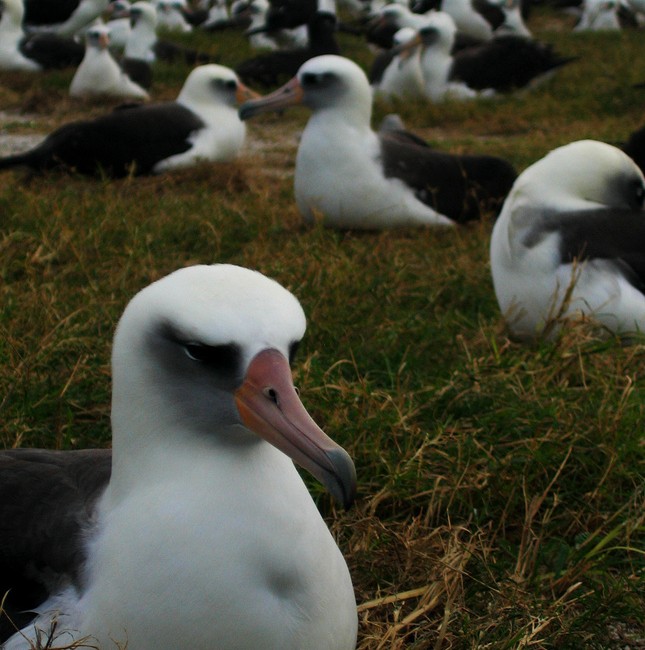
BirdAlbatrossSurrounded by thousands of miles of Pacific Ocean, the majestic Laysan Albatross birds nest on islands forming the Midway Atoll, located at the northwest point of the Hawaiian Archipelago. This unique wildlife refuge is home to 71% of the world’s Laysan Albatross population and therefore is critical to their survival. 

On Midway island, albatross live a delicate life. They typically mate and nest for the first time between the ages of five and eight. Each time they do, they hatch a solitary chick that requires constant care from both parents to stay alive.

Sadly, the deadly consequences of human overconsumption have turned the once densely albatross populated region into a mass graveyard. Like many fragile ecosystems on earth, plastic pollution in the ocean has greatly hindered this species’ survival.

One of the primary sources of albatross food is flying fish eggs, which lay in strings that attach to floating plastic in the ocean. Due to this consumption, it’s estimated that 98% of all Laysan albatrosses have varying degrees of plastic in their digestive systems.  Every year, four out of ten albatross chicks die from a variety of deadly health conditions including starvation, dehydration and obstructions of their digestive systems – all as a result of plastic ingestion. These regal seafaring birds are helpless victims, dying by the thousands every year as a result of this toxic pollution.

To get a sense of the magnitude of this tragic phenomenon, check out photographer Chris Jordan’s stunning report on the plight of Midway albatross:

***

To even begin to take on this problem we must first be willing to understand the degree of damage plastic pollution does. This non-biodegradable substance makes up 90% of ocean debris, and comes in a multitude of forms including medical garbage, bottles, bags, toys, bottles caps and plastic micro particles. 20% of this waste comes from private and commercial ships, fishing equipment, oil platforms and spillage from shipping containers, while the remaining 80% originates on land.

Thousands of tons of plastic ends up in streams, rivers and reservoirs. Eventually, it finds its way to the oceans resulting in plastic flotillas piloted by ocean winds and currents. The remainder will either sink to the bottom of the ocean floor or end up in an ocean gyre, a vortex where the debris becomes trapped. So far, one of the biggest areas of accumulated garbage is in the Pacific Ocean, also known as the ‘Great Pacific Garbage Patch’ although there are five major ‘garbage patches’ in our oceans today.

The Laysan Albatross is certainly not the only marine species endangered as a result of human pollution, but it is one of the most uniquely affected by it. Obviously we as individuals don’t have the resources to clean up the oceans. But we can become active citizens by promoting a healthy and sustainable lifestyle, while demanding that policy makers and corporations mandate the same through their laws and products.

We can commit to purchasing reusable grocery bags, reusable water bottles, eliminating styrofoam and non biodegradable storage containers from our lives as well as support politicians and local legislation that enforces environmental protections. We may not be able to undo the damage we’ve already caused to our oceans, but with commitment and dedication to a cleaner planet we can make sure we do not cause further, irreversible destruction.

As a global community, we must learn to share the planet with all species to sustain ourselves and future generations. We can make a difference, for the albatross and for all the wondrous creatures that inhabit our planet. In fact, our survival depends on it. As Jacques-Yves Cousteau once said: “For most of history, man has had to fight nature to survive; in this century he is beginning to realize that in order to survive he must protect it.”

If you would like to learn more about Midway Laysan Albatrosses and show your support, please check in and follow Wisdom on her facebook page.  Wisdom is the oldest known Laysan Albatross, first banded in 1956 when she was estimated to be 5 years. Wisdom turned 62 this year and once again nested and raised a chick, Wonder, in February. 2013.

Written by Tommie Jones, edited by Abby, Sue Martin, Photo by USFWS Headquarters
Giant Coral Die-Off Found – Gulf Spill “Smoking Gun?”

animation by Fuseman/flickrNATIONAL GEOGRAPHICA massive deep say coral die-off was discovered this week about 7 miles (11 kilometeres) southwest of the source of the Gulf of Mexico oil spill, scientists announced Thursday.

Large communities of several types of bottom-dwelling coral were found covered with a dark substance at depths of about 4,600 feet (1,400 meters) near the damaged Deepwater Horizon wellhead, according to a scientific team on the National Oceanic and Atmospheric Administration (NOAA) ship Ronald H. Brown.

“The coral were either dead or dying, and in some cases they were simply exposed skeletons,” said team member Timothy Shank of Woods Hole Oceanographic Institution.

“I’ve never seen that before. And when we tried to take samples of the coral, this black—I don’t know how to describe it—black, fluffylike substance fell off of them.” 

“Smoking Cannon” Evidence for Gulf Oil Spill

About 90 percent of 40 large groups of severely damaged soft coral were discolored and either dead or dying, the researchers say. A colony of hard coral at another site about 1,300 feet (400 meters) away was also partially covered with a similar dark substance that’s likely oil from the BP spill.

(See pictures of ten animals at risk from the Gulf oil spill.)

“Corals do die, but you don’t see them die all at once,” said cruise lead scientist Charles Fisher of Penn State University. “This … indicates a recent catastrophic event,” he told National Geographic News.

The circumstantial evidence is strong enough to be considered a “smoking gun” that the BP spill could have played a role in the coral deaths, Fisher said in a statement.

For one thing, the dead coral was found at 4,600 feet (1,400 meters), about the same depth as the now sealed wellhead, and currents at the time of the April 20 blowout would have carried the oil southwesterly, scientists say.

“The proximity of the site to the disaster, the depth of the site, the clear evidence of recent impact, and the uniqueness of the observations all suggest that the impact we have found is linked to the exposure of this community to either oil, dispersant, extremely depleted oxygen, or some combination of these or other water-borne effects resulting from the spill,” Fisher said in a statement.

Scientists have predicted for months that the oil is not degrading and that the toxic ingredients may be having dire and unseen effects on the Gulf’s marine life.

In August, for example, University of Florida (USF) oceanographer David Hollander discovered that deep-sea creatures showed a “strong toxic response” to Gulf water containing hydrocarbons, an ingredient of oil.

Hollander’s USF colleague John Paul told National Geographic News Friday that the newly discovered coral die-off is more of a “smoking cannon.”

“It doesn’t surprise me,” he said. “It could be the tip of the iceberg of all kinds of weird things we’re going to see in the Gulf of Mexico in the next three to five years” due to the Gulf spill, Paul said.

Even so, both Fisher and Paul strongly caution that sediment and coral samples need to be tested in the lab to confirm a Gulf-spill origin.

Read the full article on the Giant Coral Die-Off.

Written and researched by, Kathleen Jones aboard the Ronald H. Brown for National Geographic News

Animation by Fuseman/flickr

© COPYRIGHT NATIONAL GEOGRAPHIC, 2010

Dolphins Learn to ‘Walk on Water’ in the Wild

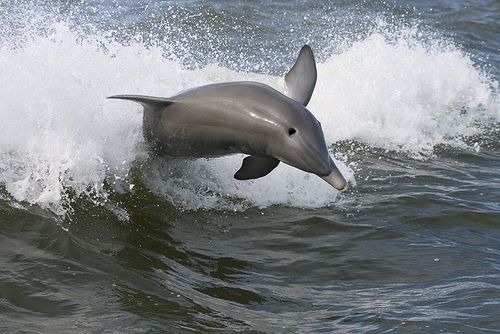
BBC NEWS– Wild dolphins in Australia are naturally learning to “walk” on water. Six dolphins have now been seen mastering the technique – furiously paddling their tail fluke, forcing their body out and across the water.

The dolphins seem to walk on water for fun, as it has no other obvious benefit, say scientists working for the Whale and Dolphin Conservation Society.

That makes the behaviour a rare example of animals “culturally transmitting” a playful rather than foraging behaviour. Only a few species are known to create their own culture – defined as the sharing or transmitting of specific novel behaviours or traditions between a community of animals.

The discovery was made by Whale and Dolphin Conservation Society (WDCS) scientist Dr Mike Bossley, who has spent 24 years studying dolphins living in the Port River in Adelaide, Australia.

In past years, Dr Bossley has witnessed two wild adult female dolphins, named Billie and Wave for research purposes, attempting to walk on water. Now four other dolphins, including young infants, have been recorded trying to learn the trick from the two adults, and have been seen practising, less successfully, in the river.

The behaviour, when a dolphin beats its tail fluke repeatedly, so it lifts its body vertically out of the water and then along the surface, is more commonly seen among captive dolphins trained to perform tricks.

Read full article on Dolphins Learning to Walk in the Wild.

Watch video of the phenomenon HERE.

Photo by Flickr User Pug Father

© COPYRIGHT BBC, 2010

BP Allegedly Stops Oil Leak in Gulf, Temporarily

GUARDIAN– The gush of oil from BP’s spewing well in the Gulf of Mexico was stopped for the first time in three months yesterday, raising hopes that it could be sealed off for good. The Obama administration immediately warned that a cap sealing off the well might only be a temporary fix.

“We’re encouraged by this development, but this isn’t over,” said Thad Allen, the US Coast Guard commander.

But for the first time in 87 days, it appeared last night that BP had control over the well. The company said it would have to monitor the cap holding back the oil in a series of pressure tests every six hours for the next 48 hours, before it could be certain the well would hold.

It also cautioned that the final solution remained a relief well, still some weeks away. “I am very excited that there’s no oil in the Gulf of Mexico,” Kent Wells, a senior vice-president for BP, said in a conference call. “But we just started the test and I don’t want to create a false sense of excitement.”

Read full article about BP Allegedly Having Stopped the Leak.

© COPYRIGHT THE GUARDIAN, 2010

Israeli Commandos Storm Aid Flotilla, Killing Ten

(Video Below)

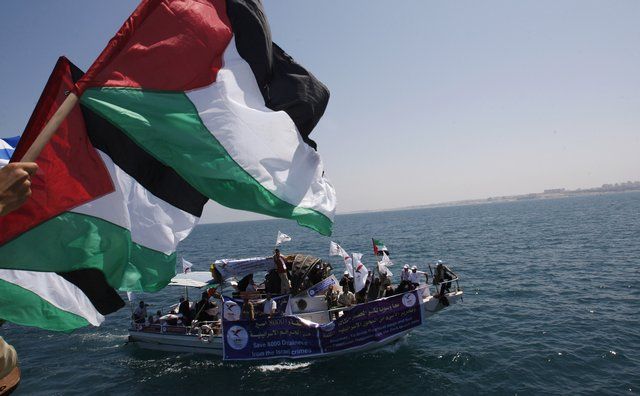
CBS– Israeli naval commandos stormed a flotilla of ships carrying aid and hundreds of pro-Palestinian activists to the blockaded Gaza Strip on Monday, killing nine passengers in a botched raid that provoked international outrage and a diplomatic crisis.

Dozens of activists and six Israeli soldiers were wounded in the bloody predawn confrontation in international waters. The violent takeover dealt yet another blow to Israel’s international image, already tarnished by war crimes accusations in Gaza and its 3-year-old blockade of the impoverished Palestinian territory.

In Turkey, which had partly sponsored the humanitarian mission, thousands of protesters condemned the raid. The Turkish prime minister described Israel’s pre-dawn commando assault as “state terrorism.”

 Prime Minister Benjamin Netanhayu canceled a much-anticipated meeting with President Barack Obama in Washington on Tuesday in a sign of just how gravely Israel viewed the uproar. In Canada, Netanyahu announced he was rushing home but said he had called the American president and agreed to meet again.

President Barack Obama voiced “deep regret” over the raid and “expressed the importance of learning all the facts and circumstances” surrounding the incident.

The U.N. Security Council held an emergency meeting Monday, while the Arab League planned to meet Tuesday in Cairo.

The activists were headed to Gaza to draw attention to the blockade, which Israel and Egypt imposed after the militant Hamas group seized the territory of 1.5 million Palestinians in 2007.

There were conflicting accounts of what happened early Monday, with activists claiming the Israelis opened fire without provocation and Israel insisting its forces fired in self defense.

Continue readng about the Aid Flotilla Being Attacked by Israeli Commandos.

© COPYRIGHT CBS, 2010