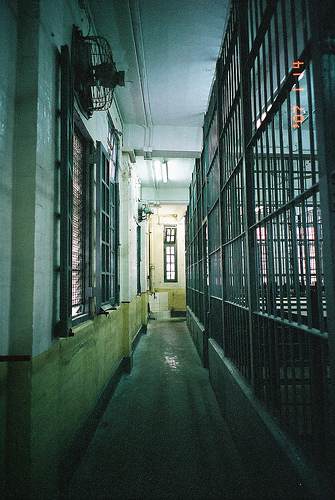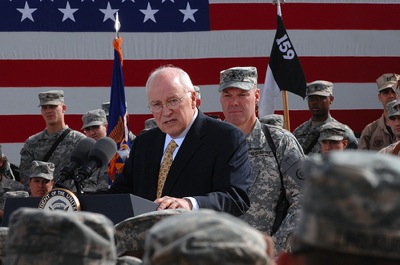
Obama Channels Cheney in Regards to Presidential Powers

WALL STREET JOURNAL– The Obama Administration this week released its predecessor’s post-9/11 legal memoranda in the name of “transparency,” producing another round of feel-good Bush criticism. Anyone interested in President Obama’s actual executive-power policies, however, should look at his position on warrantless wiretapping. Dick Cheney must be smiling.

In a federal lawsuit, the Obama legal team is arguing that judges lack the authority to enforce their own rulings in classified matters of national security. The standoff concerns the Oregon chapter of the Al-Haramain Islamic Foundation, a Saudi Arabian charity that was shut down in 2004 on evidence that it was financing al Qaeda. Al-Haramain sued the Bush Administration in 2005, claiming it had been illegally wiretapped.

At the heart of Al-Haramain’s case is a classified document that it says proves that the alleged eavesdropping was not authorized under the Foreign Intelligence Surveillance Act, or FISA. That record was inadvertently disclosed after Al-Haramain was designated as a terrorist organization; the Bush Administration declared such documents state secrets after their existence became known.

In July, the Ninth Circuit Court of Appeals upheld the President’s right to do so, which should have ended the matter. But the San Francisco panel also returned the case to the presiding district court judge, Vaughn Walker, ordering him to decide if FISA pre-empts the state secrets privilege. If he does, Al-Haramain would be allowed to use the document to establish the standing to litigate.

The Obama Justice Department has adopted a legal stance identical to, if not more aggressive than, the Bush version. It argues that the court-forced disclosure of the surveillance programs would cause “exceptional harm to national security” by exposing intelligence sources and methods. Last Friday the Ninth Circuit denied the latest emergency motion to dismiss, again kicking matters back to Judge Walker.

Continue reading about Obama Channeling Cheney.

© WALL STREET JOURNAL 2009

Photo by flickr user US Army
Despite Rhetoric, Obama Continues Bush Policy on Detainees

RAW STORY– In a stunning departure from his rhetoric on Guantánamo Bay prison, President Barack Obama signaled Friday he will continue Bush Administration policy with regard to detainees held at a US airbase in Afghanistan, saying they have no right to challenge their detentions in US courts — and denying them legal status altogether.

“This Court’s Order of January 22, 2009 invited the Government to inform the Court by February 20, 2009, whether it intends to refine its position on whether the Court has jurisdiction over habeas petitions filed by detainees held at the United States military base in Bagram, Afghanistan,” Acting Assistant Obama Attorney General Michael Hertz wrote in a brief filed Friday. “Having considered the matter, the Government adheres to its previously articulated position.”

The move seems to be a reversal from Obama’s much-trumpeted announcement to close the US prison at Guantánamo Bay, Cuba in January, in which he promised to return the United States to the “moral high ground” and “restore the standards of due process”

The US Supreme Court previously ruled that it was unconstitutional to hold detainees at Guantánamo Bay without giving them access to US courts. Following that ruling, more than 200 detainees filed suit in the District Court for the District of Columbia.

The Obama Administration announcement would appear to fly in the face of that ruling. The Court, while often supportive of previous Bush Administration terror policies, has strongly resisted efforts to curb its role in the legal aspect of US detention systems.

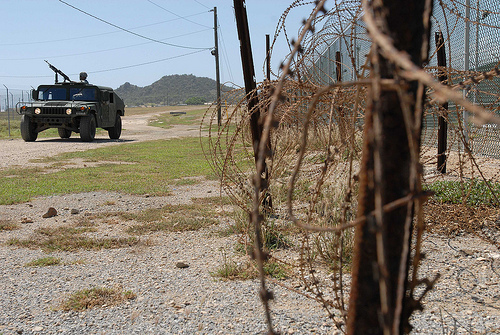
Bagram prison, where approximately 600 detainees are being held without charge or even term limits on their stay, is located about 30 miles north of Kabul in a converted Soviet Union base. The US is mulling a $60 million plan to expand the facility, which would double its current size.

Continue reading about Obama Continuing Bush’s Policy on Detainees.

Photo by US Army Flickr

© RAW STORY, 2009

Obama Justice Department Defends Rumsfeld in Torture Case

RAW STORY– In a brief filed Thursday evening, Obama Justice Department lawyers extended many of the same arguments made by Bush attorneys — that top government officials have qualified immunity from prosecution and that Guantanamo detainees do not have constitutional rights to due process.

The Department of Justice has asserted that a Supreme Court ruling reaffirming the rights of Guantanamo detainees to habeas corpus does not apply to plaintiffs in a case against former Secretary of Defense Donald Rumsfeld because the plaintiffs were released from prison four years prior to the Supreme Court’s decision.

“It is fair to say that the current brief that is filed by the new administration supports a lot of the arguments that were made by the previous administration,” said Kate Toomey, an attorney with Baach Robinson & Lewis who is representing the former detainees in an interview with RAW STORY. “They continue to assert that torture was in the scope of employment and could be reasonably expected. They continue to assert that these [top officials] be entitled to immunity. They also continue to argue that detainees at Guantanamo don’t have constitutional rights.”

The brief was filed as part of the Rasul v. Rumsfeld lawsuit of four former detainees, who include the “Tipton Three,” and are seeking damages for their detention and reported torture at Guantanamo Bay against Rumsfeld, the Chairmen of the Joint Chief of Staffs and other top military officials. The suit charges them with violations of the Fifth and Eighth Amendments, the Alien Tort Statute, the Geneva Conventions and the Religious Freedom Restoration Act. The plaintiffs are individually each seeking $10 million in damages.

The men were held for more than two years at Guantanamo where they were reportedly subjected to regular beatings, death threats, sleep deprivation, extreme temperatures, forced nakedness, interrogations at gun point and religious and racial harassment. They were never charged with any crime. The men were released in March 2004 and returned to their home country of Britain.

The plaintiffs are also being represented by the Center for Constitutional Rights, which has a full background of the case, including all court documents here.

Read full story about Obama Defending Rumsfeld in Torture Case.

© RAW STORY 2009

Obama Preserves Rendition as Counter-terrorism Tool

LA TIMES– The CIA’s secret prisons are being shuttered. Harsh interrogation techniques are off-limits. And Guantanamo Bay will eventually go back to being a wind-swept naval base on the southeastern corner of Cuba.

But even while dismantling these programs, President Obama left intact an equally controversial counter-terrorism tool.

Under executive orders issued by Obama recently, the CIA still has authority to carry out what are known as renditions, secret abductions and transfers of prisoners to countries that cooperate with the United States.

Current and former U.S. intelligence officials said that the rendition program might be poised to play an expanded role going forward because it was the main remaining mechanism — aside from Predator missile strikes — for taking suspected terrorists off the street.

The rendition program became a source of embarrassment for the CIA, and a target of international scorn, as details emerged in recent years of botched captures, mistaken identities and allegations that prisoners were turned over to countries where they were tortured.

The European Parliament condemned renditions as “an illegal instrument used by the United States.” Prisoners swept up in the program have sued the CIA as well as a Boeing Co. subsidiary accused of working with the agency on dozens of rendition flights.

But the Obama administration appears to have determined that the rendition program was one component of the Bush administration’s war on terrorism that it could not afford to discard.

The decision underscores the fact that the battle with Al Qaeda and other terrorist groups is far from over and that even if the United States is shutting down the prisons, it is not done taking prisoners.

“Obviously you need to preserve some tools — you still have to go after the bad guys,” said an Obama administration official, speaking on condition of anonymity when discussing the legal reasoning. “The legal advisors working on this looked at rendition. It is controversial in some circles and kicked up a big storm in Europe. But if done within certain parameters, it is an acceptable practice.”

Continue reading about Obama Preserving Rendition.

Written by Greg Miller, [email protected]

Photo by flickr user Mocvdleung

© LA TIMES, 2009

How to Get Our Democracy Back

NATION– We should remember what it felt like one year ago, as the ability to recall it emotionally will pass and it is an emotional memory as much as anything else. It was a moment rare in a democracy’s history. The feeling was palpable–to supporters and opponents alike–that something important had happened. America had elected, the young candidate promised, a transformational president. And wrapped in a campaign that had produced the biggest influx of new voters and small-dollar contributions in a generation, the claim seemed credible, almost intoxicating, and just in time.

Yet a year into the presidency of Barack Obama, it is already clear that this administration is an opportunity missed. Not because it is too conservative. Not because it is too liberal. But because it is too conventional. Obama has given up the rhetoric of his early campaign–a campaign that promised to “challenge the broken system in Washington” and to “fundamentally change the way Washington works.” Indeed, “fundamental change” is no longer even a hint.

Instead, we are now seeing the consequences of a decision made at the most vulnerable point of Obama’s campaign–just when it seemed that he might really have beaten the party’s presumed nominee. For at that moment, Obama handed the architecture of his new administration over to a team that thought what America needed most was another Bill Clinton. A team chosen by the brother of one of DC’s most powerful lobbyists, and a White House headed by the quintessential DC politician. A team that could envision nothing more than the ordinary politics of Washington–the kind of politics Obama had called “small.” A team whose imagination–politically–is tiny.

These tiny minds–brilliant though they may be in the conventional game of DC–have given up what distinguished Obama’s extraordinary campaign. Not the promise of healthcare reform or global warming legislation–Hillary Clinton had embraced both of those ideas, and every other substantive proposal that Obama advanced. Instead, the passion that Obama inspired grew from the recognition that something fundamental had gone wrong in the way our government functions, and his commitment to reform it.

For Obama once spoke for the anger that has now boiled over in even the blue state Massachusetts–that our government is corrupt; that fundamental change is needed. As he told us, both parties had allowed “lobbyists and campaign contributions to rig the system.” And “unless we’re willing to challenge [that] broken system…nothing else is going to change.” “The reason” Obama said he was “running for president [was] to challenge that system.” For “if we’re not willing to take up that fight, then real change–change that will make a lasting difference in the lives of ordinary Americans–will keep getting blocked by the defenders of the status quo.”

This administration has not “taken up that fight.” Instead, it has stepped down from the high ground the president occupied on January 20, 2009, and played a political game no different from the one George W. Bush played, or Bill Clinton before him. Obama has accepted the power of the “defenders of the status quo” and simply negotiated with them. “Audacity” fits nothing on the list of last year’s activity, save the suggestion that this is the administration the candidate had promised.

Read more about How to Get Our Democracy Back.

Editors’ Note: We encourage readers moved by this essay to sign the Change Congress petition, a drive to enact solutions proposed in this article. Click here to sign. A video commentary by Professor Lessig can be viewed here.

© THE NATION 2010