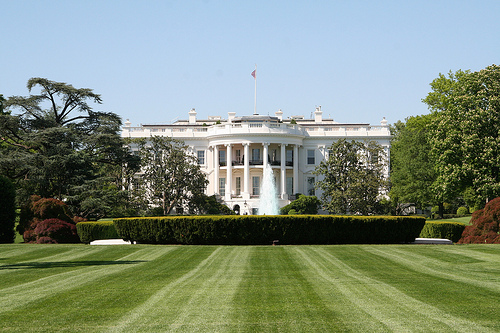
POLITICO– Caught between their boss’s anti-lobbyist rhetoric and the reality of
governing, President Barack Obama’s aides often steer meetings with
lobbyists to a complex just off the White House grounds – and several of
the lobbyists involved say they believe the choice of venue is no
accident.
It allows the Obama administration to keep these lobbyist meetings
shielded from public view — and out of Secret Service logs collected on
visitors to the White House and later released to the public.
“They’re doing it on the side. It’s better than nothing,” said
immigration reform lobbyist Tamar Jacoby, who has attended meetings at
the nearby Jackson Place complex and believes the undisclosed gatherings
are better than none.
The White House scoffs at the notion of an ulterior motive for
scheduling meetings in what are, after all, meeting rooms. But at least
four lobbyists who’ve been to the conference rooms just off Lafayette
Square tell POLITICO they had the distinct impression they were being
shunted off to Jackson Place – and off the books – so their visits
wouldn’t later be made public.
Obama’s administration has touted its release of White House visitors
logs as a breakthrough in transparency, as the first White House team
ever to reveal the comings and goings around the West Wing and the Old
Executive Office Building.
The Jackson Place townhouses are a different story.
There are no records of meetings at the row houses just off Lafayette
Square that house the White House Conference Center and the Council on
Environmental Quality, home to two of the busiest meeting spaces. The
White House can’t say who attended meetings there, or how often. The
Secret Service doesn’t log in visitors or require a background check the
way it does at the main gates of the White House.
On Tuesday, President Obama addressed the protests in Iran and
across the Middle East at a news conference in Washington, D.C.
Comparing the Iranian government’s crackdown on protesters with
Egypt’s, Obama appeared to suggest the U.S.-backed Mubarak regime did
not also try to violently repress the recent uprising.
President Obama:
“What has been true in Egypt should be true in Iran, which is, is that
people should be able to express their opinions and their grievances
and seek a more responsive government. What’s been different is the
Iranian government’s response, which is to shoot people and beat people
and arrest people. And my hope and expectation is, is that we’re going
to continue to see the people of Iran have the courage to be able to
express their yearning for greater freedoms and a more representative
government.”
Obama also defended his
administration’s handling of the Egyptian uprising, claiming he wanted
to avoid the appearance of meddling in pushing for a transition. But
Obama refused to acknowledge that two top officials—Secretary of State
Hillary Clinton and special envoy Frank Wisner—voiced support for
Mubarak’s regime.
President Obama:
“What we didn’t do was pretend that we could dictate the outcome in
Egypt, because we can’t, so we were very mindful that it was important
for this to remain an Egyptian event, that the United States did not
become the issue, but that we sent out a very clear message that we
believed in an orderly transition, a meaningful transition, and a
transition that needed to happen not later, but sooner, and we were
consistent on that message throughout.”
Democracy Now! also reports that as the Mideast “rolling revolution” grows, the U.S. dounces the Iranian crackdown, while remaining silent on the brutal repression and death of protestors in Bahrain, a key ally.
On Tuesday, President Obama addressed the protests in Iran and
across the Middle East at a news conference in Washington, D.C.
Comparing the Iranian government’s crackdown on protesters with
Egypt’s, Obama appeared to suggest the U.S.-backed Mubarak regime did
not also try to violently repress the recent uprising.
President Obama:
“What has been true in Egypt should be true in Iran, which is, is that
people should be able to express their opinions and their grievances
and seek a more responsive government. What’s been different is the
Iranian government’s response, which is to shoot people and beat people
and arrest people. And my hope and expectation is, is that we’re going
to continue to see the people of Iran have the courage to be able to
express their yearning for greater freedoms and a more representative
government.”
Obama also defended his
administration’s handling of the Egyptian uprising, claiming he wanted
to avoid the appearance of meddling in pushing for a transition. But
Obama refused to acknowledge that two top officials—Secretary of State
Hillary Clinton and special envoy Frank Wisner—voiced support for
Mubarak’s regime.
President Obama:
“What we didn’t do was pretend that we could dictate the outcome in
Egypt, because we can’t, so we were very mindful that it was important
for this to remain an Egyptian event, that the United States did not
become the issue, but that we sent out a very clear message that we
believed in an orderly transition, a meaningful transition, and a
transition that needed to happen not later, but sooner, and we were
consistent on that message throughout.”
Democracy Now! also reports that as the Mideast “rolling revolution” grows, the U.S. dounces the Iranian crackdown, while remaining silent on the brutal repression and death of protestors in Bahrain, a key ally.
GLOBAL RESEARCH– Even the Washington Post
describes the recent FCC approval of a presidential alert system like something out of Orwell’s 1984. Obama may soon appear on your television or
call your cell phone to warn you about the next specious al-Qaeda
underwear bombing event.
Commissioners voted last week to
require television and radio stations, cable systems and satellite TV
providers to participate in a test that would have them receive and
transmit a live code that includes an alert message issued by the
president. No date has been set for the test, according to the Post.
Once again, the government has imposed an unreasonable and absurd mandate on business and the American people.
“The Federal Communications
Commission today took action to help pave the way for the first-ever
Presidential alert to be aired across the United States on the Nation’s
Emergency Alert System (EAS),” the FCC announced on February 3 in a press release.
“The national test will help determine the reliability of the EAS
system and its effectiveness in notifying the public of emergencies and
potential danger nationwide and regionally.”
As Next Generation EAS systems
become operational over the next few years, they will complement other
public alert and warning systems now being developed, including FEMA’s
Integrated Public Alert and Warning System (IPAWS) and the Commercial
Mobile Alert System that will enable consumers to receive alerts through
a variety of multi-media platforms on their smart-phones, blackberries
and other mobile broadband devices.
If implemented, the president
will be able to commandeer your smart phone any time he wants and for
any reason the government deems necessary.
In November, communications company Alcatel-Lucent announced that it’s creating a Broadcast Message Center
that will allow government agencies to send cell phone users specific
information in the event of a local, state or national emergency,
including those now ubiquitous government warnings about fantastic
terror plots that invariably fizzle out or are run by FBI informants and agents provocateurs. It seems not a week or two passes that some gullible Muslim is duped by the agency into a fantastic terror plot (for instance, blowing up Christmas trees).
The Broadcast Message Center
is designed to force mobile phone manufacturers to adopt the Federal
Communication Commission’s Commercial Mobile Alert System. Under the new
system, all phones would receive emergency alerts directly from
government bureaucrats.
Former DHS boss Tom Ridge has admitted
that the government exploits terror alerts for political gain. Ridge
said he “was pushed to raise the security alert on the eve of President
Bush’s re-election, something he saw as politically motivated and worth
resigning over.” A specific al-Qaeda terror alert hyped up prior to the
election was downgraded by the DHS after Bush beat fellow bonesman Kerry
in the election.
Obama’s warnings about a
supposed al-Qaeda attack on targets in Europe was exaggerated for
political purposes, Pakistani diplomat Shamsul Hasan
said in October. “I will not deny the fact that there may be internal
political dynamics, including the forthcoming midterm American
elections. If the Americans have definite information about terrorists
and al-Qaida people, we should be provided [with] that and we could go
after them ourselves,” Hasan said.
No terror event occurred. “It was nothing specific, nothing very new,” said Swedish Justice Minister Beatrice Ask
after the official warning. “We agree that there is no indication of
concrete targets, concrete dates and concrete terror groups,” added
German Interior Minister Thomas de Maiziere.
In addition to your cell phone,
the government wants to take control of your internet broadband in the
event another phony terror attack threatens the homeland.
Lisa Fowlkes,
deputy chief of the Public Safety and Homeland Security Bureau of the
FCC, told FederalNewsRadio on Monday that the FCC is looking at how
wireless broadband could also enhance the EAS as part of a
recommendation that was in the FCC’s National Broadband Plan from last
year. The idea is to hijack broadband and the internet for emergency
alerting propaganda with the “Commercial Mobile Alert System (CMAS) being developed by FEMA and the wireless industry,” according to Fowlkes.
The system would break into your
computer or wireless device and broadcast presidential propaganda
announcements, FEMA reports, so-called “Imminent Threat Alerts,” and
AMBER Alerts.
Government has devised other creative ways to disseminate propaganda. For instance, California introduced a bill
last year to commission a study on emerging electronic license plate
technology and examine ways that it could introduce new ad revenue
streams. In addition to ads, the technology would flash Amber Alerts and
other information.
Earlier
this month, DHS unveiled a new terror alert system that will hijack
social networking sites as one way of informing people of terrorist
threat updates. “The new, two-tiered system will provide alerts that are
more specific to the threat and even recommend certain actions or
suggest that people look for specific suspicious behavior, she said.
They also may be limited to a particular audience — such as law
enforcement — rather than broadcast to the general public, and also will
have a specified end date,” reported Information Week Government.
In December, Department of Homeland Security Secretary Janet Napolitano announced
the expansion of the Department’s national “If You See Something, Say
Something” campaign to hundreds of Walmart stores across the country —
launching a new partnership between DHS and Walmart to help the American
public play an active role in informing on each other. Thousands of
Wamart stores will have telescreens pumping out government propaganda.
FEMA is also working on a new
system that would send emergency alerts as text messages to wireless
phone users. The system is still about two years away from full
implementation, according to the agency.
WASHINGTON POST– Beneath its commitment to soft-spoken diplomacy and beyond the combat
zones of Afghanistan and Iraq, the Obama administration has
significantly expanded a largely secret U.S. war against al-Qaeda and
other radical groups, according to senior military and administration
officials.
Special Operations forces have grown both in number and budget, and are
deployed in 75 countries, compared with about 60 at the beginning of
last year. In addition to units that have spent years in the Philippines
and Colombia, teams are operating in Yemen and elsewhere in the Middle
East, Africa and Central Asia.
Commanders are developing plans for increasing the use of such forces in
Somalia, where a Special Operations raid last year killed the alleged
head of al-Qaeda in East Africa. Plans exist for preemptive or
retaliatory strikes in numerous places around the world, meant to be put
into action when a plot has been identified, or after an attack linked
to a specific group.
The surge in Special Operations deployments, along with intensified CIA
drone attacks in western Pakistan, is the other side of the national
security doctrine of global engagement and domestic values President Obama released last week.
One advantage of using “secret” forces for such missions is that they
rarely discuss their operations in public. For a Democratic president
such as Obama, who is criticized from either side of the political
spectrum for too much or too little aggression, the unacknowledged CIA
drone attacks in Pakistan, along with unilateral U.S. raids in Somalia
and joint operations in Yemen, provide politically useful tools.
Obama, one senior military official said, has allowed “things that the previous administration did not.”



 POLITICO– Caught between their boss’s anti-lobbyist rhetoric and the reality of
governing, President Barack Obama’s aides often steer meetings with
lobbyists to a complex just off the White House grounds – and several of
the lobbyists involved say they believe the choice of venue is no
accident.
POLITICO– Caught between their boss’s anti-lobbyist rhetoric and the reality of
governing, President Barack Obama’s aides often steer meetings with
lobbyists to a complex just off the White House grounds – and several of
the lobbyists involved say they believe the choice of venue is no
accident.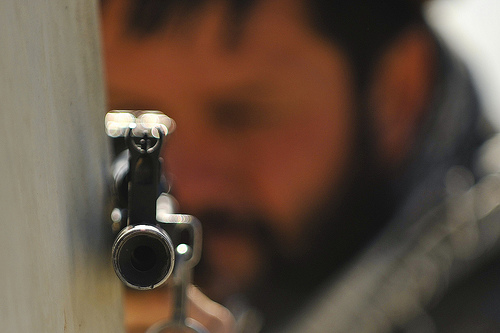 WASHINGTON POST