JUAN GONZALEZ: Japanese authorities have begun
using military helicopters and water cannon to dump water on the
crippled Fukushima Daiichi nuclear power station in an attempt to help
cool the plant’s reactors and spent fuel rods. But fears of a full-scale
nuclear meltdown are increasing as the initial attempts appear to have
failed. Water dropped from the helicopters blew off course, and the
water from the cannon has failed to reach its target.
There
appears to be growing division between Japan and the United States on
the severity of the nuclear crisis. On Wednesday, the head of the U.S.
Nuclear Regulatory Commission, Gregory Jaczko, warned that water in the
spent fuel pool at one of the plant’s six nuclear reactors had boiled
away entirely, leaving extremely high radiation levels. Japan disputed
his account.
Meanwhile, the United States has urged all Americans
living within 50 miles of the plant to evacuate. So far Japan has only
issued evacuation orders for residents living within 12 miles of the
plant. On Wednesday, State Department spokesperson Mark Toner explained
the U.S. response.
MARK TONER: We’ve
been continuing to assess the situation, obviously. And consistent,
obviously, with the guidelines of the National—or the Nuclear Regulatory
Commission, we’re now telling American citizens who live within 50
miles or 80 kilometers of the Fukushima nuclear power plant to evacuate
the area and to take shelters indoors if safe evacuation is not
practical. Again, this is—this is based on our most current assessment.
We’ve got nuclear experts on the ground. And it’s—frankly, it’s what we
would advise—it’s based on what we would advise U.S. citizens here to do
in a similar situation.
JUAN GONZALEZ:
Japan is facing an unprecedented triple crisis caused by the
earthquake, tsunami and the partial nuclear meltdown. The official death
toll has now risen to above 5,000, while 9,400 people remain missing.
Fears of radioactivity have severely hampered relief efforts in parts of
northern Japan, which was hit with a snow storm on Wednesday.
Some
850,000 households are without power, and 1.5 million homes with no
running water. Food and gas supplies have been nearly exhausted in the
ravaged northern part of the country. A 21-year-old Japanese mother
named Ayumi Yamazaki says she has had trouble finding enough food to
feed her child.
AYUMI YAMAZAKI:
[translated] We get one bowl of soup or one piece of bread to share
among three people, and get a few snacks. We rarely get white rice. So
I’m a little concerned about my daughter not getting enough nutrition.
But it’s better than not eating at all.
JUAN GONZALEZ:
We will go to Japan soon for a report on the recovery efforts, but
first we discuss the latest news from the crippled Japanese nuclear
plant.
Joining me here in New York is Karl Grossman. He’s an
investigative journalist and professor of journalism at SUNY College at
Old Westbury. He’s author of several books on the nuclear industry.
And
with us in Washington, D.C., is Paul Gunter. He’s a reactor oversight
project director at the nuclear watchdog group Beyond Nuclear. He’s also
a co-founder of the Clamshell Alliance, an anti-nuclear group.
Paul,
I want to begin with you. The latest reports that we got overnight and
early this morning about the situation in the reactors of Fukushima,
could you give us your sense of what’s happening there?
PAUL GUNTER:
Well, obviously, right now, there is a lot of contradictory
information. I think that what’s most important to understand is that
among these six units at Fukushima Daiichi, Units 4, 5 and 6, the fuel
in the reactor core was taken out of the reactor vessel, taken out of
containment, and placed in these rooftop spent fuel pools. So all of the
radioactive inventory was moved. We’re very concerned about this very
large volume of radioactive material that is now in a conflict of
information in its state of, you know, no water or water. But clearly,
right now, there is a serious danger of a full core meltdown outside of
containment at Unit 4. This could occur at Unit 5 and 6, and we still
have the crippled reactors at 1, 2 and 3.
JUAN GONZALEZ:
And the crippled reactor 3, which has also been releasing, pretty
regularly now, radioactive steam, there are reports that there has been a
breach in the containment vessel there. And that, of course, is the
only reactor that had the more toxic mixed oxide fuel that was brought
into it in the last couple of years as fuel. Your sense of reactor 3?
PAUL GUNTER:
Well, Unit 3 is burning what they call plutonium oxide. They like to
call it MOX as an acronym rather than POX, but in fact it’s plutonium
oxide. This fuel has a lower melting point, for one, and it’s just
loaded with plutonium, which is highly toxic at micro levels.
The
containment, which is a Mark I General Electric boiling water reactor—we
have 23 of these reactors in the United States, dead ringers for
Fukushima Daiichi Unit 1 through 6—it’s right now in this state of—it’s
ruptured. Unit 2 has also compromised its containment. These have all
been documented. So, you know, the walls of defense are falling, with
the melting of the cores, the collapsing of the—we’re expecting the
collapsing of the vessels. And then, with these damaged containments,
these are all open windows to the atmosphere.
JUAN GONZALEZ:
Karl Grossman, you have been following now for decades the claims of
the industry, the politicians, about nuclear energy, both in the United
States and around the world. Your assessment of what has happened here
and what it will mean in terms of nuclear power in the future?
KARL GROSSMAN:
What has happened here is an enormous nuclear power tragedy, and we’re
on the cusp, I fear, of an even more horrific tragedy, with a loss of
cool down accident—and we have multiple loss of cool down accidents
underway—and, importantly, breach of containment. And as Paul said,
that’s quite possible now. Just the most enormous disaster, except for a
loss of water accident in a spent fuel pool, where you have tons upon
tons of nuclear poisons—no containment, except for some corrugated steel
ceiling. That stuff gets out in a loss of water accident, and it would
get out explosively, because of the fuel rods being made of zirconium.
And I could explain that. It will just burst into the environment,
become airborne, affect not only Japan but much of the world.
JUAN GONZALEZ:
And Karl, in the reporting that you’ve done in the past on the battles
over the siting of nuclear plants in the United States, because,
obviously, all of the reports are saying, “Well, that’s all happening in
Japan; here in the United States, we’re in a much better situation with
our plants.” But one of the things that you uncovered was an assessment
that the government did back in the 1980s of the potential—the
potential deaths and injuries that might occur from a reactor accident
and a breach of containment in the United States. Could you talk about
that memo?
KARL GROSSMAN: Yeah. They have known the consequences all along. This is a report—it’s
called “Calculation of Reactor Accident Consequences 2″—done by the
Nuclear Regulatory Commission, not Greenpeace, and it projects peak
early fatalities, peak injuries, peak cancer deaths, scale cost in
billions in terms of property damage, and a large hunk of the earth
being rendered uninhabitable for millennia. And just, for example, for
the Indian Point 3 nuclear plant, which is about 35 miles from where we
sit now in New York, 50,000 peak early fatalities; 167,000 peak early
injuries; cancer deaths, 14,000; scale cost of billions, they say $314
billion—in 1980s dollars, we’re talking about a trillion.
As to
the likelihood of a severe core melt accident, in 1985 the NRC
acknowledged that, over a 20-year period, the likelihood of a severe
core melt accident to be basically 50/50 among the 100 nuclear power
plants—there’s 104 now—in the United States. They’ve known all along
here in this country that disaster could come, and there’s a good
likelihood of it coming, and they’ve known the consequences.
JUAN GONZALEZ: You’re saying that the NRC itself estimated a 50/50 chance of a meltdown in our plants here within 20 years?
KARL GROSSMAN:
Over a 20-year period. That was formal testimony provided to a watchdog
committee in Congress chaired by Senator Edward Markey of
Massachusetts, when he asked the question, “What does the NRC and its
staff believe the likelihood to be of a severe core meltdown?” So, you
know, when you hear these lines about, “Oh, the chances of a severe core
meltdown, infinitesimal,” and if there is, like you’re hearing these
reports out of Japan, an accident, “Oh, just some minor effects among
the population”—not at all.
You go to the documents. And many of them were, well, secret for years. In my book—I did a book in 1980, Cover Up: What You Are Not Supposed to Know about Nuclear Power—there’s
a line in a Atomic Energy Commission report, “WASH-740-Update”: “The
possible size of the area of such a disaster”—this is a meltdown with
loss of containment—”might be equal to that of the State of
Pennsylvania”—in other words, covering the whole state of what would be
the state of Pennsylvania, which almost occurred with the Three Mile
Island accident. We’re talking about huge disasters here. And with a
loss of water accident in a spent fuel pool, because you’ve got much
more nuclear garbage—and again, no containment—it would be even worse.
And
just let me mention one other thing. Everybody should, when you hear
about these hydrogen explosions, understand that the fuel rods are
composed of a substance called zircaloy. It’s based on something called
zirconium. And way back in the late ’40s and ’50s, they were looking for
something to build these—not control rods—fuel rods with, and they
decided to use zirconium, because it allowed the neutrons to move from
fuel rod to fuel rod and keep the chain reaction going. Problem was
zirconium, the other major industrial use is the speck on a flashbulb.
Zirconium is explosive; at 2,000 degrees Fahrenheit, it explodes. Before
that, it emits hydrogen gases, which have exploded in several of these
plants. There’s, in a nuclear plant itself—this is in my book—20 tons of
zirconium. At spent fuel pool, you’re talking about, because there’s
all these old fuel rods, hundreds of tons. That stuff, again, as things
get hot, explodes.
JUAN GONZALEZ: Well, I also
wanted to talk about the history of the type of nuclear reactors. There
have been warnings about the design going back for decades. The
organization Nuclear Information and Resource Service recently released
and posted online three memos [11/11/71, 9/20/72, 9/25/72]
from the U.S. Atomic Energy Commission on the GE Mark I reactor design.
The memos show that the Commission knew of serious problems with the
design of these reactors as early as the 1970s. Diane D’Arrigo of the
Nuclear Information and Resource Service spoke with us last evening.
DIANE D’ARRIGO:
Back in 1971, Stephen Hanauer of the Atomic Energy Commission did a
memo to the Atomic Energy Commission outlining serious problems with the
design of the kind of reactors that are operating, and are failing and
melting, in Japan right now. In September of 1971, he did a memo that
recommended that the United States stop licensing reactors using this
pressure suppression system. But his recommendation was rejected by the
upper-level Atomic Energy Commission safety officials. The top safety
official, Joseph Hendrie, he agreed with the recommendation, but he
rejected it, saying that it could well mean the end of nuclear power.
Now, the problems that were raised in those earlier memos are what led
to the disaster here in Japan. And I wanted to point out that the United
States has, since those memos were written and then ignored or
rejected, licensed and has operating 23 of this type of nuclear reactor.
JUAN GONZALEZ:
I also wanted to—that was Diane D’Arrigo of the Nuclear Information and
Resource Service, who spoke with us last night. Paul Gunter, I’d like
to ask you about the—the news has been worse each day in the efforts to
try to get control of these crippled reactors. But if the government is
able now to finally bring electricity back, as they’ve been saying
they’ve been trying to string a new line, and to begin bringing water
back into these reactors and into the spent fuel pools, do you envision
any problems if they’re able—continuing problems, if they’re able to get
the water back on?
PAUL GUNTER: Well, let’s
first of all realize that what’s been demonstrated at this catastrophe
is that nuclear power is going to be more of a liability than it is an
asset during natural disaster or national crisis. We sincerely hope that
the Tokyo Electric Power Company can restore power. But these six units
are history. The best we can do right now is see them buried under
concrete, and hopefully that can contain it. That’s the best scenario
right now.
But clearly, if you want to actually have civil
defense, the real issue here is to prevent this from happening. And we
believe that means to be—mean you promptly shut down these most
dangerous reactor designs all over the world, and then we begin the
rapid phase-out of this inherently dangerous technology and phase in a
21st century energy policy of renewable energy and energy efficiency.
JUAN GONZALEZ:
Well, Paul Gunter of the nuclear watchdog group Beyond Nuclear, I want
to thank you for being with us. Karl Grossman, a professor at SUNY-Old
Westbury, thank you, and a continuing investigative journalist on the
issue of nuclear power. I want to thank both of you for being with us.
We’ll be back in a moment with reports on what is going on in Japan
right now.
 The original content of this program is licensed under a Creative Commons Attribution-Noncommercial-No Derivative Works 3.0 United States License. Please attribute legal copies of this work to
 democracynow.org
.
Some of the work(s) that this program incorporates, however, may be
separately licensed. For further information or additional permissions,
contact us.



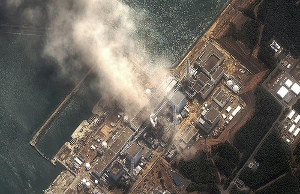 AFP– The amount of caesium-137 released since the three reactors were crippled by the March 11 quake and tsunami has been estimated at 15,000 tera becquerels, the Tokyo Shimbun reported, quoting a government calculation.
 MEDIA ROOTS- Every time I read an article about TEPCO, the Japanese government and their handling of the Fukushima nuclear plant, the situation appears progressively more bleak. For months, Japanese officials refused to admit that any meltdowns were occurring. Finally, they admitted that
  THE GUARDIAN