Over Half of Americans Do Not Trust the Press

March 6. 2008

THINK PROGRESS– The Harris results reflect the findings of a Harvard University study conducted last year, which found “nearly two-thirds of Americans do not trust campaign coverage by the news media.” A few other recent surveys offer some explanation for the public’s distrust:

– Two thirds of Americans – 67% – believe traditional journalism is out of touch with what Americans want from their news.

– The harshest indictments of the press come from the growing segment that relies on the internet as its main source for news. The internet news audience is particularly likely to criticize news organizations for their lack of empathy, their failure to “stand up for America,” and political bias.

– Democrats, Republicans and independents have decreased confidence in the accuracy of media reports on the war.

These days, the slogan “most trusted name in news” doesn’t mean as much as it once did.


© COPYRIGHT THINK PROGRESS, 2008

Posted in Uncategorized | 1 Reply

More Americans Turning to Web for News

REUTERS– Nearly 70 percent of Americans believe traditional journalism is out of touch, and nearly half are turning to the Internet to get their news, according to a new survey. 

While most people think journalism is important to the quality of life, 64 percent are dissatisfied with the quality of journalism in their communities, a We Media/Zogby Interactive online poll showed.

“That’s a really encouraging reflection of people who care A) about journalism and B) understand that it makes a difference to their lives,” said Andrew Nachison, of iFOCOS, a Virginia-based think tank which organized a forum in Miami where the findings were presented.

Nearly half of the 1,979 people who responded to the survey said their primary source of news and information is the Internet, up from 40 percent just a year ago. Less than one third use television to get their news, while 11 percent turn to radio and 10 percent to newspapers.

More than half of those who grew up with the Internet, those 18 to 29, get most of their news and information online, compared to 35 percent of people 65 and older. Older adults are the only group that favors a primary news source other than the Internet, with 38 percent selecting television.

Howard Finberg, of the Poynter Institute in St. Petersburg, Florida, said the public often doesn’t understand that the sources they are accessing online such as Google News and Yahoo News pull stories from newspapers, television, wire services and other media sources.

“It’s delivered in a non-traditional form, that doesn’t necessarily mean there isn’t traditional journalism underneath it,” he explained.

But Finberg said the study does support the belief among many large media companies that focusing on local issues is important to their journalistic and economic survival.

© COPYRIGHT REUTERS, 2008

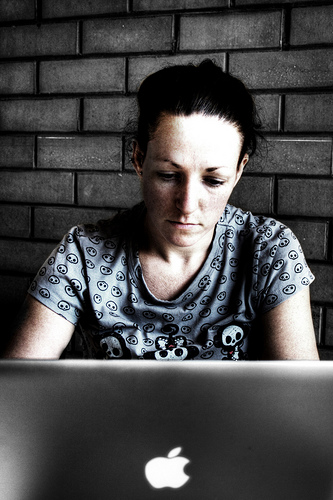
Photo by flickr user Adam Selwood

MR Original – Emergence of True Journalism

MEDIA ROOTS- Earlier this year I had the opportunity to interview Peter Phillips, former head of Project Censored, undoubtedly one of the most crucial independent media projects in the country. Project Censored exposes stories that are suppressed by the mainstream media and publishes an annual book showcasing the year’s top 25 most censored stories. The insights he shared caused me to re-evaluate just how important the media has become in shaping our perceived reality.

Many people think that if they haven’t seen an issue addressed on television or by mainstream newspapers that it either doesn’t exist or must not be important. But there are many reasons why significant stories that affect millions of people don’t hit the airwaves.

Since the corporate takeover of the media, we have been seeing more and more consolidation of control in regards to filtering what news we see and do not see. The more one investigates who is behind the scenes, the more one uncovers vast conflicts of interest between the corporate elites’ business goals and the media’s initial purpose of getting “real” information to the masses.

Ideally, the role of the media in a democracy is to keep the population in the know.  If vital issues are not addressed or evaluated rigorously by mainstream press, and if 85% of Americans still get their news strictly from television, an enormous cluster of people is adrift in a sea of unrealized ignorance. A democracy only functions properly when the voters are well informed on the people and issues that impact their lives, so that they be choose their representation with their best interests at heart.

It is imperative to seek out alternative news and media for a more balanced look at the world.  Only by seeing different sides to every story can we properly contextualize the information we are fed through the corporate media. Peter Phillips brought up a great point when I tried to ask him how we can break through to mainstream audiences. He said that first we need to understand and show how corporate news specializes in irrelevant disinformation (he called it “infotainment”). Then, we need to start funding, supporting and participating in the renaissance of independent and grassroots media.

Abby