Net Neutrality: Preserving Democracy

August, 2010

nthWORD“The neutral communications medium is essential to our society. It is the basis of a fair competitive market economy. It is the basis of democracy, by which a community should decide what to do. It is the basis of science, by which humankind should decide what is true. Let us protect the neutrality of the net. Tim Berners-Lee, inventor of the World Wide Web, from his blog in 2006.

The invention of the Internet has arguably been one of the most significant technological achievements in the history of human communications, alongside of the printing press and the telephone. It has restructured the way people live and provides the opportunity for a disconnected and fragmented public to revolutionize into an interconnected, globally integrated civilization. Billions of people now live more productively by having instantaneous communication and unfettered access to information of their choosing.

Since its inception, the unregulated medium of the Internet has always adhered to the fundamental principle of “Net Neutrality”- the notion that all websites, from mega corporations to backroom bloggers, have an equal opportunity to reach people online. Under this principle, every website, regardless of the site’s material and amount of data, is given non-discriminatory treatment from Internet Service Providers (ISPs) like Comcast and Verizon.

A 2006 poll taken by Glover Park Group  revealed that 93% of Americans had never heard of the term “Net Neutrality.” The underreporting of this issue could be due to the fact that the corporations pushing to eliminate this online freedom -the ISPs- also guide most of what the American public sees, hears and reads in the mainstream media.

These companies have been drooling at the Web’s potential for raking in tons of money by eliminating Net Neutrality. In its place the Telecoms intend to create a tiered system of access that will make web users “pay to play,” charging more than we pay now for different levels of speed, accessibility, and quality of service. This would cause greater economic stratification by discriminating against low income households who lack the finances to utilize the Internet for education and employment. According to 2009 Commerce Department figures, 26% of Americans already can’t afford to subscribe to high speed Internet at the rate we pay now.

The controlled system of access will also reduce the representation of minorities in our communities, shutting out vital perspectives. Only 46% of African Americans and 40% of Hispanics use broadband, compared to 66% of Caucasians.

Even though America invented the World Wide Web, this country has fallen far behind other developed countries in Internet speed. Japan’s Internet speed is up to 30 times faster than the US, and many European nations have access that is 10 times faster on average. We already pay more for the service. The lowest Internet price on average in America is typically $35 a month on average for a 1 megabit connection. Speeds twice this fast are offered in Canada and Denmark for cheaper. Hong Kong, Taiwan, and Sweden all have broadband access for less than $20 a month.

In 2008, the Federal Communications Commission (FCC) confronted Comcast for abusing the principle of Net Neutrality, by blocking content and slowing user access to certain file sharing websites.

Comcast contested the FCC’s ruling in court, resulting in a high profile case that has placed Net Neutrality in a state of emergency. In April of this year, the US Court of Appeals ruled that the FCC does not have the authority to enforce a neutral Internet, leaving the web more vulnerable than ever before to corporate consolidation. This means that the ISPs that provide and sell Internet access to the public could have the enhanced power of also controlling the limitations of your Internet experience, by deciding what you see and use online.

Salon.com blogger Saturn Smith provides an example for potential abuse-

“The ruling opens the door for companies to be able to slow or even block traffic to competing sites. For instance, Comcast currently runs a site called Fancast. Fancast is like Hulu, only well, less awesome. It offers TV episodes and movies, some news and entertainment stuff, and a lot of advertising for Comcast. Who’s to say now that Comcast wouldn’t make sure that anyone trying to access Hulu found it very slow going?”

Without Net Neutrality, higher costs will be imposed on hosting websites that use more space and bandwidth, and ISPs can start charging fees to companies for higher priority access speeds to their networks or their customers. This could lead to significantly slower access to independent websites and small startup businesses that cannot afford to pay the price hikes, eliminating the ability of the “small guy” to reach the same Internet consumer base as the larger corporations.

The 1996 Telecommunications Act protected a neutral Internet until the April court ruling. In June, the FCC fought back with a proposal backed by the Open Internet Coalition to reaffirm their authority in regulating broadband. They opened a procedure to debate its legal capabilities in overseeing telecommunications under the existing legal framework. The FCC still needs the legal backing to legitimize Net Neutrality and the ethical standard of an open and free Internet, an impossible objective without the help of Congress.

However, due to intense pressure from telecom lobbyists, much of Congress has aligned themselves with the telecom industry, even taking action on their behalf; 74 Congressional Democrats and 171 Congressional Republicans recently presented stern letters to the FCC urging them to abandon their Net Neutrality enforcement and leave the matter to Congress-

“[Regulation of broadband] should not be done without additional direction from Congress. We urge you not to move forward with a proposal that undermines critically important investment in broadband and the jobs that come with it.”

Unfortunately, the telecommunications companies invest big money in attempt to sway Congress. Five of the biggest telecom corporations in the country- Verizon, Time Warner, AT&T, Comcast, and Qwest collectively lobbied $218 million dollars to our Representatives and shelled out $23.7 million in campaign contributions from 2006-2008.

Now that the recent court decision and FCC rebuttal have left the Net Neutrality issue open ended, telecom firms are seizing on the uncertain future of the Web and are planning to hit Congress soon with another lobbying bonanza to ensure they get what they want.

All 74 Congressional Democrats that signed the letter to the FCC have received an average of $50,000 from phone and cable corporations. Representative Gene Green, who pushed through the Democrat’s letter, has received $111,199 from lobbying by the telecom industry.

The Representatives that spearheaded the Republicans’ letter to the FCC, Cliff Stearns and Joe Barton, have already collectively received over $177,000 in campaign contributions from AT&T, and $66,000 from Comcast in the last year alone. The other Republican signatories have similar campaign donation figures.

The respective letters to the FCC contain the typical anti-Net Neutrality disinformation that is spread through numerous fake grassroots -“astroturf”- organizations funded by the telecom industry. The main talking points are that Net Neutrality would bring heavy-handed government regulation, stifle innovation and reduce financial investment from telecom companies for improved broadband access.

In reality, the Internet is one step away from being regulated – by either the government making Net Neutrality a law, or from the telecom industry, which would gain full control to manage and restrict their networks without bureaucratic ramifications.

The government is a third party that is tasked with protecting the rights of American citizens. It is their responsibility to represent and act on behalf of their constituent base. Making Net Neutrality a law would prevent the telecom business from impeding free speech and access to information by making sure the Internet stays open and unrestricted.

Google, YouTube and Amazon flourished into incredibly successful online business models by starting off as small startups. A neutral Internet provides an equal playing field for the cultivation of new ideas. More importantly, it enables new ideas to prosper amongst the already established “big guys,” allowing for the development of and investment for new products and services and a competitive flow in the marketplace, in turn improving users’ options for better prices and higher quality of service.

The ethical imperative of Net Neutrality is about preventing private industries from having the ability to censor information based on their commercial interests. As citizens of this country, we should have the right to freely access information of our choosing, unimpeded and uncensored.

For the past three years, Representative Ed Markey has presented Net Neutrality legislation that would safeguard the Internet’s open future, but the bill has yet to make it past a House Committee. The preservation of Internet freedom will remain hanging in the balance until there is a strong constituency base demanding Congress to take action.

Unless people become involved with this issue, Capitalism will run roughshod. The Internet is a powerful democratic tool providing citizens with the ability to instantly share information. When armed with knowledge, people are more likely to become active citizens engaged with their society, and this is exactly what the power structure wants to prevent.

You can help by joining a network of 1 million + citizens for a neutral Internet at Save The Internet.

Abby Martin is a freelance writer, citizen journalist, activist and artist living in Oakland, CA. You can find more about her media projects at www.MediaRoots.org and check out her artwork at www.AbbyMartin.org

Photo by Abby Martin

Posted in Uncategorized | 1 Reply

End of the Internet? The Google-Verizon Pact: It Gets Worse

COMMON DREAMS– So Google and Verizon went public Monday with their “policy framework” — better known as the pact to end the Internet as we know it.

News of this deal broke this week, sparking a public outcry that’s seen hundreds of thousands of Internet users calling on Google to live up to its “Don’t Be Evil” pledge.

But cut through the platitudes the two companies (Googizon, anyone?) offered on Monday’s press call, and you’ll find this deal is even worse than advertised.

The proposal is one massive loophole that sets the stage for the corporate takeover of the Internet.

Real Net Neutrality means that Internet service providers can’t discriminate between different kinds of online content and applications. It guarantees a level playing field for all Web sites and Internet technologies. It’s what makes sure the next Google, out there in a garage somewhere, has just as good a chance as any giant corporate behemoth to find its audience and thrive online.

What Google and Verizon are proposing is fake Net Neutrality. You can read their framework for yourself here  or go here to see Google twisting itself in knots about this suddenly “thorny issue.” But here are the basics of what the two companies are proposing:

1. Under their proposal, there would be no Net Neutrality on wireless networks — meaning anything goes, from blocking websites and applications to pay-for-priority treatment.

2. Their proposed standard for “non-discrimination” on wired networks is so weak that actions like Comcast’s widely denounced blocking of BitTorrent would be allowed.

3. The deal would let ISPs like Verizon — instead of Internet users like you — decide which applications deserve the best quality of service. That’s not the way the Internet has ever worked, and it threatens to close the door on tomorrow’s innovative applications. (If RealPlayer had been favored a few years ago, would we ever have gotten YouTube?)

4. The deal would allow ISPs to effectively split the Internet into “two pipes” — one of which would be reserved for “managed services,” a pay-for-play platform for content and applications. This is the proverbial toll road on the information superhighway, a fast lane reserved for the select few, while the rest of us are stuck on the cyber-equivalent of a winding dirt road.

5. The pact proposes to turn the Federal Communications Commission into a toothless watchdog, left fruitlessly chasing consumer complaints but unable to make rules of its own. Instead, it would leave it up to unaccountable (and almost surely industry-controlled) third parties to decide what the rules should be.

If there’s a silver lining in this whole fiasco it’s that, last I checked anyway, it wasn’t up to Google and Verizon to write the rules. That’s why we have Congress and the FCC.

Certainly by now we should have learned — from AIG, Massey Energy, BP, you name it — what happens when we let big companies regulate themselves or hope they’ll do the right thing.

We need the FCC — with the backing of Congress and President Obama — to step and do the hard work of governing. That means restoring the FCC’s authority to protect Internet users and safeguarding real Net Neutrality once and for all.

Such a move might not be popular on Wall Street or even in certain corners of Silicon Valley, but it’s the kind of leadership the public needs right now.

If you haven’t yet told the FCC why we need Net Neutrality, please do it now. 


Craig Aaron is the managing director of Free Press, the national, nonpartisan, nonprofit media reform group, where he leads all program, public advocacy and communications work, including the SavetheInternet.com and SaveTheNews.org campaigns.

photo by Steve Rhodes

© COPYRIGHT COMMON DREAMS, 2010

Interview with Abby Martin about Media Roots

MEDIA ROOTS- Oriana Saportas of KPFA radio conducts an interview with Abby Martin, creator of MediaRoots.org at Berkeley Community Media’s public access. Abby discusses the creation and evolution of Media Roots, a grassroots media project she created to help inform and connect the community.


Abby Martin and Oriana Saportas at BCM


Posted in Uncategorized | 1 Reply

MR Original – The Decline of Media and Erosion of Liberty

October 2009

MEDIA ROOTS- The oft repeated lie will be perceived as truth. Post 9/11, the news reported has been managed propaganda, aimed at creating a climate of fear. Stories that do not reflect kindly on the agendas of the government or businesses that influence and fund the media are effectively blocked or back paged under sensationalized trivialities.

Without a functioning media that properly informs the populous which issues are significant, people will remain unaware of the pressing issues in our country and world and will be prevented from acting as responsible citizens in defense of their interests. By impeding the public from taking an informed participatory role in society, the mainstream media is crippling the democracy of the United States and undermining its very function.

Ron Suskind of the New York Times writes about speaking with a top White House aide.

“The aide said that guys like me were ”in what we call the reality-based community,” which he defined as people who ”believe that solutions emerge from your judicious study of discernible reality… We’re an empire now, and when we act, we create our own reality. And while you’re studying that reality- judiciously, as you will- we’ll act again, creating other new realities, which you can study too, and that’s how things will sort out.  We’re history’s actors… and all of you will be left to just study what we do.”

This statement demonstrates just how controlled our mainstream media has become.  The purveyors of information are so confident in their ability to manipulate public perception that they don’t even try to hide it.

Most Americans are unaware of even the most basic facts about the most important event of their lifetime.  A CNN 2003 Gallup poll showed that 51% of Americans believed that Saddam was personally responsible for 9/11. And despite being reported in the media that the U.S. and other countries had not found any weapons of mass destruction in Iraq, a 2006 Harris poll showed that a surprising 50% of U.S. adults think that Iraq had such weapons upon invasion.

These statistics are no accident.  Our country was in a volatile state after 9/11, and a great deal of responsibility was entrusted to our media to accurately report the competence of the administration’s handling of the war on terror. But the media failed in this respect, and did not scrutinize the Bush administration’s unsupported claims. The intelligence founding our pre-emptive invasion was distorted in order to manipulate public perception and garner support for the war, while the accountability from media watchdogs was virtually nonexistent.

The current and prior administrations’ agendas have been enabled by the mainstream media’s failure to report on crucial stories, and the information that is dispelled is saturated with disinformation. This makes it extremely difficult to discern the truths from the lies. For example, the Bush administration financed the preparation and distribution of false stories to the American public, and then used those stories to justify going to war. The Iraqi National Congress (INC) was paid $340,000 a month for the dissemination of information to the media about Saddam Hussein’s crimes, despite the fact that the CIA had determined their information to be completely unreliable. The propagation included inserting false stories about nonexistent weapons of mass destruction and fictional meetings between Saddam Hussein and Bin Laden into unsuspecting publications. Also, the Pentagon allotted a multimillion dollar contract to the Lincoln Group to run a pro America propaganda PR campaign in Iraqi newspapers, TV and radio in an attempt to boost the image of the war.

Due to the lack of common knowledge surrounding such issues, many people believe the media’s rhetoric is infallible, assuming the journalists are properly reporting all that is necessary to know. But television news organizations have become inundated with celebrity gossip, distorted information, and character assassinations among politicians. Once they stopped reporting on the casualties and circumstances of the Iraq war and Afghanistan occupation, it was easy to forget that we are in fact at war with one country and continuing to occupy another.

Some of the most under reported stories are the most damaging. Over the course of the last eight years, the Bush administration managed to pass constitution altering Acts that directly threaten our individual liberties and freedoms. The Military Commissions Act that was passed in 2006 dismissed the Constitutional principle of habeas corpus, one of our most innate rights as American citizens to have court review of unlawful detention. A story that should have been breaking news pinned on the front pages of newspapers was nearly ignored from mainstream media. And this is only one instance of the drastic measures that have been enacted and subsequently pushed under the rug by the prior administration and their complicit media. The John Warner Defense Authorization Act, passed in 2007, destabilized the Posse Comitatus Act and undid prohibitions on military involvement in domestic law. The National Security Presidential Directive 51 (NSPD 51), a directive that planned for the continuity of government in the event of a national emergency, allowed the Bush administration to effectively declare martial law whenever they deem it necessary.

Possibly the most frightening Act of them all, the Homegrown Terrorism and Radicalization Act, which was overwhelmingly passed in Congress by 404-4 votes on October 23rd, 2007 but was stalled in the Senate, would have initiated a new crackdown on dissent and Constitutional rights of American citizens under the guise of fighting terrorism. The act would have established a “National Commission on the prevention of violent radicalization and ideologically based violence… and report upon the facts and causes of violent radicalization, homegrown terrorism and ideologically based violence in the United States.” The idea of developing a Commission to study and report on these findings seems harmless, but the definitions of terrorism and extremism in the bill are so vague that it could be used to define or generalize any group that is working against the policies of this administration.

The definition of violent radicalization criminalizes thought and ideology, while homegrown terrorism is defined as “The ‘use, planned use, or threatened use, of force or violence to intimidate or coerce the government.” The term “force” is unclear and could encompass political activities such as rallies, marches, and other forms of nonviolent civil disobedience. When the act was proposed in Congress, it was used to target websites that are putting forth unanswered questions about the 9/11 attacks, and threatened to shut them down.

Threatening to limit the information available on the internet is a slippery slope, because it is the last bastion of free media we have. More and more people are becoming disillusioned with mainstream press and have helped the internet emerge as a powerful media resource. The public is now looking on the internet to sift through the information that is under reported or falsely portrayed in newspapers and television. Because of this, extremely important organizations such as Project Censored and Common Dreams have arisen, and are taking a stand on pushing these issues to the forefront. Only independent media organizations such as these can help the restoration of a democracy and the essential role of its informed citizenry.

The systematic dismantling of our Constitution is happening unabated. If the mainstream press did its job and primarily focused on these very important topics, then the public might be more apt to vote or participate in the democratic process on a larger scale. We need an objective reporting of the facts and a press that emphasizes the importance of a responsible and active citizenry, so that we can re-establish everything our country was built on. We can stop the deterioration of our democratic process and America can once again be the shining exemplar of freedom in the world.

***UPDATE

To find out more about media consolidation and the six major corporations that effectively guide the mainstream media’s output of information watch this video.

***UPDATE

Although the Bush administration is out of office, the same constitutional erosions still apply to Obama’s reign. In March of 2010, Obama signed an extension to the controversial Patriot Act without any reforms. Additionally, Obama has sided with the Bush Administration on key civil liberties issues dealing with terror detainees, military commissions, warrantless wiretapping and national security secrets. 

The ACLU chief, Anthony Romero, has recently stated in an interview with Politico that he is “disgusted” with Obama and his position on civil liberties. He explains his point-

“It’s 18 months and, if not now, when? … Guantanamo is still not closed. Military commissions are still a mess. The administration still uses state secrets to shield themselves from litigation. There’s no prosecution for criminal acts of the Bush administration. Surveillance powers put in place under the Patriot Act have been renewed. If there has been change in the civil liberties context, I frankly don’t see it.”

President Obama is a former Harvard law professor and head of the Harvard Law Review. Unlike Bush, Obama is an expert on civil liberties, the bill of rights and the Constitution. During his campaign, Obama repeated the promise that he would restore civil liberties and work to dismantle the Bush/Cheney war on the Constitution, but he has failed on all fronts to fulfill this promise. Just because there has been a transference of administrations doesn’t mean our civil liberties have been magically restored. Obama has been seated into a benevolent dictatorship by inheriting and adopting the Bush administration’s legislative policies and just because there is a different face on the same policies doesn’t mean we should forget about the freedoms that have been curtailed. Instead, we must be even more viligant and steadfast in the movement for accountability and restoration of the rule of law.

Written by Abby Martin

Posted in Uncategorized | 1 Reply

Four Journalists File Police Complaints After G20 Arrests

(Video Below)

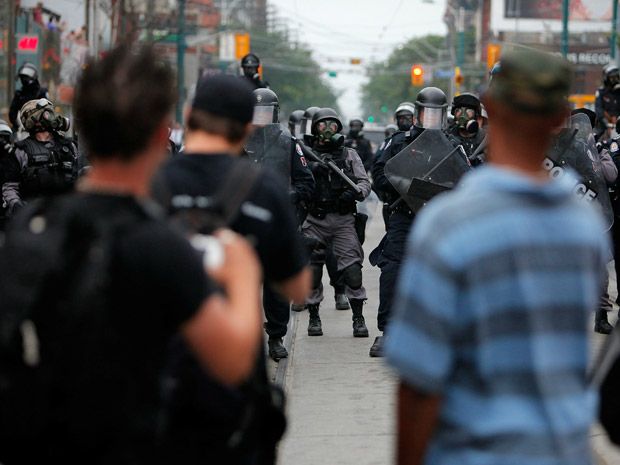
NATIONAL POST– A Toronto-based lawyer representing four journalists, who filed complaints with Ontario’s police watchdog and claimed that police physically assaulted and threatened to sexually assault the female reporters during the G20 summit, is calling for a full investigation into the alleged violence.

On Tuesday, Jesse Rosenfeld, Amy Miller, Daniel McIsaac and Lisa Walter each filed complaints about their arrests during the G20 summit with the Office of Independent Police Review Director.

Julian Falconer is representing the “Free Press 4” group.

“From our point of view, if peaceful protesters and journalists engaged in peaceful coverage are treated this way, this is a sad day for democracy. My clients are seeking accountability for what appears to be a serious overreaction by some police officers,” he said in a written statement.

Toronto Police spokesman Mark Pugash said there were more than 100 cameras documenting everything that happened in the prisoner processing centres and on the streets so “it’s not someone’s word against someone else’s.”

“We have video of everything. We’ll make sure that we provide the best possible evidence to determine the truth or otherwise in these allegations,” he said.

Police “anticipated” people would make complaints.

“We have to consider the possibility that complaints are completely unfounded. There are people who have said things so far that are clearly lies,” Pugash said.

Rosenfeld, a 26-year-old freelancer for the Guardian, a U.K.-based newspaper, was arrested when he was covering a group of demonstrators in front of a downtown Toronto hotel on Saturday night.

He said one officer told his colleague, “that’s the loudmouth kid who was mouthing off to me yesterday” and the officials didn’t bother to confirm his credentials. Instead, Rosenfeld said the officers “jumped” him.

“I was grabbed on each side and hit in the stomach and back and pounced on by officers. I kept asking them why they were beating me because I wasn’t resisting arrest. But they lifted my leg and twisted my ankle.”
Rosenfeld alleged he was also kneed in the ribs.

In Amy Miller’s complaint she said officers threatened to sexually assault her.

“You’re going to be raped. We always like the pretty ones. We’re going to wipe the grin off your face when we gang bang you. We know how the Montreal girls roll,” her complaint read.

Miller is a Montreal-based freelance journalist with The Dominion, a monthly paper published by a network of independent journalists.

Miller said the officers called her accreditation “garbage” and told her to get a “real job.”

OIPRD director Gerry McNeilly said all complaints are screened for “validity” and the investigation is then handed to the police division or to McNeilly’s office.

McNeilly must decide to group the “Free Press 4” complaints or look at them individually.

“I have the ability but I haven’t made the decision. If I say a complaint has no validity, that’s final. There’s no appeal, so I have to look at each case very carefully,” McNeilly said.

“I hoped the G20 had proceeded with minimum interruption and disruption but the complaints are coming in and we’re going to deal with them in a way that’s transparent.”

OIPRD spokesperson Allison Hawkins said the office receives, on average, 80 complaints a week. Between June 20 and June 26, 95 complaints were filed.

The civilian-led organization, which formed last October, investigates public complaints against the province’s police associations.

By Carmen Chai

Police brutality against women in Toronto at the G20


© COPYRIGHT NATIONAL POST, 2010