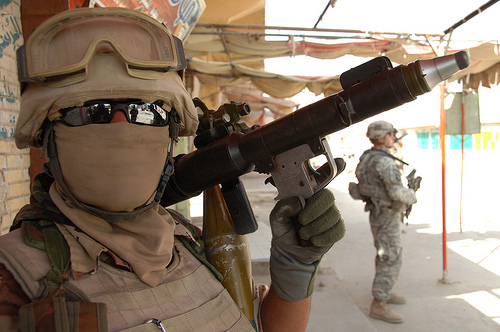
 MEDIA ROOTS – The Pentagon and corporate media actively promote the War on Terror meta-narrative, which restricts our society’s ability to view war. As an educational activist, I’ve decided to start translating Arab political scholarship in order to present a necessary alternative narrative to the U.S. public. The preface to the book Wars: Press Coverage in Arab Media is a specific text I chose with the intent of challenging readers. By breaching linguistic hurdles and circulating diverse worldviews, concerned citizens can chip away at the War on Terror’s monopoly over our media.
This translation offers a U.S. audience the opportunity to synthesize diverse viewpoints of recent armed conflicts. In stark contrast with U.S. corporate media, this author (‘Abdullah al-Kindi) frames the 1991 and 2003 Gulf Wars within a broader historical and social context. This background includes discussion about the Israeli-Palestinian conflict, Islam, imperialism, pan-Arab unity, media failures, military propaganda, and the human suffering inherent to all wars.
Christian Sorensen for Media Roots
TRANSLATION
The Second Gulf War, 1990-1991:
In its entirety, the Second Gulf War (1990-1991) burdened all aspects of life in the world in general, and in the Arab world in specific. With regard to the Arab world, this war put to test all theses about Arab unity and Arab national interest. The Arab world, with its diverse orientations and varied concerns, was not a unified tribal kinship following Iraq’s invasion of Kuwait on 2 August 1990, despite statements from public figures regarding Arab unity, interest, and alignment.
Along with slogans and statements, border disputes were perhaps the most prominent among all the unresolved or pending problems in the Middle East. In some cases these problems even developed into occasional skirmishes and led to dead border patrol troops. By the end of the 1980s, the majority of Arab countries had joined regional councils (e.g., Gulf Cooperation Council, Arab Cooperation Council, Arab Maghreb Union) in addition to the Arab League, which was the most comprehensive and important institution for Arab countries. However, these councils and unions did not implement any real solutions for the unresolved border disputes, even though they’re “artificial,” “imperial” borders left over from the colonial period and from Western imperialism, which insists on the borders’ continuation to serve their regional interests. Just as colonialism and the West have their own interests, Arab countries also have interests and wants, which should surpass those of the colonialists in order to eliminate these regional landmines, which could go off at any moment. This problem exemplified the most important cause of the Second Gulf War.
The Palestinian Cause also represented one of the reasons for the Second Gulf War. This Cause actually began with the Israeli Occupation of Palestine in 1948, and was followed by the wars of 1965, 1967, and 1973 between the Arabs and Israel. Then the Israeli invasion of Lebanon came in 1982. When Iraq decided to occupy Kuwait, it confirmed that it would liberate Palestine through occupying Kuwait, and demanded that Arab nationalists and Islamists support Iraq to confront the “imperial” force, which is allied against the Arabs and Muslims.
In connection with the goal of liberating Palestine, Iraq also announced its rejection of “imperialistic” and “artificial” borders among Arab countries as a means to achieve Arab unity, along with re-dividing the wealth among the Arab countries in order to bring about balance and to achieve comprehensive development throughout Arab countries. Since the beginning of its occupation of Kuwait on 2 August 1990, Iraq cited many reasons for its invasion, which were the subject of controversy and disagreement among Arabs, Muslims, and across the world. The Arabs and the world were divided between supporters and opposition. Accounts overlapped, alliances varied, and issues renewed. Each party gathered their opinions, demands, and aims, just as each one of them employed all they owned, including media, material, and military means.
For the first time since the Palestinian Cause began in 1948, Arabs differed regarding an issue’s fundamentals: Iraq raising the goal of liberating Palestine as a slogan for invading Kuwait. Consequently, the “fundamental” nationalist cause weakened, and wasn’t even considered an issue after the Arab armies faced one another. On a religious level, after Iraq opposed Iran and its Islamic Revolution in a war that lasted eight years (because it didn’t affect Arab nationalism and control over the region) Iraq returned in the Second Gulf War (1990) to demand Arab and Islamic unity in the face of the imperial invasion.
In the name of the Islamic religion, two seminars were also held during the build-up to the war. The first was held in Mecca on 13 September 1990 to justify summoning foreign forces to expel Iraq from Kuwait and eliminate Iraq’s threats and greed from the region. Earlier, a counter-seminar was held, also in the name of Islam, in Iraq on 17 August 1990, which refused to accept the summoning of foreign forces and forbade recourse to the infidel. Iraq invoked Islam despite an indication from Denis Halliday, who was Director of Personnel at the United Nations Development Program at the time, that Saddam Hussein didn’t ever occupy the forefront of radical Islam, since Saddam had fought with Islamic Iran and had broken with dissenting religious men within Iraq.
As for the global media’s coverage of the crisis in the Gulf, I will be content mentioning some examples of research, which clarify some media characteristics. Then I will touch upon the layout of the Arab media and its positions regarding the crisis in the Gulf. Two researchers, Abbas Malek and Lisa Leidig, conducted a study that analyzed the American press’ position on the Gulf War, and whether U.S. newspapers had put forward diverse ideas or whether the press, in short, relied upon the official viewpoint in assessing the crisis, and consequently mobilized the general opinion commensurate with the political administration and Pentagon’s narrative.
Malek and Leidig selected the New York Times and the Washington Post for analysis. According to the researchers, these two newspapers covered a wide range of local and international events. These two newspapers are also considered liberally elitist and critical, and do not hesitate to publish what might contradict the governmental point of view. The Washington Post’s disclosure and publication of the Watergate scandal and the New York Times’ publication of the Pentagon Papers are considered notable examples confirming such descriptions.
Malek and Leidig’s study spanned 2 August 1990 – 16 January 1991, before Operation Desert Storm began on 17 January 1991. Through this study, one can determine some observations about U.S. press coverage of the Gulf War. The first observation, based on the study’s results, is that the tacit relationship between the government and the media might affect the democratic process in the U.S. through influencing the newspapers’ positions. These two newspapers under study did not dispute or oppose the U.S. government’s decision to send its troops to the Gulf, because some government officials, according to the researchers’ opinion, had influenced the newspapers to not oppose the government’s decisions, especially since those officials were the lone official sources of news and information regarding the administration’s positions on the crisis. The study’s second observation is that the U.S. newspapers presented the Gulf crisis in a manner, which bolstered the legitimacy of the administration’s decisions and consequently the legitimacy and validity of the administration’s decision to go to war against Iraq and send troops to the Gulf.
Perhaps one of the most important indicators about global media coverage of events in the Gulf is the absence or scarcity of a critical or dissenting tone from within the allied countries against their respective governments’ decision to go to war, as indicated by a University of Oklahoma study. This study, entitled Telling the Gulf War Story: Coverage in Five Papers, focused on the news stories published about the Second Gulf War in five international newspapers. These papers were: the Washington Post, Germany’s Frankfort Algamaina, France’s Le Monde, Britain’s The Times, and Japan’s Asahi Shimone. This research group indicated media content during wartime didn’t reflect the events of the crisis, but simply was reconstructing events and presenting them to society in accordance the media’s preconceived visions and orientations, and not necessarily reflecting the reality of events in the Gulf. The research team expected the five newspapers under study to have similar positions on the Gulf crisis on the grounds that the newspapers predominately belong to similar economic and political ideologies, and also all belong to countries that give more space to their newspapers to inquire and debate their governments’ respective policies. Although this study confirmed the absence of a voice critical of the allied governments’ entrance into the Gulf War, it also clarified some discrepancies, which arose among the newspapers studied in their presentations of the Gulf War story. For example, Le Monde was the one newspaper, among the five, which focused on the war’s moral and humanitarian side and inquired about the war’s necessity. However, the other four papers presented the Gulf War story in a context of military operations with only slight differences among them.
These observations about the U.S. position and global press may raise some questions about the media establishment. If these observations lead to demands for media independence and pride in finding the proper balance of professionalism, objectivity, and rich history, then the following observations of the Arab press shouldn’t surprise anyone about the work of this press. The Gulf War divided the Arab world into two groups. The first group consisted of the six members of Gulf Cooperation Council, in addition to Egypt, Syria, and Morocco. These countries not only refused to accept Iraq’s invasion of Kuwait, but also participated in the international coalition. Besides Iraq, the second group consisted of Jordan, Yemen, Sudan, Algeria, Libya, and the Palestine Liberation Organization. A third group of Arab countries didn’t clarify their respective political positions on the Gulf War. This force, which included Lebanon, Tunisia, Mauritania, and Somalia, affiliated with both the first and second groups.
To a large extent, the Arab press aligned its positions on the Gulf crisis with Arab government policies, as was shown in the previous paragraph where Arab newspapers were divided into three main categories. The first category included newspapers of the Arab countries allied against Iraq, specifically the Gulf Cooperation Council countries, Egypt, Syria, and some Moroccan newspapers. Nicolas Hopkinson’s 1992 book War and the Media indicates the majority of Egyptian national newspapers, like al-Jumhurria, al-Ahram, and al-Akhbar, rejected Iraq’s invasion of Kuwait. Likewise, the Wafd Party’s eponymous newspaper, al-Wafd, forcefully criticized the Iraqi regime and called on Saddam Hussein to withdraw from Kuwait. ‘Adil Darwish’s 1991 essay Allah Is Enlisted by Arab Armies confirms the most important observation regarding this type of newspaper coverage, especially al-Ahram’s. He states that space was given to authors who oppose war in the Gulf, and to those who were occasionally indicating the war in the Gulf was an oil war for the sake of Western interests and was not about liberating Kuwait.
Syrian media conveyed the official government viewpoint and mobilized Syrian public opinion to support it. Consequently, Syrian media presented a single picture of the crisis in the Gulf. Through the media, it rejected the Iraqi invasion and sought to persuade Syrian public opinion of the legality and validity of the official Syrian decision to send troops to the Gulf. The situation didn’t differ much in newspapers of the Gulf Cooperation Council countries – if they didn’t match up completely – from the Syrian newspapers’ positions and most of the Egyptian newspapers.
The second category of Arab press coverage of the Gulf War included newspapers from countries that supported Iraq’s positions, demands, and claims. Perhaps the clearest examples of newspapers in this category, after the Iraqi newspapers, are the Jordanian newspapers, which supported Iraq without exception and continually criticized the international coalition. In Jordan, the newspapers presented a single image of the crisis, reflecting the official government position. Consequently, the newspapers shaped public opinion in line with support for Iraqi demands, and over time accepted the idea that occupying Kuwait would lead to the liberation of Palestine. Karam Shalaby, in his 1992 book Media and Propaganda in the Gulf War: Documents from the Operations Room, indicates that the Jordanian media aligned its positions with the government’s official stance throughout the crisis. It even “became an extension of the Iraqi media and propaganda, in all its aims and approaches, even in the vocabulary that this propaganda used in its daily rhetoric to the Arab masses.”
The third category of Arab newspapers – consisting of papers from Egypt and Morocco – represents a distinct phenomenon in the characteristics of Arab press coverage of the 1990-1991 Gulf War. These two countries rejected the Iraqi invasion of Kuwait and even sent their troops to join the international coalition. However, some of the newspapers in these two countries adopted different positions in evaluating the crisis. ‘Awatif ‘Abd al-Rahman, in her essay entitled Manifestations of Media Dependency in the Gulf War, indicates the Moroccan newspapers adopted an anti-Western position and tried to emphasize the necessity of an Arab solution to the crisis. According to ‘Abd al-Rahman, the Moroccan press criticized the government’s decision to send Moroccan troops to the Gulf, and confirmed that this war only aimed at controlling oil in the Middle East. The newspaper Al Bayane, the voice of the Party of Progress and Socialism, was the lone exception to the Moroccan newspapers’ positions on the crisis in the Gulf.
Karam Shalaby’s results are summarized as follows: 1) Media in countries with totalitarian regimes didn’t permit the allotment of space for opinions, which diverged from or opposed the official viewpoint. Consequently, under these regulations the media resorted to adjusting to the public’s desires or to besieging the masses with inflammatory propaganda. 2) There was space in multi-party Arab countries for other opinions that differed from the official viewpoint, however only in newspapers, party pamphlets and political rallies. Meanwhile, these same multi-party countries kept rejecting any expression or indication of viewpoints that disagreed with the television viewpoint, which was broadcast on government television channels and radio media. 3) The two sides of the Arab media – supporters and the opposition – relied on international news sources. 4) Media of the two sides – the supporters and opposition – relied on the use of Islam as a text, legal canon, and symbol as propaganda to justify their stances and to validate their claims.
‘Arafan Nidtham ad-Deen continues in the same critical direction. He determines that because of the Second Gulf War, the Arab media in all its contrivances and means “paid an exorbitant price for this disaster. This occurred at the expense of its reputation, the honor of its profession, its ability to interface with events and be affected by them, affect public opinion, and translate its hidden and declared aspirations and emotions.”
Nidtham ad-Deen’s results do not differ from those which Karam Shalaby and other researchers recorded about the Arab media’s performance during the Second Gulf War, except in some points, such as: 1) The Arab political division was reflected in the media, which led to political excitement and positions attempting to control professional work, and consequently affecting the media’s credibility. 2) Passion trumped logic and instincts overcame reason. 3) The prevalence of a case of apparent confusion over the media’s performance – the supporters and the opposition – from the beginning of the crisis until the ceasefire.
Overall, Karam Shalaby spoke about the Arab-Arab confrontation with respect to the Arab media’s performance in the Second Gulf War (1990-91). Khalil ‘Ali Fahmi’s 1991 study entitled A Gulf of Misunderstanding confirmed that this war created another confrontation between the Arabs and the West, represented in the Arab and Western media’s respective positions on this war.
Fahmi’s study focused on the op-ed sections in The Times (London) and al-Ahram (Cairo) and their coverage of the Second Gulf War. Through his analysis of these op-ed sections, Fahmi arrived at the conclusion that the War wasn’t presented as a confrontation between the Arabs and the West or between the Christian West and the Muslim East, which Fahmi considers a positive aspect in terms of cultural continuity between the West and the East. However, the two newspapers’ stances on the Second Gulf War contradicted the stances they had recorded on the First Gulf War between Iraq and Iran. Fahmi described this contradiction as media hypocrisy. At a time when The Times tried to justify the 1991 War on Iraq from a moral standpoint and refused to tie the war to the Palestinian Cause, al-Ahram wasn’t able to present an Arab or Middle Eastern narrative for that war.
Carrie Chrisco’s 1995 study, entitled Reactions to the Persian Gulf War: Editorials in the Conflict Zone, analyses six daily, English-language editorials in Middle Eastern newspapers. Carrie confined her research on the 1990-1991 Gulf War to the following newspapers: The United Jordan Times, The Arab News (Saudi Arabia), Syria Times, Jerusalem Post (Israel), Arab Emirates News (United Arab Emirates), and Kayhan International (Iran).
In chapter one of her study, Chrisco depicts media’s role in covering the crises and wars, confirming media manufacture war’s image and reality that it wants in accordance with its political and cultural affiliations. Chrisco believes she should focus on editorials and study them in order to explore what media actually manufacture during periods of crises and wars. In the same chapter, Chrisco presents many studies of media’s performance, focusing on analysis of newspaper editorials. She catalogued twelve separate pieces of research spanning 1935 to 1991. Chrisco’s study relies on two levels of analysis. On the first level, she analyses the six newspaper editorials’ topics, analyzing the actors and themes contained within. On the second level of analysis, she appraises the values in Middle Eastern newspapers (through the sample research).
The Third Gulf War, 2003:
Before the American-British campaign against Iraq began on 20 March 2003, the world had entered a phase of psychological and practical readiness for a new war. The media presented continual coverage of the events that preceded the war, especially hearings and debates of the United Nations Security Council and international and regional organizations. This coverage helped the public to achieve a high degree of what to expect in terms of the war’s timing, probable results, and its particular strategic scenarios.
The global media’s fundamental and early attendance to the Third Gulf War came as a professional accumulation and reflection of actual developments in the global media layout after the Second Gulf War, the war in the Balkans, and the U.S. campaign against Afghanistan. This war, more so than any other wars or crises, became present in media and television coverage in general, and was shown around the clock on most global television channels in an unprecedented manner. Hence, a few comparisons between the latest war and the Second Gulf War (1990-1991) might assist in clarifying some professional developments – whether negative or positive – which materialized over twelve years of war coverage.
In quantitative terms, the global public was becoming acquainted with the idea of live and direct broadcasting on CNN and BBC from the site of any event in the Second Gulf War (1990-1991). However, with the Third Gulf War, satellite channels from all over the world, in their various languages and perspectives, competed with armies to enter Baghdad. While some observers had indicated the presence of close to 1,400 journalists in the Saudi desert to cover the Second Gulf War, the number of journalists who deployed to cover the Third Gulf War reached roughly 5,000.
The strategy of “news briefs and press conferences” had proven its importance in the Second Gulf War, so it was consequently kept as a strategy of dealing with the media in the Third Gulf War, this time from U.S. Central Command headquarters in as-Sulailia, Qatar. On the other hand, the 1990-1991 strategy of news pools, which prevented the press from getting close to the battlefields unless accompanied by a military escort, was replaced with a new strategy in Third Gulf War. This new strategy was named embedded journalism. However, through reading the available literature on the coverage of wars and crises, it became clear that the concept of embedded journalism was not a new invention particular to the War on Iraq. Morand Fachot indicates that embedded journalists materialized for the first time during World War II at the hands of the Americans, and specifically through the Office of War Information, as it was called at the time.
In the Third Gulf War, war activities doubled in the media, when the latter declared itself as a Third Army trying to take a neutral stand. By “activities,” I mean the collective practices that are advanced by the belligerent parties militarily in dealing with the media. These practices affect media’s performance. In the Third Gulf War, the following practices fall within the expression media war activities:
Military control over press coverage: The two belligerent parties (the Coalition and Iraq) adopted a strategy of military control over media coverage. The British-American alliance seemed very concerned with military briefs from U.S. Central Command headquarters in as-Sulailia, Qatar. Included within the concept of military control, the Americans confirmed the importance of the idea of embedded journalism through the clear and candid justification presented by the Defense Department, which says: “This system’s goal is to present the facts to the American public and the public in coalition nations, which can affect their opinions and positions regarding the Coalition.” Military-media briefs were also an Iraqi strategy, but the Iraqi spokesman, Information Minister Mohammed S’aid, was a journalist and not a military leader, as in the case of the Coalition.
Harassing journalists, preventing them from performing their media jobs, and even expelling some of them: This kind of harassment started even before the war began on 20 March 2003. For example, the United States banished Iraqi news reporters from New York in the beginning of February 2003. So the Iraqi government responded on 16 February 2003 by expelling four Fox News reporters. These practices escalated during the war, which affected media coverage of the war. At this point, one must point out some examples that many institutions, associations, and unions concerned with protecting press rights witnessed: Iraqi authorities demanded CNN reporter Nic Robertson leave the country on 21 March 2003; Coalition Forces bombed the Iraqi Information Ministry on three consecutive occasions: on the 25th, 29th, and 30th of March 2003; On 31 March 2003, Iraqi authorities prevented the Reuters news agency from supplying CNN with images of inside Iraq; American forces bombed the Palestine Hotel, which is located in the Iraqi capital of Baghdad. The Palestine, as it is known, was the headquarters of most international media reporters. American forces also bombed the headquarters of two news channels: Abu Dhabi and Al-Jazeera.
Killing journalists through bombing their media centers. Some others die in separate instances: The Third Gulf War was described as the most dangerous war and the most lethal in terms of journalist casualties. From 20 March 2003 – 8 April 2003, fourteen journalists from various countries died. This number is considered large when compared to the four journalists who had died over a longer time period during the Second Gulf War. Although journalists had advanced knowledge about the high degree of danger they face in warzones, including death, the phenomena of intentionally targeting journalists is considered a dangerous development in the Third Gulf War. Suffice it to say, the bombing of Al-Jazeera and Abu Dhabi headquarters and the Palestine Hotel, both of which were known and clearly defined media centers, provides evidence of this premeditation.
Consequently, the belligerent parties presented media with much danger, prohibition, distortion of facts, and misinformation. Media personnel were even exposed to the dangers of bodily harm and “friendly fire,” which is when friendly military forces accidentally shoot allied units. A component of intentional bodily harm reinforces the idea that the media are turning into a “Third Army” in wars and crises, as it also gives evidence to new precedents in dealing with the media.
Despite the dangers inherent to journalism in war zones, intentional bodily harm is a new precedent set by this war. Describing 9 April 2003 as “Black Journalist Day” is a logical and natural portrayal. For on that day, the American forces decided to intentionally confront or terrorize the “Third Army” when they bombed the Palestine Hotel, out of which journalists from around the world were based. Taras Protsyuk from Reuters and Jose Couso from one of the Spanish channels were killed in the bombing. American forces also bombed Al-Jazeera’s headquarters, claiming the life of Jordanian journalist Tareq Ayyoub.
The Third Gulf War was a suitable opportunity for some Arab media establishments to impose their presence on the regional media layout, and even embrace internationalism when many global media outlets began transmitting war developments and activities of some Arab satellite channels in Iraq, like Al-Jazeera, Abu Dhabi, and Al-Arabiya. Professional evidence attests to these channels’ intensive and outstanding presence. Examples of this include live and direct broadcast around clock, which contributed to their transformation into essential news sources for some global television channels. These Arabic satellite channels, which are supported by numerous correspondents across the Arab world, are no longer just a source of television images for global satellite channels. For example, some global newspapers in France and Britain even allocated sections in their daily prints to familiarize their readers with Al-Jazeera’s on-going coverage of the Third Gulf War. Differences and debates remain over the Arabic channels’ performance, which is a testimony to their vitality. While the global media were busy with the war in the Gulf, many observers and parties concerned with media, military, and political issues were preoccupied with the performance of some Arab satellite channels. One can read these debates about the Arab media in a lot of literature, which became available in an unprecedented manner. The political circumstances in the Arab world and media in general had assisted in achieving this new global presence.
While the Second Gulf War (1990-1991) had divided the Arab world into two groups, the Third Gulf War was causing disagreement and dissent among the majority of official Arab organizations. Even the Arab League rejected the war, in case the United Nations was unable to provide international legal cover for the war. In comparison to the official Arab hesitancy in announcing positions on the recent Iraq War, the overwhelming majority of public Arab opinion was acute and candid in rejecting this war. This rejection took the form of demonstrations, marches, and institutional, popular, and public protests through some organizations, associations, and professional unions. This type of clear and obvious distinction between official Arab hesitancy and popular, mass visibility, even if only superficial in appearance, had provided a suitable climate for a new Arab media, especially satellite media, to go in new directions in terms of intensity of coverage and content.
Translation by Christian Sorensen for Media Roots
***
Photo by Flickr User The U.S. Army



 MEDIA ROOTS — Ever since the Internet took off there has been a positive push back against the corporate controlled mainstream media establishment. Many educated people now rightfully believe that they are being lied to and manipulated by these large corporate organizations that use sensationalism, fear mongering and titillation to emotionally effect the viewer into reacting on a base reptile level rather than with their higher critical brain.
  MEDIA ROOTS – Federal agents are continuing to detain a Marine Corps veteran in Chesterfield, Virginia for posts made on his website that expressed discontent for the federal government and accuse elements of it for orchestrating the 9/11 attacks.
 MEDIA ROOTS – The U.S. corporate media avoids contextual analysis of complex issues solely to attract more viewers and obtain greater advertising revenue. By promoting caricature and sensation, the establishment media avoids critical analysis of the political incentives which motivate modern conflict. Translation helps overcome U.S. media’s deficiencies by allowing narratives to cross linguistic boundaries. Dr. Nasr Ad-Din al-‘Aiadi’s chapter in the book
  MEDIA ROOTS – The Pentagon and corporate media actively