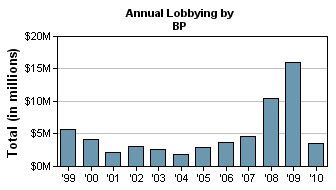
BP Enjoys Lobbying Strength as Investigation Looms

COMMON DREAMS– On Thursday, oil giant BP asked for U.S. government assistance in cleaning up massive amounts of crude oil ominously approaching the coast of Louisiana — the messy results of a recent oil rig explosion 40 miles off-shore.

In response, the Obama administration promised support in both clean up and containment of the environmental crisis. The president also sent clear signals indicating a potential federal investigation to determine cause and responsibility for the accident.

If BP faces heavy federal scrutiny, it’s well-positioned to fight back: The London-based company has consistently spent top dollar to influence legislative and regulatory activity in Washington, D.C., the Center for Responsive Politics finds.

During the 2008 election cycle, individuals and political action committees associated with BP — a Center for Responsive Politics’ “heavy hitter” — contributed half a million dollars to federal candidates. About 40 percent of these donations went to Democrats. The top recipient of BP-related donations during the 2008 cycle was President Barack Obama himself, who collected $71,000.

BP regularly lobbies on Capitol Hill, as well. In 2009, the company spent a massive $16 million to influence legislation. During the first quarter of 2010, it spent $3.53 million on federal lobbying efforts, ranking it second (behind ConocoPhillips) among all oil and gas industry interests.

Its registered lobbyists include a number of former federal government and high-ranking political campaign officials, including longtime political operative Tony Podesta, former congressional chief of staff Bob Brooks, former congressional legislative director David Pore and vice presidential aide Michael S. Berman, the Center’s research shows. 

The oil and gas industry, of which BP is a member, reported $169 million in 2009 lobbying expenditures.

Comparatively, the entire environmental industry spent $22 million on lobbying in 2009 — not much more than BP alone spent for the year. The most active member of the environmental industry, the Nature Conservancy, reported $2.2 million in 2009 expenditures. Last year, BP was active lobbying on the American Clean Energy Leadership Act of 2009, which allows increased oil and gas leasing in the Gulf of Mexico, in areas closer to shore than current law allows.

The bill also calls for additional research and inventory of oil and gas reserves in the U.S. Outer Continental Shelf. The bill is sponsored by Sen. Jeff Bingaman (D-N.M.), who has received $14,000 in campaign donations during the past two decades from those associated with BP, the Center finds.

In 2009, BP also lobbied on the Oil Spill Prevention Act of 2009 and the Clean Water Restoration Act.

The oil spill, which has yet to be remedied, was caused by an explosion on a BP-leased oil rig on April 20.

A state of emergency has since been enacted in Louisiana, and the White House has designated it an event of “national significance.” The oil well is reportedly leaking between 1,000 and 5,000 barrels a day, and rescue crews are trying to eliminate  the oil by setting it on fire, breaking it up with chemicals and skimming it off the surface of the ocean. Already, questions are being asked about cause and responsibility.

Upon hearing the cry for help in the Gulf of Mexico, Rep. Henry A. Waxman (D-Cal.), chairman of the House Energy and Commerce Committee, called for a “full blown investigation.”

In 2009, individuals and political action committees associated with BP donated $16,000 to members of the House Energy and Commerce Committee.

In addition, five of the all-time top 10 recipients of BP money in the House of Representatives sit on the House Energy Committee: John D. Dingell (D-Mich.) Joe Barton (R-Tex.), Ralph M. Hall (R-Tex.), Roy Blunt (R-Mo.) and Fred Upton, (R-Mich.).

All have received upward of $13,000 from BP-related individuals and political action committees during the past two decades. Dingell, the second most favored recipient of BP money in the House, has received $31,000.

Written by Cassandra LaRussa

© COPYRIGHT COMMON DREAMS, 2010

War Contractors Spent $27 Million Lobbying at Time of Surge

HUFFINGTON POST– The ten largest defense contractors in the nation spent more than $27 million lobbying the federal government in the last quarter of 2009, according to a review of recently-filed lobbying records.

The massive amount of money used to influence the legislative process came as the White House announced it would ramp up military activity in Afghanistan and Congress considered appropriations bills to pay for that buildup. All told, these ten companies, the largest revenue earners in the industry, spent roughly $7.2 million more lobbying in the fourth quarter of 2009 (October through December) than in the three months prior.

Such an increase in lobbying expenditures is partly a reflection of just how profitable the business of waging war can be. Each of these companies earned billions of dollars in defense contracts this past year. As the U.S. ramps up its military activities overseas, and the army is stretched thin by other ventures, it stands to reason that the contracts won’t dry up any time soon.

In mid-December, Congress passed a defense appropriations bill that totaled more than $635 billion. Shortly thereafter, the firm Northrop Grumman moved its corporate office to the Washington D.C. region to be closer to the heart of legislative action. Among the issues on which these ten firms lobbied, “appropriations” was the most frequently cited in lobbying forms.

“We’ve built Rome,” one longtime good-government official said of the symbiosis between contractors and the government.

On a related note, the Congressional Research Service released a report on Thursday, which showed that the number of private security contractors has bulged in the wake of Obama’s Afghanistan-surge announcement. Currently, contractors in Afghanistan make up between 22 percent and 30 percent of armed U.S. forces in Afghanistan.

Below is a breakdown of the military contractor, lobbying expenditures and the amount of money the company earned in contracts last year.

Company: Boeing
Lobbying In Fourth Quarter: $6.13 million
Lobbying In Third Quarter: $3.71 million
Federal Contracts in FY08 (according to fedspending.org): $23,547,610,878

Company: United Technologies
Lobbying In Fourth Quarter: $3.66 million
Lobbying In Third Quarter: $1.39 million
Federal Contracts in FY08: $8,973,091,375

Company: Lockheed Martin
Lobbying In Fourth Quarter: $3.16 million
Lobbying In Third Quarter: $3.1 million
Federal Contracts in FY08: $35,729,713,235

Company: Honeywell International
Lobbying In Fourth Quarter: $1.94 million
Lobbying In Third Quarter: $1.66 million
Federal Contracts in FY08: $2,439,634,130

Company: Northrop Grumman
Lobbying In Fourth Quarter: $5.43 million
Lobbying In Third Quarter: $3.62 million
Federal Contracts in FY08: $24,921,637,857

Company: General Dynamics
Lobbying In Fourth Quarter: $3,000,697
Lobbying In Third Quarter: $2,496,308
Federal Contracts in FY08: $14,244,546,441

Company: Raytheon
Lobbying In Fourth Quarter: $2.19 million
Lobbying In Third Quarter: $1.9 million
Federal Contracts in FY08: $14,276,349,843

Company: L3
Lobbying In Fourth Quarter: $1.05 million
Lobbying In Third Quarter: $990,000
Federal Contracts in FY08: $7,464,053,901

Company: Textron
Lobbying In Fourth Quarter: $460,000
Lobbying In Third Quarter: $890,000
Federal Contracts in FY08: $2,858,396,315

Company: Goodrich
Lobbying In Fourth Quarter: $447, 098
Lobbying In Third Quarter: $425,529
Federal Contracts in FY08: $490,224,761

© COPYRIGHT HUFFINGTON POST, 2010

Obama’s ’05 Stock Investments- Conflict of Interest?

NY TIMES–  Less than two months after ascending to the United States Senate, Barack Obama bought more than $50,000 worth of stock in two speculative companies whose major investors included some of his biggest political donors.

One of the companies was a biotech concern that was starting to develop a drug to treat avian flu. In March 2005, two weeks after buying about $5,000 of its shares, Mr. Obama took the lead in a legislative push for more federal spending to battle the disease.

The most recent financial disclosure form for Mr. Obama, an Illinois Democrat, also shows that he bought more than $50,000 in stock in a satellite communications business whose principal backers include four friends and donors who had raised more than $150,000 for his political committees.

A spokesman for Mr. Obama, who is seeking his party’s presidential nomination in 2008, said yesterday that the senator did not know that he had invested in either company until fall 2005, when he learned of it and decided to sell the stocks. He sold them at a net loss of $13,000.

Read more about Obama’s ’05 Stock Investments- Conflict of Interest?

© 2007 NY TIMES

How to Get Our Democracy Back

NATION– We should remember what it felt like one year ago, as the ability to recall it emotionally will pass and it is an emotional memory as much as anything else. It was a moment rare in a democracy’s history. The feeling was palpable–to supporters and opponents alike–that something important had happened. America had elected, the young candidate promised, a transformational president. And wrapped in a campaign that had produced the biggest influx of new voters and small-dollar contributions in a generation, the claim seemed credible, almost intoxicating, and just in time.

Yet a year into the presidency of Barack Obama, it is already clear that this administration is an opportunity missed. Not because it is too conservative. Not because it is too liberal. But because it is too conventional. Obama has given up the rhetoric of his early campaign–a campaign that promised to “challenge the broken system in Washington” and to “fundamentally change the way Washington works.” Indeed, “fundamental change” is no longer even a hint.

Instead, we are now seeing the consequences of a decision made at the most vulnerable point of Obama’s campaign–just when it seemed that he might really have beaten the party’s presumed nominee. For at that moment, Obama handed the architecture of his new administration over to a team that thought what America needed most was another Bill Clinton. A team chosen by the brother of one of DC’s most powerful lobbyists, and a White House headed by the quintessential DC politician. A team that could envision nothing more than the ordinary politics of Washington–the kind of politics Obama had called “small.” A team whose imagination–politically–is tiny.

These tiny minds–brilliant though they may be in the conventional game of DC–have given up what distinguished Obama’s extraordinary campaign. Not the promise of healthcare reform or global warming legislation–Hillary Clinton had embraced both of those ideas, and every other substantive proposal that Obama advanced. Instead, the passion that Obama inspired grew from the recognition that something fundamental had gone wrong in the way our government functions, and his commitment to reform it.

For Obama once spoke for the anger that has now boiled over in even the blue state Massachusetts–that our government is corrupt; that fundamental change is needed. As he told us, both parties had allowed “lobbyists and campaign contributions to rig the system.” And “unless we’re willing to challenge [that] broken system…nothing else is going to change.” “The reason” Obama said he was “running for president [was] to challenge that system.” For “if we’re not willing to take up that fight, then real change–change that will make a lasting difference in the lives of ordinary Americans–will keep getting blocked by the defenders of the status quo.”

This administration has not “taken up that fight.” Instead, it has stepped down from the high ground the president occupied on January 20, 2009, and played a political game no different from the one George W. Bush played, or Bill Clinton before him. Obama has accepted the power of the “defenders of the status quo” and simply negotiated with them. “Audacity” fits nothing on the list of last year’s activity, save the suggestion that this is the administration the candidate had promised.

Read more about How to Get Our Democracy Back.

Editors’ Note: We encourage readers moved by this essay to sign the Change Congress petition, a drive to enact solutions proposed in this article. Click here to sign. A video commentary by Professor Lessig can be viewed here.

© THE NATION 2010

Democracy in America a Useful Fiction

TRUTHDIG– Corporate forces, long before the Supreme Court’s decision in Citizens United v. Federal Election Commission, carried out a coup d’état in slow motion. The coup is over. We lost. The ruling is one more judicial effort to streamline mechanisms for corporate control. It exposes the myth of a functioning democracy and the triumph of corporate power. But it does not significantly alter the political landscape. The corporate state is firmly cemented in place.

The fiction of democracy remains useful, not only for corporations, but for our bankrupt liberal class. If the fiction is seriously challenged, liberals will be forced to consider actual resistance, which will be neither pleasant nor easy. As long as a democratic facade exists, liberals can engage in an empty moral posturing that requires little sacrifice or commitment. They can be the self-appointed scolds of the Democratic Party, acting as if they are part of the debate and feel vindicated by their cries of protest.

Much of the outrage expressed about the court’s ruling is the outrage of those who prefer this choreographed charade. As long as the charade is played, they do not have to consider how to combat what the political philosopher Sheldon Wolin calls our system of “inverted totalitarianism.”

Inverted totalitarianism represents “the political coming of age of corporate power and the political demobilization of the citizenry,” Wolin writes in “Democracy Incorporated.” Inverted totalitarianism differs from classical forms of totalitarianism, which revolve around a demagogue or charismatic leader, and finds its expression in the anonymity of the corporate state. The corporate forces behind inverted totalitarianism do not, as classical totalitarian movements do, boast of replacing decaying structures with a new, revolutionary structure. They purport to honor electoral politics, freedom and the Constitution. But they so corrupt and manipulate the levers of power as to make democracy impossible.

Inverted totalitarianism is not conceptualized as an ideology or objectified in public policy. It is furthered by “power-holders and citizens who often seem unaware of the deeper consequences of their actions or inactions,” Wolin writes. But it is as dangerous as classical forms of totalitarianism. In a system of inverted totalitarianism, as this court ruling illustrates, it is not necessary to rewrite the Constitution, as fascist and communist regimes do. It is enough to exploit legitimate power by means of judicial and legislative interpretation.

This exploitation ensures that huge corporate campaign contributions are protected speech under the First Amendment. It ensures that heavily financed and organized lobbying by large corporations is interpreted as an application of the people’s right to petition the government. The court again ratified the concept that corporations are persons, except in those cases where the “persons” agree to a “settlement.” Those within corporations who commit crimes can avoid going to prison by paying large sums of money to the government while, according to this twisted judicial reasoning, not “admitting any wrongdoing.” There is a word for this. It is called corruption.

Corporations have 35,000 lobbyists in Washington and thousands more in state capitals that dole out corporate money to shape and write legislation. They use their political action committees to solicit employees and shareholders for donations to fund pliable candidates. The financial sector, for example, spent more than $5 billion on political campaigns, influence peddling and lobbying during the past decade, which resulted in sweeping deregulation, the gouging of consumers, our global financial meltdown and the subsequent looting of the U.S. Treasury.

The Pharmaceutical Research and Manufacturers of America spent $26 million last year and drug companies such as Pfizer, Amgen and Eli Lilly kicked in tens of millions more to buy off the two parties. These corporations have made sure our so-called health reform bill will force us to buy their predatory and defective products. The oil and gas industry, the coal industry, defense contractors and telecommunications companies have thwarted the drive for sustainable energy and orchestrated the steady erosion of civil liberties. Politicians do corporate bidding and stage hollow acts of political theater to keep the fiction of the democratic state alive.

There is no national institution left that can accurately be described as democratic. Citizens, rather than participate in power, are allowed to have virtual opinions to preordained questions, a kind of participatory fascism as meaningless as voting on “American Idol.” Mass emotions are directed toward the raging culture wars. This allows us to take emotional stands on issues that are inconsequential to the power elite.

Our transformation into an empire, as happened in ancient Athens and Rome, has seen the tyranny we practice abroad become the tyranny we practice at home. We, like all empires, have been eviscerated by our own expansionism. We utilize weapons of horrific destructive power, subsidize their development with billions in taxpayer dollars, and are the world’s largest arms dealer. And the Constitution, as Wolin notes, is “conscripted to serve as power’s apprentice rather than its conscience.”

“Inverted totalitarianism reverses things,” Wolin writes. “It is politics all of the time but a politics largely untempered by the political. Party squabbles are occasionally on public display, and there is a frantic and continuous politics among factions of the party, interest groups, competing corporate powers, and rival media concerns. And there is, of course, the culminating moment of national elections when the attention of the nation is required to make a choice of personalities rather than a choice between alternatives. What is absent is the political, the commitment to finding where the common good lies amidst the welter of well-financed, highly organized, single-minded interests rabidly seeking governmental favors and overwhelming the practices of representative government and public administration by a sea of cash.” 

Hollywood, the news industry and television, all corporate controlled, have become instruments of inverted totalitarianism. They censor or ridicule those who critique or challenge corporate structures and assumptions. They saturate the airwaves with manufactured controversy, whether it is Tiger Woods or the dispute between Jay Leno and Conan O’Brien. They manipulate images to make us confuse how we are made to feel with knowledge, which is how Barack Obama became president. And the draconian internal control employed by the Department of Homeland Security, the military and the police over any form of popular dissent, coupled with the corporate media’s censorship, does for inverted totalitarianism what thugs and bonfires of books do in classical totalitarian regimes.

“It seems a replay of historical experience that the bias displayed by today’s media should be aimed consistently at the shredded remains of liberalism,” Wolin writes. “Recall that an element common to most 20th century totalitarianism, whether Fascist or Stalinist, was hostility towards the left. In the United States, the left is assumed to consist solely of liberals, occasionally of ‘the left wing of the Democratic Party,’ never of democrats.”

Liberals, socialists, trade unionists, independent journalists and intellectuals, many of whom were once important voices in our society, have been silenced or targeted for elimination within corporate-controlled academia, the media and government. Wolin, who taught at Berkeley and later at Princeton, is arguably the country’s foremost political philosopher. And yet his book was virtually ignored. This is also why Ralph Nader, Dennis Kucinich and Cynthia McKinney, along with intellectuals like Noam Chomsky, are not given a part in our national discourse.

The uniformity of opinion is reinforced by the skillfully orchestrated mass emotions of nationalism and patriotism, which paints all dissidents as “soft” or “unpatriotic.” The “patriotic” citizen, plagued by fear of job losses and possible terrorist attacks, unfailingly supports widespread surveillance and the militarized state. This means no questioning of the $1 trillion in defense-related spending. It means that the military and intelligence agencies are held above government, as if somehow they are not part of government. The most powerful instruments of state power and control are effectively removed from public discussion. We, as imperial citizens, are taught to be contemptuous of government bureaucracy, yet we stand like sheep before Homeland Security agents in airports and are mute when Congress permits our private correspondence and conversations to be monitored and archived. We endure more state control than at any time in American history. 

The civic, patriotic and political language we use to describe ourselves remains unchanged. We pay fealty to the same national symbols and iconography. We find our collective identity in the same national myths. We continue to deify the Founding Fathers. But the America we celebrate is an illusion. It does not exist. Our government and judiciary have no real sovereignty. Our press provides diversion, not information. Our organs of security and power keep us as domesticated and as fearful as most Iraqis. Capitalism, as Karl Marx understood, when it emasculates government, becomes a revolutionary force. And this revolutionary force, best described as inverted totalitarianism, is plunging us into a state of neo-feudalism, perpetual war and severe repression. The Supreme Court decision is part of our transformation by the corporate state from citizens to prisoners.

Chris Hedges writes a regular column for Truthdig.com. Hedges graduated from Harvard Divinity School and was for nearly two decades a foreign correspondent for The New York Times. He is the author of many books, including: War Is A Force That Gives Us Meaning, What Every Person Should Know About War, and American Fascists: The Christian Right and the War on America.  His most recent book is Empire of Illusion: The End of Literacy and the Triumph of Spectacle

© 2010 TruthDig