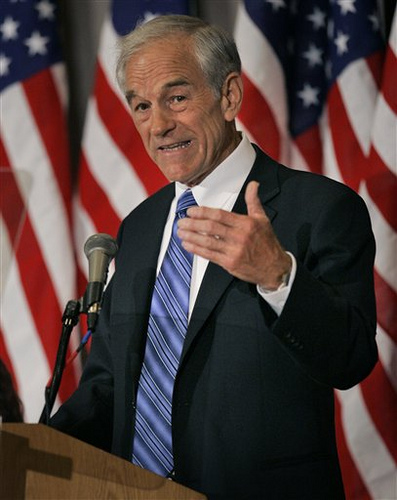
BUSINESS WIRE– Congressman Ron Paul today released the following statement on President
Obama’s speech from the Oval Office last night:
“Once again, we are being told the mission has been accomplished and our
brave men and women are coming back home. Though the people are hopeful
they remain skeptical, and rightfully so.”
“The President’s announcement that all U.S. combat troops have left Iraq
is no more believable than the ‘Mission Accomplished’ declaration was in
2003.
“The biggest problem is that success in Iraq is undefinable since the
mission was never defined. The reasons given for the invasion were based
on misinformation. Now, the war has cost us hundreds of billions of
dollars and this has contributed significantly to our economic woes.
“Forty-four hundred Americans are dead, thirty thousand severely
wounded, and more than a hundred thousand are suffering from serious
health problems related to Post Traumatic Stress Syndrome. This alone
should tell us that it was not worth the investment and the needless
sacrifice of our young people and the taxpayers.
“It is deceitful to imply we will avoid hostilities with this new
policy. We still have to contend with:
the 50,000 troops carrying weapons remain in Iraq
the 100,000 contractors that remain with more expected to go to Iraq
the 9,000 special ops personnel trained in assassinations that remain
in Iraq
a huge embassy, bigger than the Vatican, that will remain
Dozens of military bases that will stay
Al Qaeda organizations that did not exist before the war
Muqtada al Sadr, a strong nationalist who has gained much political
power
The fact that Iran benefits tremendously with the Shiites now in power
in Iraq and is a close ally of al Sadr
“Osama bin Laden wins by ‘proving’ that America has an agenda of
occupation in the Middle East. And, we continue to walk into his trap
and hand him up his best recruitment tool in his efforts to incite
hatred and terrorism against the United States.
“What’s worse, President Obama made it clear last night that the troops
and resources leaving Iraq will not come home to defend our country or
ease our economic woes. They will instead be diverted to Afghanistan,
perhaps also Pakistan and, I fear, even Iran.
“From my viewpoint we are the losers in this fool’s errand of endless
war. Tragically, this new policy is not one of peace but merely a
charade that will severely undermine our national security and continue
us down the path to bankruptcy—a threat that we best not long ignore.”
REBEL REPORTS– A couple of years ago, Blackwater executive Joseph Schmitz seemed to
see asilver lining for mercenary companies with the prospect of US
forces being withdrawn or reduced in Iraq. “There is a scenario where
we could as a government, the United States, could pull back the
military footprint,” Schmitz said. “And there would then be more of a need for private contractors to go in.”
When it comes to armed contractors, it seems that Schmitz was right. According to new statistics released by the Pentagon, with Barack Obama as commander in chief, there has been a
23% increase in the number of “Private Security Contractors” working
for the Department of Defense in Iraq in the second quarter of 2009 and
a 29% increase in Afghanistan, which “correlates to the build up of
forces” in the country.
In Iraq, the Pentagon attributes the increase
to better accounting. But, these numbers relate explicitly to DoD
security contractors. Companies like Blackwater and its successor Triple Canopy
work on State Department contracts and it is unclear if these
contractors are included in the over-all statistics. This means, the
number of individual “security” contractors could be quite higher, as
could the scope of their expansion.
Overall, contractors
(armed and unarmed) now make up approximately 50% of the “total force
in Centcom AOR [Area of Responsibility].” This means there are a
whopping 242,657 contractors working on these two US wars. These
statistics come from two reports just released by Gary J. Motsek, the
Assistant Deputy Under Secretary of Defense (Program Support):
“Contractor Support of U.S. Operations in USCENTCOM AOR, IRAQ, and
Afghanistan and “Operational Contract Support, ‘State of the Union.’”
“We
expect similar dependence on contractors in future contingency
operations,” according to the contractor “State of the Union.” It notes
that the deployment size of both military personnel and DoD civilians
are “fixed by law,” but points out that the number of contractors is
“size unfixed,” meaning there is virtually no limit (other than funds)
to the number of contractors that can be deployed in the war zone.
At
present there are 132,610 in Iraq and 68,197 in Afghanistan. The report
notes that while the deployment of security contractors in Iraq is
increasing, there was an 11% decrease in overall contractors in Iraq
from the first quarter of 2009 due to the “ongoing efforts to reduce
the contractor footprint in Iraq.”
Jeremy Scahill is the author of the international best-seller Blackwater: The Rise of the World’s Most Powerful Mercenary Army. He is a frequent contributor to The Nation magazine and a correspondent for the national radio and TV program Democracy Now! He is currently a Puffin Foundation Writing Fellow at The Nation Institute.
Scahill has won numerous awards for his reporting, including the
prestigious George Polk Award, which he won twice. While a
correspondent for Democracy Now!, Scahill reported extensively from Iraq through both the Clinton and Bush administrations.
SYDNEY MORNING HERALD– The US State Department is to more than double the number of
security contractors it employs in Iraq to around 7000, filling a gap
left by departing troops, the New York Times reported on Thursday.
The
newspaper said the contractors would be deployed to defend five
fortified compounds that will be left behind as US combat forces exit
Iraq and the US mission switches from a military-led to a
civilian-headed operation.
Citing unnamed
administration officials, the Times said private security contractors
would operate radar to warn of enemy fire, search for roadside bombs,
and fly surveillance drones.
They could also staff “quick reaction forces” dispatched to rescue civilians in trouble.
The
massive increase in security contractors is an indication of the
unusually large role that will be assumed by US diplomatic staff after
combat troops leave Iraq.
The last US combat brigade
left Iraq at dawn on Thursday, leaving behind some 56,000 US soldiers
who will gradually be drawn down over the coming year.
The
Times said more than 1200 specific tasks currently handled by US troops
have been identified for handover to US civilians or Iraqis or to be
phased out.
The State Department meanwhile, seeking
to outfit its employees for the next phase of their mission, plans to
purchase 60 mine-resistant vehicles from the Pentagon and to expand its
inventory of armoured cars to 1,320.
It also plans
to add three planes to the sole aircraft it has now, and expand its
helicopter fleet – to be piloted by contractors – to 29 from 17.
The
increased reliance on security contractors could cause conflict with
Iraq’s government, which is sensitive to the use of foreign security
personnel because of their alleged involvement in incidents involving
civilian deaths.
But the forces employed by the
State Department will not have immunity from Iraqi prosecution, will be
required to register with the country, and will be trailed by State
Department regional security officers for extra oversight.
WASHINGTON POST– Off a dusty street flanked by piles of rubble and bombed-out car
skeletons, the Saleh family is rebuilding their home with American aid
money they got because three family members were accidentally killed in
crossfire between U.S. forces and insurgents.
In another neighborhood of the battleground city of Ramadi, a new boat
motor and fishing nets are tucked into a corner of the Zeyadan family’s
courtyard, bought with money from the same U.S. aid fund.
The aid for these families and hundreds of others like them came from a
special fund earmarked by Congress for innocent civilians killed in U.S.
military operations in Iraq. But recently, members of Congress asked
the U.S. Agency for International Development in Baghdad, which manages
the fund, to explore having Iraq take over financing and management of
the project.
Though no timeframe was given for the transition, the request is one
small example of how the U.S. is looking to cut more than just military
ties with Iraq as it withdraws its remaining troops over the next 17
months. Already some victims are worried they will never see the
compensation if Iraqi authorities – seen as corrupt and inefficient –
run the process.
Christopher Crowley, USAID director in Iraq, said the push for Iraqis to
take over the U.S. victims aid program is part of a general trend for
all American assistance programs here. The U.S. is “seeking a larger
contribution from the (Iraqi) government to these programs so they will
become more sustainable as time goes on,” he said.
AMY GOODMAN: President Obama said Monday the US military is on
target to withdraw all its combat troops from Iraq by the end of this
month. Speaking before the Disabled American Veterans national
convention in Atlanta, the President pledged the American presence in
Iraq would soon transform from a primarily military to a diplomatic one.
PRESIDENT BARACK OBAMA: I made it clear that by August
31st, 2010, America’s combat mission in Iraq would end. And that is
exactly what we are doing, as promised and on schedule. Already, we have
closed or turned over to Iraq hundreds of bases. We’re moving out
millions of pieces of equipment in one of the largest logistics
operations that we’ve seen in decades. By the end of this month, we’ll
have brought more than 90,000 of our troops home from Iraq since I took
office. More than 90,000 have come home. Today, even as terrorists try
to derail Iraq’s progress, because of the sacrifices of our troops and
their Iraqi partners, violence in Iraq continues to be near the lowest
it’s been in years.
And next month we will change our military mission from combat to
supporting and training Iraqi security forces. These are dangerous
tasks. There are still those with bombs and bullets who will try to stop
Iraq’s progress. And the hard truth is, we have not seen the end of
American sacrifice in Iraq. But make no mistake, our commitment in Iraq
is changing from a military effort led by our troops to a civilian
effort led by our diplomats.
AMY GOODMAN: President Obama, promising major changes to the US-led war in Iraq.
But Iraqi government figures refute Obama’s statement that
violence in Iraq is near the lowest it’s been in years. The latest
numbers from Iraq show that July was the deadliest month in Iraq in well
over a year, with over 500 people killed last month. The US military
has rejected those figures, saying some 200 people were killed in July.
Well, for more on what the promised drawdown of forces and the
official end of the US combat mission in Iraq looks like, I’m joined
here in New York by investigative journalist Jeremy Scahill, Puffin
Foundation writing fellow at the Nation Institute and author of Blackwater: The Rise of the World’s Most Powerful Mercenary Army. He blogs at thenation.com.
Welcome to Democracy Now!, Jeremy.
JEREMY SCAHILL: Thanks, Amy.
AMY GOODMAN: Respond to President Obama’s announcement.
JEREMY SCAHILL: Well, first of all, what President Obama
is doing is implementing the policy that was on the desk of George W.
Bush when he left the White House. This is essentially the Petraeus-Bush
Iraq plan. So, the idea that Obama is making good on a campaign pledge
to end the war is sort of playing with words, because the reality is he
just implemented what was current US policy when he came into the White
House.
What I think is more important for people to understand is, when
President Obama talks about how the war is going to be shifted over to
the diplomats, that doesn’t just mean that all of a sudden there’s going
to be negotiations by pencil pushers. The fact is that Hillary Clinton,
the Secretary of State, last month submitted a request to the Pentagon
for an incredible beefing up of the State Department’s own paramilitary
force. And what the State Department is saying is, when you take out all
these combat troops, we want to have a replacement for that capacity.
So Clinton, who as a candidate for president said she would ban
Blackwater and other mercenary firms, is now presiding over what is
going to be a radical expansion of the use of these companies and
private soldiers in Iraq. The US embassy is the size of eighty football
fields; you know, it’s the size of Vatican City. The Vatican has
embassies around the world. Our embassy is the size of the Vatican, in
Iraq.
AMY GOODMAN: Is it the largest US embassy in the world?
JEREMY SCAHILL: It’s the largest embassy of any country in
the history of civilization. I mean, it’s a city unto itself. And it
necessitates, Hillary Clinton believes, between 6,000 and 7,000 private
security operatives. Just to put this in perspective, there are 4,000
special forces operators deployed in seventy-five countries around the
world. That is the US special forces deployment under Obama. Hillary
Clinton wants 7,000 of these guys just in Baghdad alone to protect the
US embassy.
There are also—the State Department also has plans to remake some
US bases into what they call “enduring presence posts,” EPPs. And so,
you’ll have these outposts around the country that are essentially—what
is essentially unfolding here is a downsized and rebranded occupation,
Obama-style, that is going to necessitate a surge in private forces. The
State Department is asking for MRAP vehicles, armored vehicles, for
Black Hawk helicopters and for these paramilitary forces. So, yes, you
can say that officially combat has ended, but in reality you’re
continuing it through the back door by bringing in these paramilitary
forces and classifying them as diplomatic security, which was Bush’s
game from the very beginning.
AMY GOODMAN: What about the level of violence currently in Iraq?
JEREMY SCAHILL: Well, I mean, you know, as you said in the
intro to this segment, we heard President Obama say that violence is at
an all-time low. The Iraqi government says it’s at an all-time high,
since 2008 ’til now, July, 500 people being killed. The fact is that the
situation in Iraq right now is as unstable as it’s ever been. They
can’t form a government. You have Ayad Allawi, who is a CIA asset, who’s
accused of murdering unarmed prisoners, who was a Baathist and one of
Saddam’s top people early on in his political career. And then you have
Nouri al-Maliki, who has been a pliant sort of US puppet. Those two,
it’s the CIA guy versus the White House’s guy kind of fighting for
control of Iraq right now.
The vast majority of people don’t have consistent access to
potable water, to electricity, to gasoline, in one of the richest,
oil-richest countries in the world. Oil production levels are below the
Saddam-era level right now. And under Saddam’s Iraq, there were
crippling sanctions led by the United States that were classified as UN
sanctions. I mean, Iraq is a disaster right now. It’s an utter disaster
and a humanitarian catastrophe. Millions of people are internally
displaced or have fled to Syria or Jordan. Most Iraqis think it was
better under Saddam Hussein. You know—
AMY GOODMAN: Although they didn’t like him.
JEREMY SCAHILL: Well, no, of course no. I mean, but that’s
the point, is for Iraqi—anyone who was in Iraq under Saddam and saw
people who had their tongues cut out for saying something, you know,
negative, mildly negative, about Saddam Hussein, for Iraqis to say it
was better under Saddam is a devastating commentary on the failure of
the United States to do anything except make it worse in Iraq.
AMY GOODMAN: Level of even electricity in the city?
JEREMY SCAHILL: Yeah, I mean, it was—well, I spent a lot
of time in Saddam’s Iraq, and, you know, there were electrical outages,
but electricity was pretty consistent. Now in Iraq, I mean, people fear
for their lives at times, having to go out to try to seek clean drinking
water, to get gasoline. You know, you had an ethnic cleansing that took
place in Baghdad, where Sunnis and other minorities were expelled from
the city. I mean, it’s been an utter shameful operation, utterly
shameful operation.
AMY GOODMAN: The nine—what, more than $9 billion of money—
JEREMY SCAHILL: Yeah, in satchels of a million dollars.
AMY GOODMAN: —gone.
JEREMY SCAHILL: Yeah, I mean—but remember, this is—in a
way, this is an old story. Iraq was a money pit from the very beginning.
Tons of people made off as millionaires out of this thing. They were
giving all this cash to pay bribes. We’re seeing it happen in
Afghanistan, too. US taxpayers are funding massive amounts of money that
have no accountability trail whatsoever. I think it’s much greater than
the figures that we’re seeing right now in Iraq. And in Afghanistan,
we’re funding both sides of the war. We’re funding, you know, US
forces—and “we” meaning taxpayers in the United States—and we’re also
funding the Taliban, because they’re paying bribes in Pakistan and in
Afghanistan to get US military supplies to fight the Taliban. I mean,
it’s incredible. And Iraq and Afghanistan, it’s very similar in that
way. We can have a crisis in this country—you know, education,
healthcare, all of the problems that we’re facing right now in the
United States—and $9 billion goes missing in Iraq. And who knows how
many millions go missing every month in Afghanistan? You saw the stories
about all this money leaving on crates going out of the airport in
Kabul. What is going on? How can the Democrats not raise this issue, not
make this, you know, one of the key points? A hundred of them say—you
know, they vote against the war funding. Why are the other Democrats
even voting for this anymore? Who’s representing the people here?
AMY GOODMAN: Jeremy, we’re going to be speaking with
Julian Assange in a minute, the editor-in-chief of WikiLeaks. US
government is really amping up going after WikiLeaks, him personally,
Bradley Manning. Some remarkable statements have been made. One of the
exposés in the tens of thousands of documents was Task Force 373,
something you’ve been talking about before.
JEREMY SCAHILL: Right. I mean, we actually discussed this on Democracy Now!
earlier this year, these task forces that are operating in Afghanistan,
Pakistan. They operated in the Horn of Africa, Ethiopia, Eritrea,
Somalia. Task Force 373 was a task force that was hunting, essentially,
people that were determined to be high-value targets. They had a list of
some 2,000 people that were going to be targeted for either
assassination or some kind of an abduction, you know, or incarceration.
And this task force has since been—it then was transferred into a
different designation where it was Task Force 714, and now it’s under
another designation that’s classified right now. And these task forces
are being portrayed by the New York Times and other media outlets
as sort of a permanent standing thing. They talk about Task Force 373.
There are scores of these task forces that are formed around the world
that are made up of different elements of US special forces. They’ll
take 160th Aviation people from the Night Stalkers, the specialized
paramilitary pilots of the US military. They’ll take people from Navy
SEAL Team 6 or from Delta Force. And they form these task forces, and
then they go out with a specific set of missions.
This is not about Task Force 373. What we learned from the
documents about Task Force 373 is what some of us have been observing
for quite some time, that in Afghanistan there are two wars that the US
is fighting. One is the publicly available or accessible war.
Journalists go and they embed with Marines or other sort of conventional
forces. And then you have the special forces war, which is the real
war—night raids, kicking down doors, a lot of civilians being killed,
very little regard for the value of civilian life if they’re near
someone that these task forces consider to be a high-value target. And
there are reports that are emerging now that are coming out, studies
showing that for every civilian the US kills in Afghanistan, that there
is a—there are six attacks that take place then over the ensuing months
after that attack. So what we’re seeing is a public rhetoric about
reducing civilian casualties and then these task forces literally
hunting human beings, killing them, and not caring about the civilians
that are killed, and, in fact, actively covering it up and issuing false
press releases and blaming other forces, when in reality it’s been US
special forces.
AMY GOODMAN: Jeremy Scahill, I want to thank you for being with us. Jeremy Scahill, Puffin Foundation writing fellow at The Nation, he’s a correspondent for Democracy Now! and author of the bestselling book Blackwater: The Rise of the World’s Most Powerful Mercenary Army. Check out his blog at thenation.com.



 BUSINESS WIRE– Congressman Ron Paul today released the following statement on President
Obama’s speech from the Oval Office last night:
BUSINESS WIRE– Congressman Ron Paul today released the following statement on President
Obama’s speech from the Oval Office last night:
 SYDNEY MORNING HERALD
 WASHINGTON POST