Theft of Funds – $6.6 Billion Missing in Iraq

RAW STORY– Approximately $6.6 billion in cash was likely stolen after being flown to Iraq during the months that followed the U.S.-led invasion, Pentagon officials said recently.

Stuart Bowen, the U.S. Special Inspector General for Iraq Reconstruction, told The Los Angeles Times that the sum just might be “the largest theft of funds in national history.”

The cash was part of a series of shipments totaling more than $12 billion, taken largely from the U.N. “oil-for-food” program and the sales of Iraqi oil. Officials in the Bush administration had hoped the massive pallets of cash would help calm Iraq’s civilian population following the chaotic and violent invasion and toppling of Saddam.

The funds — which were separate from a $53 billion appropriation Congress approved for Iraqi reconstruction efforts — were cobbled together by the Federal Reserve Bank of New York before being flown to Baghdad and distributed to interim Iraqi ministers, who U.S. officials see as the most likely culprits in the theft: an allegation that’s not officially been leveled.

Read the full article about Billions Missing in Iraq May Be ‘Largest Theft of Funds in National History’.

© 2011 Raw Story

Photo by Flickr user

What Will Turn Americans Against Militarism?

SALON– What if, from the beginning, everyone killed in the Iraq and Afghan wars had been buried in a single large cemetery easily accessible to the American public? Would it bring the fighting to a halt more quickly if we could see hundreds of thousands of tombstones, military and civilian, spreading hill after hill, field after field, across our landscape?

I found myself thinking about this recently while visiting the narrow strip of northern France and Belgium that has the densest concentration of young men’s graves in the world. This is the old Western Front of the First World War. Today, it is the final resting place for several million soldiers. Nearly half their bodies, blown into unrecognizable fragments by some 700 million artillery and mortar shells fired here between 1914 and 1918, lie in unmarked graves; the remainder are in hundreds upon hundreds of military cemeteries, still carefully groomed and weeded, the orderly rows of headstones or crosses covering hillsides and meadows.

Stand on a hilltop in one of the sites of greatest slaughter — Ypres, the Somme, Verdun — and you can see up to half-a-dozen cemeteries, large and small, surrounding you. In just one, Tyn Cot in Belgium, there are nearly 12,000 British, Canadian, South African, Australian, New Zealander, and West Indian graves.

Every year, millions of people visit the Western Front’s cemeteries and memorials, leaving behind flowers and photographs of long-dead relatives. The plaques and monuments are often subdued and remarkably unmartial. At least two of those memorials celebrate soldiers from both sides who emerged from the trenches and, without the permission of their top commanders, took part in the famous informal Christmas Truce of 1914, marked by soccer games in no-man’s-land.

Read more about What Will Turn Americans Against Militarism?

© 2011 Salon

Photo by Flickr user chrism70

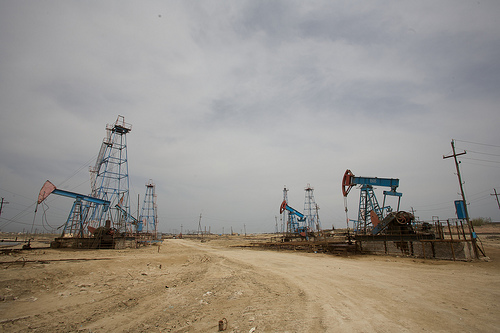
Iraq Daily Oil Production Exceeds 2.6M Barrels

RAW STORY– Iraq’s newly appointed oil minister on Monday said the country’s daily oil production has increased by about 100,000 barrels a day, exceeding 2.6 million barrels per day for the first time in 20 years.

Abdul-Karim Elaibi said Iraq’s production of crude will continue to rise and will reach its planned, higher targets “sooner than expected.”

“Today, our production exceeded 2.6 million barrels a day,” Elaibi told reporters during a ceremony to formally put him in charge of Iraq’s oil ministry after the country’s new government was sworn in last week.

“We haven’t reached this figure since 20 years ago,” Elaibi said.

Last week, Elaibi also reported an increase by 100,000 barrels a day to 2.5 million barrels a day, saying it was a significant jump in a long while.

Iraq has awarded 15 oil and gas deals since 2008 to international companies in the first major investment drive in more than three decades aimed at strengthening the country’s battered energy industry.

The crude-rich nation plans to raise its daily output to about 12 million barrels by 2017.

Read full article about the increase in Iraq’s oil production here.

Photo by flickr user indigo prime

© COPYRIGHT RAW STORY, 2010

How the Wars Are Sinking the Economy

DAILY BEAST– Nobel Prize recipient Joseph Stiglitz and Harvard budget guru Linda J. Bilmes are revising their original $3 trillion war cost estimate. As Bilmes reports, the Iraq and Afghanistan wars are at least 25 percent costlier than previous projections.

As Election Day draws near, it’s pretty clear: Voters are worried about jobs, the budget deficit and the rising national debt. But behind those issues—behind the ads and candidates’ speeches, behind the rhetoric about “out-of-control” government spending—there lurks a hidden, less-talked-about issue: the cost of the ongoing wars.

Already, we’ve spent more than $1 trillion in Iraq, not counting the $700 billion consumed each year by the Pentagon budget. And spending in Iraq and Afghanistan now comes to more than $3 billion weekly, making the wars a major reason for record-level budget deficits.

Two years ago, Joseph Stiglitz and I published The Three Trillion Dollar War in which we estimated that the budgetary and economic costs of the war would reach $3 trillion.

Taking new numbers into account, however, we now believe that our initial estimate was far too conservative—the cost of the wars will reach between $4 trillion and $6 trillion.

For example, we recently analyzed the medical and disability claim patterns for almost a million troops who have returned from the wars, and, based on this record, we’ve revised our estimate upward to between $600 billion and $900 billion—a broad specter, yes, but certainly also a significant upward tick from our earlier projection of $400 billion to $700 billion, based on historical patterns.

Similarly, our estimates for the economic and social costs associated with returning veterans can be expected to rise by at least a third—the staggering toll of repeated deployments over the past decade.

Read full article HERE.

Iraq War Logs: Secret Files Show How US Ignored Torture

GUARDIAN– A grim picture of the US and Britain’s legacy in Iraq has been revealed in a massive leak of American military documents that detail torture, summary executions and war crimes.

Almost 400,000 secret US army field reports have been passed to the Guardian and a number of other international media organisations via the whistleblowing website WikiLeaks.

The electronic archive is believed to emanate from the same dissident US army intelligence analyst who earlier this year is alleged to have leaked a smaller tranche of 90,000 logs chronicling bloody encounters and civilian killings in the Afghan war.

The new logs detail how:

• US authorities failed to investigate hundreds of reports of abuse, torture, rape and even murder by Iraqi police and soldiers whose conduct appears to be systematic and normally unpunished.

• A US helicopter gunship involved in a notorious Baghdad incident had previously killed Iraqi insurgents after they tried to surrender.

• More than 15,000 civilians died in previously unknown incidents. US and UK officials have insisted that no official record of civilian casualties exists but the logs record 66,081 non-combatant deaths out of a total of 109,000 fatalities.

The numerous reports of detainee abuse, often supported by medical evidence, describe prisoners shackled, blindfolded and hung by wrists or ankles, and subjected to whipping, punching, kicking or electric shocks. Six reports end with a detainee’s apparent death.

As recently as December the Americans were passed a video apparently showing Iraqi army officers executing a prisoner in Tal Afar, northern Iraq. The log states: “The footage shows approximately 12 Iraqi army soldiers. Ten IA soldiers were talking to one another while two soldiers held the detainee. The detainee had his hands bound … The footage shows the IA soldiers moving the detainee into the street, pushing him to the ground, punching him and shooting him.”

The report named at least one perpetrator and was passed to coalition forces. But the logs reveal that the coalition has a formal policy of ignoring such allegations. They record “no investigation is necessary” and simply pass reports to the same Iraqi units implicated in the violence. By contrast all allegations involving coalition forces are subject to formal inquiries. Some cases of alleged abuse by UK and US troops are also detailed in the logs.

Read full article on Iraq War Logs.

© COPYRIGHT GUARDIAN, 2010