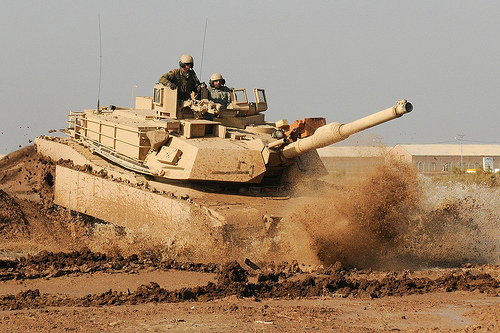
MR Translation – Wars: Press Coverage in Arab Media Pt 2


MEDIA ROOTS – The U.S. corporate media avoids contextual analysis of complex issues solely to attract more viewers and obtain greater advertising revenue.  By promoting caricature and sensation, the establishment media avoids critical analysis of the political incentives which motivate modern conflict.  Translation helps overcome U.S. media’s deficiencies by allowing narratives to cross linguistic boundaries.  Dr. Nasr Ad-Din al-‘Aiadi’s chapter in the book Wars: Press Coverage in Arab Media analyzes the relationship between media and war.

Christian Sorensen for Media Roots


TRANSLATION

“War is like an aging actress: more and more dangerous and less and less photogenic.” – Robert Capa, American photographic journalist

What is the distance between certainty and delusion?

The literature and discussion, which circulated during the War on Iraq, confirms a lack of information about Iraq’s internal circumstances prior to 9 March 2003.  The bulk of battlefield operations remained far from the “parasitism” of journalists and covered up what the military produced: victims, prisoners of war, destruction, and ruin.  This confirmation implicitly reveals a prevailing silent faith in professional and academic circles, and assumes media present objective, complete information about war.  Why this faith?  Because there is a preconception that media have presented complete information about wars and previous conflicts.  To disperse this delusion, we can ask: What did we witness about the Falkland Island War (the Maldives War), which broke out between the British and Argentinians in 1982?  And what did we witness about the Iran-Iraq War, nicknamed “The Bus War,” which lasted eight years?  It earned this name because the Iraqi Army was organizing bus trips for journalists to see Iranian prisoners of war.  In turn, the Iranian military was transporting journalists in busses to view Iraqi prisoners of war.  Everyone knows that journalists were not permitted to move to the battlefield, which would have conveyed the destructive war’s reality and would have shown war’s multi-dimensional tragedies.

What did we see of the following wars: the Second Gulf War and the War on Afghanistan, the events of which are still alive in individual and collective memory, in front of insistence by the American Armed Forces and Taliban to prohibit media field work?  The Americans and the Taliban pushed the media to capture stereotypical images or clichés in order to signify the presence of war: images of planes taking off from battleships; planes hovering in the sky amid clouds of smoke; anti-aircraft missiles piercing the darkness; a man in Afghan garb smiling and shaving in front of the camera crews; and the corpse of a civilian slipping by the camera’s lens, lying on the sidewalk, without us knowing who was behind his death.

Indeed these images, to which one can add the “concentrations” of Afghan refugees along the Afghanistan-Pakistan and Iranian-Afghanistan borders, do not convey the war led by the five wealthiest countries of the world against the poorest countries of the world.  Rather, such visuals reproduced stereotypical imagery far from the furnace of war, which convert the scenes into a simplified visual record, and leave one to dig into prejudices without raising any questions.  In short, war coverage in Afghanistan was like trying to describe a black cat in a dark room, as the Vice President of Fox News Channel put it.

As a matter of accuracy, one can say there are indeed very few examples of media succeeding in highlighting war’s ugly face.  Among them: the early days of the launch of the War against Afghanistan and the latter years of the War against Vietnam.

Maybe some believe that confirmation of a lack of information about the War on Iraq translates practically into the following judgment.  Much has changed recently in the media world.  There has been a rise in the number of media outlets, an increase in furious competition among them, and development in their technological arsenals, especially the speed with which they transmit linked, digital information directly to studios and newsrooms.  There has been a rise in the pace of this flow, along with the potential to monitor events in a more professional manner.  Despite all, humanity still suffers from a scarcity of information and news regarding the war.  Indeed, technology cannot eliminate the distance between certainty and delusion.  War contributed to overthrowing this illusory visualization, which links advanced technology, the right to complete information, and freedom of expression and the press.  Perhaps this fact propelled some researchers to confirm “the demise” of the fourth power.  

A French cameraman, Jean Claude Cousteau once said:

War had been perceived through a set of familiar images: artillery shelling and air bombardment; anti-aircraft armed response; the movement of military units; ambulances racing onto the battlefield, transporting the wounded and injured; explosions; body parts strewn amid the rubble of a car bomb.  We can convey war in more depth and greater detail in the photographic image.  For example, consider highlighting a woman who is skinnier than her shadow, wrapped in sorrow, in a residential, grey neighborhood in the former Yugoslavia.  She lays out her laundry, limited to military uniforms.  This image might enrich the view of war.  We might likewise tell about the war in Bosnia through the image of a Bosnian grandfather displaced from his town.  He left aboard an old Fiat, carrying his humble belongings.  An old picture of his father wearing a Tarbush stands out among the man’s belongings.

However, in light of a view of war and armed conflicts still under “formation,” we believe the media condense some images, which turned into religious icons through their frequent repetition.  These images became evidence to comprehend the conflict on the one hand and to justify it on the other hand.  For example, many camera crews were physically standing amid the Israelis to capture images of the sons of the First Palestinian Intifada, but they were largely exempting the Israeli soldiers from their images!  Within this shortcut, we find that the Palestinian martyr is translated, in visual media in a solemn procession of large crowds, which raise his coffin wrapped in the Palestinian flag, to his final resting place, amid wails and gunfire, and slogans of various Palestinian organizations.  In contrast, a dead Israeli is symbolized by the remainder of a bus, by ambulances and tanks circling Palestinian villages and towns, by Apache helicopters pouring its wrath upon populated district in which “one who is wanted” by Israeli soldiers lives.  Indeed, the first images produce grief, sorrow, and perhaps compassion and empathy.  The second images don’t include the violent military response only, but justify it.

Can one develop a way of dealing with media without varying its content?

The U.S. Armed Forces created a new relationship with the press and various media known as “embedding,” whereby the Americans recruit “press representatives and attach them to military units” on the battlefield.  For the first time in media’s history, roughly 600 press representatives joined the allies’ forces.  Some professional organizations have indeed criticized this practice, expressing their fears that it is a serious violation of the journalist occupation, since the “recruited” press representative commits in writing to respecting 50 articles of a document that defines their “new” life.  This whole process revolves around a lack of penetrating “military secrets,” like that of any soldier!  Articles 41, 42, and 43 of the same document stipulate the prevention of airing images of military units without approval of the American military authorities!  Perhaps the concerned authorities realize verbal communication possesses the flexibility, word play, and metaphors, which allow one to communicate better than imagery alone.

Some reporters who lived through this experience have tried to dispel these fears by affirming that what they’ve gone through is considered a positive step in news coverage on the conditions of war.  In previous wars, reporters were far from the battlefield and were only permitted to transmit what commanders clarified in press conferences, which were held regularly and which nearly turned the media into a loudspeaker for the military.  This war is different, as one of the French press “recruits” confirms: “I descended into the battlefield and witnessed what happened on the level of individual military units with whom I travelled.  I was content to write what I saw,” wrote one embedded French journalist.  Mr. Claude Bruillot, a broadcast journalist from France 24, affirms his side of the story: “While what I reported about war, originating from the American military unit to which I was attached, was partial and incomplete, it was still factual and real.”

If some war correspondents were considering their experiences with Coalition military units as embodying a development in their profession during wartime, then for the following reasons they had a hard time convincing the media masses of this “qualitative step,” which the media made in covering the aforementioned war: Armies don’t usually agree to publish images, except for those which highlight their victories.  History is always written by the victors.  If they do not, then they need to, maybe even forcefully, go against all who try to write it without their consent.

The formula for dealing with reporters has changed its shape.  But has its meaning changed in light of the absence of multiple sources and the absence of possibly using non-military news sources?  Certain circumstances justify asking that question.  Among them, the difficulty reporters face in moving around alone on the battlefield, the lack of space within which to work, and the fact that they’re unable to investigate what is presented to them as “official” information.

In war correspondents’ media discipline, freedom to act independently always remains in newsroom officials’ hands, far from battlefield realities.  Freedom to act independently takes on new meaning in the dictionary when dealing with the media: abolishing publishing and broadcasting; delaying or cutting off one’s broadcast to lose the real-time feed, and consequently its importance; rewording or summarizing the events, et cetera.

What do media do to war? Or what does war do to media?

We believe that the sharp debate over the relationship between media and war is still a prisoner of the ancient dilemma and represented in the question: What do media do to war?

This consuming dilemma loaded the debate, drawing attention to media’s coverage of war.  It revealed the dimension of propaganda and misinformation in war reporting, through covering up war’s tragic reality and through recording the allegedly neutral linguistic vocabulary of modern war.  For example, “clean war,” “surgical war,” “smart rockets,” “neutralizing the enemy force,” and other such vocabulary switch, in the long run, from explaining the misinformation to justifying it on one hand.  And on the other hand this vocabulary overlooks details known to the media establishment, like recent developments, the forms of their interaction, and comportment with the reality of wars and armed conflicts.  Many justifications are used to confer legitimacy upon media’s “deficiencies” in armed conflicts.  We recall two justifications, which begin from different starting points, but integrate well as the arguments progress:

The First Justification: Some believe that the media blackout in wars and armed conflicts is almost necessary and incontrovertible, because “armies are intent on secret planning and military operations, and are intent on not restraining the soldiers’ determination.”  One can infer from this statement that armies do not possess a deliberate intention to deny the public of their media rights, but rather are just striving to adhere to their legal right to protect military secrets!  Those who believe in the validity of this view argue that armies are changing their methods of dealing with journalists during armed conflicts.  So the armies no longer prevent journalists from reporting on war events, and no longer deal with the media by cutting their communications and content haphazardly, but rather become a frame within which media must work.  In this regard, Director of Press Service for Media Delegation and American Military Communication, Colonel Tangy, says:

“We came to establish press centers regularly on the battlefield.  The goal of setting up these centers is to put information and news at journalists’ disposal in all neutrality.  We began from a principle, which insists that whoever speaks in the name of the army should always tell the truth, but this doesn’t mean that he should speak the whole truth.”  

The Second Justification: The French researcher Armand Mattelard (1992) believes media’s forceful persuasion and its capability to “create” and erase events emerged at a very early time in the history of mass communication, and that war has only reinforced media’s persuasion.  These events resulted in giving legitimacy to media censorship.  This is the same legitimacy which competent authorities use to justify the measures they adopt in order to limit media activity in any armed conflict.  This all started from previous events in which public opinion impacted the course of military operations.

Consequently, one understands from the previous two components that war granted armies legitimacy to “control” the media.  Armies used this legitimacy to highlight an event, to conceal it, or to draw attention away from it.  Consider the U.S. invasion of Panama during a time when events in Romania led to the death of Ceausescu, the Romanian head of state.  Despite the fact that the number of casualties from the invasion of Panama was double the number of casualties from events in Romania, nobody talked about the heinous massacres that the U.S. military perpetrated in Panama.  The reason is clear.  The United States of America had imposed an airtight media blackout of this invasion.  In comparison, media exaggerated what happened in Romania in an immoral and unprofessional manner.  Media exaggerated events in Romania for the sake of hiding the massacres that the U.S. military committed in Panama.

The extent of this control in the media doesn’t stop at “filtering news and information,” but extends to the control media have over war’s image in the audience’s imagination, whether by altering the grounds which the concept of war covers, or by concealing its real goals and presenting them as if they are necessary to attain some humanitarian ideal.

This is the framework within which wars and armed conflicts were diagnosed.  In other words, wars and armed conflicts were linked to certain people, like political leaders and heads of state.  Indeed, this diagnosis explains wars and armed conflicts through factors far from the economy, society, or politics, where war is linked to certain individuals’ behavior and to subjective and personal inclinations.  In this context, it approaches chapters of war and armed conflicts as if they were Westerns, in which a good cowboy fights an evil cowboy.  Or media give a simple, naive explanation for wars, like saying that World War II broke out due to Adolf Hitler’s coarse disposition and mood swings!

Military experts, who comment on events and entice studio correspondents, also enter involuntarily within the aforementioned endeavor.  Television channels now have an honorable and defiant desire to use all possible means to transmit the facts of war and explain the military strategy used.

Due to repeated scenes and an absence of images and information about war’s on-goings, this presence slid into what resembles an athletic sports match: players are on the field, while coaches and specialists comment on the contest from the studio.  And so, on a symbolic plane, war transformed into a spectacle absorbing humane and permanent elements in order to open the field to dramatic content and commentary of the conflict.  The aforementioned concepts and methods used were incapable of changing the image of war, armed conflicts, and its goals pertaining to collective consciousness.  

We believe that now is the time to approach the relationship between war and the media from other angles.  Among them: What do wars do to media?  This dilemma, if filled with scrutiny and precision, can withdraw the aforementioned debate from a domain of justification and place it on the platform of critical review in order to analyze what media does during wars and armed conflicts.  This will occur in order to upgrade the media profession, despite difficult circumstances which might ultimately take the journalists’ very lives.  This will also occur for a new debate to explode around media’s relationship to reality, around media’s moral and literary responsibility, and about standards to evaluate media’s credibility.

Who said media is satisfied with simply transmitting news during war?

The lack of information about the War on Iraq is reflected in a belief, which is considered genuine to some and naive to others.  This belief indicates that media’s job remains the same regardless of the context within which it is active.  In other words, the functions that direct media’s activities stay the same whether in circumstances of war or in a peaceful context.  Indeed, trying to escape from the burden of this belief should not be understood as a blessing to what media does, but should be understood as describing earlier experiences.  Has it not been said in the past that propaganda is the legitimate daughter of wars?  Historians confirm World War I created propaganda, and specified propaganda’s initial definition as follows: the overall activities and work that a government undertakes to influence the citizenry and public opinion.  This concept had developed in World War II to become synonymous with psychological warfare, which includes disinformation, rumors, spreading false reports, and misinformation.  Wars have changed media’s roles, since wars pushed media to incline towards propaganda more than information.  Can it be said that media, which belong to states involved in war or are a party to these states, had strove to stand up against this inclination and succeeded?

The examples that proved this success were regrettably very few.  The famous satirical French newspaper Le Canard Enchaine came into being for rejecting war propaganda and government censorship of the press.  Wars had supplied the public with a fundamental lesson: many media outlets toe the line between information and propaganda, a line which could be destroyed if the horrors of war intensified.

Then, one should ponder the most useful and most feasible ways to take a stand against media’s transformation into an obedient instrument of psychological warfare during armed conflicts, as evidenced by its submissiveness to the justifications, which we touched upon in asking “what do media do to war?”  We believe diversifying news sources and preferring neutral ones is the first way to take a stand.  And if neutral sources cannot be reached, then the source from which news is derived must be confirmed.  This assurance addresses the audience clearly and implicitly, and directs their attention to the necessity of dealing with this news cautiously or to put its content in parenthesis.

Offering parameters within which news and images should function is the second way to take a stand against media’s transformation.  Many armed conflicts have demonstrated that numerous television images, which pour forth abundantly, do not specify the time, place, or context within which the images were produced.  Television screens overflow with these images, manipulating the viewers’ emotions without teaching them anything.  Images fit for consumption without an expiration date; these scenes paint war as the military wants it to be and not as it occurs in reality.  So images, contrary to what some believe, are not credible documentation of events as they occur, but are rather less accurate in transmitting or expressing reality.  This is because images are tied to a framework, which introduces some elements into the visual field and excludes other elements.  It is sufficient that we alter the framework, which includes the image itself, until we change the meaning and exchange it with the “truth.”

Note:  For all original citations and formatting, please consult the original text.

Translation by Christian Sorensen for Media Roots

***

Photo by Flickr User Truthout.org
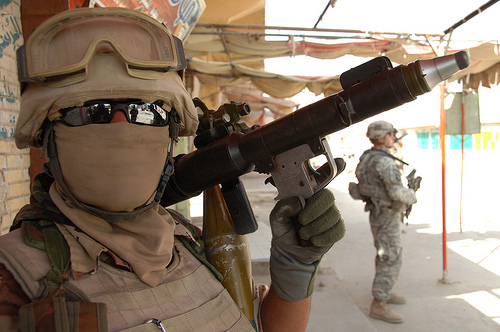

MR Translation – Wars: Press Coverage in Arab Media

MEDIA ROOTS – The Pentagon and corporate media actively promote the War on Terror meta-narrative, which restricts our society’s ability to view war.  As an educational activist, I’ve decided to start translating Arab political scholarship in order to present a necessary alternative narrative to the U.S. public.  The preface to the book Wars: Press Coverage in Arab Media is a specific text I chose with the intent of challenging readers.  By breaching linguistic hurdles and circulating diverse worldviews, concerned citizens can chip away at the War on Terror’s monopoly over our media.  
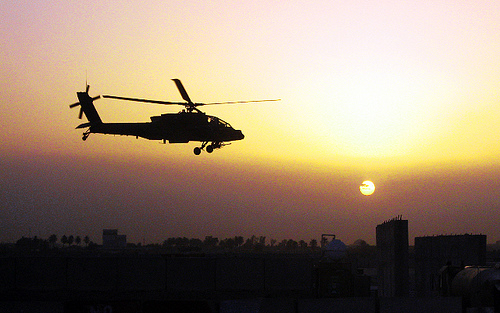
This translation offers a U.S. audience the opportunity to synthesize diverse viewpoints of recent armed conflicts.  In stark contrast with U.S. corporate media, this author (‘Abdullah al-Kindi) frames the 1991 and 2003 Gulf Wars within a broader historical and social context.  This background includes discussion about the Israeli-Palestinian conflict, Islam, imperialism, pan-Arab unity, media failures, military propaganda, and the human suffering inherent to all wars.

Christian Sorensen for Media Roots


TRANSLATION

The Second Gulf War, 1990-1991:

In its entirety, the Second Gulf War (1990-1991) burdened all aspects of life in the world in general, and in the Arab world in specific.  With regard to the Arab world, this war put to test all theses about Arab unity and Arab national interest. The Arab world, with its diverse orientations and varied concerns, was not a unified tribal kinship following Iraq’s invasion of Kuwait on 2 August 1990, despite statements from public figures regarding Arab unity, interest, and alignment.

Along with slogans and statements, border disputes were perhaps the most prominent among all the unresolved or pending problems in the Middle East.  In some cases these problems even developed into occasional skirmishes and led to dead border patrol troops.  By the end of the 1980s,  the majority of Arab countries had joined regional councils (e.g., Gulf Cooperation Council, Arab Cooperation Council, Arab Maghreb Union) in addition to the Arab League, which was the most comprehensive and important institution for Arab countries.  However, these councils and unions did not implement any real solutions for the unresolved border disputes, even though they’re “artificial,” “imperial” borders left over from the colonial period and from Western imperialism, which insists on the borders’ continuation to serve their regional interests.  Just as colonialism and the West have their own interests, Arab countries also have interests and wants, which should surpass those of the colonialists in order to eliminate these regional landmines, which could go off at any moment.  This problem exemplified the most important cause of the Second Gulf War.

The Palestinian Cause also represented one of the reasons for the Second Gulf War.  This Cause actually began with the Israeli Occupation of Palestine in 1948, and was followed by the wars of 1965, 1967, and 1973 between the Arabs and Israel.  Then the Israeli invasion of Lebanon came in 1982.  When Iraq decided to occupy Kuwait, it confirmed that it would liberate Palestine through occupying Kuwait, and demanded that Arab nationalists and Islamists support Iraq to confront the “imperial” force, which is allied against the Arabs and Muslims.

In connection with the goal of liberating Palestine, Iraq also announced its rejection of “imperialistic” and “artificial” borders among Arab countries as a means to achieve Arab unity, along with re-dividing the wealth among the Arab countries in order to bring about balance and to achieve comprehensive development throughout Arab countries.  Since the beginning of its occupation of Kuwait on 2 August 1990, Iraq cited many reasons for its invasion, which were the subject of controversy and disagreement among Arabs, Muslims, and across the world.  The Arabs and the world were divided between supporters and opposition.   Accounts overlapped, alliances varied, and issues renewed.  Each party gathered their opinions, demands, and aims, just as each one of them employed all they owned, including media, material, and military means.

For the first time since the Palestinian Cause began in 1948, Arabs differed regarding an issue’s fundamentals: Iraq raising the goal of liberating Palestine as a slogan for invading Kuwait.  Consequently, the “fundamental” nationalist cause weakened, and wasn’t even considered an issue after the Arab armies faced one another.  On a religious level, after Iraq opposed Iran and its Islamic Revolution in a war that lasted eight years (because it didn’t affect Arab nationalism and control over the region) Iraq returned in the Second Gulf War (1990) to demand Arab and Islamic unity in the face of the imperial invasion.

In the name of the Islamic religion, two seminars were also held during the build-up to the war.  The first was held in Mecca on 13 September 1990 to justify summoning foreign forces to expel Iraq from Kuwait and eliminate Iraq’s threats and greed from the region.  Earlier, a counter-seminar was held, also in the name of Islam, in Iraq on 17 August 1990, which refused to accept the summoning of foreign forces and forbade recourse to the infidel.  Iraq invoked Islam despite an indication from Denis Halliday, who was Director of Personnel at the United Nations Development Program at the time, that Saddam Hussein didn’t ever occupy the forefront of radical Islam, since Saddam had fought with Islamic Iran and had broken with dissenting religious men within Iraq.

As for the global media’s coverage of the crisis in the Gulf, I will be content mentioning some examples of research, which clarify some media characteristics.  Then I will touch upon the layout of the Arab media and its positions regarding the crisis in the Gulf.  Two researchers, Abbas Malek and Lisa Leidig, conducted a study that analyzed the American press’ position on the Gulf War, and whether U.S. newspapers had put forward diverse ideas or whether the press, in short, relied upon the official viewpoint in assessing the crisis, and consequently mobilized the general opinion commensurate with the political administration and Pentagon’s narrative.  

Malek and Leidig selected the New York Times and the Washington Post for analysis.  According to the researchers, these two newspapers covered a wide range of local and international events.  These two newspapers are also considered liberally elitist and critical, and do not hesitate to publish what might contradict the governmental point of view.  The Washington Post’s disclosure and publication of the Watergate scandal and the New York Times’ publication of the Pentagon Papers are considered notable examples confirming such descriptions.

Malek and Leidig’s study spanned 2 August 1990 – 16 January 1991, before Operation Desert Storm began on 17 January 1991.  Through this study, one can determine some observations about U.S. press coverage of the Gulf War.  The first observation, based on the study’s results, is that the tacit relationship between the government and the media might affect the democratic process in the U.S. through influencing the newspapers’ positions.  These two newspapers under study did not dispute or oppose the U.S. government’s decision to send its troops to the Gulf, because some government officials, according to the researchers’ opinion, had influenced the newspapers to not oppose the government’s decisions, especially since those officials were the lone official sources of news and information regarding the administration’s positions on the crisis.  The study’s second observation is that the U.S. newspapers presented the Gulf crisis in a manner, which bolstered the legitimacy of the administration’s decisions and consequently the legitimacy and validity of the administration’s decision to go to war against Iraq and send troops to the Gulf.

Perhaps one of the most important indicators about global media coverage of events in the Gulf is the absence or scarcity of a critical or dissenting tone from within the allied countries against their respective governments’ decision to go to war, as indicated by a University of Oklahoma study.  This study, entitled Telling the Gulf War Story: Coverage in Five Papers, focused on the news stories published about the Second Gulf War in five international newspapers.  These papers were: the Washington Post, Germany’s Frankfort Algamaina, France’s Le Monde, Britain’s The Times, and Japan’s Asahi Shimone.  This research group indicated media content during wartime didn’t reflect the events of the crisis, but simply was reconstructing events and presenting them to society in accordance the media’s preconceived visions and orientations, and not necessarily reflecting the reality of events in the Gulf.  The research team expected the five newspapers under study to have similar positions on the Gulf crisis on the grounds that the newspapers predominately belong to similar economic and political ideologies, and also all belong to countries that give more space to their newspapers to inquire and debate their governments’ respective policies.  Although this study confirmed the absence of a voice critical of the allied governments’ entrance into the Gulf War, it also clarified some discrepancies, which arose among the newspapers studied in their presentations of the Gulf War story.  For example, Le Monde was the one newspaper, among the five, which focused on the war’s moral and humanitarian side and inquired about the war’s necessity.  However, the other four papers presented the Gulf War story in a context of military operations with only slight differences among them.

These observations about the U.S. position and global press may raise some questions about the media establishment.  If these observations lead to demands for media independence and pride in finding the proper balance of professionalism, objectivity, and rich history, then the following observations of the Arab press shouldn’t surprise anyone about the work of this press.  The Gulf War divided the Arab world into two groups.  The first group consisted of the six members of Gulf Cooperation Council, in addition to Egypt, Syria, and Morocco.  These countries not only refused to accept Iraq’s invasion of Kuwait, but also participated in the international coalition.  Besides Iraq, the second group consisted of Jordan, Yemen, Sudan, Algeria, Libya, and the Palestine Liberation Organization.  A third group of Arab countries didn’t clarify their respective political positions on the Gulf War.  This force, which included Lebanon, Tunisia, Mauritania, and Somalia, affiliated with both the first and second groups.

To a large extent, the Arab press aligned its positions on the Gulf crisis with Arab government policies, as was shown in the previous paragraph where Arab newspapers were divided into three main categories.  The first category included newspapers of the Arab countries allied against Iraq, specifically the Gulf Cooperation Council countries, Egypt, Syria, and some Moroccan newspapers.  Nicolas Hopkinson’s 1992 book War and the Media indicates the majority of Egyptian national newspapers, like al-Jumhurria, al-Ahram, and al-Akhbar, rejected Iraq’s invasion of Kuwait.  Likewise, the Wafd Party’s eponymous newspaper, al-Wafd, forcefully criticized the Iraqi regime and called on Saddam Hussein to withdraw from Kuwait.  ‘Adil Darwish’s 1991 essay Allah Is Enlisted by Arab Armies confirms the most important observation regarding this type of newspaper coverage, especially al-Ahram’s.  He states that space was given to authors who oppose war in the Gulf, and to those who were occasionally indicating the war in the Gulf was an oil war for the sake of Western interests and was not about liberating Kuwait.

Syrian media conveyed the official government viewpoint and mobilized Syrian public opinion to support it.  Consequently, Syrian media presented a single picture of the crisis in the Gulf.  Through the media, it rejected the Iraqi invasion and sought to persuade Syrian public opinion of the legality and validity of the official Syrian decision to send troops to the Gulf.  The situation didn’t differ much in newspapers of the Gulf Cooperation Council countries – if they didn’t match up completely – from the Syrian newspapers’ positions and most of the Egyptian newspapers.

The second category of Arab press coverage of the Gulf War included newspapers from countries that supported Iraq’s positions, demands, and claims.  Perhaps the clearest examples of newspapers in this category, after the Iraqi newspapers, are the Jordanian newspapers, which supported Iraq without exception and continually criticized the international coalition.  In Jordan, the newspapers presented a single image of the crisis, reflecting the official government position.  Consequently, the newspapers shaped public opinion in line with support for Iraqi demands, and over time accepted the idea that occupying Kuwait would lead to the liberation of Palestine.  Karam Shalaby, in his 1992 book Media and Propaganda in the Gulf War: Documents from the Operations Room, indicates that the Jordanian media aligned its positions with the government’s official stance throughout the crisis.   It even “became an extension of the Iraqi media and propaganda, in all its aims and approaches, even in the vocabulary that this propaganda used in its daily rhetoric to the Arab masses.”

The third category of Arab newspapers – consisting of papers from Egypt and Morocco – represents a distinct phenomenon in the characteristics of Arab press coverage of the 1990-1991 Gulf War.  These two countries rejected the Iraqi invasion of Kuwait and even sent their troops to join the international coalition.  However, some of the newspapers in these two countries adopted different positions in evaluating the crisis.  ‘Awatif ‘Abd al-Rahman, in her essay entitled Manifestations of Media Dependency in the Gulf War, indicates the Moroccan newspapers adopted an anti-Western position  and tried to emphasize the necessity of an Arab solution to the crisis.  According to ‘Abd al-Rahman, the Moroccan press criticized the government’s decision to send Moroccan troops to the Gulf, and confirmed that this war only aimed at controlling oil in the Middle East.  The newspaper Al Bayane, the voice of the Party of Progress and Socialism, was the lone exception to the Moroccan newspapers’ positions on the crisis in the Gulf.

Karam Shalaby’s results are summarized as follows: 1) Media in countries with totalitarian regimes didn’t permit the allotment of space for opinions, which diverged from or opposed the official viewpoint.  Consequently, under these regulations the media resorted to adjusting to the public’s desires or to besieging the masses with inflammatory propaganda. 2) There was space in multi-party Arab countries for other opinions that differed from the official viewpoint, however only in newspapers, party pamphlets and political rallies.  Meanwhile, these same multi-party countries kept rejecting any expression or indication of viewpoints that disagreed with the television viewpoint, which was broadcast on government television channels and radio media. 3) The two sides of the Arab media – supporters and the opposition – relied on international news sources. 4) Media of the two sides – the supporters and opposition – relied on the use of Islam as a text, legal canon, and symbol as propaganda to justify their stances and to validate their claims.

‘Arafan Nidtham ad-Deen continues in the same critical direction. He determines that because of the Second Gulf War, the Arab media in all its contrivances and means “paid an exorbitant price for this disaster. This occurred at the expense of its reputation, the honor of its profession, its ability to interface with events and be affected by them, affect public opinion, and translate its hidden and declared aspirations and emotions.”

Nidtham ad-Deen’s results do not differ from those which Karam Shalaby and other researchers recorded about the Arab media’s performance during the Second Gulf War, except in some points, such as: 1) The Arab political division was reflected in the media, which led to political excitement and positions attempting to control professional work, and consequently affecting the media’s credibility. 2) Passion trumped logic and instincts overcame reason. 3) The prevalence of a case of apparent confusion over the media’s performance – the supporters and the opposition – from the beginning of the crisis until the ceasefire.

Overall, Karam Shalaby spoke about the Arab-Arab confrontation with respect to the Arab media’s performance in the Second Gulf War (1990-91). Khalil ‘Ali Fahmi’s 1991 study entitled A Gulf of Misunderstanding confirmed that this war created another confrontation between the Arabs and the West, represented in the Arab and Western media’s respective positions on this war.

Fahmi’s study focused on the op-ed sections in The Times (London) and al-Ahram (Cairo) and their coverage of the Second Gulf War.  Through his analysis of these op-ed sections, Fahmi arrived at the conclusion that the War wasn’t presented as a confrontation between the Arabs and the West or between the Christian West and the Muslim East, which Fahmi considers a positive aspect in terms of cultural continuity between the West and  the East.  However, the two newspapers’ stances on the Second Gulf War contradicted the stances they had recorded on the First Gulf War between Iraq and Iran.  Fahmi described this contradiction as media hypocrisy.  At a time when The Times tried to justify the 1991 War on Iraq from a moral standpoint and refused to tie the war to the Palestinian Cause, al-Ahram wasn’t able to present an Arab or Middle Eastern narrative for that war.

Carrie Chrisco’s 1995 study, entitled Reactions to the Persian Gulf War: Editorials in the Conflict Zone, analyses six daily, English-language editorials in Middle Eastern newspapers.  Carrie confined her research on the 1990-1991 Gulf War to the following newspapers: The United Jordan Times, The Arab News (Saudi Arabia), Syria Times, Jerusalem Post (Israel), Arab Emirates News (United Arab Emirates), and Kayhan International (Iran).

In chapter one of her study, Chrisco depicts media’s role in covering the crises and wars, confirming media manufacture war’s image and reality that it wants in accordance with its political and cultural affiliations.  Chrisco believes she should focus on editorials and study them in order to explore what media actually manufacture during periods of crises and wars.  In the same chapter, Chrisco presents many studies of media’s performance, focusing on analysis of newspaper editorials.  She catalogued twelve separate pieces of research spanning 1935 to 1991.  Chrisco’s study relies on two levels of analysis.  On the first level, she analyses the six newspaper editorials’ topics, analyzing the actors and themes contained within.  On the second level of analysis, she appraises the values in Middle Eastern newspapers (through the sample research).


The Third Gulf War, 2003:

Before the American-British campaign against Iraq began on 20 March 2003, the world had entered a phase of psychological and practical readiness for a new war.  The media presented continual coverage of the events that preceded the war, especially hearings and debates of the United Nations Security Council and international and regional organizations.  This coverage helped the public to achieve a high degree of what to expect in terms of the war’s timing, probable results, and its particular strategic scenarios.

The global media’s fundamental and early attendance to the Third Gulf War came as a professional accumulation and reflection of actual developments in the global media layout after the Second Gulf War, the war in the Balkans, and the U.S. campaign against Afghanistan.  This war, more so than any other wars or crises, became present in media and television coverage in general, and was shown around the clock on most global television channels in an unprecedented manner.  Hence, a few comparisons between the latest war and the Second Gulf War (1990-1991) might assist in clarifying some professional developments – whether negative or positive – which materialized over twelve years of war coverage.

In quantitative terms, the global public was becoming acquainted with the idea of live and direct broadcasting on CNN and BBC from the site of any event in the Second Gulf War (1990-1991).  However, with the Third Gulf War, satellite channels from all over the world, in their various languages and perspectives, competed with armies to enter Baghdad.  While some observers had indicated the presence of close to 1,400 journalists in the Saudi desert to cover the Second Gulf War, the number of journalists who deployed to cover the Third Gulf War reached roughly 5,000.

The strategy of “news briefs and press conferences” had proven its importance in the Second Gulf War, so it was consequently kept as a strategy of dealing with the media in the Third Gulf War, this time from U.S. Central Command headquarters in as-Sulailia, Qatar.  On the other hand, the 1990-1991 strategy of news pools, which prevented the press from getting close to the battlefields unless accompanied by a military escort, was replaced with a new strategy in Third Gulf War.  This new strategy was named embedded journalism.  However, through reading the available literature on the coverage of wars and crises, it became clear that the concept of embedded journalism was not a new invention particular to the War on Iraq.  Morand Fachot indicates that embedded journalists materialized for the first time during World War II at the hands of the Americans, and specifically through the Office of War Information, as it was called at the time.

In the Third Gulf War, war activities doubled in the media, when the latter declared itself as a Third Army trying to take a neutral stand.  By “activities,” I mean the collective practices that are advanced by the belligerent parties militarily in dealing with the media.  These practices affect media’s performance.  In the Third Gulf War, the following practices fall within the expression media war activities:

Military control over press coverage: The two belligerent parties (the Coalition and Iraq) adopted a strategy of military control over media coverage.  The British-American alliance seemed very concerned with military briefs from U.S. Central Command headquarters in as-Sulailia, Qatar.  Included within the concept of military control, the Americans confirmed the importance of the idea of embedded journalism through the clear and candid justification presented by the Defense Department, which says:  “This system’s goal is to present the facts to the American public and the public in coalition nations, which can affect their opinions and positions regarding the Coalition.”  Military-media briefs were also an Iraqi strategy, but the Iraqi spokesman, Information Minister Mohammed S’aid, was a journalist and not a military leader, as in the case of the Coalition.

Harassing journalists, preventing them from performing their media jobs, and even expelling some of them:  This kind of harassment started even before the war began on 20 March 2003.  For example, the United States banished Iraqi news reporters from New York in the beginning of February 2003.  So the Iraqi government responded on 16 February 2003 by expelling four Fox News reporters.  These practices escalated during the war, which affected media coverage of the war.  At this point, one must point out some examples that many institutions, associations, and unions concerned with protecting press rights witnessed:  Iraqi authorities demanded CNN reporter Nic Robertson leave the country on 21 March 2003;  Coalition Forces bombed the Iraqi Information Ministry on three consecutive occasions: on the 25th, 29th, and 30th of March 2003;  On 31 March 2003, Iraqi authorities prevented the Reuters news agency from supplying CNN with images of inside Iraq;  American forces bombed the Palestine Hotel, which is located in the Iraqi capital of Baghdad. The Palestine, as it is known, was the headquarters of most international media reporters.  American forces also bombed the headquarters of two news channels: Abu Dhabi and Al-Jazeera.

Killing journalists through bombing their media centers. Some others die in separate instances:  The Third Gulf War was described as the most dangerous war and the most lethal in terms of journalist casualties.  From 20 March 2003 – 8 April 2003, fourteen journalists from various countries died.  This number is considered large when compared to the four journalists who had died over a longer time period during the Second Gulf War.  Although journalists had advanced knowledge about the high degree of danger they face in warzones, including death, the phenomena of intentionally targeting journalists is considered a dangerous development in the Third Gulf War. Suffice it to say, the bombing of Al-Jazeera and Abu Dhabi headquarters and the Palestine Hotel, both of which were known and clearly defined media centers, provides evidence of this premeditation.

Consequently, the belligerent parties presented media with much danger, prohibition, distortion of facts, and misinformation.  Media personnel were even exposed to the dangers of bodily harm and “friendly fire,” which is when friendly military forces accidentally shoot allied units.  A component of intentional bodily harm reinforces the idea that the media are turning into a “Third Army” in wars and crises, as it also gives evidence to new precedents in dealing with the media.

Despite the dangers inherent to journalism in war zones, intentional bodily harm is a new precedent set by this war.  Describing 9 April 2003 as “Black Journalist Day” is a logical and natural portrayal.  For on that day, the American forces decided to intentionally confront or terrorize the “Third Army” when they bombed the Palestine Hotel, out of which journalists from around the world were based.  Taras Protsyuk from Reuters and Jose Couso from one of the Spanish channels were killed in the bombing.  American forces also bombed Al-Jazeera’s headquarters, claiming the life of Jordanian journalist Tareq Ayyoub.

The Third Gulf War was a suitable opportunity for some Arab media establishments to impose their presence on the regional media layout, and even embrace internationalism when many global media outlets began transmitting war developments and activities of some Arab satellite channels in Iraq, like Al-Jazeera, Abu Dhabi, and Al-Arabiya.   Professional evidence attests to these channels’ intensive and outstanding presence.  Examples of this include live and direct broadcast around clock, which contributed to their transformation into essential news sources for some global television channels.  These Arabic satellite channels, which are supported by numerous correspondents across the Arab world, are no longer just a source of television images for global satellite channels.  For example, some global newspapers in France and Britain even allocated sections in their daily prints to familiarize their readers with Al-Jazeera’s on-going coverage of the Third Gulf War.  Differences and debates remain over the Arabic channels’ performance, which is a testimony to their vitality.  While the global media were busy with the war in the Gulf, many observers and parties concerned with media, military, and political issues were preoccupied with the performance of some Arab satellite channels.  One can read these debates about the Arab media in a lot of literature, which became available in an unprecedented manner.  The political circumstances in the Arab world and media in general had assisted in achieving this new global presence.

While the Second Gulf War (1990-1991) had divided the Arab world into two groups, the Third Gulf War was causing disagreement and dissent among the majority of official Arab organizations.  Even the Arab League rejected the war, in case the United Nations was unable to provide international legal cover for the war.  In comparison to the official Arab hesitancy in announcing positions on the recent Iraq War, the overwhelming majority of public Arab opinion was acute and candid in rejecting this war.  This rejection took the form of demonstrations, marches, and institutional, popular, and public protests through some organizations, associations, and professional unions.  This type of clear and obvious distinction between official Arab hesitancy and popular, mass visibility, even if only superficial in appearance, had provided a suitable climate for a new Arab media, especially satellite media, to go in new directions in terms of intensity of coverage and content.

Translation by Christian Sorensen for Media Roots

***

Photo by Flickr User The U.S. Army


CBC Documentary: To Sell a War

MEDIA ROOTS – According to neoconservative Robert Kagan, the USA has been involved in military conflict abroad 70 percent of the time since the end of the Cold War.  Many times, these foreign wars need to be “sold” to the U.S. public in order to galvanize the populace against a common enemy (e.g. Noriega ’89, Saddam ’91, Bin Laden ’01, and Saddam ’03).  This “selling” of war comes in the form of deliberate deception and manipulation by Executive authorities and Pentagon officials.  The Pentagon’s vast resources, propaganda apparatuses, media links, and international ties are crucial in fomenting public support for military aggression.

If we, as a society, want to progress beyond such militancy and avoid future wars of aggression, it is crucial to recognize manipulation of public opinion when it occurs.  The 28 minute CBC documentary To Sell A War details precisely the elaborate lengths to which the Pentagon and Executive Branch will go in order to rally the public for war.  As you will see, nothing is off limits.  

Christian Sorensen for Media Roots

***

Documentary: To Sell a War


***

Photo by Flickr user US Army

Posted in Uncategorized | 1 Reply

Selective Accountability and Apologies for US War Crimes


MEDIA ROOTS
— Early last Sunday, an unhinged U.S. Army Sergeant walked more than a mile, from village to village in rural Afghanistan, broke down the doors of three homes, and methodically murdered at least 16 Afghani civilians—nine of them being children.

The U.S. Department of State issued an uncharacteristic apology, given how a formal apology was never issued, nor actions taken, to hold accountable the soldiers from the “Collateral Murder” video nor Iraqi Wedding Party massacre for their war crimes, to name a couple of examples.

When asked by a reporter if the Afghanistan massacre was comparable to the My Lai Massacre in Vietnam, Obama stated:  “It appeared you had a lone gunman who acted on his own.  In no way is this representative of the enormous sacrifices that our men and women have made in Afghanistan.”

The fact that the Obama Administration would be so quick to demean the actions of one soldier and not condemn the other aforementioned detestable acts illustrates the fine line between what our leadership deems morally reprehensible versus what is simply dismissed as expected collateral damage when following the ‘rules of engagement.’

Other political players try to spin a more commonly heard epithet.  U.S. Secretary of Defense Leon Panetta responded to the recent tragedy by saying, “War is hell. These kinds of events and incidents are going to take place, they’ve taken place in any war. They’re terrible events. This is not the first of those events, and it probably won’t be the last.”  Panetta also didn’t hesitate to say that the death penalty could be used against the soldier who committed these atrocities.

Pushing the mentality that “war is hell” is a common way to dismiss endemic military acts, which government officials downplay as isolated events in a chaotic war time environment instead of addressing them in the larger framework of what war does to the psychology of human beings.  Unlike WWII and the U.S. invasion and occupation of Vietnam, U.S. military aggression against Iraq and Afghanistan are not ‘wars‘ in the conventional sense; they are militarized occupations of sovereign nations with mostly little to no army and barely any means to defend themselves.

Written by Abby and Robbie Martin

***

REUTERS
— Sunday’s shootings triggered angry calls from Afghans for an immediate American exit. Obama said there should not be a “rush to the exits” for U.S. forces who have been fighting in Afghanistan since 2001 and that the drawdown must be carried out in a responsible way.

The accused U.S. Army staff sergeant walked off his base in the southern province of Kandahar in the middle of night and gunned down at least 16 villagers, mostly women and children.

Defense Secretary Leon Panetta said the death penalty could be sought in the U.S. military justice system against the soldier, whose name has not been publicly disclosed.

Referring to Sunday’s massacre, Obama said in an interview with KDKA, a CBS affiliate in Pittsburgh: “It makes me more determined to make sure we’re getting our troops home.”

Photo by Flickr user Sdasm Archives

Pentagon Wants Another $3 Billion For War in Iraq

TankFlickrUSArmyMEDIA ROOTS — Various official claims of military victory and success have been pronounced as the continuing occupation of Iraq by U.S. mercenaries festers and causes misery for Iraqis.

Even after having allegedly withdrawn all U.S. troops from the country, the Pentagon wants another $3 billion of taxpayer money for its imperialistic adventures, despite the astronomical costs already incurred. 

MR

***

RT — The American public has been told that the Iraq War is a thing of the past. Even still, the US Department of Defense is asking the federal government for almost $3 billion for “activities” in a country that they shouldn’t be in.

The last US troops were supposedly withdrawn from Iraq just before 2012 began, but after years of a war that abruptly ended this past December, the Pentagon still wants billions to continue doing…something in Iraq. According to the latest budget request, the DoD think around $2.9 billion should cover the cost of “Post-Operation NEW DAWN (OND)/Iraq Activities.”

In a report published Monday by Wired.com, they acknowledge that the funding that the Pentagon wants now is almost as bizarre as the war itself. For nearly $3 billion, the DoD says that will be able to afford “Finalizing transition” from Iraq. Only two months earlier, however, President Obama celebrated the end of the Iraqi mission. At the time, some critics called the ending of the war as more of a catapult for Obama re-election campaign than anything else. Now with the revelation that the US Defense Department still wants billions for a war America is told it isn’t fighting, the alleged ending of Operation New Dawn seems just as questionable as its mysterious beginning.

On the bright side, it might be easier to foot the cost of this make-believe war than you would think. Suspiciously, the Special Inspector General for Iraq Reconstruction announced in January that upwards of $2 billion that the US was holding onto for Iraq had mysteriously disappeared.

Read more about Pentagon wants $3 billion for the War in Iraq that we thought was over.

***

Photo by Flickr user US Army