Iraq: Declassified Documents of US Support for Hussein

WASHINGTON POST– The National Security Archive at George Washington University has published a series of declassified U.S. documents detailing the U.S. embrace of Saddam Hussein in the early 1980’s. The collection of documents, published on the Web, include briefing materials, diplomatic reports of two Rumsfeld trips to Baghdad, reports on Iraqi chemical weapons use during the Reagan administration and presidential directives that ensure U.S. access to the region’s oil and military expansion.

Join Joyce Battle, Middle East analyst at the National Security Archive at George Washington University, online Thursday, Feb. 27 at 11 a.m. ET to discuss the series of declassified U.S. documents detailing U.S. support of Saddam Hussein in the early 1980’s.

The transcript follows.

____________________

washingtonpost.com: washingtonpost.com: Hi Joyce. Welcome. Before we could begin maybe you could give our readers a little background about Donald Rumsfeld’s visits to Iraq in 1983 and 1984. What was he doing and why is this information relevant today?

Joyce Battle: Hello. I’m very pleased to have this opportunity to discuss some of the historical background to the U.S.’s present policy toward Iraq.

Donald Rumsfeld was sent to the Middle East as a special envoy for President Reagan in December 1983 and March 1984. At the time, he was a private citizen, but had been a high-ranking official with several Republican administrations. He had a number of items on his agenda, including conflict in Lebanon. However, one of his main objectives was to establish direct contact between President Reagan and Iraqi President Saddam Hussein — he carried a letter from Reagan to Saddam to further this process.

His trip, and other overtures by the U.S., were necessary because the Reagan administration had decided to assist Iraq in its war against Iran in order to prevent an Iranian victory, which the administration saw as contrary to U.S. interests. But until the early 1980s, U.S.-Iraqi relations had been frosty — Iraq broke off formal diplomatic relations in 1967. So in order to enable the U.S. to set up the mechanisms needed to provide Iraq with various forms of assistance, contacts had to be established, Iraq had to be removed from the State Department’s list of countries supporting terrorism, and diplomatic relations needed to be re-established (which occurred in November 1984.)

____________________

Derwood, Md.: Who cares what these documents say? Iraq is the enemy of the day and needs to be dealt with.

Joyce Battle: I respectfully disagree with your point of view. In a democracy, citizens are expected to be informed about decisions that affect their own lives and that of their neighbors. If the U.S. goes to war with Iraq, many people will be put in harm’s way, and I think that we all should seek some understanding of earlier developments and policies that led us to the current situation.

____________________

Wheaton, Md.: I hear pro-Saddam activists often claim that Reagan supplied Hussein with chemical weapons. I’ve seen no evidence to support these claims. Is there any truth to this?

Joyce Battle: I have not personally seen documents that indicate that the Reagan administration supplied Iraq with chemical weapons. However, the documents we recently posted on the Internet demonstrate that the administration had U.S. intelligence reports indicating that Iraq was using chemical weapons, both against Iran and against Iraqi Kurdish insurgents, in the early 1980s, at the same time that it decided to support Iraq in the war. So U.S. awareness of Iraq’s chemical warfare did not deter it from initiating the policy of providing intelligence and military assistance to Iraq. There were shipments of chemical weapons precursors from several U.S. companies to Iraq during the 1980s, but the U.S. government would deny that it was aware that these exports were intended to be used in the production of chemical weapons.

____________________

Chicago, Ill.: Greetings,

This might be slightly off point but I’ll submit it for discussion.

The current administration has made a point of keeping all information that it can close to the vest. Not just secret information (which is understandable), but also material this is simply unflattering.

Examples: Energy documents from Cheney’s summits; instructing DoJ to find reasons to reject even the most legit FOIA requests

Does a pattern of Secretizing Everything result in greater public skepticism when the administration pulls the “Trust Me” card in its discussions of the potential war in Iraq?

Joyce Battle: I agree with you. Strangely, one of the earliest responses of the current Bush administration to the events of September 11 was to begin efforts to vastly augment the ability of the government to limit the availability of information about its activities to the public. In particular, it attempted to impede the release of documents from the Reagan and Bush administrations, which were to be declassified under existing guidelines for making historical documents available. I considered this suspicious, since at that time questions were being raised as to the extent to which U.S. support for Islamist militants, in Afghanistan and elsewhere, had helped in creating the infrastructure used by al-Qaeda. I believe that government efforts to control and/or conceal information contribute not only to skepticism but to paranoia on the part of those who see contradictions between government rhetoric and policy.

____________________

Maryland: The Sun in London recently published a photo of Chirac shaking hands with Saddam in 1984. Do the archives have any photos of current US officials shaking hands with Saddam?

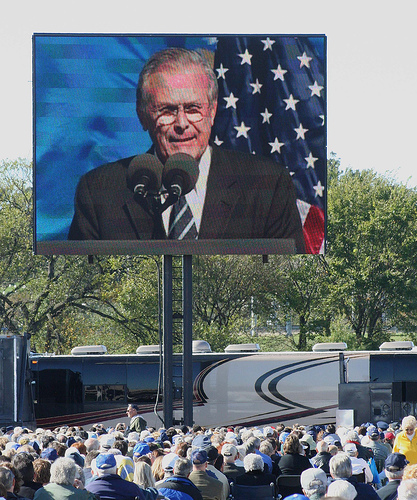
Joyce Battle: Our website displays an image of current Defense Secretary Donald Rumsfeld shaking hands with Saddam during this 1983 visit. You can also view a short video (silent) clip of Rumsfeld’s meeting with Saddam. To locate our website, just use a search engine to find “national security archive.”

____________________

Arlington, Va.: Ms. Battle,
Do the declassified documents you’ve seen reveal much detail of the U.S. policy toward Iran, and the extent to which Saudi influence and an Arabist-heavy State Dept. caused us to take sides in a Sunni-Shiite, Arab-Persian conflict? It seems that our willingness to accept Saudi influence with regard to two policy areas during the 80s (supporting Afghan resistance against the Russians, supporting Saddam against Iran) has caused enormous “blowback” today.

Joyce Battle: Based on the documents I have seen, I don’t believe that Saudi Arabia was the tail that wagged the American dog. The U.S. and Saudi Arabia have had mutually supportive relations for some 70 years, and particularly since World War II. For decades, the U.S. believed that it was in its interest to support Saudi Arabia and other conservative Gulf monarchies. Despite their differences with the U.S. over issues like the Arab-Israeli dispute, these monarchies have on the whole been very supportive of U.S. political and economic interests. The U.S. was as fearful of the possible consequences of the expansion of revolutionary ideas from Iran as the Saudis were.

The U.S., for many years, held the view that promoting Islamist beliefs would effectively counter the spread of communist ideology in the Middle East, South Asia, and Africa, and was not at all opposed to Saudi support for conservative Islamist movements. In return, the U.S. presence in various military facilities in Saudi Arabia is widely viewed as the ultimate guarantor of the Saudi royal family’s continuing rule. Again, these two countries’ policies have always been based on mutual self-interest.

____________________

Cumberland, Md.: Do you believe that the US should have stayed neutral in the Iran-Iraq war thereby allowing Iran and the Ayatollahs to win thereby enlarging their influence in the region?

Joyce Battle: It is obviously very difficult to second-guess history, and I won’t attempt to do so. I believe that when the U.S. became aware of Iraq’s chemical weapons use it should have used what influence it had to stop it. Doing so was actually incumbent upon the U.S. under international law. I believe the U.S. should have used its international influence, which is enormous, to do everything it could to end this war. It was an atrocity, resulting in hundreds of thousands of casualties. Too many countries had ulterior motives and did not do enough to cut off arms shipments to the two combattants. I think that U.S. support for Iraq, despite its public condemnation of chemical warfare, encouraged Saddam Hussein to believe that the U.S. did not really believe, or act on, its public posture.

____________________

Ocean Pines, Md.: We often hear that Saddam Hussein gassed his own people in 1988. It is reported by Stephen Pelletiere that most of the civilians killed at that time were killed by Iranian poison gas. Do you know anything about this?

Joyce Battle: I have seen one analysis that makes this claim. Most of the government documents I have seen from this time period (1987-1989) indicate that the U.S. believed that Iraq had used chemical weapons against the Kurds. This was part of a series of measures undertaken by Iraq to punish Kurdish insurgents for allying with Iran during the war.

____________________

Alexandria, Va.: Are you arguing that the policies of the early 80’s were correct? Or that they were mistaken? Or just that we need to know? Personally, while I would wish that the policies of the early 80’s had turned out differently, the goal appears to have been to establish a working relationship with Iraq. That goal obviously was not reached, and Saddam took the wrong message, that we were not bothered by his use of chemical weapons.

Times change; it could be argued that the current Bush administration is being more realistic than were the Reagan and Bush 1 administrations.

Joyce Battle: Mostly, I think that we need to know. We try to make documents available to the public to help them reach their own conclusions. Before making the decision as to whether they support or oppose war with Iraq, people should learn as much as they can about the issues and about the history of our relations with that country. The Bush administration, in attempting to persuade the public to support the war, presents an overly simplistic case. The problems of the Middle East are enormously complex. The Reagan administration’s policies toward the Iran-Iraq war show that international relations are conducted not in black-and-white but in shades of gray

____________________

Joyce Battle: It’s time for me to go — thank you all very much for your questions and for your interest in this very important topic.


© WASHINGTON POST, 2003
After Downing Street- Bush Began Invasion Before Authorized by Congress

DEMOCRACY NOW– Writing in The Nation magazine, Democracy Now! correspondent Jeremy Scahill reports on Washington’s undeclared air war against Iraq in 2002:

“It was a huge air assault: Approximately 100 US and British planes flew from Kuwait into Iraqi airspace. At least seven types of aircraft were part of this massive operation, including US F-15 Strike Eagles and Royal Air Force Tornado ground-attack planes. They dropped precision-guided munitions on Saddam Hussein’s major western air-defense facility, clearing the path for Special Forces helicopters that lay in wait in Jordan. Earlier attacks had been carried out against Iraqi command and control centers, radar detection systems, Revolutionary Guard units, communication centers and mobile air-defense systems. The Pentagon’s goal was clear: Destroy Iraq’s ability to resist. This was war.

“But there was a catch: The war hadn’t started yet, at least not officially. This was September 2002–a month before Congress had voted to give President Bush the authority he used to invade Iraq, two months before the United Nations brought the matter to a vote and more than six months before “shock and awe” officially began.”

AMY GOODMAN: Here to talk about this all with us is Jeremy Scahill, producer and correspondent for Democracy Now!, has an article at The Nation magazine’s website, called “The Other Bomb Drops: How Bush Began the Iraq Invasion Before He Went to Congress or the U.N.” We are also joined on the telephone by Hans Von Sponeck, former Assistant Secretary General of the United Nations. And we are joined by John Bonifaz, who has just begun a website that deals with this issue. He is author of Warrior King: The Case for Impeaching George W. Bush. The website is called, AfterDowningStreet.org, a coalition of various groups urging Congress to begin a formal investigation to whether Bush has committed impeachable offenses in connection with the invasion of Iraq. Let’s begin, Jeremy, with you. Welcome to Democracy Now!, on this side of the mic.

JEREMY SCAHILL: Thank you, Amy. It’s good to be here.

AMY GOODMAN: Talk about what you found.

JEREMY SCAHILL: I think for many people who have been following the politics of the invasion and occupation of Iraq, it comes as no surprise to learn that the Bush administration intentionally misled the U.S. public and the world and operated with tremendous bad faith when it said it was trying to do everything it could to avoid war. And what we have here is really solid documentation that backs that up. What the British Times of London published last weekend was statistics from the British defense ministry that showed that in the second half of 2002—let’s remember that the invasion of Iraq officially began in March of 2003—that from May 2002 until the end of 2002, that the United States and Britain doubled the amount of attacks that—the number of attacks that they were carrying out against Iraq, from the whole of 2001. So, what you saw was the Bush administration ordering attacks, offensive attacks on Iraq, that were intended to take out communications infrastructure in the country, the ability of commanders in the Iraqi military to communicate with one another, pretty much defensive mechanics for the country, and these attacks were happening with the justification that they were protecting the so-called no-fly zones in Iraq.

The real scandal here is that the Bush administration, like the Clinton administration before it, oversaw the longest sustained bombing campaign since Vietnam. We reported on this show for years consistently that the United States was bombing Iraq once every three days. This bombing began—you could say that the preparations for this invasion began the moment that the so-called Gulf War ended and that Clinton laid the groundwork for this in his regular bombings of Iraq. We saw a spike in activity in these so-called no-fly zone attacks which had no U.N. mandate whatsoever, which were not approved by the international community.

AMY GOODMAN: Which are often mistakenly called the U.N. no-fly zones.

JEREMY SCAHILL: Right. And it was only the United States and Britain. France pulled out almost immediately after the United States began this program. So you had the United States and Britain, and then with the approval and support of some of the puppet regimes in the region that were for whatever reason in bed with the United States. After the passage of the Iraq Liberation Act in 1998, you saw an escalation in the so-called no-fly zones. The Clinton administration was using them to try to provoke Saddam Hussein’s regime into attacking the United States to justify further attacks. And you remember there was the heavy bombing known as “Operation Desert Fox” in December of 1998. So the Clinton administration is not innocent here. It carried out illegal bombings against Iraq consistently throughout the presidency of Clinton.

What we saw that sort of changed here under Bush is that the Bush administration dropped all of the rhetoric about the no-fly zones having something to do with defending Shiites or Kurds and actually were quite public about what they were using these no-fly zones for. They were using them to systematically and preemptively degrade Iraq’s ability to defend itself, not from an uprising of Shiites or Kurds, but from the invasion of a foreign army.

AMY GOODMAN: And then, can you locate the Downing Street memo, talk about its significance, and what happened with the bombing then? This Downing Street memo, what, July 23rd, 2002.

JEREMY SCAHILL: Yes. It reports on a meeting that senior British officials had had with members of the Bush administration, and what it is is a reflection of what the British understood to be the United States’ policy at the moment. And what’s clear from reading this—it’s actually not a memo, it’s minutes, but it’s called the Downing Street memo. It’s minutes of this meeting with Tony Blair and some of his most senior defense advisers. And the picture that is painted from this memo is that the United States already was not just planning and preparing for war, but was actively carrying out air strikes in support of this war. The invasion had begun already when the British had this meeting. And we find that in the form of remarks attributed to Geoff Hoon within these minutes, where he is talking about the Americans already spiking up activity against Saddam Hussein, and what he’s referring to is the increasing use of these so-called no-fly zones to degrade Iraq’s ability to defend against a U.S. invasion and to prepare the route for U.S. Special Forces to enter into the country. In September of 2002—now this is months before the actual invasion officially began, and a few months before Bush went to the Congress or the United Nations—100 aircraft violate Iraqi airspace, British and American aircraft. They go in and they carry out a systematic campaign of air strikes in the west of Iraq and basically destroy the west of Iraq’s ability to defend against an invasion. And that was one of the main places where U.S. Special Forces troops came in from Jordan into the west of Iraq. That happened in September of 2002. We’re talking about months before the actual invasion began.

AMY GOODMAN: We are talking to Democracy Now! correspondent, Jeremy Scahill, has a piece in The Nation online called “The Other Bomb Drops.” When we come back, we’ll also be joined by attorney John Bonifaz and the former U.N. Assistant Secretary General, Hans Von Sponeck..

’06 Zogby Poll: Over 70% of US Troops Want War to End Immediately

ZOGBY INTERNATIONAL– Le Moyne College/Zogby Poll shows just one in five troops want to heed Bush call to stay “as long as they are needed.”

*While 58% say mission is clear, 42% say U.S. role is hazy

*Plurality believes Iraqi insurgents are mostly homegrown

*Almost 90% think war is retaliation for Saddam’s role in 9/11, most don’t blame Iraqi public for insurgent attacks

*Majority of troops oppose use of harsh prisoner interrogation Plurality of troops pleased with their armor and equipment

An overwhelming majority of 72% of American troops serving in Iraq think the U.S. should exit the country within the next year, and more than one in four say the troops should leave immediately, a new Le Moyne College/Zogby International survey shows.

The poll, conducted in conjunction with Le Moyne College’s Center for Peace and Global Studies, showed that 29% of the respondents, serving in various branches of the armed forces, said the U.S. should leave Iraq “immediately,” while another 22% said they should leave in the next six months. Another 21% said troops should be out between six and 12 months, while 23% said they should stay “as long as they are needed.”

Different branches had quite different sentiments on the question, the poll shows. While 89% of reserves and 82% of those in the National Guard said the U.S. should leave Iraq within a year, 58% of Marines think so. Seven in ten of those in the regular Army thought the U.S. should leave Iraq in the next year. Moreover, about three-quarters of those in National Guard and Reserve units favor withdrawal within six months, just 15% of Marines felt that way. About half of those in the regular Army favored withdrawal from Iraq in the next six months.

Continue reading about the Thoughts of Soldiers.

Photo by US Army flickr

© ZOBGY, 2006

US Embassy the Size of Vatican City in Iraq a Mystery

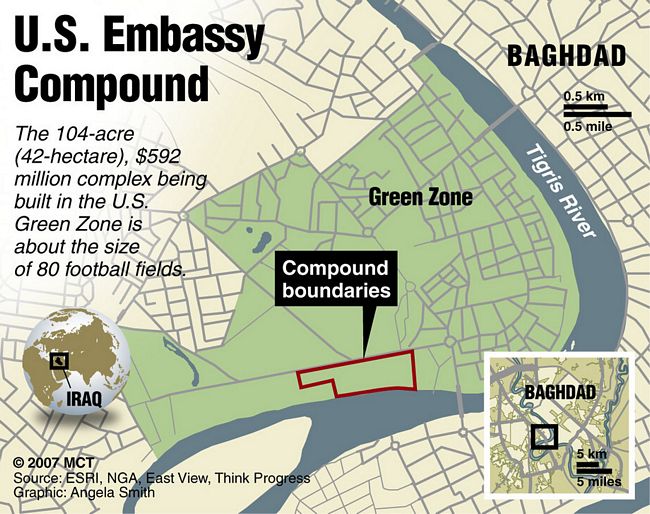
MSNBC– The fortress-like compound rising beside the Tigris River here will be the largest of its kind in the world, the size of Vatican City, with the population of a small town, its own defense force, self-contained power and water, and a precarious perch at the heart of Iraq’s turbulent future.

The new U.S. Embassy also seems as cloaked in secrecy as the ministate in Rome. “We can’t talk about it. Security reasons,” Roberta Rossi, a spokeswoman at the current embassy, said when asked for information about the project.

A British tabloid even told readers the location was being kept secret — news that would surprise Baghdadis who for months have watched the forest of construction cranes at work across the winding Tigris, at the very center of their city and within easy mortar range of anti-U.S. forces in the capital, though fewer explode there these days.

The embassy complex — 21 buildings on 104 acres, according to a U.S. Senate Foreign Relations Committee report — is taking shape on riverside parkland in the fortified “Green Zone,” just east of al-Samoud, a former palace of Saddam Hussein’s, and across the road from the building where the ex-dictator is now on trial.

The Republican Palace, where U.S. Embassy functions are temporarily housed in cubicles among the chandelier-hung rooms, is less than a mile away in the 4-square-mile zone, an enclave of American and Iraqi government offices and lodgings ringed by miles of concrete barriers.

Continue reading about the Giant US Embassy in Iraq.

© 2010 The Associated Press.

No Ties Between al Qaeda and Iraq, Pentagon Says

CNN– The U.S. military’s first and only study looking into ties between Saddam Hussein’s Iraq and al Qaeda showed no connection between the two, according to a military report released by the Pentagon.

A U.S. soldier in front of a bus hit by a roadside bomb near Nasiriyah, southeast of Baghdad, Iraq, on Tuesday.

The report released by the Joint Forces Command five years after the U.S.-led invasion of Iraq said it found no “smoking gun” after reviewing about 600,000 Iraqi documents captured in the invasion and looking at interviews of key Iraqi leadership held by the United States, Pentagon officials said.

The assessment of the al Qaeda connection and the insistence that Hussein had weapons of mass destruction were two primary elements in the Bush administration’s arguments in favor of going to war with Iraq.

The Pentagon’s report also contradicts then-Secretary of Defense Donald Rumsfeld, who said in September 2002 that the CIA provided “bulletproof” evidence demonstrating “that there are, in fact, al Qaeda in Iraq.”

Although other groups, like the September 11 commission, have concluded that there was no link between Hussein and al Qaeda, the Pentagon was able to analyze much more information.

The documents cited in the report do reveal that Hussein supported a number of terrorists and terrorist activities inside and outside Iraq.

“The Iraqi regime was involved in regional and international terrorist operations prior to Operation Iraqi Freedom. The predominant targets of Iraqi state terror operations were Iraqi citizens, both inside and outside of Iraq,” according to the report. Read excerpts from report (pdf)

Most of the terrorism was aimed at keeping Hussein and his Baath party in power, according to Pentagon officials.

“State sponsorship of terrorism became such a routine tool of state power that Iraq developed elaborate bureaucratic processes to monitor progress and accountability in the recruiting, training and resourcing of terrorists,” according to the report.

The report cited such examples as training for car bombs and suicide bombings in 1999 and 2000, both of which U.S. and Iraqi forces have struggled to contain since the rise of the insurgency in summer 2003.

Photo by flickr user DBKing

© COPYRIGHT CNN, 2008