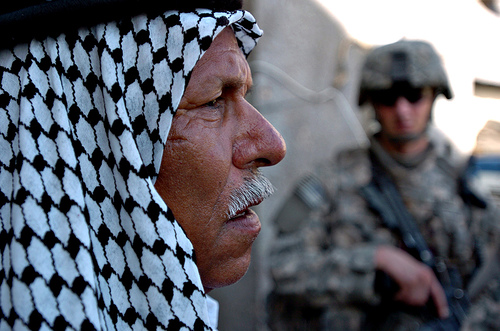
 NATION– Someday, we will undoubtedly discover that, in the term “surge” –
as in the President’s “surge” plan (or “new way forward”)
announced to the nation in January – was the urge to avoid the language (and
experience) of the Vietnam era. As there were to be no “body bags”
(or cameras to film them as the dead came home), as there were to be no
“body counts” (“We have made a conscious effort not to be a
body-count team” was the way the President put it), as there were to be no
“quagmires,” nor the need to search for that “light at the end
of the tunnel,” so, surely, there were to be no “escalations.”
NATION– Someday, we will undoubtedly discover that, in the term “surge” –
as in the President’s “surge” plan (or “new way forward”)
announced to the nation in January – was the urge to avoid the language (and
experience) of the Vietnam era. As there were to be no “body bags”
(or cameras to film them as the dead came home), as there were to be no
“body counts” (“We have made a conscious effort not to be a
body-count team” was the way the President put it), as there were to be no
“quagmires,” nor the need to search for that “light at the end
of the tunnel,” so, surely, there were to be no “escalations.”
The escalations of the Vietnam
era, which left more than 500,000 American soldiers and vast bases and massive
air and naval power in and around Vietnam
(Laos, and Cambodia),
had been thoroughly discredited. Each intensification in the delivery of
troops, or simply in ever-widening bombing campaigns, led only to more misery
and death for the Vietnamese and disaster for the U.S.
And yet, not surprisingly, the American experience in Iraq
— another attempted occupation of a foreign country and culture — has been
like a heat-seeking missile heading for the still-burning American memories of Vietnam.
As historian Marilyn Young noted in early April 2003 with the invasion of
Iraq barely underway: “In less then two weeks, a 30 year old vocabulary is
back: credibility gap, seek and destroy, hard to tell friend from foe, civilian
interference in military affairs, the dominance of domestic politics, winning,
or more often, losing hearts and minds.” By August 2003, the Bush administration,
of course, expected that only perhaps 30,000 American troops would be left in Iraq,
garrisoned on vast “enduring” bases in a pacified country. So, in a
sense, it’s been a surge-a-thon ever since. By now, it’s beyond time to call
the President’s “new way forward” by its Vietnamese equivalent.
Admittedly, a “surge” does sound more comforting, less aggressive,
less long-lasting, and somehow less harmful than an “escalation,” but
the fact is that we are six months into the newest escalation of American power
in Iraq. It has
deposited all-time high numbers of troops there as well, undoubtedly, as more
planes and firepower in and around that country than at any moment since the
invasion of 2003. Naturally enough, other “all-time highs” of the
grimmest sort follow.
This September, General David Petraeus, our escalation commander in Iraq,
and Ryan Crocker, our escalation ambassador there, will present their
“progress report” to Congress. (“Progress” was another word
much favored in American official pronouncements of the Vietnam
era.) The very name tells you more or less what to expect. The report has
already been downgraded to a “snapshot” of an ongoing set of
operations, which shouldn’t be truly judged or seriously assessed until at
least this November, or perhaps early 2008, or… With that in mind, here is
the second Tomdispatch “by the numbers” report on Iraq.
Consider it an attempt to put the Iraqi quagmire-cum-nightmare – two classic
Vietnam-era words – in perspective.
Few numbers out of Iraq
can be trusted. Counting accurately amid widespread disruption, mayhem, and
bloodshed, under a failing occupation, in a land essentially lacking a central
government, in a U.S.
media landscape still dizzy from the endless spin of the Bush administration
and its military commanders is probably next to impossible. But however
approximate the figures that follow, they still offer an all-too-vivid picture
of what the President’s much-desired invasion let loose. No country could
suffer such uprooting, destruction, death, loss, and deprivation, yet remain
collectively sane.
American civilian and military officials now talk about staying in Iraq
through 2008, or 2009, or into the next decade, or for undefined but
lengthening periods of time. And yet Iraq
(by the numbers) has devolved month by month, year by year, for four-plus
years. There was never any reason to believe that the latest escalation – or
any future escalation, whatever it might be called, and whether accomplished
via the U.S.
military or by a growing shadow army of guns-for-hire employed by
private-security firms — could be capable of anything but hurrying the pace of
that devolution. So imagine what Iraq-by-the-numbers will be like in 2008 or
2009, given the clear determination of the Bush administration’s “strategic
thinkers” to garrison that country into the distant future.
Here, then, is escalation in Iraq
by the numbers – almost all of them continue to “surge” – as of
mid-August 2008:
Number of American troops stationed in Iraq:
162,000 (plus at least several thousand government employees), an all-time
high.
Estimated number of U.S.-(taxpayer)-paid
private contractors in Iraq:
More than 180,000, again undoubtedly an all-time high. That figure includes
approximately 21,000 Americans, 43,000 non-Iraqi foreign contractors (including
Chileans, Nepalese, Colombians, Indians, Fijians, El Salvadorans, and Filipinos
among others), and 118,000 Iraqis, but does not include a complete count of
“private security contractors who protect government officials and buildings,”
according to State Department and Pentagon figures obtained by the Los Angeles
Times.
Percentage of private contractors in total U.S.
forces deployed in World War II and the Korean War: 3-5%, according to the
Congressional testimony of human rights lawyer Scott Horton. In Vietnam
and the first Gulf War, that figure reached 10%. Now, it is at least near
parity.
Number of private companies working in Iraq
on contract for the U.S.
government: 630, with personnel from more than 100 countries, according to
Jeremy Scahill, author of the bestselling Blackwater, The Rise of the World’s
Most Powerful Mercenary Army.
Typical pay of a former U.S.
Special Forces soldier working for a private-security company in Iraq:
$650 a day, according to Scahill, “after the company takes its cut.”
That rate, however, can hit $1,000 a day.
Number of trucks on the road each day as part of the U.S.
resupply operation in Iraq:
3,000.
Number of attacks from June 2006 through May 2007 on U.S.
supply convoys guarded by private-security contractors: 869, a near tripling from the previous
twelve months.
Number of private contractors who have died in Iraq:
Over 1,000, according to the U.S. Department of Labor, based on partial figures
because private companies do not have to declare their war dead.
Predicted cost of a surge of 21,500 American troops into Iraq,
according to White House calculations in January 2007: $5.6 billion, a
figure offered the month the President’s surge strategy was announced.
Predicted cost of a one-year surge of 30,000-40,000 troops, according to
Robert Sunshine, assistant director for budget analysis of the non-partisan
Congressional Budget Office: $22 billion (two years for a cut-rate $40
billion). These figures were offered in testimony to Congress five months after
the President’s surge was officially launched.
Percentage of dollars annually appropriated by the U.S.
government and spent on Iraq-related activities: More than 10%, or one
dollar out of every 10, according to the CBO’s Sunshine.
Estimated monthly cost of the Iraq
(and Afghan) Wars: $12 billion-$10 billion for Iraq-a
third higher than in 2006, according to the non-partisan Congressional Research
Service.
Estimated total cost of the Iraq
War, if Robert Sunshine’s “optimistic scenario”–30,000 U.S.
troops left in Iraq
by 2010–plays out: Over $1 trillion. (If his less optimistic scenario
proves accurate–75,000 troops in 2010–closer to $1.5 trillion.)
Number of Iraqis estimated to have fled their country: Between 2
million and 2.5 million. An estimated 750,000 to Jordan;
1.5 million to Syria;
200,000 to Egypt
and Lebanon–with
another 40,000-50,000 fleeing each month, 2,000 a day, according to UN figures.
Officials at the central travel office in Baghdad
are deluged by up to 3,000 passport applications a week. In addition, though
it’s anyone’s guess, more than two million Iraqis may now be internal refugees,
uprooted from their homes largely by sectarian violence and ethnic cleansing.
Approximately 70% of these are women and children, according to UNICEF.
Number of Iraqi refugees admitted to the United
States in July: 57; only 133 for
the year to date.
Number of Iraqis held in American prisons in Iraq:
Approximately 22,500, according to U.S.
military officials, a leap to an all-time high from 16,000 in February when the surge
began. (American prisons in Iraq
also continue to undergo expansion.)
Number of Iraqis released from American incarceration in the last month:
224.
Number of foreign fighters (jihadis) held by the U.S.
military in Iraq:
135 (nearly half are Saudis).
Estimated number of bullets fired by U.S.
troops for every insurgent killed in Iraq
(or Afghanistan):
250,000, according to John Pike, director of the Washington
military-research group GlobalSecurity.org. This comes out to 1.8 billion
rounds of small-arms ammunition yearly. With U.S.
munitions factories unable to meet the demand, 313 million rounds of such
munitions were purchased from Israel
last year for $10 million more than if produced domestically.
Percentage of amputations performed on U.S.
war-wounded in Iraq:
An estimated 6%. The average in earlier U.S.
conflicts, where the equivalents of IEDs and car bombings did not play such a
role, was 3%.
Estimated replacement limbs needed yearly for Iraqis in northern Iraq
alone: 3,000, according to the Red Crescent Society and the director
general for health services in Mosul.
(Unlike American soldiers, Iraqis who have lost limbs have access only to
limited numbers of outdated prostheses.)
Cost of a coffin in Baghdad:
$50-75. Cost of a coffin in Saddam Hussein’s time, $5-10.
Number of Iraqi civilians who died in July 2007: 1,652, according to
figures compiled by the Iraqi Health, Defense, and Interior Ministries; 2,024,
according to the tally of the Associated Press; 1,539 according to the
Washington Post. All but the Post claim this as a “spike” in
casualties. All such figures are, for a variety of reasons, surely significant
undercounts.
Approximate number of American civilians who would have died in July if a
similar level of killings were underway in the United
States: 18,000, according to Middle
East scholar Juan Cole.
Estimated number of Iraqi deaths from the invasion of 2003 through June
2007, if the Lancet study’s median figure of 655,000 deaths was accurate and
similar death rates held true for the year since it was published: Just
over one million, according to Just Foreign Policy. (The Lancet study has been
the single, on-the-ground, scientific report on Iraqi casualties in these
years.)
Number of Iraqi civilians killed in July in mass-casualty bomb attacks:
378, a sharp rise
over June, according to the Washington Post. The five-month U.S.
surge has caused “no appreciable change” in vehicle-bomb attacks,
according to figures collected by reporters from the McClatchy Newspapers.
Number of unidentified bodies, assumedly murdered by death squads, found
on the streets of Baghdad
in June 2007: 453, a
rise of 41% over January 2007, the month before surge operations began,
according to unofficial Iraqi Health Ministry statistics taken from morgue
counts.
Number of Iraqi civilians killed or wounded in “escalation of
force” incidents at American checkpoints or near American patrols and
convoys in the past year: 429, according to U.S.
military statistics obtained by the McClatchy Newspapers. These statistics,
which “spiked” during the recent escalation months, don’t include
civilian deaths during raids on homes or in the midst of battle (and are
considered incomplete in any case, since an unknown number of
escalation-of-force deaths go unreported by U.S.
units).
Total number of attacks against U.S.
and coalition forces, Iraq
security forces, Iraqi civilians, and infrastructure targets in June 2007:
5,335. This works out to a daily average of 177.8, an all-time high since May
2003, according to the Pentagon, and 46% more than in June 2006; more than 68%
of these attacks–3,671 to be exact–were launched against U.S.
troops, up 7% from May 2007.
Number of attacks in July 2007 using the most powerful type of roadside
bomb: 99, an all-time high, according to Lt. Gen. Ray Odierno, U.S.
second-in-command in Iraq,
accounting for one-third of American casualties that month.
Number of American military deaths in the surge months, February-July
2007: 572, according to the Iraq Coalition Casualties website. This
represents 189 more American deaths than in the same set of months in 2004, 215
more than in 2005, 237 more than in 2006.
Average daytime summer temperature in Baghdad:
110-120 degrees, though 130 degrees is not uncommon. It rarely drops below 100
degrees even at night.
Number of megawatts of electricity produced daily in Iraq:
Less than 4,000 megawatts, below pre-invasion levels in a country where daily
demand is now in the 8,500 to 9,500 range.
Hours of electricity normally delivered to Baghdadis by the national
electricity grid: 1-2 hours a day. The only recourse, according to French
reporter Anne Nivat, who lived in “red zone” Baghdad for two weeks
recently, is electricity produced by small local generators, which consume up
to 20 gallons
of gasoline a day.
Number of nationwide blackouts in just two days in July 2007: 4. The
Shiite Holy city of Karbala was
without any power for at least 3 consecutive days in July, during which its
water mains “went dry.” (“‘We no longer need television
documentaries about the Stone Age. We are actually living in it. We are in
constant danger because of the filthy water and rotten food we are having,’
said Hazim Obeid, who sells clothing at a stall in the Karbala
market.”)
Cost of a bottle of purified water during the present water shortages:
$1.60 for a 10-liter bottle, a rise of 33%. (Many Iraqis can’t afford to buy
bottled water in a country where, according to a recent Oxfam summary study of
the Iraqi humanitarian crisis, 43% of Iraqis live in “absolute
poverty,” earning less than a dollar a day.)
Percentage of water engineers who have left Iraq:
40%, according to Oxfam’s report. Similar percentages of middle-class
professionals–doctors, teachers, lawyers–have evidently fled as well.
According to Oxfam, some universities and hospitals in Baghdad
have lost up to 80% of their staffs.
Number of Iraqis who have access to clean drinking water: 1 in 3, according to UN figures. (In
2007, waterborne diseases, including diarrhea, “the most prolific killer
of children under 5,” are up in some areas by 70% over the previous year.)
Of the 3.5 million cubic meters of water Baghdad‘s
six million people are estimated to need, amount actually delivered: 2.1
million cubic meters. Number of high-tension lines running into Baghdad
that are in operation: 2 of 17, thanks to insurgent sabotage, according to an
Electricity Ministry spokesman. These are contributing to the worst electricity
shortages since the invasion summer of 2003. The country’s power grid is
reportedly nearing collapse.
Number of ministers still in the cabinet of Prime Minister Nouri
al-Maliki: 20.
Number of ministers who have walked out: 17.
Number of senior officers who have recently resigned from the Iraqi Army
in protest over the Maliki government: 9, including Chief of Staff Maj.
Gen. Babaker Zebari.
Number of countries for which Iraq’s parliamentarians, who adjourned for
a month-long August vacation, have departed: At least six, according to the
New York Times, including Jordan, Syria, Dubai, Iran, Great Britain, and Egypt
as well as “a resort in Iraq’s safest region, autonomous Kurdistan.”
Estimated cost of that vacation time to the U.S.
per minute for ongoing operations in Iraq:
$200,000, according to Bob Schieffer of CBS News.
Amount of oil Iraq
possesses: 115 billion barrels in proven oil reserves, the third largest
reserves in the world (after neighboring Saudi
Arabia and Iran).
Estimates of possible oil deposits still to be discovered range from 45 billion
additional barrels up to 400 billion additional barrels.
Price of 40 gallons
of gas under Saddam Hussein: 50 cents.
Price of 40 gallons
of gas in July 2007: $75 on the black market; $35 if a motorist is willing
to spend hours, or even days, in line at a gas station.
Percentage of Iraq‘s
revenues that come from the export of oil: More than 90%, though oil
production remains below that of the worst days of Saddam Hussein’s rule.
Amount the Iraqi Oil Ministry budgeted for capital expenses to bolster
the oil industry last year: $3.5 billion, according to the latest report by
the U.S. Special Inspector General for Iraq Reconstruction.
Amount the Iraqi Oil Ministry actually spent: $90 million.
Percentage of allocated capital funds spent by the Iraqi government on
oil, electricity, and education projects in 2006: 22%.
Amount of money missing due to governmental corruption, as uncovered in
investigations by Iraq‘s
top anti-corruption investigator, Judge Rahdi al Rahdi: $11 billion.
Number of U.S. dollars invested in “standing up” (training) the
Iraqi military and police: $19.2 billion. This works out to $55,000 per
Iraqi recruit, according to a bipartisan U.S.
Congressional investigation.
Amount the Pentagon has requested for continued training and equipping of
Iraqi security forces: $2 billion.
Percentage of equipment the Pentagon has issued to Iraqi security forces
since 2003 that cannot be accounted for: 30%. That includes at least
“110,000 AK-47 rifles, 80,000 pistols, 135,000 items of body armor and
115,000 helmets,” according to the U.S. Government Accountability Office
(GAO). According to the Washington Post, “One senior Pentagon official
acknowledged that some of the weapons probably are being used against U.S.
forces.”
Number of U.S.
steel-shipping containers in Iraq
and Afghanistan
now considered “lost”: 54,390 or one-third of them, according to
the GAO.
Estimated cost of training Iraqi (and Afghan) security forces over the
next decade, if present course continues: At least 50 billion dollars,
according to the Congressional Budget Office.
Number of major U.S.
bases in Iraq:
More than 75, according to the New York Times.
Cost of U.S.
bases in Iraq
(which Congress has mandated as not “permanent”) and in Afghanistan
(which the Pentagon refers to as “enduring”): Unknown. In a
prestigious engineering magazine in late 2003, Lt. Col. David Holt, the Army
engineer “tasked with facilities development” in Iraq,
was already speaking proudly of “several billion dollars” being sunk
into base construction. According to the Washington Post, the Congressional
Research Service (CRS) claims $2 billion went into “military
construction” in Iraq
and Afghanistan,
2004-2006; another $1.7 billion was approved by Congress for 2007. And the
Pentagon is still building. For fiscal 2008, $738.8 million was requested
“for 33 critical construction projects for Iraq
and Afghanistan.”
(When it comes to base construction, these figures are undoubtedly
undercounts.)
Amount that former Halliburton subsidiary Kellogg, Brown, and Root (now
known as KBR) has received so far for a prewar contract to supply the American
military with food, fuel, housing, and other necessities: At least $20
billion. A Pentagon audit of $16.2 billion worth of KBR’s work “found that
$3.2 billion in KBR billing was either questionable or unsupported by
documentation.”
Percentage of Iraqis who cannot afford to buy enough to eat: 15%,
according Oxfam.
Percentage of Iraqi children who are malnourished: 28% (compared to
19% before the invasion); Percentage of babies born underweight, 11% (compared
to 3% before the invasion).
Percentage of Iraqi children now considered to suffer from learning
“impediments”: 92%, according to one study cited by Oxfam.
The cost of a single Predator unmanned aerial vehicle (UAV), armed with
two Hellfire missiles: More than $3 million. (At least 5 Predators have
crashed or been shot down in the last year in Iraq
and Afghanistan.)
Cost of the latest UAV, the “hunter-killer” MQ-9 Reaper, now
being deployed to Afghanistan
and soon to be deployed to Iraq:
$7 million. The Reaper is four times as heavy as the Predator and can be armed
with 14 Hellfire missiles, or four Hellfires and two 500-pound Joint Direct
Attack Munitions. It is considered equivalent in firepower to the F-16.
According to Associated Press reporter Charles Hanley, “Its pilot, as it
bombs targets in Iraq,
will sit at a video console 7,000
miles away in Nevada.”
Number of American planes in Iraqi air space at any moment: 100,
according to Hanley.
Increase in bombs dropped in Iraq
in the first six months of 2007 compared to the first six months of 2006:
Fivefold.
Percentage of Iraqi oil resources around Basra
in Shiite southern Iraq,
where, in September 2006, the British launched their own unsuccessful version
of the present American “clear, hold and reconstruct” escalation
operation in Baghdad:
66%.
Number of doctors assassinated by “unidentified gunmen” in
“peaceful” Basra since
2003: 12.
Number of times the airport base outside Basra, which houses a
well-barricaded regional U.S. Embassy office and the last 5,500 of the 40,000
troops England dispatched to Iraq, has been attacked by mortars or rockets over
the past four months: 600.
Effect of Iraq
War spending on the profits of major weapons corporations: Northrop Grumman
has just announced a 15% second-quarter increase in sales over 2006 for its
information and services division, 7% for its electronics division; General
Dynamics’ combat systems unit just recorded a 19% rise in sales. Lockheed
Martin’s profits went up 34% to $778 million, according to Eli Clifton of Inter
Press Service.
Estimated cost of deploying an American soldier to Iraq
for one year: $390,000, according to the Congressional Research Service.
Cost of flying a soldier home from the war zone: $627.80. That’s the
price the Pentagon pays FedEx and UPS, among other companies, for each soldier
brought back to the U.S.
Estimated tonnage of U.S.
equipment that might be driven out of Iraq
and shipped home from Kuwait
in case of a decision to withdraw: One million tons.
Percentage of Americans in the latest Washington
Post-ABC News poll who had served in Iraq
or “had a close friend or relative who served in Iraq,”
who approve of the President’s handling of the Iraq
conflict: 38%. In a May New York Times/CBS News poll, fewer than half of
military families and military members agreed that “the United
States did the right thing in invading Iraq.”
Written by Jeremy Scahill
Photo by flickr user US Army.
© NATION, 2007



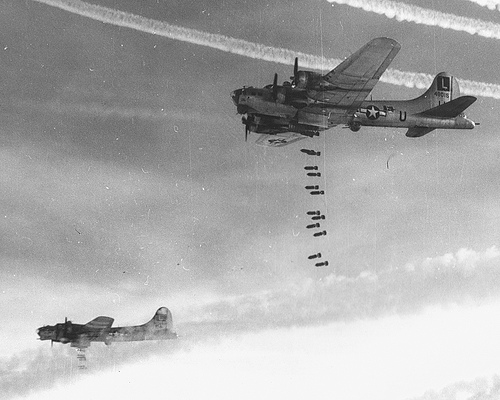 YAHOO NEWS– In late 2006, George W. Bush met with the Joint Chiefs of Staff at
the Pentagon and asked if military action against Iran’s nuclear program was feasible. The unanimous
answer was no. Air strikes could take out some of Iran’s nuclear
facilities, but there was no way to eliminate all of them.
YAHOO NEWS– In late 2006, George W. Bush met with the Joint Chiefs of Staff at
the Pentagon and asked if military action against Iran’s nuclear program was feasible. The unanimous
answer was no. Air strikes could take out some of Iran’s nuclear
facilities, but there was no way to eliminate all of them.  RAW STORY
 NATION
 AFP
AFP