MEDIA ROOTS- After using NATO’s Orwellian “humanitarian bombing” operation as the front for US intervention in Libya, the establishment is narrowing its sight on oil rich Syria next. Already the US and the EU have slapped economic sanctions on the country, citing President Bashar al-Assad’s human rights abuses during Syria’s recent protests. The corporate media is also beginning to ingrain propaganda about Syria’s stockpile of deadly weapons that is reminiscent of the propaganda surrounding the lead up to the Iraq war.
Earlier this month, Russia Today reported that the UN Security Council condemned “the widespread violation of human rights in Syria and the use of force against civilians by the country’s security forces,” while also urging the Damascus authorities to respect human rights and observe international law. “Those responsible for the violence should be held accountable,” the Council said in a presidential statement, the UN official website reports.
A great article by Global Research cuts through the misinformation regarding Syria and lays out some facts that don’t jive with what we are being told about their “democratic uprising”. Instead, reports suggest that the government and corporate press are fabricating a pretext for another NATO led humanitarian intervention in the region. Let’s not forgot that the United States pays the largest percentage of all NATO efforts, and wields the most influence on the shots being called on the grand chessboard.
Abby
***
 GLOBAL RESEARCH– There is evidence of gross media
manipulation and falsification from the outset of the protest
movement in southern Syria on March 17th.
GLOBAL RESEARCH– There is evidence of gross media
manipulation and falsification from the outset of the protest
movement in southern Syria on March 17th.
The Western media has presented the events in Syria as part of the broader Arab pro-democracy protest movement, spreading spontaneously from Tunisia, to Egypt, and from Libya to Syria.
Media coverage has focussed on the Syrian police and armed forces, which are accused of indiscriminately shooting and killing unarmed “pro-democracy” demonstrators. While these police shootings did indeed occur, what the media failed to mention is that among the demonstrators there were armed gunmen as well as snipers who were shooting at both the security forces and the protesters.
The death figures presented in the reports are often unsubstantiated. Many of the reports are “according to witnesses”. The images and video footages aired on Al Jazeera and CNN do not always correspond to the events which are being covered by the news reports.
There is certainly cause for social unrest and mass protest in Syria: unemployment has increased in recent year, social conditions have deteriorated, particularly since the adoption in 2006 of sweeping economic reforms under IMF guidance. The IMF’s “economic medicine” includes austerity measures, a freeze on wages, the deregulation of the financial system, trade reform and privatization.
With a government dominated by the minority Alawite (an offshoot of Shia Islam), Syria is no “model society” with regard to civil rights and freedom of expression. It nonetheless constitutes the only (remaining) independent secular state in the Arab world. Its populist, anti-Imperialist and secular base is inherited from the dominant Baath party, which integrates Muslims, Christians and Druze.
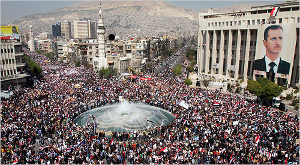
Moreover, in contrast to Egypt and Tunisia, in Syria there is considerable popular support for President Bashar Al Assad. The large rally in Damascus on March 29, “with tens of thousands of supporters” (Reuters) of President Al Assad is barely mentioned. Yet in an unusual twist, the images and video footage of several pro-government events were used by the Western media to convince international public opinion that the President was being confronted by mass anti-government rallies.
The “Epicenter” of the Protest Movement. Daraa: A Small Border Town in southern Syria
What is the nature of the protest movement? From what sectors of Syrian society does it emanate? What triggered the violence?
What is the cause of the deaths?
The existence of an organized insurrection composed of armed gangs involved in acts of killing and arson has been dismissed by the Western media, despite evidence to the contrary.
The demonstrations did not start in Damascus, the nation’s capital. At the outset, the protests were not integrated by a mass movement of citizens in Syria’s capital.
The demonstrations started in Daraa, a small border town of 75,000 inhabitants, on the Syrian Jordanian border, rather than in Damascus or Aleppo, where the mainstay of organized political opposition and social movements are located. (Daraa is a small border town comparable e.g. to Plattsburgh, NY on the US-Canadian border).
The Associated Press report (quoting unnamed “witnesses” and “activists”) describes the early protests in Daraa as follows:
The violence in Daraa, a city of about 300,000 near the border with Jordan, was fast becoming a major challenge for President Bashar Assad, …. Syrian police launched a relentless assault Wednesday on a neighborhood sheltering anti-government protesters [Daraa], fatally shooting at least 15 in an operation that began before dawn, witnesses said.
At least six were killed in the early morning attack on the al–Omari mosque in the southern agricultural city of Daraa, where protesters have taken to the streets in calls for reforms and political freedoms, witnesses said. An activist in contact with people in Daraa said police shot another three people protesting in its Roman-era city center after dusk. Six more bodies were found later in the day, the activist said.
As the casualties mounted, people from the nearby villages of Inkhil, Jasim, Khirbet Ghazaleh and al–Harrah tried to march on Daraa Wednesday night but security forces opened fire as they approached, the activist said. It was not immediately clear if there were more deaths or injuries. (AP, March 23, 2011, emphasis added)
The AP report inflates the numbers: Daraa is presented as a city of 300,000 when in fact its population is 75,000; “protesters gathered by the thousands”, “casualties mounted”.
The report is silent on the death of policemen which in the West invariably makes the front page of the tabloids.
The deaths of the policemen are important in assessing what actually happened. When there are police casualties, this means that there is an exchange of gunfire between opposing sides, between policemen and “demonstrators”.
Who are these “demonstrators” including roof top snipers who were targeting the police.
Israeli and Lebanese news reports (which acknowledge the police deaths) provide a clearer picture of what happened in Daraa on March 17-18. The Israel National News Report (which cannot be accused of being biased in favor of Damascus) reviews these same events as follows:
Seven police officers and at least four demonstrators in Syria have been killed in continuing violent clashes that erupted in the southern town of Daraa last Thursday.
…. On Friday police opened fire on armed protesters killing four and injuring as many as 100 others. According to one witness, who spoke to the press on condition of anonymity, “They used live ammunition immediately — no tear gas or anything else.”
…. In an uncharacteristic gesture intended to ease tensions the government offered to release the detained students, but seven police officers were killed, and the Baath Party Headquarters and courthouse were torched, in renewed violence on Sunday. (Gavriel Queenann, Syria: Seven Police Killed, Buildings Torched in Protests, Israel National News, Arutz Sheva, March 21, 2011, emphasis added)
The Lebanese news report, quoting various sources, also acknowledges the killings of seven policemen in Daraa: They were killed “during clashes between the security forces and protesters… They got killed trying to drive away protesters during demonstration in Dara’a”
The Lebanese Ya Libnan report quoting Al Jazeera also acknowledged that protesters had “burned the headquarters of the Baath Party and the court house in Dara’a” (emphasis added)
These news reports of the events in Daraa confirm the following:
1. This was not a “peaceful protest” as claimed by the Western media. Several of the “demonstrators” had fire arms and were using them against the police: “The police opened fire on armed protesters killing four”.
2. From the initial casualty figures (Israel News), there were more policemen than demonstrators who were killed: 7 policemen killed versus 4 demonstrators. This is significant because it suggests that the police force might have been initially outnumbered by a well organized armed gang. According to Syrian media sources, there were also snipers on rooftops which were shooting at both the police and the protesters.
What is clear from these initial reports is that many of the demonstrators were not demonstrators but terrorists involved in premeditated acts of killing and arson. The title of the Israeli news report summarizes what happened: Syria: Seven Police Killed, Buildings Torched in Protests.
The Daraa “protest movement” on March 18 had all the appearances of a staged event involving, in all likelihood, covert support to Islamic terrorists by Mossad and/or Western intelligence. Government sources point to the role of radical Salafist groups (supported by Israel)
Other reports have pointed to the role of Saudi Arabia in financing the protest movement.
What has unfolded in Daraa in the weeks following the initial violent clashes on 17-18 March, is the confrontation between the police and the armed forces on the one hand and armed units of terrorists and snipers on the other which have infiltrated the protest movement.
Reports suggest that these terrorists are integrated by Islamists. There is no concrete evidence as to which Islamic organizations are behind the terrorists and the government has not released corroborating information as to who these groups are.
Both the Syrian Muslim Brotherhood (whose leadership is in exile in the UK) and the banned Hizb ut-Tahrir (the Party of Liberation), among others have paid lip service to the protest movement. Hizb ut Tahir (led in the 1980s by Syrian born Omar Bakri Muhammad) tends to “dominate the British Islamist scene” according to Foreign Affairs. Hizb ut Tahir is also considered to be of strategic importance to Britain’s Secret Service MI6. in the pursuit of Anglo-American interests in the Middle East and Central Asia. (Is Hizb-ut-Tahrir another project of British MI6? | State of Pakistan).
Syria is a secular Arab country, a society of religious tolerance, where Muslims and Christians have for several centuries lived in peace. Hizb ut–Tahrir (the Party of Liberation) is a radical political movement committed to the creation of an Islamic caliphate. In Syria, its avowed objective is to destabilize the secular state.
Since the Soviet-Afghan war, Western intelligence agencies as well as Israel’s Mossad have consistently used various Islamic terrorist organizations as “intelligence assets”. Both Washington and its indefectible British ally have provided covert support to “Islamic terrorists” in Afghanistan, Bosnia, Kosovo and Libya, etc. as a means to triggering ethnic strife, sectarian violence and political instability.
The staged protest movement in Syria is modelled on Libya. The insurrection in Eastern Libya is integrated by the Libya Islamic Fighting Group (LIFG) which is supported by MI6 and the CIA. The ultimate objective of the Syria protest movement, through media lies and fabrications, is to create divisions within Syrian society as well as justify an eventual “humanitarian intervention”.
Read more about Who is Behind The Protest Movement? Fabricating a Pretext for a US-NATO “Humanitarian Intervention”
Written by Prof. Michel Chossudovsky
© 2011 Global Research
Photo by Flickr use gmsampaio
 ALTERNET
 SALON
SALON
 GUARDIAN