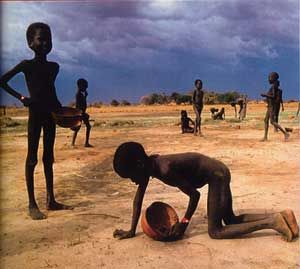
HUFFINGTON POST– Three-day-old Odong Obong lay in the hospital bed, his pencil-thin arms
almost motionless and his shriveled, gaunt face resembling that of an elderly
man.
Emaciated babies and young children throughout the ward bore the signs of
hunger: exposed ribs and distended stomachs. Outside, old villagers reclined
motionless in the shade, too frail to walk.
The U.N. calls this the “hungriest place on Earth” after years of
drought and conflict, with aid agencies already feeding 80,000 people here. A
doctor says the worst is yet to come.
Two years of failed rains and tribal clashes have laid the foundation for Africa’s
newest humanitarian crisis. The World Food Program quadrupled its assistance
levels from January to March in the Akobo region of southeastern Sudan.
International aid agencies are bracing for the worst. Even if spring rains
materialize this year, the harvest won’t come in until fall.
“And if there is no rain, it will get worse,” said Dr. Galiek
Galou, one of three doctors at the hospital in this town on the border with Ethiopia.
“If you stay here for a week you’ll have problems, even if you have
money,” he said. “There is nothing to buy.”
Southern Sudan lies in a drought-prone belt of Africa,
but the situation has been exacerbated by rising intertribal violence that
claimed more than 2,000 lives in 2009. Because of the global financial
meltdown, the government has fewer available resources.
The food crisis is also a legacy of a devastating north-south civil war of
more than 21 years that left 2 million people dead and many more displaced.
That conflict is separate from the war in the western Sudanese region of Darfur,
which began in 2003 and has killed 300,000.
DEMOCRACY NOW– AMY GOODMAN: We’re broadcasting from Bolivia in the town of
Tiquipaya, just outside Cochabamba. On Thursday, the World Peoples’
Summit on Climate Change and Rights of Mother Earth concluded with a
major rally at the Félix Capriles Stadium in Cochabamba featuring
Bolivian President Evo Morales and Venezuelan President Hugo Chávez.
Over the past three days of the summit, known here simply as “La
Cumbre,” seventeen working groups met to discuss various
climate-related issues, from climate debt to the dangers of carbon
trading. Last night, summit organizers released an Agreement of the
Peoples based on the working group meetings.
Key proposals include the establishment of an international
tribunal to prosecute polluters, passage of a Universal Declaration of
the Rights of Mother Earth, protection for climate migrants, and the
full recognition of the UN Declaration on the Rights of Indigenous
Peoples. The peoples’ summit also condemned a proposed forest program
known as REDD, or Reducing Emissions from Deforestation and Degradation.
At Thursday’s rally, Bolivian President Evo Morales called on
world leaders to adopt these proposals from the peoples’ summit.
PRESIDENT EVO MORALES: [translated] If we apply and
implement all of the conclusions of this World Conference on the Rights
of Mother Earth, Cochabamba will be a hope to the world. What the
governments of developed countries suggest is allowing the earth to warm
two degrees or more. Clearly, the proposals coming from some working
groups are not solutions, but ways to cook all of humanity.
AMY GOODMAN: Bolivian President Evo Morales, speaking before
over 15,000 people in Cochabamba’s largest soccer stadium.
In the hours before the rally, supporters of Morales filled the
sidewalks of the city. Morales is the first indigenous president of
Bolivia, and much of his support comes from the majority indigenous
population.
Signs of Bolivia’s vibrant indigenous culture were on full
display outside and inside the stadium. Many indigenous women wore
bowler hats and flared skirts. The sound of pan flutes and the Andean
string instrument, the charango, could be heard throughout the stadium
as several musical acts gave impromptu performances on the field.
Bolivian women and children sold empanadas and fresh juices.
At the rally, Venezuelan President Hugo Chávez warned that
capitalism could lead to the destruction of the planet.
PRESIDENT HUGO CHÁVEZ: [translated] We will not submit
to the hegemony of the imperial Yankees. You can even write it down. If
the hegemony of capitalism continues on this planet, human life will
one day come to an end. For those of you who believe that’s an
exaggeration, one must remember this: the planet lived for millions of
years without the human species.
AMY GOODMAN: This is Democracy Now!, democracynow.org,
the War and Peace Report. We’re broadcasting from Cochabamba. Again, you
were listening to the closing ceremony and the closing speeches at
Cochabamba’s largest soccer stadium. It took place on Earth Day. You
just heard the President Evo Morales. You also heard, as well, President
Chávez. In just a moment, we are going to be joined by President
Morales. He has just arrived by van. He’s coming up the stairs. So we’ll
go to a break, some of the remarkable indigenous music that has been
playing throughout the area, and then we’ll be joined by the president
of Bolivia, Evo Morales.
[break]
AMY GOODMAN: As the World Peoples’ Summit on Climate
Change and the Rights of Mother Earth concludes, we are joined now by
Bolivian President Evo Morales. Following the failed Copenhagen climate
talks in December, Morales issued a call to hold the peoples’ summit to
give the poor and the Global South an opportunity to strategize on
fighting climate change. President Morales joins us now for the hour.
We’re here at the Universidad del Valle—Uni. del Valle, it’s called
here—in Tiquipaya.
Welcome to Democracy Now!, President Morales.
PRESIDENT EVO MORALES: [translated] Thank you very much.
AMY GOODMAN: You have joined us in New York several times
on Democracy Now! We are very honored to be here in your country,
in Bolivia.
PRESIDENT EVO MORALES: [translated] And thank you very
much for the invitation to converse, as we’ve always done.
AMY GOODMAN: Well, we are speaking on the day after the
World Peoples’ Conference has concluded, the day after Earth Day. What
do you feel you have accomplished?
PRESIDENT EVO MORALES: [translated] First of all, we have
been surprised by the participation of all the peoples of the world. We
didn’t imagine so many people, more than 30,000 participants in
sixteen—or seventeen working groups, and a declaration that provides so
much direction for life and for nature, the participation of scientists
and people responsible for different sectors and regions of the world.
There are two particularly important things. In Copenhagen, there
was interest in having a document approved that would cause harm to
Mother Earth. And the debate was only about the effects of the climate
crisis, not the causes. And the peoples here have debated the causes,
which is capitalism—I could elaborate on that—genetically modified
crops, which cause harm to Mother Earth and human life.
And in addition, I am so pleased to see that there’s been such
deep interest in engaging in a dialogue with the United Nations, so that
these conclusions of the peoples of the world can be heard and
respected. Not just by the peoples who participated, they should also be
heard and respected by humankind as a whole, all of those who live on
the planet.
AMY GOODMAN: The proposals that have come out of this
conference, this summit, can you name them and explain them, beginning
with the climate justice tribunal?
PRESIDENT EVO MORALES: [translated] For example, the
developed countries should respect the Kyoto Protocol, and that means
put it into practice, the 50 percent reduction in greenhouse gas
emissions; and that the global temperature increase should be a maximum
one-degree Centigrade; that a climate justice tribunal should be
established, based in Cochabamba—and I say thank you very much to the
social movements who approved this proposal that it be based here; that
there should continue to be a debate or there still is a debate on
having a world referendum on climate change; that the economic resources
spent on defense and wars should be for life and for nature.
According to information we have, we find that the developed
countries spend $1.7 trillion, supposedly for defense and international
security, but that actually means in military intervention in other
countries. Imagine, with $1.7 trillion for life and for nature, that
would be so important. And that is the right of Mother Earth, the right
to regenerate Mother Earth’s caring capacity. It’s very important.
And I can tell you, I know and I have lived in my family, in my
community, in my aillu, traditional community, where we said this
year, we’ll grow chili peppers the next year, and we evaluate this
among five different or eight communities. And over that time, it is
regenerated in another place. Some time goes by, and we replant it in
different place. And so, if we rotate the crops, then there’s not a
detrimental impact on the environment. These seem like small things, but
they translate into large things internationally in terms of the world
environment.
In Bolivia, after this event, we are going to begin with
reforestation. And the plan that we have in Bolivia, as of the first
anniversary of the Declaration of International Mother Earth Day,
because last year that was approved—before, it was Earth Day, and now
it’s International Mother Earth Day. So one year after that, which is
now, we’re going to begin planting. And next year, as of April 22nd, we
will plant ten million trees. What does that mean? That a Bolivian,
whether it’s a child or an older person, has to plant a plant or a tree.
And we’re ten million, and there will be ten million, without any
international contribution. This would be just an effort by Bolivians to
begin to reforest our country.
AMY GOODMAN: Can you explain what is happening to the
glaciers here in Bolivia?
PRESIDENT EVO MORALES: [translated] It’s a very bitter
experience. Chacaltaya, near the city of La Paz, when I was a child, I
always heard that people would ski there. And now that I am president
and living in La Paz, there is no skiing there. And there’s just a spot
of snow left. Also, in the department of Potosí, we have another
mountain, and the miners would say [inaudible], that they would say that
it was dressed in white. It was all snow-covered. And what I’ve been
told is that fifty years from now, there will no longer be snow on
Illimani, the major mountain overlooking La Paz. This is what the
experts say. These have to do with water problems, and that is the great
concern, not only of the peasant and indigenous communities who love
their Mother Earth and who take care of it, but also of the whole
population.
AMY GOODMAN: President Morales, who would be brought
before a climate justice tribunal?
PRESIDENT EVO MORALES: [translated] First, the developed
countries that are not respecting the Kyoto Protocol. It’s a basic
document, the Kyoto Protocol. The developed countries should responsibly
implement the provisions. We would begin with the countries that have
not ratified or adopted the Kyoto Protocol, such as the government of
the United States. And to that effect, you also have the International
Court of Justice. So this is a new organization that would grow out of
this event, this world movement for the rights of Mother Earth. This
world movement for the rights of Mother Earth should already bring an
action, as I say, against the countries that have not ratified the Kyoto
Protocol. And second, those that have ratified it, but are not
implementing the Kyoto Protocol.
AMY GOODMAN: We’re talking to President Evo Morales, the
president of Bolivia. Yesterday at the Earth Day rally, the foreign
minister of Ecuador said that the US had cut two-and-a-half million
dollars to Ecuador because they didn’t sign onto the Copenhagen Accord.
He said he would give two-and-a-half million dollars to the United
States if they signed onto the Kyoto Protocol. Bolivia, the US cut
two-and-a-half million dollars, or $3 million, because you didn’t sign
onto the Copenhagen Accord. Can you explain what happened?
PRESIDENT EVO MORALES: [translated] The thing is that
there’s permanent sabotage and blackmail from the US government. I
cannot believe that a black president can have so much vengeance with an
Indian president, because our grandparents and our populations, black
and indigenous, have been excluded, marginalized, humiliated. That’s
where Obama is coming from, from that experience and that suffering. And
me, too. And so, it’s one who’s been discriminated against
discriminating against another who’s been discriminated against, one
oppressed who is oppressing another oppressed. So much blackmail, and
the so much blackmail we had experienced before, and now I’m being
subject to $3 million blackmail.
But it’s with great pride and humility that we’re now better off
without the United States. We’re better off economically. And in terms
of macroeconomic policy, we’re better off without the International
Monetary Fund.
AMY GOODMAN: What was the $3 million supposed to be for,
before it was cut?
PRESIDENT EVO MORALES: [translated] Of course, for social
programs, as well as environmental programs, but that’s just $3 million.
In terms of fighting drug trafficking, they have the responsibility to
make an investment, and that it’s not just a question of cooperation,
it’s a matter of an obligation on their part. Nonetheless, they have
pulled out, and we are facing drug trafficking alone—some crumb to make
it seem like something, certainly. And so, for example, I had
information that they were going to invest in the Millennium Development
Account, like $600 million, and they withdrew all of it. And so, we
worked this out with other countries. We’re talking about investment.
One is not going to raise that claim about this. We are a country of
dignity.
But what they do is take vengeance, intimidate. And that is why
my doubt is, one who has been subjugated, one’s family has been
subjugated to discrimination, is now president; how is it possible that
he can discriminate against another movement that has been discriminated
against? It is the peoples who will hear.
AMY GOODMAN: Do you see a change between President Bush
and President Obama?
PRESIDENT EVO MORALES: [translated] If something is
changed, it’s just the color of the president that’s changed.
AMY GOODMAN: President Morales, you have often talked
about the difference between coca and cocaine. You say coca is not
cocaine. For a US audience, that is hard to understand. Please explain.
PRESIDENT EVO MORALES: [translated] Cocaine is like the
white hair of our interpreter, and the coca leaf is green like the
leaves that you see on the tree outside. The coca leaf, in its natural
state, is food, it’s medicine. It is used quite a lot in rituals, as you
will have seen in the ceremonies that have taken place at this World
Conference on the Rights of Mother Earth.
To turn coca into cocaine, many chemical agents are required,
chemical precursors, and therefore a mix of sulfuric acid and other
chemicals will turn it into a drug. But we have no culture of cocaine,
but we do have a profound culture of coca leaf. I’m very sorry that the
US State Department considers that people who consume coca leaf are drug
addicts. That’s absurd. It’s totally false. And that those of us who
produce coca leaf are drug traffickers and that they say that coca is
cocaine, well, that is a lie. And so, we’re engaged in a permanent
battle to continue to inform the whole world about this. But people like
you, for example, know now that coca is not cocaine.
But in addition to that, when Bolivian tin was in its boom, it
was used by US industry. And at that time, the United States was
encouraging coca production, so that the miners, the workers, would
consume coca leaf to help them extract tin to be sent to the United
States. The best producers of coca leaf at that time were given awards.
This is documented.
And I continue to be convinced that cocaine and drug trafficking
is an invention of the United States. And with that invention, they’ve
been able to create this war against drug trafficking. Capitalism lives
from war. Capitalism needs wars in order to sell its weaponry. So this
is not an isolated drug issue. It goes to the very interests of
capitalism. And on the pretext of fighting drugs, they establish
military bases. It’s political control and domination that they want.
It’s the new colonialism.
AMY GOODMAN: President Morales, let me ask you, though—I
have been speaking, not with your opponents, but your supporters, who
are concerned that there is a growing narcotrafficking problem here. And
I’m wondering if you feel that is the case. And you, more than anyone,
understand that anything like this could be a trigger for massive
intervention. So what will you do about this?
PRESIDENT EVO MORALES: [translated] It is a problem, and
we acknowledge it. I don’t know if it’s growing, but the drug cartels
and the cocaine cartels have become so powerful, the Plurinational State
of Bolivia does not have certain instruments and technology for
struggling against the drug cartels. It is a weakness on our part.
And the most important thing is that the peasant movement is
voluntarily reducing coca crops. Before, it was forced eradication,
which violated human rights. The disadvantage is that we don’t have
radars, satellites, and a drug trafficker is not the one who steps
on—who processes the coca leaf. They go around all around the world, and
their money is in the banks. We need to end bank secrecy, for example.
Why not? So, imagine, there’s not any real effective contribution to the
anti-drug trafficking effort.
AMY GOODMAN: Is there a role the US can play in combating
drug trafficking here that you think would be constructive?
PRESIDENT EVO MORALES: [translated] We just need equipment
and technology.
AMY GOODMAN: We’re talking to Bolivian President Evo
Morales, who rose to the presidency—was a cocalero, the head of
the coca growers’ union. And now I want to go back ten years. I want to
go back to the Water Wars, where you really rose in popularity and
ultimately to the presidency. Right outside this window here at the
University del Valle, we can see the mountain Tunari. That was the name
used for this mysterious company, Aguas del Tunari, that was actually
the US company Bechtel, who came to privatize the water supply. You
joined with the farmers, with the factory workers, led by Oscar Olivera,
and you led a mass movement against the privatization and pushed out
Bechtel. Talk about those moments.
PRESIDENT EVO MORALES: [translated] I was born in Oruro,
Orinoco, in another department in the Altiplano, and—before doing my
obligatory military service in 1978. In 1979, I went to the Chapare
region, which is here in the department of Cochabamba. And in 1979 and
1980, when I was going back and forth, I would come by Tunari, and it
was always covered with snow. Most of the year it was snow-covered. Now,
when there’s snowfall, it may be covered with snow just for half a day
at most. I have experienced that.
Now, apart from that, the first companions who rose up against
the drilling of wells was right over here in a place called La Vinto,
Vinto Chico. I remember perfectly well that the communities had
mobilized and put up roadblocks. And they said, “Evo, you have contacts
with the press. Bring the press.” And they said, “The privatization of
water is harming us.” I had some friends in the press. We brought them
there. They talked with them, and they denounced it. I was very struck
by the situation. And now I’m talking about the 1990s. I learned a great
deal.
And then this contract came with the company called Aguas del
Tunari. For the people in the city, the rate that they were going to be
charged for water was going to increase threefold, fourfold, sevenfold.
That provoked a response from the population. And the privatization of
the springs, the melting, for irrigating, for the peasant movement, all
of this was a problem. And Oscar Olivera and others came together. We
all came together in order to wage debates. There was a colleague named
Fernandez, who was among the irrigators. There was Oscar Olivera from
the workers’ sector.
And what had most struck was that in the legislature—and at the
time, I was a legislator, in 1999, 2000—I was told in the Congress that
we need to approve a $50 million loan for the—and from the Andean
Development Corporation, but that was going to be for Aguas del Tunari.
So I figured that if there’s a company that is going to be awarded a
project or a contract for privatizing water, they need to invest the
money. Why is it that the government needs to lend money to the company
Aguas del Tunari? Am I making my—you get my point? In the indigenous and
peasant world, in the world of the poor, the businessperson is one who
has a lot of money. Transnational corporations are great millionaires.
And a transnational, Aguas del Tunari, was given a contract for
privatizing the water. Well, then the legislature has to approve a law
to give a loan to that company? What kind of privatization is that? Now I
can make some more comments, with all the more reason, about other
transnationals. That really struck me. There’s no investment by the
company at all here. Then we found out who were the partners of this
transnational: a politician by the name of Medina, another politician.
And they put the papers together to create a company. But there wasn’t
any money, and so the Bolivian government was supposed to lend it money.
This and many things brought us together—the peasant movement,
the irrigators, the people in the city. I would say that the factory
workers of Oscar Olivera participated in this struggle very little. It
was essentially the peasants, the irrigators and the coca growers. We
joined the struggle. We didn’t have water problems in Chapare. There’s
flooding in Chapare. The issue was that it had to do with a policy of
privatization. And drinking water included the trade unions. So we said,
“This policy is going to come to Chapare, and before that happens,
let’s fight it in Cochabamba.”
I remember that one day I felt defeated in our mobilizations
here. About a thousand of us went out, said, “Let’s go out and march.”
And we went out to march, and they began to shoot teargas at us. And the
press said they’re shooting teargas at the coca growers, who are
defending water. And then the population rose up, and there was a state
of siege. It was the last state of siege that we defeated. And since
then, there’s been no state of siege.
AMY GOODMAN: So how does it feel, from—going from that
victory, pushing Bechtel out of the country, being a stone-throwing
protester, to becoming the president of your nation, representing the
police and the military that you were opposing at that time?
PRESIDENT EVO MORALES: [translated] Well, as president, we
continue getting the companies out of the country. Before, as a social
movement leader, now as president. We also have removed the company
Aguas del Illimani from La Paza, as president. As president, we have
removed Transredes, an oil company. So that’s not changing. These are
policies that have been defined by social movements in Bolivia, and
we’ll continue to pursue them.
But I do want you to know, we said no more will we have companies
being the owners of our natural resources. We do need partners. For
example, some agreements that we’ve signed with some companies, the
company invests, but under the control of the owner is the Plurinational
State of Bolivia. We are owners of 60 percent of the shares, and the
investor holds 40 percent. It is legally guaranteed and constitutionally
guaranteed that they will recover their investment, but they also—we
also guarantee the right to share in the profits.
AMY GOODMAN: We have to break for sixty seconds, but then
we’re coming back to our exclusive hour with the president of Bolivia,
Evo Morales, as we broadcast live from Cochabamba, Bolivia. Stay with
us.
[break]
AMY GOODMAN: You’ve just been watching and listening to
the celebratory music, the major celebrations that took place at the
close of the summit yesterday in the main soccer stadium here in
Cochabamba, Bolivia.
This is Democracy Now!, democracynow.org, the War and
Peace Report. I’m Amy Goodman. And we have been broadcasting all week
from the World Peoples’ Summit on Climate Change and Rights of Mother
Earth. We’re here now in the Bolivian town of Tiquipaya, just outside of
Cochabamba, with President Evo Morales.
You are talking about industry and the role of corporations. I’d
like to address how you deal with indigenous rights, environmental
rights, and reconcile that with corporations. Let’s go to San Cristóbal,
the mine, the protests of the last week. Please tell us what is
happening there. The miners have shut down the area. They’re calling on
Sumitomo, the Japanese company, to give them reparations, stop polluting
the water. I think 6,000 liters of water a second are used. What is the
government doing? What are you doing, President Morales?
PRESIDENT
EVO MORALES: [translated] First, that is a concession that is
legally guaranteed and armored by the previous governments. It’s the
legacy of the neoliberal governments. But in addition, the people in the
area know that the company has negotiated with them. They’ve created a
foundation to give money to community members and the experience that is
that such kinds of agreements, blackmail or prebends, are not a
solution. Those are not eternal. And that those who are culpable are the
leaders of the communities who agreed to enter into agreements with the
company. There’s also a political component. When the right lost in the
municipal elections, the next day, they began to wage conflicts. So
there’s an internal issue there.
If we want to resolve the issue of San Cristóbal, we need to
change a law, a law on mining. And certainly, that is going to be
subject to an in-depth review, the concession contract itself. But
yesterday, the day before yesterday, the conflict has ended. They lifted
that, and we explained the truths. But sometimes these kinds of
conflicts are used politically at the local level.
AMY
GOODMAN: The State Department has issued a warning that people
shouldn’t travel in that area, the US State Department.
PRESIDENT
EVO MORALES: [translated] You always hear campaigns of that sort
from the US State Department. It’s just one part of the highway that’s
been blocked. But, as I say, that was lifted two days ago. And then I
was informed that some tourists were kept from going through, but the
community members, in a responsible way, had the tourists come through.
You can see that this is a satanization by the United States State
Department. And we say, in a humanitarian sense, they have a right to be
there, even though they’ve politicized it.
But they don’t realize that those responsible for those
agreements are not only the previous governments, but also the leaders
of—the previous leaders of those communities. So there was this
agreement between the state and the leaders of the community. I know
about it. I was there talking with them. They accepted that there be a
foundation that would invest, I’m not sure how many millions in the
community.
That also doesn‘t mean that we’re trying to deflect
responsibility. It is our responsibility to seek solutions. And I was
saying a moment ago that we need to—that there are contracts that are
armored, and we need to figure out how to change them.
AMY
GOODMAN: Let’s go to the bigger issue. Bolivian economy is based on
20 percent, 30 percent on extractive industries like silver, zinc. You
are really getting into lithium now. Bolivia has the world’s majority
reserves in lithium, an incredible alternative energy source for
batteries, for electric cars. How do you reconcile the extractive
industries with the environment, Pachamama, the indigenous word for
Mother Earth, with indigenous rights?
PRESIDENT EVO
MORALES: [translated] We need in-depth studies on this. If we want
to defend Mother Earth and the rights of Mother Earth, any project for
industrializing natural resources has to respect the regeneration of
bio-capabilities. Like with some minerals, for example, non-renewable
minerals, it will be difficult. So the internal debate is what to do
about this, because Bolivia, before, lived from tin, as a colonial
state. Now we live off of gas and oil. Our economic resources come
fundamentally from oil and gas, and mining is in second place. To what
extent can the industrialization of these resources allow for respect
for Mother Earth?
As of this conference, and going forward, everything has to
change. But when they tell us that lithium could be an alternative
energy source, I was asking, what about the brine, and in what time can
it be regenerated? Some tell me fifty years, some tell me 100 years. I
would be happy if it were fifty years, because we have there these salt
flats of 10,000 square kilometers. And if you take a broader look, it’s
16,000 square kilometers. It’s immense. So we’re going forward. And if
that happens, then we’ll be satisfied, in terms of having a replacement
for the energy sources that cause so much harm to Mother Earth.
AMY
GOODMAN: These are the issues that have been raised by mesa 18, the
group that was not included in the summit, the issues of—even someone
on the stage in your opening ceremony, Faith Gemmill from North Alaska,
said, “Keep the coal in the hole, keep the oil in the ground.” What is
your response to that, to stop the extractions?
PRESIDENT
EVO MORALES: [translated] You want me to tell you the truth about
working group 18? That’s a business of the NGOs and the foundations. The
indigenous brothers and sisters had never before had an indigenous
working group within the seventeen. But since it’s a question of
justifying investments by the NGOs, then they set up working group 18.
Now, the internal debate. Those foundations, NGOs, said, “Amazon,
no oil.” So they’re telling me that I should shut down oil wells and
gas wells. So what is Bolivia going to live off of? So let’s be
realistic. But since these foundations and NGOs justify using some of
the indigenous brothers and sisters—I don’t blame my indigenous brothers
and sisters. They use the leaders to justify their good salaries and
their own way of life.
I heard yesterday—last night I was with the people from Via
Campesina up until 2:00 a.m. You know Via Campesina. I’m one of the
founders. And they tell me, “Don’t build roads.” And another one says,
“Don’t build dams.” The day before yesterday, when I was just back here,
I announced that we’re going to build a road from Oruro to a place near
here. That is the most widely applauded project by the grassroots
people, because the people who need to be able to have access. If we
look just out here, in Alto, every day they’re asking for small-scale
dams. So NGOs and some leaders say, no, when they’re not interpreting
the needs of their grassroots. That is the truth. And for this reason,
it was like a confrontation Via Campesina—
AMY GOODMAN: We
just have thirty seconds. Your hope for this summit?
PRESIDENT
EVO MORALES: [translated] I wanted to explain—I don’t want to feel
that there’s not freedom of expression, in terms of addressing your
concern. But I do want you to know, that is the truth, and that last
night, with Via Campesina, we had those confrontations. So they ended
up—they stopped talking about the dams, about the roads. Now I’m an
enemy of thermoelectric plants, for example, but not hydroelectric
plants.
AMY GOODMAN: Five Seconds.
PRESIDENT
EVO MORALES: [translated] Well, then, thank you very much.
AMY
GOODMAN: Thank you very much. We’ve been speaking with Bolivian
President Evo Morales. And that concludes our exclusive week here in
Cochabamba, Bolivia at the Worlds Peoples’ Summit on Climate Change and
Rights of Mother Earth.
SALON– The
Washington Post‘s Dana Priest today reports that “U.S.
military teams and intelligence agencies are deeply involved in secret
joint operations with Yemeni troops who in the past six weeks have
killed scores of people.” That’s no surprise, of course, as Yemen is
now another predominantly Muslim country (along with Somalia and
Pakistan) in which our military is secretly involved to some unknown
degree in combat operations without any declaration of war, without any
public debate, and arguably (though
not clearly) without any Congressional authorization. The exact
role played by the U.S. in the late-December missile attacks in Yemen,
which killed numerous civilians, is still unknown.
But buried in Priest’s article is her revelation that American
citizens are now being placed on a secret “hit list” of people whom the
President has personally authorized to be killed:
After the Sept. 11 attacks, Bush gave the CIA, and later the
military, authority to kill U.S. citizens abroad if
strong evidence existed that an American was involved in organizing or
carrying out terrorist actions against the United States or U.S.
interests, military and intelligence officials said. . . .
The Obama administration has adopted the same stance.
If a U.S. citizen joins al-Qaeda, “it doesn’t really change anything
from the standpoint of whether we can target them,” a senior
administration official said. “They are then part of the enemy.”
Both the CIA and the JSOC maintain lists of individuals, called
“High Value Targets” and “High Value Individuals,” whom they seek to
kill or capture. The JSOC list includes three Americans, including [New
Mexico-born Islamic cleric Anwar] Aulaqi, whose name was added late
last year. As of several months ago, the CIA list included three U.S.
citizens, and an intelligence official said that Aulaqi’s name has now
been added.
Indeed, Aulaqi was clearly one of the prime targets of the
late-December missile strikes in Yemen, as anonymous officials excitedly
announced — falsely, as it turns out — that he was killed in one
of those strikes.
Just think about this for a minute. Barack Obama, like George Bush
before him, has claimed the authority to order American citizens
murdered based solely on the unverified, uncharged, unchecked claim that
they are associated with Terrorism and pose “a continuing and imminent
threat to U.S. persons and interests.” They’re entitled to no charges,
no trial, no ability to contest the accusations. Amazingly, the Bush
administration’s policy of merely imprisoning foreign nationals (along
with a couple of American citizens) without charges — based solely on
the President’s claim that they were Terrorists — produced intense
controversy for years. That, one will recall, was a grave assault on
the Constitution. Shouldn’t Obama’s policy of ordering American
citizens assassinated without any due process or checks of any kind —
not imprisoned, but killed — produce at least as much controversy?
AMERICAN PROSPECT– Two weeks ago, Noor Uthman Mohammed sat in the same high-security
military-commissions courtroom at Camp Justice, Guantánamo Bay, that was
built to hold the trial of Khalid Sheik Mohammed and the other
September 11 defendants.
Clad in the white garments of a detainee who
has had no recent “discipline” problems, Mohammed stroked his
gray-flecked beard as the judge, Navy Cpt. Moira Modzelewski, set the
next hearing for August. Mohammed’s presumptive trial date is in
February 2011, nearly a decade after his 2002 capture in Pakistan
alongside Abu Zubaydah. Zubaydah is perhaps best known as the first
detainee to be subjected to waterboarding by the Bush administration.
Mohammed is one of the lucky ones. He is, after all, among the 35
Guantánamo detainees getting a trial and not one of the 50 the
administration says are “too dangerous to release” but can’t be tried.
His lawyers — while frustrated with the pace of the proceedings — are
nonetheless relieved by the changes made to the military commissions.
“There are significant improvements both in terms of procedure,
rights available, and rights to resources, in particular in
death-penalty cases,” says Mike Berrigan, principal deputy chief defense
counsel for the Office of Military Commissions. “But there’s a large
hill to climb.” The size of that hill will become apparent in the coming
weeks as reporters from all over the world descend on Guantánamo for
the initial hearings in the case of Canadian national Omar Khadr, who
was captured in Afghanistan in 2002 at the age of 15.
Howard Ross Cabot, a civilian attorney who is a part of Mohammed’s
defense team, agrees. “Often times I read a lot of critical things about
Guantánamo. It’s not that it’s great, but when you compare where we are
today to where they were in 2002, 2003, 2004, we’re moving ahead,”
Cabot says.
None of this is supposed to be happening. Barack Obama was elected
having rejected the national-security policies of the Bush
administration as a “false choice between security and liberty.” Just
days after his inauguration, Obama signed an executive order mandating
that the prison at Guantánamo Bay be closed within a year. Mohammed’s is
the first of the new military-commission hearings to occur since that
promise was broken. With the administration waffling on its original
decision to try the 9-11 defendants in civilian court, the high-security
courtroom where Mohammed’s hearing took place may yet serve its
original purpose.
In the meantime, the ongoing existence of the detention camp at
Guantánamo Bay stands as a poignant symbol of the Obama administration’s
failure to reverse the trajectory of U.S. national-security policy and
of its ultimate decision to embrace the core framework of the Bush
administration’s “war on terror.” The military commissions, for example,
are fairer. They ban evidence gained through torture, put the burden on
the government to argue that hearsay evidence is reliable, (in the
past, the presumption went in the other direction), and now require
judges to use virtually the same standards as civilian courts in
evaluating classified evidence — all reforms put in place by the 2009
Military Commissions Act.
POST GAZETTE– Pennsylvania had the largest prison population growth in the
Northeast last year, part of a national trend of proliferating prison
populations in which more than one in 100 American adults now is
incarcerated, according to a study released yesterday by the Pew
Center’s Public Safety Performance Project.
In spite of the sobering statistics behind the highest imprisonment
rate in American history, the report concluded that efforts to reduce
incarceration and recidivism have proved effective in some states.
“We’ve crossed this statistical and psychological threshold, but we
don’t have to keep heading down this path,” said the project’s director,
Adam Gelb, in a news teleconference.
Pennsylvania added about 1,600 prisoners to its state prison
population in 2007 — a 3.7 percent increase from the previous year –
and totaled 46,028 on Jan. 1. While that was the highest numerical growth in the Northeast, it was
far behind increases in Florida’s and Georgia’s incarcerations, which
grew by 4,447 and 2,413, respectively.
Texas’ prison population – 171,790 – is the nation’s highest,
according to the study.
The study concluded that much of the growth in prison populations has
to do with “a wave of policy choices that are sending more lawbreakers
to prison and, through popular ‘three-strikes’ measures and other
sentencing enhancements, keeping them there longer.”
Alfred Blumstein, a criminologist at Carnegie Mellon University, said
it has a lot to do with politics. In the early ’80s, Dr. Blumstein predicted that the prison population
in Pennsylvania would continue to rise until the end of the decade and
flatline at about 8,000 inmates.
Today, there are about 46,000 inmates. What he did not anticipate, he
said, was a dramatic shift in the political paradigm in the early ’90s
that led politicians to push for stricter penalties for all offenders,
bloating the prison population.
“The political system took over,” he said. “As the public became
increasingly concerned about crime, the politicians and particularly the
Legislature responded by instituting a variety of tougher legislation
such as mandatory minimum sentencing.
“It doesn’t necessarily work in reducing crime but it did work in
satiating the public,” he said.
The study included some startling statistics.
Men are about 10 times more likely to be incarcerated, but the female
population is growing at a faster rate. The study also found that age
limits jail time. One in every 53 people in their 20s is in prison, but
above age 55 that falls to one in 837. Even so, between 1992 and 2001,
the number of state and federal inmates aged 50 and older rose from
41,586 to 113,358, a jump of 173 percent.



 HUFFINGTON POST– Three-day-old Odong Obong lay in the hospital bed, his pencil-thin arms
almost motionless and his shriveled, gaunt face resembling that of an elderly
man.
HUFFINGTON POST– Three-day-old Odong Obong lay in the hospital bed, his pencil-thin arms
almost motionless and his shriveled, gaunt face resembling that of an elderly
man.
 SALON
SALON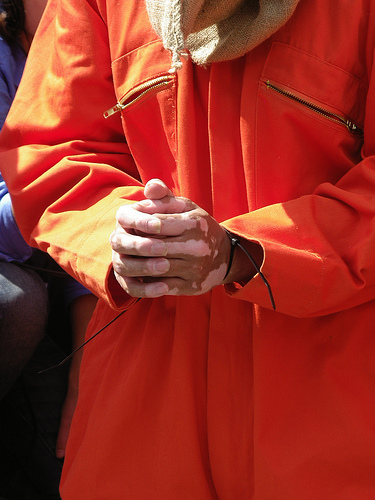 AMERICAN PROSPECT