Graham Hancock Explores Ancient Mysteries

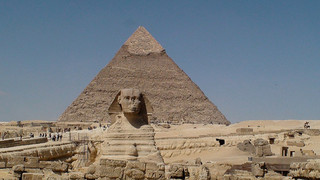
pyramid sphinxMEDIA ROOTS — Graham Hancock, arguably the world’s foremost expert on ancient mysteries, has devoted his life to uncovering and demystifying the rituals, legends, and wisdom of ancient cultures.  In this video, he investigates oft-ignored inconsistencies.  For example, he discusses the true age of the Great Sphinx of Giza, which remains under debate.  Scholars’ estimates vary widely, though mainstream Egyptologists generally believe it was constructed approximately 4,500 years ago, whereas Hancock asserts heavy water erosion indicates the Sphinx was built quite earlier than believed, at a time when the Giza Plateau wasn’t even a desert yet. 

Hancock also questions how Egyptian culture could have attained, such an advanced state so quickly.  As he explains, cultures generally undergo evolutionary processes before reaching a point of historic greatness or iconic status.  There is usually a progression, in which the building blocks of a society are gradually created over time, giving rise to increased sophistication as the civilization matures.  However, with ancient Egypt this does not seem to be the case.  Egypt seemingly appeared out of nowhere, complete with massive, architectural wonders, a complex mythology, and an eerily accurate astronomy.  Yet, no concrete evidence links Egypt to a previous culture.  So, where did ancient Egyptians develop their wisdom?  Or should we be asking:  Where did the Egyptians come from?

In the video, Hancock lays out a fascinating theory.  He believes an ancient culture existed far earlier than contemporary scientists believe, which laid the foundation for Egyptian civilization.  He suggests around the end of the last ice age, approximately 10,500 BCE, a cataclysmic natural disaster altered the course of mankind by disrupting this ancient culture.  Because most people at this time were living close to water, flooding from the disaster killed the vast majority of them.  However, the small minority, which survived retained the wisdom of their antecedents.

Who were these people?  Hancock believes they were from Atlantis, the mythical lost island, which most scholars have concluded to be non-existent.  For example, Alex Cameron wrote in Greek Mythography in the Roman World (124), “It is only in modern times that people have taken the Atlantis story seriously; no one did so in antiquity.”

Hancock also investigates a number of other ancient artifacts, mysterious discoveries, and cultural anomalies.  With cultivated elocution and an erudite demeanor, Hancock tempers his non-traditional theories with cool, detached logic and reasoning.  Whether one’s persuaded by him or not, one can’t deny his ability to bring excitement and attention to the study of ancient cultures.  For example, Hancock tells us ancient cultures were much more in tune with nature, astronomy, and the Earth itself, all of which helped shape their worldview.  Consequently, their wisdom and spirituality was much deeper and more encompassing than modern cultures.  In fact, Hancock’s theories may cause you to wonder whether humanity has progressed at all since the time of the ancients.

Written by Adam Miezio

Edited by Alex Starace

***


***

Photo by Flickr user S W Ellis
Matthew Taylor on 21st Century Enlightenment

MEDIA ROOTS– What is is that enhances and what is it that inhibits our empathic capacity? Matthew Taylor explores the concept of 21st century enlightment in this RSA animate video, suggesting that the new enlightenment should champion a more self-aware, socially embedded model of autonomy that recognizes the frailties and limitations of the human race and the planet in which we live. Matthew discusses how the idea might help us meet the challenges we face today, and the role that can be played by certain organizations to help in the evolution of our global consciousness.


Matthew Taylor on RSA Animate


Abby

Photo by flickr user digitalbob8

Early Man Walked Upright 2 Million Years Earlier?

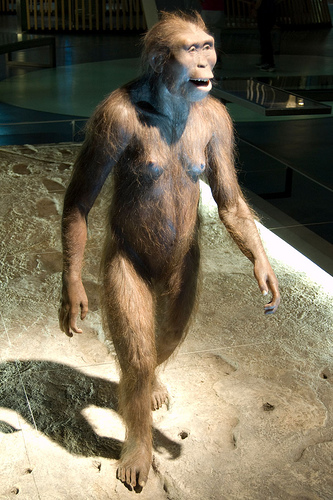
POPULAR SCIENCE– A lot of the debate about when modern humans became modern humans has to do with the head–when our brains evolved into the functional equivalent of that of modern mankind. But while that particular argument continues, a team of UK researchers using a new kind of statistical technique have analyzed ancient footprints at a site in Tanzania and found that if our feet are allowed to tell the tale, our early ancestors were becoming human-like as much as two million years earlier than we previously thought.

The study relies on eleven well-preserved footprints at the Laetoli site in Tanaznia that the researchers subjected to a new statistical technique derived from methods used in functional brain imaging. Using this technique, they created 3-D average of the 11 prints there, comparing them with data obtained from the study of modern humans and living great apes.

The researchers also used computer simulations to model a variety of gaits–and the footprints they would have produced–for the likely maker of the Laetoli prints, a species known as Australopithecus afarensis. It was previously thought that this ancestor walked crouched over, putting pressure on the side of the foot and pushing off from the middle, like a modern ape.

Read more about Early Man Walked Upright 2 Million Years Earlier Than We Thought, Says New Analysis

© 2011 Popular Science

Photo by Flickr user Grabthar

Howard Zinn: Human Nature and Aggression

MEDIA ROOTS Howard Zinn challenges the philosophy that acts of aggression are integral to human nature and discusses how one’s society and surrounding environment is what creates of hostility. The excerpt is taken from the documentary You Can’t Be Neutral On a Moving Train.

Howard Zinn, “On Human Nature and Aggression.” From You Can’t Be Neutral On a Moving Train, 2004.

DVD available from firstrunfeatures.com.


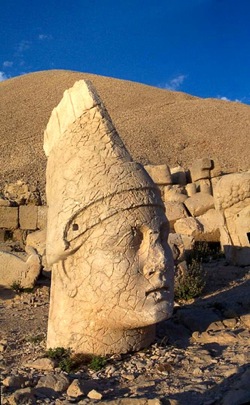
Göbekli Tepe – The Birth of Religion

NATIONAL GEOGRAPHIC– Every now and then the dawn of civilization is reenacted on a remote hilltop in southern Turkey.

The reenactors are busloads of tourists—usually Turkish, sometimes European. The buses (white, air-conditioned, equipped with televisions) blunder over the winding, indifferently paved road to the ridge and dock like dreadnoughts before a stone portal. Visitors flood out, fumbling with water bottles and MP3 players. Guides call out instructions and explanations. Paying no attention, the visitors straggle up the hill. When they reach the top, their mouths flop open with amazement, making a line of perfect cartoon O’s.

Before them are dozens of massive stone pillars arranged into a set of rings, one mashed up against the next. Known as Göbekli Tepe (pronounced Guh-behk-LEE TEH-peh), the site is vaguely reminiscent of Stonehenge, except that Göbekli Tepe was built much earlier and is made not from roughly hewn blocks but from cleanly carved limestone pillars splashed with bas-reliefs of animals—a cavalcade of gazelles, snakes, foxes, scorpions, and ferocious wild boars. The assemblage was built some 11,600 years ago, seven millennia before the Great Pyramid of Giza. It contains the oldest known temple. Indeed, Göbekli Tepe is the oldest known example of monumental architecture—the first structure human beings put together that was bigger and more complicated than a hut. When these pillars were erected, so far as we know, nothing of comparable scale existed in the world.

At the time of Göbekli Tepe’s construction much of the human race lived in small nomadic bands that survived by foraging for plants and hunting wild animals. Construction of the site would have required more people coming together in one place than had likely occurred before. Amazingly, the temple’s builders were able to cut, shape, and transport 16-ton stones hundreds of feet despite having no wheels or beasts of burden. The pilgrims who came to Göbekli Tepe lived in a world without writing, metal, or pottery; to those approaching the temple from below, its pillars must have loomed overhead like rigid giants, the animals on the stones shivering in the firelight—emissaries from a spiritual world that the human mind may have only begun to envision.

Archaeologists are still excavating Göbekli Tepe and debating its meaning. What they do know is that the site is the most significant in a volley of unexpected findings that have overturned earlier ideas about our species’ deep past. Just 20 years ago most researchers believed they knew the time, place, and rough sequence of the Neolithic Revolution—the critical transition that resulted in the birth of agriculture, taking Homo sapiens from scattered groups of hunter-gatherers to farming villages and from there to technologically sophisticated societies with great temples and towers and kings and priests who directed the labor of their subjects and recorded their feats in written form. But in recent years multiple new discoveries, Göbekli Tepe preeminent among them, have begun forcing archaeologists to reconsider.

Read full article on Göbekli Tepe – The Birth of Religion.

©2011 National Geographic

Photo by flickr user *saipal