MEDIA ROOTS – Greenpeace specializes in environmental advocacy, striving daily to convince humanity to care for its planet. Recognizing Earth’s fragile state, the organization provides tangible solutions and affects positive change. Their tactics include lobbying, grassroots campaigns, and bold non-violent direct action. Greenpeace confronts multiple, interwoven environmental concerns, including climate change, deforestation, ocean degradation, toxic pollution, and nuclear weapons.
Recently, Greenpeace has focused on lobbying Brazilian politicians to accept responsibility for rampant deforestation and environmental injustice. After significant pressure from the organization, the public prosecutor of the Brazilian state of Para levied strict fines on abattoirs and retailers, which were linked to illicit ranches operating within his jurisdiction. These farms were functioning on illegally deforested land, selling cow meat and hide to international corporations like Wal-Mart, Nike, and Toyota. Facing fines totaling over $1 billion, the associated abattoirs and international retailers pledged to conduct future business with only registered, legal ranching establishments.
Sometimes Greenpeace must resort to innovative tactics in order to induce environmentally responsible behavior. Recently, they targeted Nestle’s KitKat bar, which contained palm oil derived from unsustainable sources, through a creatively morose internet campaign. As a result, Greenpeace goaded Nestle into halting purchases from their questionable Indonesian supplier. After pressuring corporate heavyweights like Nike, Wal-Mart, and Kraft, Greenpeace received judicious cooperation against illegal deforestation. Any respite from the pressure on all parties will lead to a resumption of illicit activities, inherent to the exploitative measures of international capitalism.
Despite its encouraging track record, there are plenty of reasons why Greenpeace must continue its lobbying efforts, grassroots tactics, and international campaigns. Primarily, corporate behemoths have only responded to Greenpeace’s requests because they’ve received substantial pressure from some socially-responsible consumers who demand strict environmental standards to be adopted along the corporate supply chain. Unfortunately, the average shopper has no desire to pay the increased prices resulting from expensive environmental standards. In response to the conflict between customer responsibility and consumer frugality, corporations continue to cut corners in favor of profit, potentially resorting to illegal strategies to achieve a more profitable bottom line.
Even if all necessary environmental standards are adhered to, corporations don’t consider the deleterious effect, which their mere presence has on local environments. For example, timber corporations build roads into isolated habitats in order to extract timber. Yet these roads remain long after the logging companies depart. By connecting cities to forests in this manner, loggers contribute to an expedited drain of other natural resources, leading to the collapse of many fragile ecosystems. With scant concern for sustainable extraction techniques, irresponsible corporate clientele will continue to degrade our global habitat beyond repair, regardless of any demand for environmental justice.
One cannot help but sympathize with Greenpeace and admire their efforts of using creativity and audacity as weapons against our collective disregard of the environment. Al Jazeera Worldlooks at Greenpeace’s humble beginnings and the courage it takes to stand up to those who deliberately ruin our one and only planet.
Christian Sorensen for Media Roots
***
Al Jazeera World – Greenpeace: From Hippies to Lobbyists
MEDIA ROOTS –One in five women in the U.S. Armed Forces is sexually assaulted, but most do not report these despicable acts. Two weeks ago, U.S. Air Force General Edward Rice held a press conference regarding allegations of sexual assault at Lackland Air Force Base, where all Air Force enlisted trainees undergo Basic Military Training (BMT). After listening to General Rice adroitly muffle concern and dodge responsibility, it is important to clarify precisely how he fails to understanding the trainee mindset, refuses to investigate sexual assault comprehensively, and likely will not hold himself accountable.
General Rice, Commander of Air Education and Training Command (AETC), fails to understand the mindset of enlisted trainees. When in BMT, one’s overarching priority is to complete training on schedule and with all due haste. Most often, this requires maintaining a low profile, “blending in,” or avoiding the training instructors’ ire. Trainees fear any circumstance leading to being “recycled” or “washed back,” which could add weeks to a trainee’s BMT experience. This fear is one reason why trainees do not speak up. As disturbing as it sounds, trainees weigh the costs and benefits: speaking up, seeking administrative attention, enduring even more time in BMT, and starting an Air Force career with clerical paperwork vs. bottling up, suppressing sexual incident(s), and perhaps seeking redress later on. Addressing this reality may involve affording victims all psychological and physical help while simultaneously allowing them to progress in training at their own pace and comfort.
General Rice also needs to focus on another distressing aspect of the trainee mindset, the nuances of which a former Marine drill instructor explains:
“You cannot do anything without requesting permission from your drill instructor… You are literally in many cases a robot waiting for permission to take a step. And if you have that relationship which is based on fear and intimidation… if that’s the person you’re asking help from, it becomes a very bizarre scenario… You are subject to every single order that comes out of that instructor’s mouth.”
While Marine and Air Force basic training environments differ in many respects, the underlying point is clear: it is incredibly difficult to seek help as a trainee after a sexual assault, due in part to the very nature of the trainee-instructor relationship. This relationship is vital for training purposes, but impedes justice and administrative recourse in certain circumstances. General Rice believes an existing system of “comment sheets” and anonymous “comment boxes” provides each Air Force trainee with the outlet they need. Unfortunately, fear of an extended duration in BMT often stifles trainee recourse to comment sheets. Rice must examine how to alleviate such a destructive mentality without compromising the caliber of existing Air Force training.
Additionally, General Rice and his fellow senior officers fail to investigate sexual assault across AETC. Observe Rice’s equivocation:
“I indicated we had 12 instructors that are under investigation… Nine of those 12 were in one [squadron]. We have a total of nine squadrons, and nine of them came from one squadron. So in my assessment to this point, it is not an issue of an endemic problem throughout basic military training. It is more localized, and we are doing a very intensive investigation on that squadron to find out what exactly happened and why.”
General Rice, whose academic credentials boast multiple graduate degrees, could surely fathom a reality in which numerous victims of sexual assault exist across AETC and the operational Air Force. For Rice, it’s far easier to blame a localized problem at the squadron level than engage in institutional introspection or examine the culture over which he reigns.
If recent history is any indication, General Rice and senior Air Force officers will not be held accountable. After the Abu Ghraib torture scandal, a dozen lower-enlisted service members were punished but only onegeneral was reprimanded. After repeated Afghan civilian deaths under General Petraeus’ command, no U.S. general was disciplined. These are dismal precedents.
In 2008, Defense Secretary Robert Gates fired the two most senior Air Force leaders for mismanagement of nuclear weapons. Although their indiscretions led to no casualties, Gates recognized the imperative of holding senior Air Force officials accountable. The standing lesson is clear: senior officials who endanger lives with nuclear weapons get fired, while those who oversee a ruinous culture of endemic sexual abuse survive without a scratch. To right this wrong, Defense Secretary Leon Panetta must ask for General Rice’s resignation along with all relevant officers in the AETC chain of command. All forms of punishment are available when reprimanding the abusers, their immediate superiors, and their entire chain of command, including reduction in rank, forfeiture of pay, confinement, and imprisonment.
General Rice has failed in his duty by misunderstanding the trainee mindset, avoiding a comprehensive investigation of sexual misconduct, and evading punishment. Although administrative accountability doesn’t ease the pain of victimhood, it sends a firm message to every soldier, sailor, airman, and Marine: sexual assault will not be tolerated in the U.S. military, and every link in the chain of command is responsible for enforcing this. The tragedy of sexual assault is deafening; a catastrophe which numerous military members endure through no fault of their own. This is a defining time for Pentagon leadership to prove its mettle.
Written by Christian Sorensen for Media Roots. Christian went through BMT at Lackland’s 331 Training Squadron.
MEDIA ROOTS — Abby and Robbie Martin grew up in Pleasanton, CA, a city located ten miles from the Lawrence Livermore National Laboratory (LLNL), a secret nuclear weapons production facility. They initially set out to explore the psychological impacts of taking nuclear testing into virtual space. But as their investigation unfolded, they found that the LLNL—in conjunction with Site 300—has built an impressive greenwashing PR campaign cloaking a sinister reality.
Despite a moratorium on nuclear testing, the nuclear arms race continues unabated at very high costs. In addition to the startling cases of LLNL’s mismanagement of dangerous materials and ‘accidental‘ releases, the facilities are still testing every radioactive component of a nuclear bomb in open air, according to sources.
Malignant melanoma (skin cancer) rates are six times higher among children born in Livermore; melanoma has been linked to radiation exposure. And the amount of radiation which has been expelled from the lab since its
inception is equivalent to that released from the bombing of Hiroshima.
Most disturbingly, the Livermore community is largely unaware of what the lab
is actually doing and what its potential impacts are on its health and the
environment.
Written by Abby Martin
***
The Continuing Nuclear Arms Race & The Lawrence Livermore National Lab:
Mismanagement, Dangers & Effects
Produced/Filmed/Directed/Edited by Abby & Robbie Martin
***
Abby Martin: “The United
States has the biggest weapons arsenal in the world and is the only country who
has ever used nuclear bombs during war.
All of the nuclear weapons stockpile management and nuclear weapon technology
come from two locations in the United States:
Los Alamos Laboratory in New Mexico, which is surrounded by a giant plot
of desert, and Lawrence Livermore Laboratory, a square-mile facility located
right next to a city of 90,000 people.
If a large-scale disaster or nuclear accident happened here, it would
affect the entire Bay Area—comprised of San Francisco/Oakland—with seven
million people living in it. This blue
well behind me is used to measure radioactive runoff from the Lawrence
Livermore Lab.”
Abby Martin Narration (c. 0:36): “The United
States used to blow up full-scale nuclear weapons in open air until the 1963 Limited Test Ban Treaty, which permitted the continuation
of nuclear testing underground. In 1992,
Congress passed the Nuclear Testing Moratorium Act, which banned all nuclear
testing. However, the treaty is not yet
ratified. And the U.S. still has over
5,000 nuclear weapons, 2,000 of which are on readiness alert at all times. To compensate for the loss of full-scale
underground nuclear testing, the Department of Energy created the Stockpile
Stewardship Program, which built new facilities that test different components
of a nuclear weapons explosion, using super computers to put them all together.
“Most of
the PR surrounding the Lawrence Livermore Lab gives the impression that it’s a
technology innovator, working to harvest
the energy of the sun to create clean
energy for the world. As it turns out, out
of the Lawrence Livermore Lab’s $1.5 billion dollar annual budget, less than 1%
is alternative energy; the rest is defence and nuclear weapons development.
“Another,
more elusive, site buried in the hills behind the Lawrence Livermore Lab is called
Site 300, a live-fire explosives test range where they blow up highly
radioactive compounds used to simulate many of the nuclear systems designed at
the lab. Site 300 is mountainous with
many watersheds and canyons making contamination easy to spread and clean-up
extremely difficult. At Site 300, we
found that they are testing depleted uranium and tritium, the radioactive
hydrogen in the hydrogen bomb, in open air tests. Site 300 happens to be located in a very
high-velocity wind area.
“We took a
closer look at Lawrence Livermore Lab and Site 300 and found out if the
Livermore community is aware of its impact on their health and the environment
and the potential danger it poses to the entire San Francisco Bay Area.”
Abby Martin (c. 2:25): “Do you know about the Lawrence Livermore
Lab?”
Livermore Man:
“Yes.”
Livermore Woman: “I mean it’s common knowledge to grow up in Livermore—”
Livermore Man B: “Oh, here we go.”
Abby Martin:
“What?”
Livermore Woman B: “I’m aware of it, yeah.”
Abby Martin:
“What is it
that you think they do there?”
Livermore Woman C: “At the Lab? Oh, it’s a
government [Shrugs], testing on all kinds
of different things?”
Livermore Man B: “I’m not really educated to what exactly, what they do. You gonna tell me?”
Livermore Woman C: “I know they do a lot of research and they have, like, the top
scientists from all over the world that work there.”
Livermore Woman B: “They used to do, like, nuclear devices.
But to my knowledge they don’t really do that anymore.”
Livermore Man C: “Well, what I think they do there is research and development.”
Abby Martin:
“What do you
think it is they do there?”
Livermore Man:
“I worked
there for nearly 30 years.”
Abby Martin:
“So, what
did you do there?
Livermore Woman B: “I don’t know. My dad works in a
machine shop there. [Laughs] I don’t know what he does, though. [Laughs]”
Marylia Kelley (Tri-Valley CAREs): “In many ways, Livermore is a community that’s in denial. It is also a community that I would call
disempowered because you have a super-secret nuclear weapons laboratory and a
community around it that’s supposed to not
ask questions.”
Abby Martin Narration (c. 3:39): “We went to the lab in Site 300 to try to
find out more.”
Site 300 Armed Military Gatekeeper: “Can you just turn that off please? [Leaving
Gate Booth]”
Abby Martin:
“Isn’t this publicly-funded
property?”
Site 300 Armed Military Gatekeeper: “The Federal, um, could you turn it off just to make? I gotta make, I gotta call my captain.”
Site 300 Armed Military Captain: “Um, could you go ahead and turn the camera off?” [Camera Cuts Out]”
Abby Martin:
“I don’t know;
I’ve read somewhere that they were testing depleted uranium. I was, like, that can’t be true. [Inside a Reception Area]”
Receptionist Woman: “No, nothing nuclear.”
Scott Yundt (Tri-Valley CAREs): “What we’ve been able to place together from FOIA requests and from public documents is that they’ve released over a million curies of radiation from the lab
since 1953 when they opened. That’s
about the same amount of radiation that was released in the bombing of Hiroshima.”
“The study
also found that, for one decade, there was a threefold increase in brain
cancer in Livermore children.”
Abby Martin (c. 4:47): “Do you think that there’s any sort of
impacts on the environment or to the health of the community with the testing
that they’re doing there? [Outside in
Downtown Livermore]”
Livermore Man:
“Probably
very little over what most all of us do everyday. [Shrugs]”
Livermore Woman B: “None that haven’t been around since I was a kid. [Shrugs] So, I don’t know. [Laughs]
I mean I survived. [Young Woman
Laughs and Shrugs]”
Livermore Woman C: “Yeah, ‘cos they’ve had some problems with the, you know, ground w-,
releases of some of the poisons and—”
Livermore Man D: “I know that there was plutonium
in a park near my house when I was growing up.”
Abby Martin Narration (c. 5:16): “During the ‘70s and ‘80s, the Lawrence
Livermore Lab was flushing radioactive materials, including plutonium down the
drain. And it was recycled by the City
of Livermore’s sanitation department as compost. The City then gave away the toxic compost as
landscaping.
“Local residents
around the lab have even coined a neighbourhood park, plutonium park, which is located adjacent to a school.
Marylia Kelley (Tri-Valley CAREs): “They kept a log book, you know, a guest register. So, people signed it, but one day the lab
showed up and took it with them. And it’s
never been seen again. So, there’s no
way to track who has this plutonium-contaminated sludge or if the particular bit of
sludge they took home has plutonium contamination in it or not.
“And, in
the midst of all this, Livermore Lab went and got some of this sludge because
they were interested in looking at the uptake of plants after a nuclear war.”
Livermore Man D: “Obviously, most cities don’t dump plutonium into their sewage treatment
plants. So, that’s a unique experience
to our area.”
Abby Martin Narration (c. 6:26): “One of the most impressive PR campaigns
coming from the lab is the National
Ignition Facility (or the NIF).”
Scott Yundt (Tri-Valley CAREs): “It’s a mega-laser that they love to talk about how it’s gonna save the
world through creating nuclear fusion energy.
Most of what the National Ignition Facility is for is ‘stockpile management.’ And it’s really a way for them to test
nuclear weapon components because it creates an environment—in that chamber—that is similar to the environment created by a nuclear weapons explosion.”
Abby Martin Narration (c. 7:01): “Just like many war technologies that the
U.S. government rebrands as peace through force, the ‘Stockpile Stewardship’ program is nothing more than a cloak on the
continued and unabated nuclear arms race.”
Scott Yundt (Tri-Valley CAREs): “We have a nuclear-weapons-complex that is still stuck in the Cold War era.”
Marylia Kelley (Tri-Valley CAREs): “80% of the American population tell pollsters that they would feel
safer if no county, including the United States, had nuclear weapons.”
Abby Martin Narration: “Despite the moratorium, we continue to find a way to test nuclear
weapons. But by testing each component
of a nuclear bomb separately with Site 300, the NIF, and super computers, they’re
able to pacify the public. However, in
the back of our minds, we all know that at any moment—by mistake, by
miscalculation, or by madness—life, as we know it, could end on this planet.
“How is the
looming threat of nuclear annihalation affecting our daily lives?”
MEDIA ROOTS- If there is one thing that’s been constant over the course of this planet’s evolution, it’s nature’s resilience. Even if a pesticide is designed to eradicate a weed or insect species native to a particular area, nature will eventually bounce back and become resistant to the poison.
Similar to the heavy use of antibiotics leading to supergerms, a recent epidemic of super weeds have started to take over farmers’ lands that have been spraying crops with Monsanto’s Roundup Ready weedkiller. According to the president of the Arkansas
Association of Conservation Districts, the built up resistance to these pesticides is “the single largest threat to production agriculture that we have
ever seen.”
For the first time, Monsanto’s BT corn crops in Iowa are now falling prey to the very bug they’re engineered to resist: the rootworm.
This could be very bad news for Monsanto, a company that has monopolized both the pesticide and genetically modified food industry for more than a decade. Since Monsanto’s Roundup Ready GM seeds are engineered to withstand their Roundup Ready pesticide, American farmers have gotten accustomed to using both products hand in hand. However, if Monsanto’s seeds are deemed useless, what incentive will farmers have to spend the extra money for seeds that no longer kill weeds or bugs?
Monsanto is a monolithic and ruthless corporation that will do anything to meet their bottom line of profit maximization. Hopefully this is the beginning of Monsanto’s disintegration into irrelevancy. For more about Monsanto’s callous domination over the global food market read Media Roots Original – Monsanto’s Global Food Domination.
Abby Martin
***
WALL STREET JOURNAL– Iowa State University entomologist Aaron Gassmann’s discovery that
western corn rootworms in four northeast Iowa fields have evolved to
resist the natural pesticide made by Monsanto’s corn plant could
encourage some farmers to switch to insect-proof seeds sold by
competitors of the St. Louis crop biotechnology giant, and to return to
spraying harsher synthetic insecticides on their fields.
“These are isolated cases, and it isn’t clear how widespread the
problem will become,” said Dr. Gassmann in an interview. “But it is an
early warning that management practices need to change.”
The finding adds fuel to the race among crop biotechnology rivals to
locate the next generation of genes that can protect plants from
insects. Scientists at Monsanto and Syngenta
AG of Basel, Switzerland, are already researching how to use a medical
breakthrough called RNA interference to, among other things, make crops
deadly for insects to eat. If this works, a bug munching on such a plant
could ingest genetic code that turns off one of its essential genes.
Monsanto said its rootworm-resistant corn seed lines are working as
it expected “on more than 99% of the acres planted with this technology”
and that it is too early to know what the Iowa State University study
means for farmers.
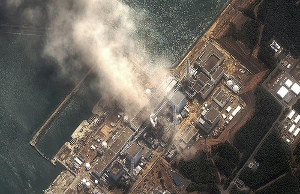
MEDIA ROOTS- An extremely harrowing aspect of the Fukushima meltdown is the amount of radiation that has been expelled and will continue to be released into the atmosphere as a result. A recent report from the Japanese government states that the amount of radioactive caesium-137 released by the disaster is so far equivalent to that of 168 Hiroshima nuclear bombs, and that 34 different locations around Fukushima already exceed the radiation standards of inhabitability used for the Chernobyl disaster. The Center for Disease Control (CDC) states the following about caesium-137:
“External exposure to large amounts of Cs-137 can cause burns, acute radiation sickness,
and even death. Exposure to Cs-137 can increase the risk for cancer
because of exposure to high-energy gamma radiation. Internal exposure to
Cs-137, through ingestion or inhalation, allows the radioactive
material to be distributed in the soft tissues, especially muscle
tissue, exposing these tissues to the beta particles and gamma radiation
and increasing cancer risk.”
As scary as this seems, it’s important to put it into perspective. There is nothing much we can do about what is going on in Japan right now, but there are things we can do to reduce the risk of over exposure to our bodies by continuing to be healthy and conscious consumers.
Abby
***
AFP– The amount of caesium-137 released since the three reactors were crippled by the March 11 quake and tsunami has been estimated at 15,000 tera becquerels, the Tokyo Shimbun reported, quoting a government calculation.
That compares with the 89 tera becquerels released by “Little Boy”, the uranium bomb the United States dropped on the western Japanese city in the final days of World War II, the report said.
The estimate was submitted by Prime Minister Naoto Kan’s cabinet to a lower house committee on promotion of technology and innovation, the daily said.
The government, however, argued that the comparison was not valid.
While the Hiroshima bomb claimed most of its victims in the intense heatwave of a mid-air nuclear explosion and the highly radioactive fallout from its mushroom cloud, no such nuclear explosions hit Fukushima.
There, the radiation has seeped from molten fuel inside reactors damaged by hydrogen explosions.
“An atomic bomb is designed to enable mass-killing and mass-destruction by causing blast waves and heat rays and releasing neutron radiation,” the Tokyo Shimbun daily quoted a government official as saying. “It is not rational to make a simple comparison only based on the amount of isotopes released.”



 MEDIA ROOTS – Greenpeace specializes in environmental advocacy, striving daily to convince humanity to care for its planet. Recognizing Earth’s fragile state, the organization provides tangible solutions and affects positive change. Their tactics include lobbying, grassroots campaigns, and bold non-violent direct action. Greenpeace confronts multiple, interwoven environmental concerns, including climate change, deforestation, ocean degradation, toxic pollution, and nuclear weapons.
 MEDIA ROOTS –
  MEDIA ROOTS — Abby and Robbie Martin grew up in
  MEDIA ROOTS- If there is one thing that’s been constant over the course of this planet’s evolution, it’s nature’s resilience. Even if a pesticide is designed to eradicate a weed or insect species native to a particular area, nature will eventually bounce back and become resistant to the poison.
  AFP
AFP