
WikiLeaks Haiti: Let Them Live on $3 a Day

THE NATION– Contractors for Fruit of the Loom, Hanes and Levi’s worked in close concert with the US Embassy when they aggressively moved to block a minimum wage increase for Haitian assembly zone workers, the lowest-paid in the hemisphere, according to secret State Department cables.

The factory owners told the Haitian Parliament that they were willing to give workers a 9-cents-per-hour pay increase to 31 cents per hour to make T-shirts, bras and underwear for US clothing giants like Dockers and Nautica.

But the factory owners refused to pay 62 cents per hour, or $5 per day, as a measure unanimously passed by the Haitian Parliament in June 2009 would have mandated. And they had the vigorous backing of the US Agency for International Development and the US Embassy when they took that stand.

To resolve the impasse between the factory owners and Parliament, the State Department urged quick intervention by then Haitian President René Préval.

“A more visible and active engagement by Préval may be critical to resolving the issue of the minimum wage and its protest ‘spin-off’—or risk the political environment spiraling out of control,” argued US Ambassador Janet Sanderson in a June 10, 2009, cable back to Washington.

Two months later Préval negotiated a deal with Parliament to create a two-tiered minimum wage increase—one for the textile industry at about $3 per day and one for all other industrial and commercial sectors at about $5 per day.

Still the US Embassy wasn’t pleased. A deputy chief of mission, David E. Lindwall, said the $5 per day minimum “did not take economic reality into account” but was a populist measure aimed at appealing to “the unemployed and underpaid masses.”

Haitian advocates of the minimum wage argued that it was necessary to keep pace with inflation and alleviate the rising cost of living. As it is, Haiti is the poorest country in the hemisphere and the World Food Program estimates that as many as 3.3 million people in Haiti, a third of the population, are food insecure. In April 2008 Haiti was rocked by the so-called Clorox food riots, named after hunger so painful that it felt like bleach in your stomach.

According to a 2008 Worker Rights Consortium study, a family of one working member and two dependents needed at least 550 Haitian gourdes, or $12.50, per day to meet normal living expenses.

Read the full article about WikiLeaks Haiti: Let Them Live on $3 a Day.

© 2011 The Nation

Photo by Flickr user Okinawa Soba
Ousted by US-back Coup in ’91, Aristide Returns to Haiti

DEMOCRACY NOW! – 7 Years After Ouster in U.S.-Backed Coup, Former Haitian President Aristide Prepares to Return Home

Former Haitian President Jean-Bertrand Aristide is preparing to return to Haiti after seven years in exile. Aristide has lived in South Africa since his ouster in a 2004 U.S.-backed coup. Reporting from Johannesburg, Democracy Now!’s Amy Goodman speaks with Aristide’s attorney Ira Kurzban and actor Danny Glover as they prepare to accompany Aristide back to his country.

Rush transcript here.


© Copyright DemocracyNow!, 2011

Photograph by cliff1066™

A Year After the Earthquake, Haiti Still Needs Help

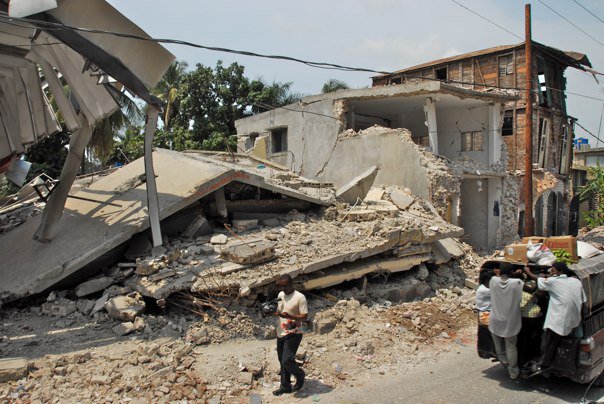
COMMONDREAMS – When the Enriquillo fault line shifted at 4:53 p.m. last Jan. 12, our bed was sent across the hotel room, the other side of the building collapsed and, as we would soon find out, Haiti was devastated.

My 1-year-old son and I had accompanied my wife, an HIV educator for health-care workers, to Haiti only two days before the earthquake. In the immediate aftermath, the emergency medical technician who was a guest at our hotel formed a makeshift clinic in the circular driveway to attend to hundreds of badly injured Haitians.
My wife and I were quickly deputized as orderlies in his driveway emergency room, and without any prior medical training, we assisted in whatever way we could – stripping the sheets off hotel beds to apply as bandages, breaking chairs to use the wood for splints, and transforming the poolside deck chairs into hospital beds.

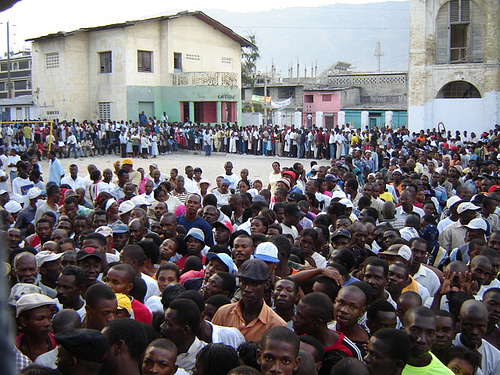
However, tens of thousands of Haitians didn’t receive even this basic first-aid, resulting in a much higher mortality rate. The catastrophe can only begin to be grasped through comparisons; with some 300,000 people dead and another 300,000 injured, the total number of casualties roughly equals the entire population of Seattle. More than the entire population of King County – more than 2 million people – were rendered homeless. Some 1.5 million still live in tent encampments today.

Upon returning home, we learned that half of all American households had given a charitable donation to help the people of Haiti and were overjoyed that Haiti’s plight had not been overlooked.

However, the overwhelming majority of the money pledged to Haiti has yet to reach the Haitian people. Only $6 million of the $52 million Clinton-Bush Haiti Fund had been spent by November, The Washington Post reported. The U.S. government’s pledge of more than $1 billion dollars was completely unfulfilled until November, when it finally released $120 million.

Worse, the U.S. is pursuing a development strategy calling for garment factories (read: sweatshops) and tourism instead of the sustainable agriculture programs proposed by Haitian civil-society organizations that would create jobs, produce food for countless Haitians, and allow Haiti to address the environmental degradation that has crippled its economy for generations.

According to an extensive Institute for Justice and Democracy in Haiti study, “We Have Been Forgotten,” 75 percent of families living in the tent camps had someone go an entire day without eating, 44 percent drink untreated water, and 27 percent had no access to sanitation.

The terrible conditions of the tent camps have contributed to the rapid spread of cholera in Haiti, believed to have been introduced by United Nations occupying troops from Nepal. Already some 2,600 Haitians have died from the disease with The New York Times predicting, “cholera may become a way of life that could afflict as many as 270,000 people over the next several years.”

To tackle a problem of this proportion, Haiti will need an effective government that understands the needs of its people and can coordinate a rebuilding project on the scale required. Yet Haiti’s most popular political party, Lavalas, has been banned from participation in the most recent election – with U.S. and U.N. support – preventing any new government from truly representing the will of the people.

If any people can overcome these challenges, it is the Haitians, who gained their independence through the only successful slave revolt in history and who have as recently as the mid-1980s deposed a brutal dictatorship through popular uprising.

As the people of Haiti struggle for a better future, we here would do well to remember the Haitian proverb, Men anpil chay pa lou: “Many hands make the load lighter.”

Jesse Hagopian is a teacher in Seattle and serves on the board of Maha-Lilo (Many Hands, Light Load), a Haiti solidarity organization that is currently working to bring water filters to tent camps in Cap Haitien. He can be reached at [email protected]

Maha-Lilo is holding a dinner benefit to mark the anniversary of the earthquake Sunday in Seattle. The event will begin at 4 p.m. at Waid’s Haitian Cuisine, 1212 E Jefferson St., Seattle. For more information, call 734-218-6622 or go to: www.mahalilo.org

© COPYRIGHT COMMONDREAMS, 2011

Photograph by Rick Pickett III

Haiti’s Election Tally Shows Massive Irregularities

CENTER FOR ECONOMIC AND POLICY RESEARCH – An independent recount and review of 11,171 tally sheets from Haiti’s November 28 election shows that the outcome of the election is indeterminate. The review, conducted by the Center for Economic and Policy Research (CEPR), found massive irregularities and errors in the tally. A report detailing the recount’s findings, and methodology, will be made available next week.
“With so many irregularities, errors, and fraudulent vote totals, it is impossible to say what the results of this election really are,” said Mark Weisbrot, economist and CEPR Co-Director.

“If the Organization of American States certifies this election, this would be a political decision, having nothing to do with election monitoring,” said Weisbrot. “They would lose all credibility as a neutral election-monitoring organization.”

Among the preliminary findings:

While OAS Assistant Secretary General Albert Ramdin was quoted by the Associated Press as saying that “Nearly 4 percent of polling place tally sheets used to calculate the results were thrown out for alleged fraud at the tabulation center,” the actual number is closer to 12 percent. CEPR found that 11.9 percent (1,324) of the tally sheets were either never received by the CEP (Haiti’s Provisional Electoral Council) or were quarantined by the CEP due to irregularities.  These tally sheets added up to more than 15 percent of the total votes counted.

In addition to the 11.9 percent of tally sheets not counted by the CEP, CEPR found that 6.4 percent of the tally sheets were irregular. These tally sheets contained vote counts that were so far outside the distribution of votes that they would not be considered valid. If we add these to the tally sheets not counted by the CEP, there are more than 18 percent of tally sheets – representing more than 22 percent of votes counted — that are invalid.

In addition, there were widespread clerical errors – mis-recorded numbers – on the tally sheets: 5.4 percent of tally sheets had numbers that were obvious clerical errors. Although these errors did not necessarily affect the distribution of votes among the candidates, they add another element of uncertainty to the vote count. It is clear that with so many mistakes in recorded totals in the tally sheets, there would have to be errors in the candidate vote counts in addition to those that CEPR detected.

Turnout was extremely low: an estimated 22.3 percent of the electorate participated, as compared with 59.3 percent in the last (2006) presidential election. This was partly due to the fact that more than 12 political parties were arbitrarily excluded from participating in the election, including the country’s most popular political party.

Internally displaced people (IDP’s), who have been made homeless by the earthquake, were especially disenfranchised. In the cities of Port-au-Prince, Carrefour, Delmas and Petionville – which contain 20 percent of Haiti’s registered voters – the average participation rate was just 12.4 percent (11.25 percent if we remove additional irregular tally sheets).

“This election was of questionable legitimacy to begin with because the electoral authorities banned over a dozen political parties, including the country’s most popular political party,” said Weisbrot. “But with this massive level of irregularity, fraud, and disenfranchisement, it can hardly be considered a legitimate election.”


Photograph of Haiti’s 2006 election by Flickr user Robert Miller


Why Washington Won’t Allow Democracy in Haiti

photo by US Army/flckrTHE GUARDIAN UK – The polarisation of the debate around WikiLeaks is pretty simple, really. Of all the governments in the world, the United States government is the greatest threat to world peace and security today. This is obvious to anyone who looks at the facts with a modicum of objectivity. The Iraq war has claimed certainly hundreds of thousands, and, most likely, more than a million lives. It was completely unnecessary and unjustifiable, and based on lies. Now, Washington is moving toward a military confrontation with Iran.

As Lawrence Wilkerson, former chief of staff to Colin Powell, pointed out in an interview recently, in the preparation for a war with Iran, we are at about the level of 1998 in the buildup to the Iraq war.

On this basis, even ignoring the tremendous harm that Washington causes to developing countries in such areas as economic development (through such institutions as the International Monetary Fund and World Trade Organisation), or climate change, it is clear that any information which sheds light on US “diplomacy” is more than useful. It has the potential to help save millions of human lives.

You either get this or you don’t. Brazil’s president Lula da Silva, who earned Washington’s displeasure last May when he tried to help defuse the confrontation with Iran, gets it. That’s why he defended and declared his “solidarity” with embattled WikiLeaks founder Julian Assange, even though the leaked cables were not pleasant reading for his own government.

One area of US foreign policy that the WikiLeaks cables help illuminate, which the major media has predictably ignored, is the occupation of Haiti. In 2004, the country’s democratically elected president, Jean-Bertrand Aristide, was overthrown for the second time, through an effort led by the United States government. Officials of the constitutional government were jailed and thousands of its supporters were killed.

The Haitian coup, besides being a repeat of Aristide’s overthrow in 1991, was also very similar to the attempted coup in Venezuela in 2002 – which also had Washington’s fingerprints all over it. Some of the same people in Washington were even involved in both efforts. But the Venezuelan coup failed – partly because Latin American governments immediately and forcefully declared that they would not recognise the coup government.

Read full article about Why the US Won’t Allow Democracy in Haiti.

© Guardian News and Media Limited 2010

Mark Weisbrot is Co-Director of the Center for Economic and Policy Research (CEPR), in Washington, DC.
