Our Nazi Allies

SALON– Dieter Maier, an amateur investigator working from his home on the outskirts of Frankfurt, Germany, has uncanny luck finding out about U.S. ties to the Nazis.

For the past 20 years, Maier has been filing a steady stream of requests for information to a variety of U.S. government agencies, largely for the existential pleasure of historical inquiry, and also out of a fear of a rebirth of Nazism, fascism and racism in Germany. The more he knows about the past, he says, the better prepared he is to deal with the future and present.

What is most startling about Maier’s success, however, is that he appears to have had an easier time finding information on U.S. collaboration with Nazis after World War II than a committee appointed by Congress to extract the same controversial data.

Maier, through Freedom of Information Act requests, has unearthed new information on characters like Karl Heinz-Priester, one of the most prominent postwar neo-Nazi leaders. According to “The Biographical Dictionary of the Extreme Right,” Priester, a former Waffen SS liaison officer, helped found the National Democratic Reich Party in 1949. After being expelled for his dictatorial tendencies, Priester set up the equally virulent German Social Movement and became a leading player in the international fascist movement.

Maier received files from U.S. Army Intelligence that show that Priester was on the U.S. payroll as an informant, a fact never before reported. Priester was terminated as a U.S. spy in 1959 when it was deemed that his usefulness was falling off, or as it was put on his file card: “Subject’s services no longer needed. Production and performance poor.” (The FOIA is, unfortunately, a hit-and-miss proposition. I also filed a request on Priester, and was sent, among other things, the identical file card — with the notations identifying Priester as a U.S. agent blacked out.)

That U.S. officials collaborated with Nazis after World War II is, of course, well known. Just one day after Germany’s surrender, on May 10, 1945, the Joint Chiefs of Staff ordered Gen. Dwight Eisenhower to arrest all suspected war criminals, though advising him “to make such exceptions as you deem advisable for intelligence and other military reasons.” In other words, cut deals with war criminals who could be usefully employed by U.S. intelligence. Over the years, the United States found a spot on the payroll for thousands of former Nazis, especially as part of intelligence gathering operations aimed at the Soviet Union, our wartime ally but soon-to-be mortal foe.

Not much has been learned about these programs since, with successes such as Maier’s rare. But that was supposed to change in the fall of 1998, when Congress passed the little-noticed Nazi War Crimes Disclosure Act. It requires government agencies to turn over to the National Archives all files relating to Nazi looting and war crimes, including documents that detail American ties to Nazi war criminals.

Read full article about Our Nazi Allies.


© SALON, 2000

Operation Northwoods Proposed False Flag Attack to Gain Support for Cuban War

ABC NEWS– In the early 1960s, America’s top military leaders reportedly drafted plans to kill innocent people and commit acts of terrorism in U.S. cities to create public support for a war against Cuba.

Code named Operation Northwoods, the plans reportedly included the possible assassination of Cuban émigrés, sinking boats of Cuban refugees on the high seas, hijacking planes, blowing up a U.S. ship, and even orchestrating violent terrorism in U.S. cities.

The plans were developed as ways to trick the American public and the international community into supporting a war to oust Cuba’s then new leader, communist Fidel Castro.

America’s top military brass even contemplated causing U.S. military casualties, writing: “We could blow up a U.S. ship in Guantanamo Bay and blame Cuba,” and, “casualty lists in U.S. newspapers would cause a helpful wave of national indignation.”

Details of the plans are described in Body of Secrets (Doubleday), a new book by investigative reporter James Bamford about the history of America’s largest spy agency, the National Security Agency. However, the plans were not connected to the agency, he notes.

The plans had the written approval of all of the Joint Chiefs of Staff and were presented to President Kennedy’s defense secretary, Robert McNamara, in March 1962. But they apparently were rejected by the civilian leadership and have gone undisclosed for nearly 40 years.

“These were Joint Chiefs of Staff documents. The reason these were held secret for so long is the Joint Chiefs never wanted to give these up because they were so embarrassing,” Bamford told ABCNEWS.com.

“The whole point of a democracy is to have leaders responding to the public will, and here this is the complete reverse, the military trying to trick the American people into a war that they want but that nobody else wants.”

Gunning for War

The documents show “the Joint Chiefs of Staff drew up and approved plans for what may be the most corrupt plan ever created by the U.S. government,” writes Bamford.

The Joint Chiefs even proposed using the potential death of astronaut John Glenn during the first attempt to put an American into orbit as a false pretext for war with Cuba, the documents show.

Should the rocket explode and kill Glenn, they wrote, “the objective is to provide irrevocable proof … that the fault lies with the Communists et all Cuba [sic].”

The plans were motivated by an intense desire among senior military leaders to depose Castro, who seized power in 1959 to become the first communist leader in the Western Hemisphere — only 90 miles from U.S. shores.

The earlier CIA-backed Bay of Pigs invasion of Cuba by Cuban exiles had been a disastrous failure, in which the military was not allowed to provide firepower.The military leaders now wanted a shot at it.

“The whole thing was so bizarre,” says Bamford, noting public and international support would be needed for an invasion, but apparently neither the American public, nor the Cuban public, wanted to see U.S. troops deployed to drive out Castro.

Reflecting this, the U.S. plan called for establishing prolonged military — not democratic — control over the island nation after the invasion.

“That’s what we’re supposed to be freeing them from,” Bamford says. “The only way we would have succeeded is by doing exactly what the Russians were doing all over the world, by imposing a government by tyranny, basically what we were accusing Castro himself of doing.”

Over the Edge’

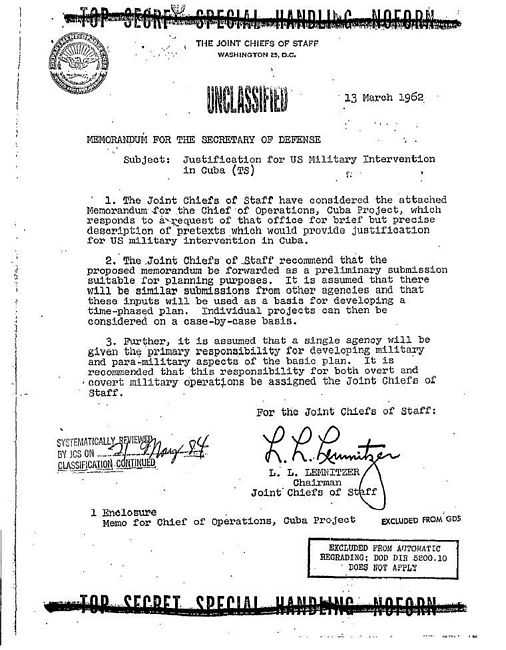
The Joint Chiefs at the time were headed by Eisenhower appointee Army Gen. Lyman L. Lemnitzer, who, with the signed plans in hand made a pitch to McNamara on March 13, 1962, recommending Operation Northwoods be run by the military.

Whether the Joint Chiefs’ plans were rejected by McNamara in the meeting is not clear. But three days later, President Kennedy told Lemnitzer directly there was virtually no possibility of ever using overt force to take Cuba, Bamford reports. Within months, Lemnitzer would be denied another term as chairman and transferred to another job.

The secret plans came at a time when there was distrust in the military leadership about their civilian leadership, with leaders in the Kennedy administration viewed as too liberal, insufficiently experienced and soft on communism. At the same time, however, there real were concerns in American society about their military overstepping its bounds.

There were reports U.S. military leaders had encouraged their subordinates to vote conservative during the election.

And at least two popular books were published focusing on a right-wing military leadership pushing the limits against government policy of the day.

The Senate Foreign Relations Committee published its own report on right-wing extremism in the military, warning a “considerable danger” in the “education and propaganda activities of military personnel” had been uncovered. The committee even called for an examination of any ties between Lemnitzer and right-wing groups. But Congress didn’t get wind of Northwoods, says Bamford.

“Although no one in Congress could have known at the time,” he writes, “Lemnitzer and the Joint Chiefs had quietly slipped over the edge.”

Even after Lemnitzer was gone, he writes, the Joint Chiefs continued to plan “pretext” operations at least through 1963.

One idea was to create a war between Cuba and another Latin American country so that the United States could intervene. Another was to pay someone in the Castro government to attack U.S. forces at the Guantanamo naval base — an act, which Bamford notes, would have amounted to treason. And another was to fly low level U-2 flights over Cuba, with the intention of having one shot down as a pretext for a war.

“There really was a worry at the time about the military going off crazy and they did, but they never succeeded, but it wasn’t for lack of trying,” he says.

After 40 Years

Ironically, the documents came to light, says Bamford, in part because of the 1992 Oliver Stone film JFK, which examined the possibility of a conspiracy behind the assassination of President Kennedy.

As public interest in the assassination swelled after JFK’s release, Congress passed a law designed to increase the public’s access to government records related to the assassination.

The author says a friend on the board tipped him off to the documents.

Afraid of a congressional investigation, Lemnitzer had ordered all Joint Chiefs documents related to the Bay of Pigs destroyed, says Bamford. But somehow, these remained.

“The scary thing is none of this stuff comes out until 40 years after,” says Bamford.

See Declassified Document HERE.

© ABC NEWS 2001

In the early 1960s, America’s top military leaders reportedly drafted plans to kill innocent people and commit acts of terrorism in U.S. cities to create public support for a war against Cuba.

Code named Operation Northwoods, the plans reportedly included the possible assassination of Cuban émigrés, sinking boats of Cuban refugees on the high seas, hijacking planes, blowing up a U.S. ship, and even orchestrating violent terrorism in U.S. cities.

The plans were developed as ways to trick the American public and the international community into supporting a war to oust Cuba’s then new leader, communist Fidel Castro.

America’s top military brass even contemplated causing U.S. military casualties, writing: “We could blow up a U.S. ship in Guantanamo Bay and blame Cuba,” and, “casualty lists in U.S. newspapers would cause a helpful wave of national indignation.”

Details of the plans are described in Body of Secrets (Doubleday), a new book by investigative reporter James Bamford about the history of America’s largest spy agency, the National Security Agency. However, the plans were not connected to the agency, he notes.

The plans had the written approval of all of the Joint Chiefs of Staff and were presented to President Kennedy’s defense secretary, Robert McNamara, in March 1962. But they apparently were rejected by the civilian leadership and have gone undisclosed for nearly 40 years.

“These were Joint Chiefs of Staff documents. The reason these were held secret for so long is the Joint Chiefs never wanted to give these up because they were so embarrassing,” Bamford told ABCNEWS.com.

“The whole point of a democracy is to have leaders responding to the public will, and here this is the complete reverse, the military trying to trick the American people into a war that they want but that nobody else wants.”

Gunning for War

The documents show “the Joint Chiefs of Staff drew up and approved plans for what may be the most corrupt plan ever created by the U.S. government,” writes Bamford.

The Joint Chiefs even proposed using the potential death of astronaut John Glenn during the first attempt to put an American into orbit as a false pretext for war with Cuba, the documents show.

Should the rocket explode and kill Glenn, they wrote, “the objective is to provide irrevocable proof … that the fault lies with the Communists et all Cuba [sic].”

The plans were motivated by an intense desire among senior military leaders to depose Castro, who seized power in 1959 to become the first communist leader in the Western Hemisphere — only 90 miles from U.S. shores.

The earlier CIA-backed Bay of Pigs invasion of Cuba by Cuban exiles had been a disastrous failure, in which the military was not allowed to provide firepower.The military leaders now wanted a shot at it.

“The whole thing was so bizarre,” says Bamford, noting public and international support would be needed for an invasion, but apparently neither the American public, nor the Cuban public, wanted to see U.S. troops deployed to drive out Castro.

Reflecting this, the U.S. plan called for establishing prolonged military — not democratic — control over the island nation after the invasion.

“That’s what we’re supposed to be freeing them from,” Bamford says. “The only way we would have succeeded is by doing exactly what the Russians were doing all over the world, by imposing a government by tyranny, basically what we were accusing Castro himself of doing.”

‘Over the Edge’

The Joint Chiefs at the time were headed by Eisenhower appointee Army Gen. Lyman L. Lemnitzer, who, with the signed plans in hand made a pitch to McNamara on March 13, 1962, recommending Operation Northwoods be run by the military.

Whether the Joint Chiefs’ plans were rejected by McNamara in the meeting is not clear. But three days later, President Kennedy told Lemnitzer directly there was virtually no possibility of ever using overt force to take Cuba, Bamford reports. Within months, Lemnitzer would be denied another term as chairman and transferred to another job.

The secret plans came at a time when there was distrust in the military leadership about their civilian leadership, with leaders in the Kennedy administration viewed as too liberal, insufficiently experienced and soft on communism. At the same time, however, there real were concerns in American society about their military overstepping its bounds.

There were reports U.S. military leaders had encouraged their subordinates to vote conservative during the election.

And at least two popular books were published focusing on a right-wing military leadership pushing the limits against government policy of the day.

The Senate Foreign Relations Committee published its own report on right-wing extremism in the military, warning a “considerable danger” in the “education and propaganda activities of military personnel” had been uncovered. The committee even called for an examination of any ties between Lemnitzer and right-wing groups. But Congress didn’t get wind of Northwoods, says Bamford.

“Although no one in Congress could have known at the time,” he writes, “Lemnitzer and the Joint Chiefs had quietly slipped over the edge.”

Even after Lemnitzer was gone, he writes, the Joint Chiefs continued to plan “pretext” operations at least through 1963.

One idea was to create a war between Cuba and another Latin American country so that the United States could intervene. Another was to pay someone in the Castro government to attack U.S. forces at the Guantanamo naval base — an act, which Bamford notes, would have amounted to treason. And another was to fly low level U-2 flights over Cuba, with the intention of having one shot down as a pretext for a war.

“There really was a worry at the time about the military going off crazy and they did, but they never succeeded, but it wasn’t for lack of trying,” he says.

After 40 Years

Ironically, the documents came to light, says Bamford, in part because of the 1992 Oliver Stone film JFK, which examined the possibility of a conspiracy behind the assassination of President Kennedy.


As public interest in the assassination swelled after JFK’s release, Congress passed a law designed to increase the public’s access to government records related to the assassination.

The author says a friend on the board tipped him off to the documents.

Afraid of a congressional investigation, Lemnitzer had ordered all Joint Chiefs documents related to the Bay of Pigs destroyed, says Bamford. But somehow, these remained.

“The scary thing is none of this stuff comes out until 40 years after,” says Bamford.

Bush Lied About the War? Nope, No News There!

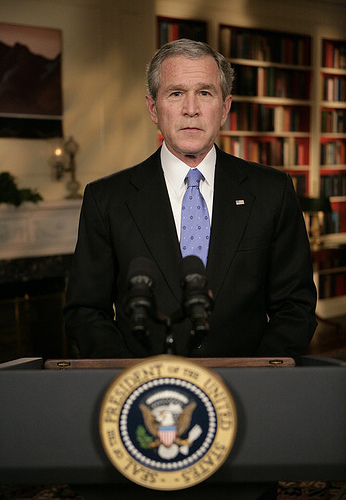
SALON– Halfway through Sunday’s “Meet the Press,” host Tim Russert, interviewing Republican National Committee chairman Ken Mehlman, asked about a secret, top-level British government memorandum. Consisting of minutes from a July 23, 2002, meeting attended by Prime Minister Tony Blair and his closest advisors, the memo revealed their impression that the Bush administration, eight months before the start of the Iraq war in 2003, had already decided to invade and that Washington seemed more concerned with justifying a war than preventing one.

The memo was leaked this year to the Times of London, which printed it on May 1. The story, coming on the eve of Blair’s reelection, generated extensive press coverage in Britain. In setting up his question to Mehlman on Sunday, Russert said, “Let me turn to the now famous Downing Street memo” (emphasis added).

Famous? It would be famous in America if the D.C. press corps functioned the way it’s supposed to. Russert’s June 5 reference, five weeks after the story broke, represented the first time NBC News had even mentioned the document or the controversy surrounding it. In fact, Russert’s query was the first time any of the network news divisions addressed the issue seriously. In an age of instant communications, the American mainstream media has taken an exceedingly long time — as if news of the memo had traveled by vessel across the Atlantic Ocean — to report on the leaked document. Nor has it considered its grave implications — namely, that President Bush lied to the American people and Congress during the run-up to the war with Iraq when he insisted over and over again that war was his administration’s last option.

And yet, as Russert’s weeks-late inquiry illustrates, the Downing Street memo story has also refused to simply fade away. Championed by progressive activists, media advocates, nearly 100 Democratic members of Congress, liberal radio hosts and bloggers, ombudsmen, a handful of columnists and an army of newspaper readers — who have flooded editors with letters demanding that the story be reported — the British memo continues to enjoy a peculiar afterlife. A small band of protesters, led by a retired Air Force lieutenant colonel, even held a sidewalk vigil outside a Tampa, Fla., television station over the weekend, demanding that it “Air the truth!” about the memo.

At Tuesday’s joint White House press briefing, Bush and Blair were finally asked about the memo in public, an event that the press dutifully chronicled. But the two leaders, not accepting follow-up questions, simply denied the accuracy of the memo’s contents, while circumventing the central question of why Blair’s most senior intelligence officer believed the White House had already decided on war in the summer of 2002. (Bush finished his response to the memo question with his well-worn catchphrase, “The world is better off without Saddam Hussein in power.”)

The fact that it took five weeks for more than a handful of Washington reporters to focus on the memo highlights a striking disconnect between some news consumers and mainstream news producers. The memo story epitomizes a mainstream press corps that is genuinely afraid to ask tough questions and write tough stories about the Bush administration. Worse, in the case of the Downing Street memo, it simply refuses to report on the existence of a plainly newsworthy document.

Continue reading on SALON.

Written by Eric Boehlert

© SALON 2005

Photo by flickr user Editor

Posted in Uncategorized | 1 Reply

The Secret Downing Street Memo

TIMES ONLINESECRET AND STRICTLY PERSONAL – UK EYES ONLY

DAVID MANNING
From: Matthew Rycroft
Date: 23 July 2002
S 195 02

cc: Defence Secretary, Foreign Secretary, Attorney-General, Sir Richard Wilson, John Scarlett, Francis Richards, CDS, C, Jonathan Powell, Sally Morgan, Alastair Campbell

IRAQ: PRIME MINISTER’S MEETING, 23 JULY

Copy addressees and you met the Prime Minister on 23 July to discuss Iraq.

This record is extremely sensitive. No further copies should be made. It should be shown only to those with a genuine need to know its contents.

John Scarlett summarised the intelligence and latest JIC assessment. Saddam’s regime was tough and based on extreme fear. The only way to overthrow it was likely to be by massive military action. Saddam was worried and expected an attack, probably by air and land, but he was not convinced that it would be immediate or overwhelming. His regime expected their neighbours to line up with the US. Saddam knew that regular army morale was poor. Real support for Saddam among the public was probably narrowly based.

C reported on his recent talks in Washington. There was a perceptible shift in attitude. Military action was now seen as inevitable. Bush wanted to remove Saddam, through military action, justified by the conjunction of terrorism and WMD. But the intelligence and facts were being fixed around the policy. The NSC had no patience with the UN route, and no enthusiasm for publishing material on the Iraqi regime’s record. There was little discussion in Washington of the aftermath after military action.

CDS said that military planners would brief CENTCOM on 1-2 August, Rumsfeld on 3 August and Bush on 4 August.

The two broad US options were:

(a) Generated Start. A slow build-up of 250,000 US troops, a short (72 hour) air campaign, then a move up to Baghdad from the south. Lead time of 90 days (30 days preparation plus 60 days deployment to Kuwait).

(b) Running Start. Use forces already in theatre (3 x 6,000), continuous air campaign, initiated by an Iraqi casus belli. Total lead time of 60 days with the air campaign beginning even earlier. A hazardous option.

The US saw the UK (and Kuwait) as essential, with basing in Diego Garcia and Cyprus critical for either option. Turkey and other Gulf states were also important, but less vital. The three main options for UK involvement were:

(i) Basing in Diego Garcia and Cyprus, plus three SF squadrons.

(ii) As above, with maritime and air assets in addition.

(iii) As above, plus a land contribution of up to 40,000, perhaps with a discrete role in Northern Iraq entering from Turkey, tying down two Iraqi divisions.

The Defence Secretary said that the US had already begun “spikes of activity” to put pressure on the regime. No decisions had been taken, but he thought the most likely timing in US minds for military action to begin was January, with the timeline beginning 30 days before the US Congressional elections.

The Foreign Secretary said he would discuss this with Colin Powell this week. It seemed clear that Bush had made up his mind to take military action, even if the timing was not yet decided. But the case was thin. Saddam was not threatening his neighbours, and his WMD capability was less than that of Libya, North Korea or Iran. We should work up a plan for an ultimatum to Saddam to allow back in the UN weapons inspectors. This would also help with the legal justification for the use of force.

The Attorney-General said that the desire for regime change was not a legal base for military action. There were three possible legal bases: self-defence, humanitarian intervention, or UNSC authorisation. The first and second could not be the base in this case. Relying on UNSCR 1205 of three years ago would be difficult. The situation might of course change.

The Prime Minister said that it would make a big difference politically and legally if Saddam refused to allow in the UN inspectors. Regime change and WMD were linked in the sense that it was the regime that was producing the WMD. There were different strategies for dealing with Libya and Iran. If the political context were right, people would support regime change. The two key issues were whether the military plan worked and whether we had the political strategy to give the military plan the space to work.

On the first, CDS said that we did not know yet if the US battleplan was workable. The military were continuing to ask lots of questions.

For instance, what were the consequences, if Saddam used WMD on day one, or if Baghdad did not collapse and urban warfighting began? You said that Saddam could also use his WMD on Kuwait. Or on Israel, added the Defence Secretary.

The Foreign Secretary thought the US would not go ahead with a military plan unless convinced that it was a winning strategy. On this, US and UK interests converged. But on the political strategy, there could be US/UK differences. Despite US resistance, we should explore discreetly the ultimatum. Saddam would continue to play hard-ball with the UN.

John Scarlett assessed that Saddam would allow the inspectors back in only when he thought the threat of military action was real.

The Defence Secretary said that if the Prime Minister wanted UK military involvement, he would need to decide this early. He cautioned that many in the US did not think it worth going down the ultimatum route. It would be important for the Prime Minister to set out the political context to Bush.

Conclusions:

(a) We should work on the assumption that the UK would take part in any military action. But we needed a fuller picture of US planning before we could take any firm decisions. CDS should tell the US military that we were considering a range of options.

(b) The Prime Minister would revert on the question of whether funds could be spent in preparation for this operation.

(c) CDS would send the Prime Minister full details of the proposed military campaign and possible UK contributions by the end of the week.

(d) The Foreign Secretary would send the Prime Minister the background on the UN inspectors, and discreetly work up the ultimatum to Saddam.

He would also send the Prime Minister advice on the positions of countries in the region especially Turkey, and of the key EU member states.

(e) John Scarlett would send the Prime Minister a full intelligence update.

(f) We must not ignore the legal issues: the Attorney-General would consider legal advice with FCO/MOD legal advisers.

(I have written separately to commission this follow-up work.)

MATTHEW RYCROFT

(Rycroft was a Downing Street foreign policy aide)

Propaganda Effort in Iraq a Mistake, Rumsfeld Says

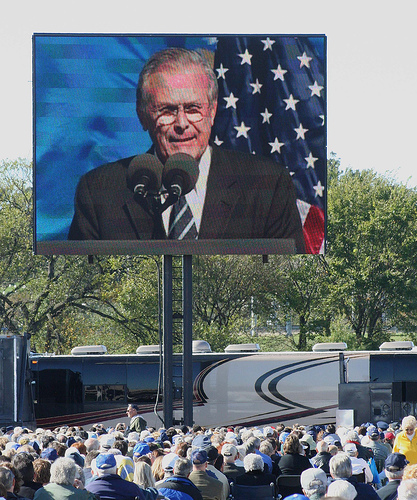
LA TIMES– Defense Secretary Donald H. Rumsfeld on Friday criticized a U.S. military program that pays Iraqi newspapers to plant stories favorable to the American mission, and mistakenly said the Pentagon had shut down the program shortly after its existence was revealed.

In his most specific comments thus far about the information operations program, — carried out by U.S. troops and a private contractor — Rumsfeld said the U.S. military should not be paying Iraqi media to publish articles, whose origin was concealed even from the news outlets.

He said he had not been initially aware of the clandestine program, and ordered it shut down after news outlets published details of it.

“When we heard about it, we said, ‘Gee, that’s not what we ought to be doing,’ ” Rumsfeld said Friday during a taped interview on PBS’ “The Charlie Rose Show.”

Rumsfeld said the contractor, Lincoln Group, and commanders in Iraq were notified of the Pentagon’s concerns and ended the propaganda effort. “They stopped doing that,” he said.

Rumsfeld’s remarks were made available by PBS producers before the show aired late Friday night. One person familiar with Lincoln Group’s operations, who spoke on condition of anonymity because of an ongoing investigation, said the program in Iraq was still active as of a week ago.

Read more at LA TIMES.

© LA TIMES 2006

Photo by flickr user DBKing