Bizarre Sea Slug is Half Plant, Half Animal

MOTHER NATURE NETWORK– It looks like any other sea slug, aside from its bright green hue. But the Elysia chlorotica is far from ordinary: it is both a plant and an animal, according to biologists who have been studying the species for two decades.

Not only does E. chlorotica turn sunlight into energy — something only plants can do — it also appears to have swiped this ability from the algae it consumes.

Native to the salt marshes of New England and Canada, these sea slugs use contraband chlorophyll-producing genes and cell parts called chloroplasts from algae to carry out photosynthesis, says Sidney Pierce, a biologist at the University of South Florida in Tampa.

That genetic material has since been passed down to the next generation, eliminating the need to consume algae for energy.

However, the baby slugs can’t carry out photosynthesis until they’ve stolen their own chloroplasts, which they aren’t yet able to produce on their own, from their first and only meal of algae.

Continue reading about Bizarre Sea Slug is Half Plant, Half Animal.

© Mother Nature Network, 2010

Photo by Nicholas E. Curtis and Ray Martinez
‘Zombie Ants’ Controlled by Parasitic Fungus for 48 Mil Yrs

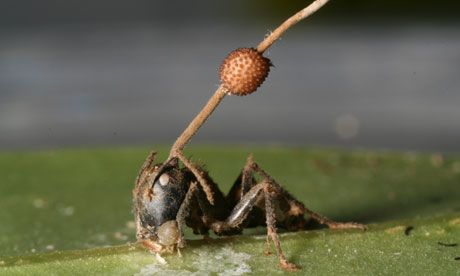
GUARDIAN– The oldest evidence of a fungus that turns ants into zombies and makes them stagger to their death has been uncovered by scientists.

The gruesome hallmark of the fungus’s handiwork was found on the leaves of plants that grew in Messel, near Darmstadt in Germany, 48m years ago.

The finding shows that parasitic fungi evolved the ability to control the creatures they infect in the distant past, even before the rise of the Himalayas.

The fungus, which is alive and well in forests today, latches on to carpenter ants as they cross the forest floor before returning to their nests high in the canopy.

The fungus grows inside the ants and releases chemicals that affect their behaviour. Some ants leave the colony and wander off to find fresh leaves on their own, while others fall from their tree-top havens on to leaves nearer the ground.

The final stage of the parasitic death sentence is the most macabre. In their last hours, infected ants move towards the underside of the leaf they are on and lock their mandibles in a “death grip” around the central vein, immobilising themselves and locking the fungus in position.

“This can happen en masse. You can find whole graveyards with 20 or 30 ants in a square metre. Each time, they are on leaves that are a particular height off the ground and they have bitten into the main vein before dying,” said David Hughes at Harvard University.

Continue reading about ‘Zombie Ants’ Controlled by Parasitic Fungus for 48 Million Years.

© Guardian, 2010

Photo by David P Hughes

Posted in Uncategorized | 1 Reply

NASA: Asteroids Might Have Brought Water to Earth

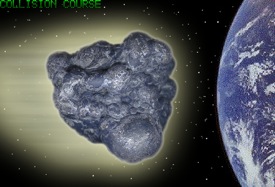
asteroidCOMPUTER WORLD– The discovery of water ice on the surface of an asteroid has NASA scientists conjecturing that asteroids and comets could have delivered enough water to a primordial Earth to fill its oceans.

A study of data compiled during six years of observing the asteroid 24 Themis through a NASA-funded telescope found evidence of water ice and carbon-based organic materials. The asteroid orbits the sun at a distance of 297 million miles, or between the planets of Jupiter and Mars.

The telescope, housed at NASA’s Infrared Telescope Facility on the summit of Mauna Kea in Hawaii, has constantly focused on 24 Themis asteroid.

“For a long time the thinking was that you couldn’t find a cup’s worth of water in the entire asteroid belt,” said Don Yeomans, manager of NASA’s Near-Earth Object Program Office, in a statement yesterday. “Today we know you not only could quench your thirst, but you just might be able to fill up every pool on Earth — and then some.”

According to NASA, this new research could help rewrite the book not just on the nature of asteroids but on how the solar system was formed as well.

Continue reading about NASA: Asteroids Might Have Brought Water to Earth.

© Computerworld, 2010 

Photo by flickr user andrewsrj

New Two Million Year Old Humanoid Species Found

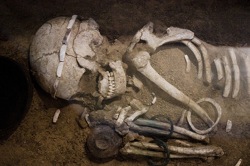
skeletonNEWS 24– Two partial skeletons unearthed in a South African cave belong to a previously unclassified species of pre-human dating back almost two million years and may shed new light on human evolution, scientists said on Thursday.

Fossils of the bones of a young male and an adult female suggest the newly documented species, called Australopithecus sediba, walked upright and shared many physical traits with the earliest known human Homo species.

The finding of the pre-human, or hominid, fossils – which scientists say are between 1.78 and 1.95 million years old – was published in the journal Science and may answer some key questions about where humans came from.

Lee Berger of the University of the Witwatersrand, Johannesburg, who led the team that found the fossils in August 2008, said the team were hoping to reveal a possible two further skeletons from the same site.

He was reluctant to define the new species as a “missing link” in human evolutionary history, but said it would “contribute enormously to our understanding of what was going on at that moment where the early members of the genus Homo emerged”.

Continue reading about New Two Million Year Old Humanoid Species Found.

© Reuters, 2010

Photo by flickr user vintagedept

Food of the Gods – Book Review

drugsBUZZFLASH– I took some drugs today to help me write this review. Specifically, a xanthine-family drug called caffeine that appears in the berries of a largely equatorial bush, along with a few weaker xanthine-family alkaloids that aren’t as well known but are also present in the coffee bean.

Last night before going to bed, I took another drug. Fermented from the fruit of a vine grown in the south of France, the alcohol in the glass of wine I drank altered my consciousness in a way I found pleasant, while the raw juice (wine is not heated) contains, its promoters say, some other chemicals that may be good for my heart.

Fact is, we’re a society of drug-takers. Outside of Mormons, Seventh Day Adventists and Jehovah Witnesses (and a few other smaller mostly Christian sects), we as a society nearly all take drugs specifically to alter consciousness. We use the most addictive drug known to human kind — five times more addictive than heroin — in a way that earns the tobacco barons billions of profits every year. The three primary drugs of our culture — caffeine, nicotine, and alcohol — are ubiquitous. As are other drugs McKenna takes aim at — sugar, chocolate, and television.

And, says Terence McKenna, they’re the wrong drugs for us to be using. Or at least some of us.

Continue reading about Food of the Gods- Book Review.

© Buzzflash, 2007

Reviewed by Thom Hartmann

Photo by flickr user digitalbob8