Whales Descended From Tiny Deer-Like Ancestors

SCIENCE DAILY– Hans Thewissen, Ph.D., Professor of the Department of Anatomy, Northeastern Ohio Universities Colleges of Medicine and Pharmacy (NEOUCOM), has announced the discovery of the missing link between whales and their four-footed ancestors.

Scientists since Darwin have known that whales are mammals whose ancestors walked on land, and in the past 15 years, researchers led by Dr. Thewissen have identified a series of intermediate fossils documenting whale’s dramatic evolutionary transition from land to sea. But one step was missing: The identity of the land ancestors of whales.

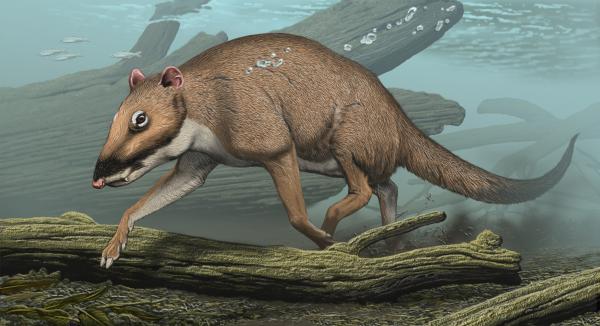
Now Dr. Thewissen and colleagues discovered of the skeleton of Indohyus, an approximately 48-million-year-old even-toed ungulate from the Kashmir region of India, as the closest known fossil relative of whales. Dr. Thewissen’s team studied a layer of mudstone with hundreds of bones of Indohyus, a fox-sized mammal that looked something like a miniature deer.

Dr. Thewissen and colleagues report key similarities between whales and Indohyus in the skull and ear that show their close family relationship.

Thewissen and colleagues also explored how Indohyus lived, and came up with some surprising results.  They determined that the bones of the skeleton of Indohyus had a thick outside layer, much thicker than in other mammals of this size.  This characteristic is often seen in mammals that are slow aquatic waders, such as the hippopotamus today.  Indohyus’ aquatic habits are further confirmed by the chemical composition of their teeth, which revealed oxygen isotope ratios similar to those of aquatic animals.  All this implies that Indohyus spent much of its time in water.

Dr. Walt Horton, Vice-President for Research at NEOUCOM commented:  “This remarkable research demonstrates that the study of the structure and composition of fossil bones can tell us about how the skeleton of whales and, by extension, other mammals like humans, interacts with the environment and changes over time.”

Read the full article on Whales Descended From Tiny Deer-Like Ancestors.

© 2011 Science Daily

Photo courtesy of Northeastern Ohio Universities Colleges of Medicine and Pharmacy
Göbekli Tepe – The Birth of Religion

NATIONAL GEOGRAPHIC– Every now and then the dawn of civilization is reenacted on a remote hilltop in southern Turkey.

The reenactors are busloads of tourists—usually Turkish, sometimes European. The buses (white, air-conditioned, equipped with televisions) blunder over the winding, indifferently paved road to the ridge and dock like dreadnoughts before a stone portal. Visitors flood out, fumbling with water bottles and MP3 players. Guides call out instructions and explanations. Paying no attention, the visitors straggle up the hill. When they reach the top, their mouths flop open with amazement, making a line of perfect cartoon O’s.

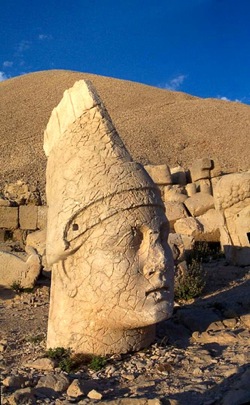
Before them are dozens of massive stone pillars arranged into a set of rings, one mashed up against the next. Known as Göbekli Tepe (pronounced Guh-behk-LEE TEH-peh), the site is vaguely reminiscent of Stonehenge, except that Göbekli Tepe was built much earlier and is made not from roughly hewn blocks but from cleanly carved limestone pillars splashed with bas-reliefs of animals—a cavalcade of gazelles, snakes, foxes, scorpions, and ferocious wild boars. The assemblage was built some 11,600 years ago, seven millennia before the Great Pyramid of Giza. It contains the oldest known temple. Indeed, Göbekli Tepe is the oldest known example of monumental architecture—the first structure human beings put together that was bigger and more complicated than a hut. When these pillars were erected, so far as we know, nothing of comparable scale existed in the world.

At the time of Göbekli Tepe’s construction much of the human race lived in small nomadic bands that survived by foraging for plants and hunting wild animals. Construction of the site would have required more people coming together in one place than had likely occurred before. Amazingly, the temple’s builders were able to cut, shape, and transport 16-ton stones hundreds of feet despite having no wheels or beasts of burden. The pilgrims who came to Göbekli Tepe lived in a world without writing, metal, or pottery; to those approaching the temple from below, its pillars must have loomed overhead like rigid giants, the animals on the stones shivering in the firelight—emissaries from a spiritual world that the human mind may have only begun to envision.

Archaeologists are still excavating Göbekli Tepe and debating its meaning. What they do know is that the site is the most significant in a volley of unexpected findings that have overturned earlier ideas about our species’ deep past. Just 20 years ago most researchers believed they knew the time, place, and rough sequence of the Neolithic Revolution—the critical transition that resulted in the birth of agriculture, taking Homo sapiens from scattered groups of hunter-gatherers to farming villages and from there to technologically sophisticated societies with great temples and towers and kings and priests who directed the labor of their subjects and recorded their feats in written form. But in recent years multiple new discoveries, Göbekli Tepe preeminent among them, have begun forcing archaeologists to reconsider.

Read full article on Göbekli Tepe – The Birth of Religion.

©2011 National Geographic

Photo by flickr user *saipal

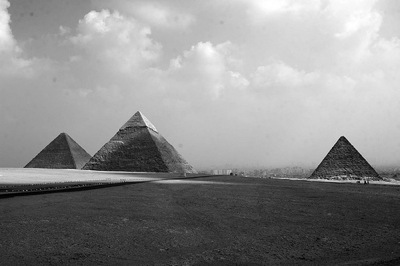
17 Hidden Pyramids Discovered with Satellite

NPR– When you think archeology, you think shovels, brushes, brooms and other time-honored tools used to uncover archeological treasures. Now a new way to peer beneath the Earth’s surface may have made an exciting find: more pyramids, buried deep under an ancient Egyptian city.

By studying infrared images taken by NASA satellites, Sarah Parcak and her team from the University of Alabama at Birmingham identified the suspected pyramids in Tanis, Egypt. The ancient city, abandoned centuries ago, is famous as the fictional home of the Lost Ark from the Indiana Jones movies. Satellite images also showed other lost structures, like tombstones and houses, buried for thousands of years.

“What these satellites do is they record light radiation that’s reflected off the surface of the Earth in different parts of the light spectrum,” Parcak explains to NPR’s Rachel Martin. “We use false color imaging to try to tease out these very subtle differences on the ground.”

Those subtle differences are an archaeologist’s clues to what might lie under a rice paddy or a city street. “You just pull back for hundreds of miles using the satellite imagery, and all of a sudden this invisible world become visible,” Parcak says. “You’re actually able to see settlements and tombs — and even things like buried pyramids — that you might not otherwise be able to see.”

What Parcak’s team actually found was 17 structures that had a similar size, shape and orientation to other pyramids in the area. Initial excavations indicate that at least two of the structures are most likely pyramids, but Parcak warns, “we’re not going to be able to say with a 100-percent certainty that they are pyramids until they’re excavated.”

Read full article and transcript of broadcast at 17 Hidden Pyramids Discovered with Satellite.

© 2011 NPR

Photo by Flickr user apdk

Posted in Uncategorized | 1 Reply

Earliest Evidence for Magic Mushroom Use in Europe

NEW SCIENTIST – EUROPEANS may have used magic mushrooms to liven up religious rituals 6000 years ago. So suggests a cave mural in Spain, which may depict fungi with hallucinogenic properties – the oldest evidence of their use in Europe.

The Selva Pascuala mural, in a cave near the town of Villar del Humo, is dominated by a bull. But it is a row of 13 small mushroom-like objects that interests Brian Akers at Pasco-Hernando Community College in New Port Richey, Florida, and Gaston Guzman at the Ecological Institute of Xalapa in Mexico. They believe that the objects are the fungi Psilocybe hispanica, a local species with hallucinogenic properties.

Click to continue reading on mushroom use in Europe 6,000 years ago.

© Copyright New Scientist, 2011

Photograph by hans s

Posted in Uncategorized | 1 Reply

Will Getting Dumped Affect Your Next Relationship?

MEDIA ROOTS- In an ideal world, your partner would not judge you based on the way your last relationship ended. Unfortunately, as a recent study in the scientific journal Evolutionary Psychology discovered, the real world is a little different.

It is no surprise that neither men nor women find their partners more attractive after discovering that they were on the receiving end of their last break-ups. The flip-side, however, is a different story.

According to the study, titled “Rejection Hurts: The Effect of Being Dumped on Subsequent Mating Efforts,” the average woman actually finds her partner more attractive after discovering that he initiated the split with his last partner.

The subjects of the study rated fictional personal ads for individuals of their genders of choice before and after they learned whether the fictional people had dumped their last partners, had been dumped, or refused to say. According to the results, nobody will like you better if you’ve been dumped, and nobody will like you better if you won’t tell – but women will like you better if you were the one to end your last relationship.

As with any scientific study, this does not apply to everyone; it merely points out a trend. And the trend, in this case, appears to be that you can’t win with men no matter what you do, and you can only win with women by breaking someone’s heart.

Don’t come to any conclusions about what you should do with your current relationship just because of this study; all of the differences in preference were relatively minor. But if you date women, and you expect your current relationship to end soon, you might want to consider doing the dirty work yourself. It may help you in the long run.

Mitchell Singer is an SFSU undergraduate student with a great interest in all types of verbal expression. Aside from newswriting, blogging, and freelance copywriting, he spends his time sampling different media of visual art and reading books on a variety of subjects.

Photo by flickr user oedipusphinx